🔄 Updated 21 Jun 2026
Phu Kao-Phu Phan Kham National Park covers Non Sang District in Nong Bua Lamphu province and stretches south into Ubol Ratana District in Khon Kaen, taking in roughly 201,250 rai in total. It was declared a national park on 20 September 1985. The name comes from two groups of hills with clearly different characters: Phu Kao on the Nong Bua Lamphu side, known for its strange rocks and traces of ancient people, and Phu Phan Kham, a long ridge running along the lake above Ubol Ratana Dam. Most of the sights people talk about sit on the Phu Kao side, in Nong Bua Lamphu.
Phu Kao — nine hills hiding plenty of good stuff
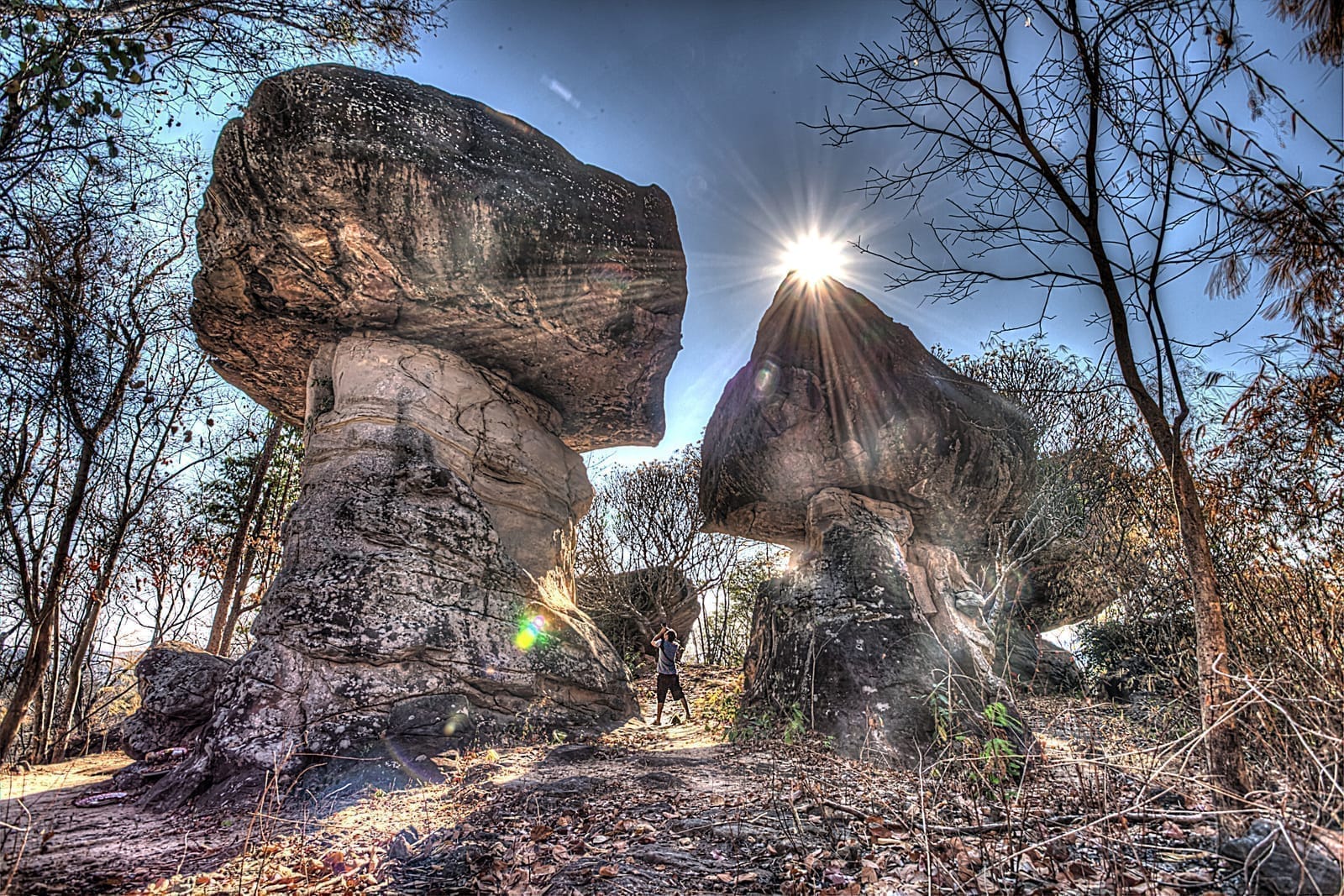
The name "Phu Kao" (literally "nine hills") comes from nine hills arranged in a ring: Phu Fang, Phu Khum Pun, Phu Han, Phu Moei, Phu Kho Mo, Phu Chan, Phu Phro, Phu Luak and Phu Wat. Inside you'll find dry dipterocarp forest mixed with evergreen patches, caves, small waterfalls, broad sloping rock terraces, and what most people remember best: the strangely shaped boulders stacked up like castles or mushrooms, sculpted over a very long time by wind and water erosion. You can happily wander and shoot photos here all day.
- Oddly shaped rocks — wide rock terraces where boulders pile up like castles and mushrooms, the main photo spot on the Phu Kao side.
- Ho Sawan pavilion — a pavilion built on top of a rock; climb up to catch the breeze and look out over the surrounding forest.
- Wat Phra Phutthabat Phu Kao — a temple with large human and dog footprints carved into the rock, tied to local Isan folklore.
- Rock-painting cave walls — scattered across several spots around the temple grounds and rock terraces, traces left by a prehistoric community.
Want more out of Nong Bua Lamphu? Book tours & activities
Booking online ahead on Klook or GetYourGuide is usually cheaper than the gate and skips the queue. Pick only the experiences you actually want — prices and availability are shown live on each site.
Prehistoric rock paintings — the real thing, thousands of years old
What sets Phu Kao apart from an ordinary hill is the traces of prehistoric people still surviving on the rock walls. There are painted handprints, human figures, animals, and carvings cut into the stone, connected to the Ban Chiang-era culture that spread across the upper Isan region. The park is also where dinosaur footprints have been found on the rock terraces, which makes the place feel like a page of history left open in the middle of the forest.
Getting the most out of the rock paintings
The paintings have faded over time, and they show up clearest under the low, angled light of early morning or late afternoon — not at midday when the sun is overhead. Never touch them with your hands or splash water on them to make the colors stand out; that causes permanent damage. If you can't find a spot, ask the park staff at the headquarters to point you in the right direction.
Phu Phan Kham — viewpoints over the Ubol Ratana reservoir
The Phu Phan Kham side is a long ridge that forms part of the Phu Phan mountain range. The highlight is the elevated view down over the wide lake above Ubol Ratana Dam, where the blue water plays off the islets and distant hills — a scene many people consider the signature image of Nong Bua Lamphu. Evening is the popular time, since the sun setting over the lake gives you a photo that needs no editing.
Viewpoint over Ubol Ratana Dam
Looks down on the wide lake stretching to the horizon — best in the morning under clear skies, or in the evening for sunset.
Ho Sawan pavilion on the rock
A viewing pavilion atop a large boulder, a short walk up, with views over the forest and hills around Phu Kao.
Hiking and camping — really sleeping to the sound of the forest
Phu Kao-Phu Phan Kham is an easy park to camp in. There's a park campground with toilets and service points, and if you didn't bring a tent you can rent one from the park. If you'd rather sleep more comfortably, the park has bungalows you can book in advance through the national park accommodation booking system. Most of the hiking trails in the Phu Kao area are short walks linking the strange rocks, the rock-painting terraces and the viewpoints — family-friendly, nowhere near as brutal as a high mountain.
- Park campground — a tent area with toilets and service points; you can rent tents and bedding from the park.
- Park bungalows — a limited number of bungalows that sleep several people each, bookable in advance through nps.dnp.go.th.
- Short hiking trails — linking the strange rocks, the rock paintings and the viewpoints, good for a family walk.
- Bring your own supplies — shops inside the park are limited, so pack water, food and a flashlight, especially if you're staying overnight.
Before you go camping
Long weekends and the cool season get crowded. If you plan to stay overnight or book a bungalow, reserve ahead through the national park accommodation booking system (nps.dnp.go.th) or call the park first. When it rains the rocks get very slippery, so take extra care walking on the rock terraces — and always pack your trash back out with you.
Entry fee, opening hours and getting there
The park is open every day. Entry uses the standard national park rates — roughly 40 THB for Thai adults and 20 THB for children, with higher rates for foreign visitors. Rates can change, so it's worth checking with the park before you go. The park headquarters is in Non Sang District; you can reach them on 063 648 4821.
- From Nong Bua Lamphu town — take Highway 2146 (the Nong Bua Lamphu–Non Sang road) for about 40 km to the Ban Sok Chan junction, then turn onto the Ban Sok Chan–Ubol Ratana Dam road for another 14 km or so.
- From the Ubol Ratana side, Khon Kaen — take the Ubol Ratana–Non Sang road for about 7 km and you'll reach the park headquarters.
- Getting around — a private or rental car works best, since public transport barely reaches here. The mountain road winds a fair bit, so drive slowly and watch the bends.
The best time to visit
The best window is the late-rainy-to-early-cool season, roughly November to February: cool, comfortable weather, the forest still green, clear skies that show off the lake view. It's good for both hiking and camping. In the rainy season the forest is lush and pretty but the rocks are slick and the trails can get muddy. In the hot season the sun is fierce, so go early or late and carry enough water. If you want sunset over the lake, aim to reach the viewpoint a little before evening so you don't miss the light.
Want to plan a full Nong Bua Lamphu trip from start to finish?
See the Nong Bua Lamphu travel guide →