🔄 Updated 21 Jun 2026
Phu Kradueng sits in Phu Kradueng District, Loei Province. It's a flat-topped sandstone mountain whose summit is a plateau around 1,200–1,300 metres above sea level, a broad expanse of meadows mixed with mountain pine forest, which keeps the air cool and pleasant even in the hot season. The appeal here is that you have to climb up under your own steam: there's no road or cable car to carry you. Everyone who makes it to the top feels like it's a reward they earned with their own legs.
The most important thing to know before planning a trip is that Phu Kradueng isn't open all year. It normally opens for visits and overnight stays from 1 October to 31 May, then closes from 1 June to 30 September so the environment can recover and to avoid dangerously slippery trails in the rainy season. So if you want to go, you'll need to plan for the cool season through early hot season.
The Climb — Lang Pae Is the Hard Part
The trail starts at the visitor centre at the bottom (the park headquarters) and climbs 5.5 kilometres up the mountain, passing rest stops along the way called sam. There are around 5–6 of them, such as Sam Haek, Sam Bon, Sam Kok Kok and Sam Kok Wa, each with stalls selling water, snacks and a place to sit. The walking gets easier in stretches until the final and steepest section, Lang Pae, the last kilometre or so before the top, a stone-and-wood staircase so steep you're practically scrambling up it.
- Distance to the top — 5.5 km from headquarters to the top of Lang Pae (where the plateau begins)
- Walking time — around 3–5 hours, depending on your fitness and how much you carry
- Lang Pae — the final 1 km is the steepest, a stone staircase you take slowly
- Reaching Lang Pae isn't the end — you still walk another 3.5 km across the plateau to the Wang Kwang campsite
A lot of people assume that once you reach Lang Pae you've reached the accommodation. In reality, once you're past Lang Pae you hit wide meadows and flat trail, but you still have to walk another 3.5 kilometres to reach the Wang Kwang campsite. This part is much easier going since it's flat trail over soft sand, passing through meadows and pine groves, but all told you'll walk around 9 kilometres in a single day. Brace your mind and your legs for it.
Tips for the climb
Set off early, before 9 a.m. is even better, so you're not walking under the midday sun and you reach the campsite with time to spare before dark. The park usually only lets people start the climb until around 2 p.m. because they don't want hikers caught out after nightfall. Walking slowly, resting in stages and sipping water often beats pushing hard and running out of energy halfway up.
Want more out of Loei? Book tours & activities
Booking online ahead on Klook or GetYourGuide is usually cheaper than the gate and skips the queue. Pick only the experiences you actually want — prices and availability are shown live on each site.
Entry Fees, Porters and Costs
The park entry fee follows the standard national park rates. For Thais it's 40 THB for adults and 20 THB for children (foreigners pay more than this), paid once at the lower checkpoint before you climb. The real hero of a Phu Kradueng trip, though, is the porter: someone who carries your gear up and down the mountain for you, so you can walk up far more comfortably with nothing on your back.
- Park entry fee — 40 THB for adults, 20 THB for children (Thai rate)
- Porter fee — around 30–40 THB/kg, with a minimum of roughly 10 kg
- Camping fee — renting a tent with bedding runs around 225–600 THB/night depending on size
- Park cabins — around 1,200–2,500 THB per cabin, booked in advance through nps.dnp.go.th
- Food on top — budget around 200–350 THB/day; there are food stalls at Wang Kwang
On the porters, we'll be straight with you: they're well worth it unless you're seriously fit and used to hiking. Porters weigh your gear and charge by the kilo. The drop-off point is at the lower checkpoint, and they'll carry it up and deliver it to Wang Kwang for you, so you just walk up with a small daypack holding water and the essentials. Porting is also a livelihood for local people, so hiring one supports the community directly.
What to know about porters
Pack your gear into a single bag or pack so it's easy to weigh and carry. The things to hand to a porter are your tent, sleeping bag, warm clothes and food, while drinking water, your phone, medication and money should stay on you, since the porter may reach the top at a different time than you do.
Wang Kwang Campsite, the Hub on Top
Wang Kwang is the visitor centre up on the summit and the base everyone uses for staying overnight. There's a large campsite under the pines, park cabins, restaurants, shops, toilets, and a place to rent tents and bedding. The temperature drops sharply in the evening, and on some winter nights it falls below 10°C, so come prepared with warm clothing and a sleeping bag.
Bring your own tent
Carry your own tent up or have a porter haul it, and pay the lowest pitch fee. Best for serious campers.
Rent a park tent
Rent a tent with bedding at Wang Kwang so you don't have to carry one up, around 225–600 THB/night.
Park cabins
A proper cabin, sleeping comfortably out of the wind. Book ahead via nps.dnp.go.th since they're limited.
The winter months of December and January are peak season, when it's busiest. The campsite fills up and cabins are hard to book; if you want a cabin you'll need to reserve several weeks ahead. Rental tents on the day are usually available, but if you're going over a long weekend, be ready to wait in line.
Meadows and Pine Forest on the Plateau
What sets Phu Kradueng apart from other mountains is that the summit is a wide plateau resembling savanna grassland, interspersed with tall, airy groves of two- and three-needle pines, easy to wander or cycle through. In winter the grass turns golden, and in places red maple leaves fall along the paths, especially from late in the year into the new year when the air is at its coldest, a sight you rarely see anywhere else in Thailand.
- The meadow at Wang Kwang — walk and take photos from morning to evening; there's a light mist at dawn
- Pine groves — airy, shaded mountain pine forest, perfect for an easy stroll
- Red maple leaves — late in the year into the new year along the trails to the waterfalls; if you're lucky you'll find red leaves on the ground
Waterfalls on Phu Kradueng
Several waterfalls are tucked away in the forest up on the plateau, reached on foot from Wang Kwang along the nature trails. The popular ones are Tham So Nuea Waterfall, Wang Kwang Waterfall, Phen Phop Waterfall and Phon Phop Waterfall. Early in the season (October–November) the water is at its strongest and most beautiful, having just come off the rainy season, while later in the season the flow starts to thin out.
Many of the trails to the waterfalls pass through maple groves, so going in winter gives you two things in one trip: the falls and the changing leaves. But some waterfalls are several kilometres round trip, so check the map and set off early. Don't start hiking in the late afternoon, or you'll come back in the dark, cold forest after nightfall.
Manage your time well
If you only stay one night on top, time will be very tight. We'd suggest staying two nights so you can see the waterfalls and viewpoints without rushing. You'll be tired from the climb the first night, so use it to rest, then tackle the waterfalls and the cliffs the next day.
Pha Nok Aen and Pha Lom Sak, Two Viewpoints You Can't Skip
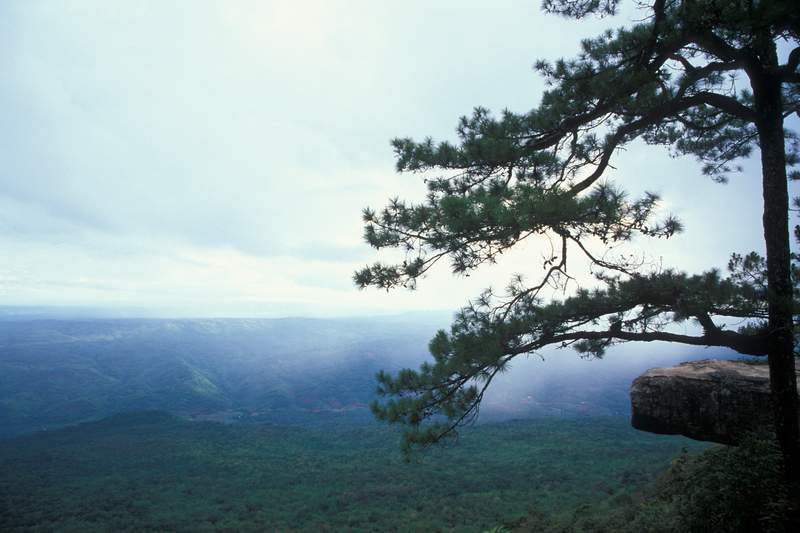
Pha Nok Aen is the sunrise spot people wake up at four or five in the morning to walk out and wait for. It's about 2 kilometres from Wang Kwang, an east-facing cliff with a single pine tree standing out on the edge that has become Phu Kradueng's signature image. The pre-dawn air is bitterly cold, so wear warm clothes and bring a torch, since you'll be walking out while it's still dark.
Pha Lom Sak, meanwhile, is the most famous sunset spot. It's around 9 kilometres from Wang Kwang, a cliff that juts out with a pine leaning over the edge. The image of someone sitting on the rocky outcrop with the pine in the golden light is the classic shot you see everywhere. It's a fair distance, so leave Wang Kwang in the afternoon to catch the evening light and allow time for the walk back.
- Pha Nok Aen — sunrise, about 2 km from Wang Kwang, walked to before dawn
- Pha Lom Sak — sunset, about 9 km from Wang Kwang, with the cliff-edge pine that makes the classic shot
- Pha Yiap Mek–Pha Mak Duk — quieter secondary viewpoints with sweeping views over a sea of mountains
Renting a bike helps
There are bikes for rent up on top, which cut down the time to far-off spots like Pha Lom Sak a lot. But some stretches are sandy and hard to pedal, so if cycling isn't your thing, walk it instead, just allow enough time.
The Best Time to Go and How to Prepare
The popular window is late October to January. Early in the season the waterfalls are lovely and the forest is lush and green after the rains, while November to January brings just the right cool weather and a chance of red maple leaves, but it's also the busiest time. If you want to avoid the crowds, try early in the month or on a weekday, when the walking is more relaxed and accommodation is easier to book.
- Footwear — trainers or hiking shoes with good grip; the rocky trail at Lang Pae gets slippery
- Warm clothing — the summit is bitterly cold in winter, dropping below 10°C at night
- Torch/headlamp — essential for walking out to the sunrise in the dark
- Daypack + water — carry water, medication, money and your phone; hand the heavy stuff to a porter
- Cash — shops on top mainly take cash, and signal and ATMs are limited
As for getting there, if you drive from Loei town it takes around an hour and a half, or you can take a coach to Pha Nam–Phu Kradueng District and then a songthaew or hired truck into the park headquarters. We'd suggest arriving at the lower checkpoint in the morning so you have plenty of time for the climb, and don't forget to check with the park beforehand that it's open to visitors as usual that day.
Plan a full Loei trip with Phu Kradueng, Chiang Khan and Phu Ruea
See the Loei travel guide →