🔄 Updated 21 Jun 2026
Phu Phan Rajanivet Palace is one of King Rama IX's four regional residences — this one covers the Northeast (Isan). It was built in 1975 on the foothills of the Phu Phan range. What a lot of people don't know is that the King chose the site himself, using aerial maps together with survey trips through the routes, forests and waterfalls around here. The real draw for a visitor isn't the buildings, though — it's the gardens and the shady forest that stays pleasantly cool all day.
The key thing to understand before you plan the palace opens to the public only when no royal residence is in session. If there is a royal visit scheduled, the whole area closes. So don't head out assuming it'll be open — always check with the provincial authorities or the office that looks after the site first. Visiting the inner grounds also requires a written request submitted in advance to the Bureau of the Royal Household, while the gardens and outer grounds on open days are far easier to get into.
The flower gardens and plant collection
The heart of this place is the gardens, laid out in several styles within one area — from formal, neatly clipped beds, to natural-style gardens that let the plants grow into their own shapes, to rock gardens where boulders and shrubs are arranged to suit the mountain terrain. It's an easy, pleasant wander with plenty of shade and gentle sun, good for bringing older relatives or kids along for a relaxed stroll.
Formal gardens
Tidy, well-clipped beds of ornamental flowers with seasonal blooms rotating through. This is the spot people most like to photograph — the colours are fresh and the layout just works.
Natural-style & rock gardens
Plants are left to grow naturally, with boulders and shrubs worked into the mountain terrain. Cool and shady to walk through — good for anyone who likes a quiet, unhurried feel.
Palms & tropical ornamentals
Several kinds of palm and tropical ornamental plants are spread across the grounds, keeping the gardens green and lush year-round even though the wildflowers only bloom in the cool season.
Want more out of Sakon Nakhon? Book tours & activities
Booking online ahead on Klook or GetYourGuide is usually cheaper than the gate and skips the queue. Pick only the experiences you actually want — prices and availability are shown live on each site.
Rare Phu Phan wildflowers that bloom in the cool season
What sets this garden apart from an ordinary one is the rare Phu Phan wildflowers that grow specifically in the forests of this range. Several of them are tiny insect-eating plants that bloom only at the turn from the rainy to the cool season. The flowers are small but vivid — you have to look up close to see how pretty they are. Time it right and you'll catch rarities you don't often get to see elsewhere.
- Dusita — a tiny, vivid-purple wildflower that grows on the damp rock platforms of the Phu Phan range, blooming at the turn from rainy to cool season. It's one of the highlights people come specifically to see.
- Maneethewa — a minuscule white-purple flower that grows in clusters on sandy rock; you have to crouch down close to make out the detail. It's a plant found only in the Phu Phan forests.
- Thipkesorn — another pale-purple wildflower that blooms alongside it in the same window. Together they make the rock platforms look scattered with little flowers.
- Soi Suwanna — small yellow flowers that grow on the damp ground, adding more colour to the Phu Phan wildflowers in the cool season.
When to come if you want the wildflowers
Phu Phan wildflowers like Dusita, Maneethewa and Thipkesorn bloom only at the turn from the rainy to the cool season — roughly October to December. Come outside that window and you'll only see the planted flower gardens, not the wildflowers. Best to check what the bloom timing is for that particular year, since it shifts with the rainfall, and don't forget it also has to be a period when the palace is open to visitors.
Shady forest and cool air on Phu Phan
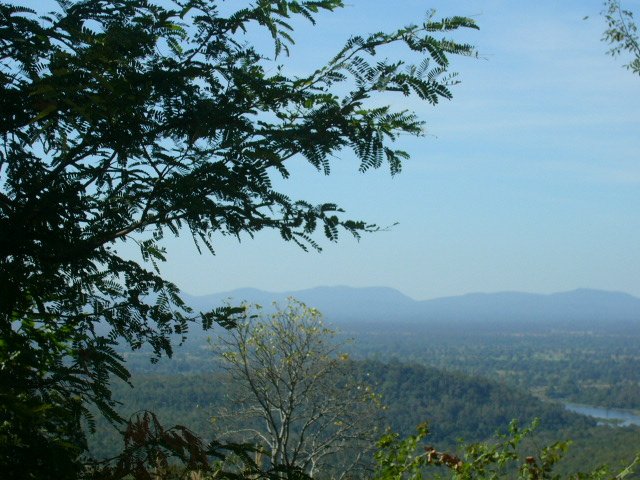
Beyond the gardens themselves, the area around the palace also has a large stretch of regenerated forest that extends out from the original palace grounds, which keeps the whole place shady and noticeably cooler than town — especially in the cool season when a cool breeze blows all day. You can walk the gardens the whole day without overheating. Some mornings a light mist drifts along the forest line, and for many people that atmosphere beats the buildings themselves.
- Cool year-round, distinctly cool in winter — sitting on the foothills, it's cooler than town; from November to February a cool breeze stays comfortable all day.
- Lots of shade, easy walking — big trees and palms shade the whole area, so there's no worry about the sun. Good for kids and older folks.
- Quiet and peaceful, good for garden photos — not as packed as the popular spots, so you get a calm atmosphere and an easy stroll.
- Easy to combine with Phu Phan — it's on the same Highway 213 as Phu Phan National Park, so you can string both together in one day.
Getting there and requesting permission to visit
The palace sits beside Highway 213, the Sakon Nakhon–Kalasin road, around the 14 km marker, about 14–16 km from Sakon Nakhon town. It's a short uphill drive from town and you're there; there's parking and a few small shops in the grounds. The most convenient way to visit is to drive yourself or rent a car in town, since public transport doesn't reach it easily.
- Open only when no royal residence is in session — if there's a royal visit scheduled, the area closes. Always check before you go; don't just guess.
- Hours roughly 09:00–16:00 — on days it's open to visitors; times may be adjusted per the authorities' announcements.
- No entry fee — you can visit the gardens and outer grounds free of charge.
- Inner grounds need a written request — visiting the inner area requires a request submitted in advance to the Bureau of the Royal Household; once you have a reply confirming it, you can make the trip.
- Dress modestly — this is royal grounds, so dress neatly and follow the staff's rules.
Always check before you go
Because opening here is uncertain — it depends on whether a royal residence is in session — call to check with the Sakon Nakhon Provincial Administrative Organisation or the provincial tourist information centre before setting out. That way, if it's closed that day, you can switch to Phu Phan National Park or Pha Sawoei viewpoint, which are on the same route, and not waste the trip.
A half-day trip combining the palace with Phu Phan
Because the palace is on the same Highway 213 as Phu Phan National Park, it's easy to string a continuous half- to full-day trip together. Stay in Sakon Nakhon town by Nong Han lake, drive up the mountain in the morning, and catch the flower gardens, waterfalls and viewpoints all in one go.
Flower gardens in the morning, then Phu Phan
If the palace is closed that day
Plan a full Sakon Nakhon trip — town, mountain and lake
See the Sakon Nakhon travel guide →