🔄 Updated 21 Jun 2026
When people think of Udon Thani, the Red Lotus Sea and the cafes in town usually come to mind first. But if you want a side of the province that fewer people reach — one with stories going back thousands of years — Phu Phra Bat Historical Park is worth setting aside time for. It sits on a sandstone hill in Ban Phue district, about 55–60 km northwest of the city, and pulls geology, archaeology, religion and local legend together in one place.
What makes Phu Phra Bat stand out is the massive sandstone boulders that wind, rain and time have carved into strange shapes — some like mushrooms, some jutting out like roofed shelters. Prehistoric people used these rock shelters as homes and ritual sites and left paintings on the walls. By the Dvaravati period, people planted stone sema markers around them to mark sacred ground, making this one of the densest concentrations of sema culture anywhere in the world.
What is Phu Phra Bat, and why is it a World Heritage site?
Phu Phra Bat is a historical park under the Fine Arts Department, covering more than 3,400 rai on a sandstone hill that's part of the Phu Phan range. Inside, you find traces of continuous human use from the prehistoric era through the Dvaravati, Lopburi and Lan Xang periods and into the Rattanakosin era, with dozens of archaeological and historical sites scattered around.
What earned it UNESCO World Heritage status is the evidence of Dvaravati-era sema culture. Phu Phra Bat has large numbers of stone sema markers planted around rock shelters and stone terraces, marking out Buddhist sacred zones in a way so complete and continuous that it's hard to match anywhere else. UNESCO inscribed Phu Phra Bat as a Cultural World Heritage site on 27 July 2024, making it Thailand's 8th World Heritage site, its 5th cultural site, and Udon Thani's 2nd after Ban Chiang.
Want more out of Udon Thani? Book tours & activities
Booking online ahead on Klook or GetYourGuide is usually cheaper than the gate and skips the queue. Pick only the experiences you actually want — prices and availability are shown live on each site.
The strange rocks and shelters you have to see
Phu Phra Bat's charm hits you straight away through its oddly shaped sandstone boulders, many named after the Nang Usa and Thao Baros legend. Follow the park's trail and you'll pass the highlights one after another.
- Hor Nang Usa — the icon of the park, a sandstone shelter shaped like a giant mushroom, with a large slab balanced on a thin rock stem, around 10 metres tall. The top shows signs of being adapted into a religious structure. Legend says it's the tower Thao Kongpan built so Nang Usa could live alone.
- Khok Ma Thao Baros (Thao Baros's stable) — a group of rocks where, the legend says, Thao Baros tied up his horse while searching for Nang Usa; the stones stack into gaps that look like stalls.
- Wat Phor Ta–Wat Luk Khoei — two rock shelters once used as religious sites, ringed by sema stones. The names come from the legend's Thao Kongpan (father-in-law) and Thao Baros (son-in-law).
- Ku Nang Usa–Bo Nam Nang Usa — a cluster of rocks and a natural water basin tied to the same story, so walking past them brings the legend more sharply to life.
- Rock shelters and open stone terraces — along the way you'll find overhanging ledges, open stone plazas and rock arches to duck through — natural backdrops that photograph well and stay cool and shaded.
Tip
The walking trail is a loop around the hill, several kilometres in total, over rock and dirt with some ups and downs. Sneakers or hiking shoes are far more comfortable than sandals, and bring water with you, since the shops are only near the entrance.
Prehistoric rock paintings
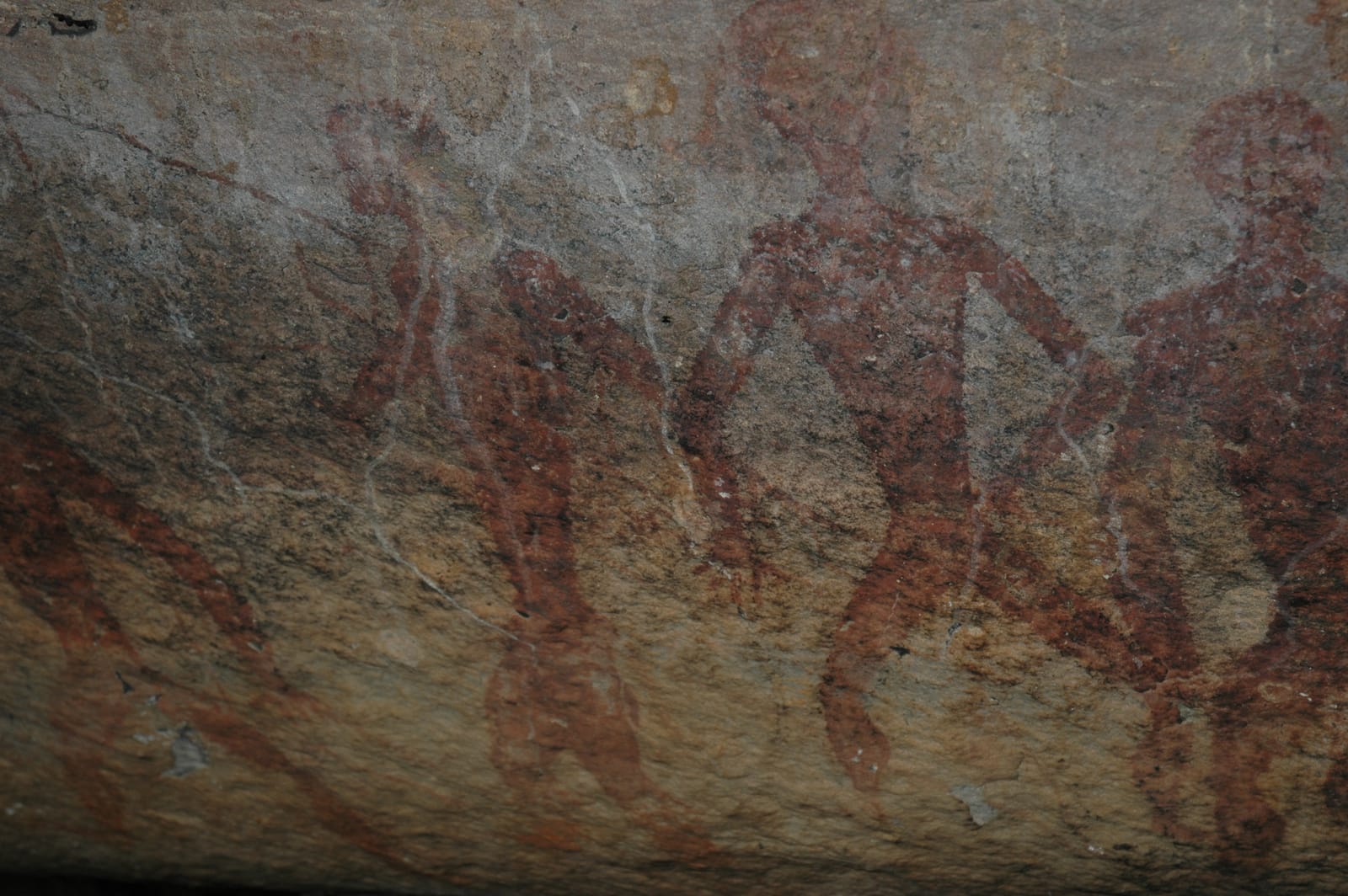
Another highlight not to miss is the prehistoric rock paintings spread across the walls of dozens of rock shelters and caves throughout Phu Phra Bat. Archaeologists have found red paintings — and some in other colours — at more than 50 spots, dating back thousands of years. They're like a notebook left behind by prehistoric people, recorded on stone.
- People and hands — figures of people in various poses and handprints, found at spots like Tham Khon and Tham Lai Mue (the cave of hand patterns).
- Animals — cattle, buffalo and other animals that reflect the way of life and environment of the time, found at spots like Tham Wua Tham Khon.
- Geometric patterns — lines, dots and abstract motifs that can still be read several ways, a puzzle scholars are still debating.
Seeing the paintings clearly
Some of the paintings have faded over time and are easy to miss at a glance. Slow down at the signs marking where the paintings are, and if a park guide is available to walk you through, they'll point out the spots and explain the meanings far better than going it alone.
The legend of Nang Usa and Thao Baros
Many of the rocks at Phu Phra Bat take their names from the local folk tale of Usa-Baros, passed down across the Isan region. In short: Nang Usa was born from a lotus flower, raised by the hermit Chantha, and later taken in as an adopted daughter by Thao Kongpan, the ruler of Mueang Phan, who built her a tall tower to live in alone so no suitors could court her.
Lonely, Nang Usa wove a swan-shaped garland, made a wish to find her match and set it floating on the water. The garland drifted far until it reached Thao Baros, a prince from another city, who found it and searched until he found Nang Usa, and the two fell in love. But Thao Kongpan wasn't pleased, so he set a contest: build a temple before dawn. That's where the names of the rocks and shelters come from — Hor Nang Usa, Khok Ma Thao Baros, Wat Phor Ta and Wat Luk Khoei. Knowing the gist of the legend before you head up makes walking past each rock a lot more fun.
Entry fees and opening hours
Entry to Phu Phra Bat is very cheap for what you get to see, especially for Thais, and several groups get in free. Official prices can change, so it's worth checking the park's page again before you go.
- Entry fee: 20 THB for Thais, around 100 THB for foreigners.
- Free entry: seniors aged 60 and over, children under 15, people with disabilities, monks, novices and clergy.
- Opening hours: open daily, roughly 08:30–16:30 (best to enter before 3 pm to finish the full loop in time).
- Time to walk: at an easy pace, the main route takes about 1.5–2.5 hours.
- Facilities: there's a visitor centre, an exhibition room, guides (Thai and English), and umbrellas and an electric shuttle on some stretches.
Avoid the harsh midday sun
Most of the hilltop is open stone terrace, and the sun gets strong from late morning to midday. Go right after opening or in the late afternoon when the air is nicer, and bring a hat and water. In the rainy season the rocks can get slippery, so watch your step.
Getting to Phu Phra Bat
Phu Phra Bat is in Ban Phue district, northwest of Udon Thani city, about 55–60 km away. The main route is the Mittraphap Road (the Udon–Nong Khai highway): around kilometre marker 13, turn left onto Highway 2021 toward Ban Phue district, then continue about another 12 km to the park. The drive from the city takes roughly 1–1.5 hours, and the signs are clear.
Rental car / self-drive
The most convenient option, since public transport is hard to reach here. There's a car park at the entrance, and you can pair it with Ban Phue–area sights in a single day.
Private car / taxi
If you're not driving, chartering a car from the city for a half or full day works out better — have the driver wait and stop at other spots along the way.
Bus + local transfer
There are buses from the city to Ban Phue district, then you transfer to a local ride into the park. It's the budget route, but allow extra time and check the schedules.
Pair your trip to make it worthwhile
Phu Phra Bat is in the northwest, the opposite direction from the Red Lotus Sea (which is to the south), so if you want both, split them across separate days. On the day you do Phu Phra Bat, you could pair it with a forest temple or a nature spot around Ban Phue along the same route.
How to plan a Phu Phra Bat trip
Phu Phra Bat is a fair distance from the city, so plan it as a half- to full-day trip. Below are sample plans to give you a picture — adjust them to your time and interests.
Half-day morning, all Phu Phra Bat
Full day of history and nature
Is Phu Phra Bat worth it? Straight talk
If you're into history, geology, or walking through nature with a story attached, Phu Phra Bat is well worth it — you get rare strange sandstone formations, real rock paintings, and a legend tied to actual places, all for a cheap entry fee. But if you can't manage a lot of walking, you're with young kids, or you just want a quick photo check-in, this place may feel tiring and a bit far, since the loop involves a fair amount of walking in the sun. Worth knowing in advance so you can prepare. Best plan is to go when it's not too hot, read up on the Nang Usa legend beforehand, and you'll get a lot more out of walking past each rock.
Plan a full Udon Thani trip covering every angle
See the Udon Thani guide →