🔄 Updated 21 Jun 2026
First, a quick lay of the land. Hua Hin sits at the very north of Prachuap Khiri Khan province, right next to Phetchaburi, while Prachuap town itself is another 90 kilometers or so further south. When people say they're "going to Prachuap," most mean the Hua Hin–Khao Takiab–Pranburi zone — but the province is genuinely long, stretching down to Khao Sam Roi Yot, Ao Manao, Ban Krut, and Bang Saphan at the far south. So the first planning question is which zone to base yourself in, because driving from Hua Hin down to Bang Saphan is a solid two hours plus.
When to Go and What the Weather's Like
The best window is November to February — the dry, cool season, with clear skies, almost no rain, daytime highs around 28–32°C, and a pleasant breeze in the mornings and evenings. It's great for swimming, cycling along the beach, and cafe-hopping. Naturally, this is also when it's busiest and accommodation is priciest.
March to May is the hot season — strong sun, some days topping 35°C. You can still swim, but skip the midday sun. May to October is the rainy season, but on this Gulf coast the rain doesn't fall all day; it mostly comes in bursts in the afternoon and evening, with clear mornings roughly four days out of five. The upside of the rainy season is much cheaper rooms and fewer people, so if you can live with the risk of an afternoon shower, it's good value.
Picking the right month
If you want clear skies and smaller crowds without peak prices, aim for early November or late January through mid-February. The weather's still good, but you sidestep New Year and Chinese New Year, when it's most packed.
Avoid the Long Weekends — When It's Most Crowded
Hua Hin is so close to Bangkok that every long weekend means heavy traffic on Phetkasem Road and Rama II Road, room rates that double, and queues at the popular spots. Unless you're specifically after a lively, buzzing atmosphere, it's worth avoiding these dates in 2026.
- New Year — late December 2025 into January 1–2, 2026. The busiest of the year; book several months ahead.
- Songkran — April 13–15, 2026, plus Chakri Day on April 6, which makes April the longest holiday stretch. Heavy traffic both ways.
- Visakha Bucha — late May into June 1, 2026, with a substitute day off bridging the weekend.
- King's Birthday, late July — around July 28–30, 2026, which usually bridges into a long weekend.
- October — several significant days cluster in the middle to end of the month; check the calendar before you plan.
- Early December — December 5, 7, 10, 2026, a run of close-together holidays when people love escaping the city for a nearby beach.
If you can't avoid a long weekend
Leave Bangkok before dawn on the first day (before 6 a.m.) or late afternoon once the first wave has passed, and book your accommodation and any popular restaurants well ahead. Don't count on walking in during peak times.
Getting There from Bangkok — Options and Prices
Bangkok to Hua Hin is about 200 kilometers, normally a 2.5–3 hour drive (not counting holiday traffic). Here are the main options, with rough price ranges — always check for updates before you travel.
Driving yourself
The most flexible option, and ideal if you want to spread out across several zones — Khao Takiab, Pranburi, Khao Sam Roi Yot — that public transport doesn't reach. The downsides: traffic on long weekends, and parking in central Hua Hin can be hard to find.
Minivan / coach
Departs frequently all day from the Southern Bus Terminal (Taling Chan) and drops you right in central Hua Hin. Good if you don't have a car — from the terminal you can grab a taxi or motorbike taxi onward.
Train
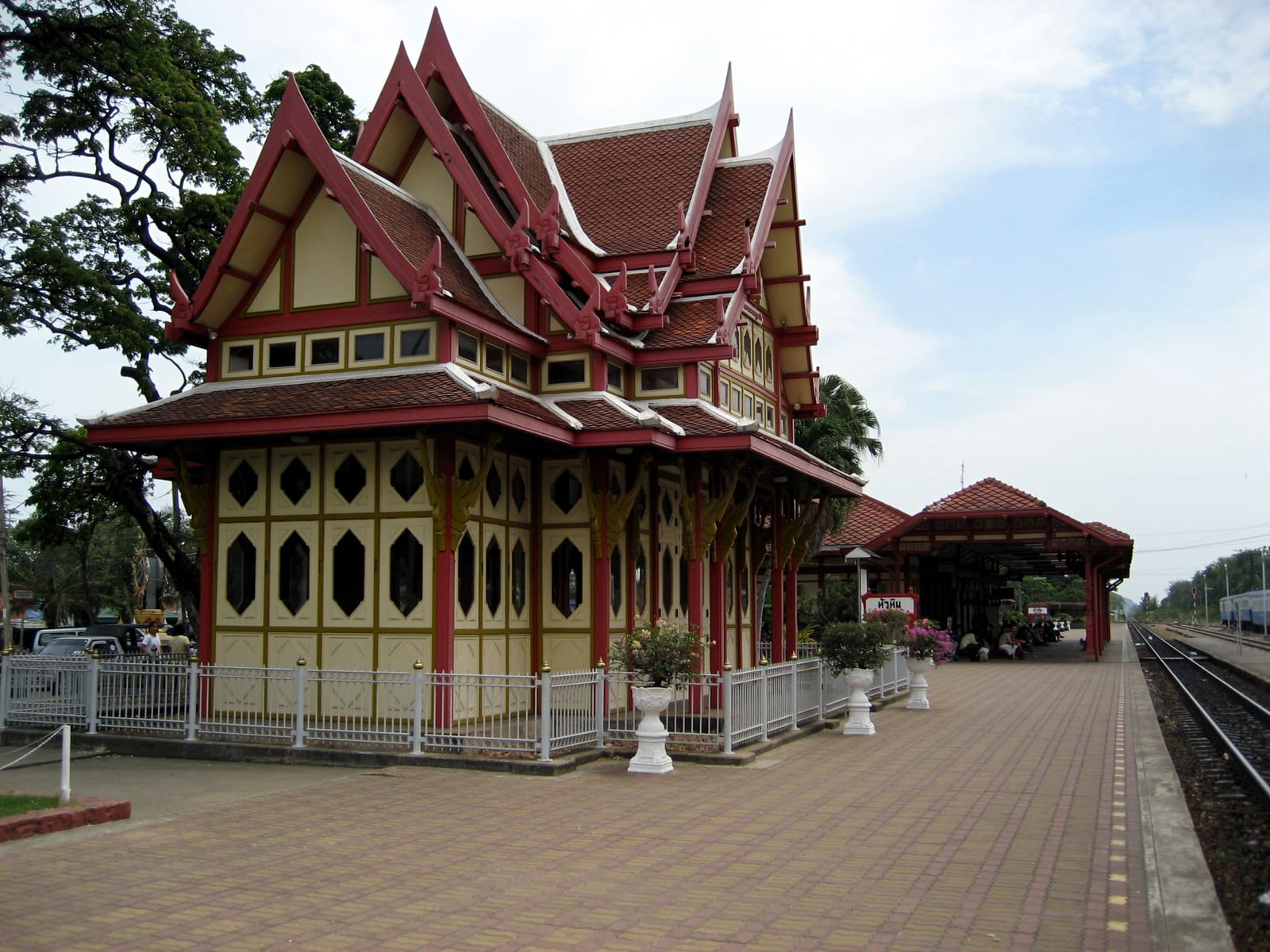
You arrive at Hua Hin's pretty old wooden station, which is worth a photo. The atmosphere is lovely, but it's slow and the timings aren't reliable — better for people who care about the experience more than speed. An ordinary train takes nearly five hours.
How Much to Budget
Hua Hin runs the full range from hostels to five-star resorts, so your budget can vary hugely. Here's a rough framework per person per day (not including travel from Bangkok) to help you set a budget before booking a room.
- Budget — hostel or guesthouse ฿400–700, eating at night markets and local spots for ฿60–120 a meal, roughly ฿900–1,400/day.
- Comfortable — a 3–4 star hotel ฿1,500–3,000, mid-range seafood restaurants with the odd cafe, roughly ฿2,500–4,500/day.
- Full-on relaxation — a beachfront resort from ฿4,000 up, well-known seafood spots, beach clubs, spa treatments, ฿6,000 and up/day.
Room rates climb noticeably in the cool season and on long weekends — some places double their prices. If you're on a tight budget, head down in the rainy season or on weekdays and you'll get the same room for a lot less.
Save on food
Seafood in Prachuap town and at the mackerel markets is considerably cheaper than the Hua Hin zone. If you're already heading south toward Khao Sam Roi Yot or Bang Saphan, save your big seafood meal for down there — it's better value.
What to Wear and Pack
Overall it's easygoing beach clothing, but there are a few spots that call for extra prep — especially if you plan to visit Wat Khao Takiab, Wat Khao Chong Krachok, or Phraya Nakhon Cave.
- Breathable clothing + swimwear — it's hot and humid almost year-round, so go for thin, quick-drying fabrics.
- A shawl or sleeved top — for visiting temples, where you should keep shoulders and knees covered.
- Sunscreen + hat + sunglasses — the beach sun is strong, especially in the hot season.
- Shoes you can hike in — if you're climbing to Phraya Nakhon Cave, the trail is steep and slippery; flip-flops won't cut it.
- A light windbreaker — only in the cool season; the seafront gets chillier than you'd expect at dawn and at night.
- Mosquito repellent + personal medications — the mangrove zones and Khao Sam Roi Yot get a lot of mosquitoes in the evening.
SIM Cards and Signal
If you're a Thai traveler who already has a SIM, there's nothing extra to do — AIS/True/dtac coverage in central Hua Hin and Prachuap town is solid and data runs smoothly. But there are a few spots where the signal is weak or drops out, so it's worth being prepared.
- Khao Sam Roi Yot, Phraya Nakhon Cave, forest mountain roads — the signal cuts in and out, so download offline maps beforehand.
- Ban Krut–Bang Saphan — the towns are fine, but some beachfront resorts have slow internet, so plan around it if you need to work online.
- Foreign travelers — you can buy a tourist SIM from AIS/True/dtac at the airport or convenience stores; weekly packages come with plenty of data for a few hundred baht.
Watch the Monkeys at Khao Takiab
This is the thing travelers trip up on most. Wat Khao Takiab has a large resident troop of long-tailed macaques along the path up and at the viewpoints. The monkeys here are used to people and unafraid, and they snatch things fast — especially food bags, water bottles, glasses, and phones. People get items grabbed and the occasional scratch all the time.
- Don't hold food or drinks in view — stash them deep in a zipped bag; plastic bags are target number one.
- Never feed the monkeys — besides breaking the rules, it makes them more aggressive and more likely to approach people.
- Take off your glasses and grip your phone tightly — a monkey can grab a shiny object from your hand in a blink.
- Don't make eye contact or grin at them — they read it as a threat, and don't run away either, as that triggers a chase.
- Keep small kids by the hand — a child holding a snack is an easy target.
If a monkey grabs something
Don't chase it or try to pull it back — you risk getting bitten. Most of the time a monkey will drop the item once it realizes it's not edible. Stay calm and wait, or ask the temple staff for help.
Pre-Departure Checklist
- Check whether your trip falls on a long weekend — if so, book accommodation and popular restaurants ahead.
- Look at the 3–5 day forecast before you go, especially in the rainy season.
- Set a daily budget and book a room that fits within it.
- Download offline maps for the Khao Sam Roi Yot zone.
- Pack a shawl for temple visits, and hiking shoes if you're heading to Phraya Nakhon Cave.
- Remind yourself about the Khao Takiab monkeys before you head up.
All set — now plan your full Prachuap / Hua Hin trip
See the Prachuap travel guide →