🔄 Updated 21 Jun 2026
Prasat Muang Tam sits in Ban Khok Muang, Jorakhe Mak subdistrict, Prakhon Chai district, just about 8 km southeast of Prasat Phanom Rung — under a 15-minute drive. That's exactly why the two temples have become a popular pairing for a single day. Phanom Rung is up on a hill: a tiring climb with sweeping views, while Muang Tam is on flat ground, easy to walk, with the focus on the detail of the stonework and the ponds. Seeing them together gives you a much fuller picture of the Khmer civilization of southern Isan.
What makes Prasat Muang Tam special
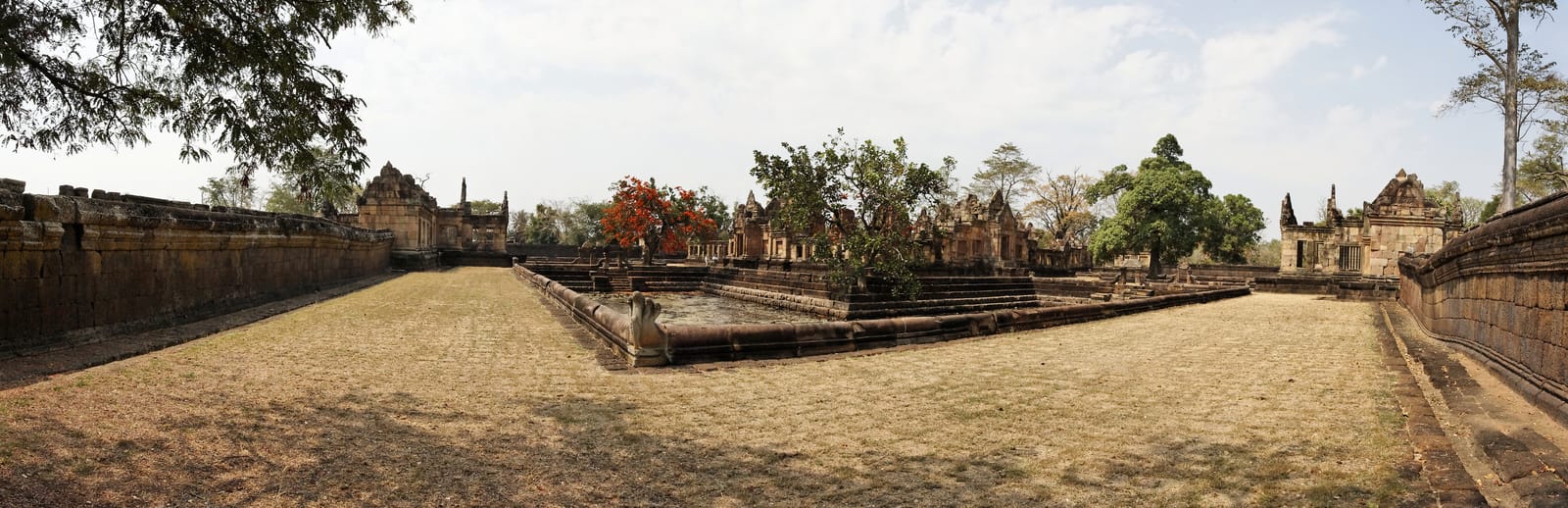
The temple was built on Hindu beliefs and is thought to have been dedicated to Shiva, dating to around the 16th Buddhist century — roughly a thousand years ago — in early Khleang-to-Baphuon Khmer style. Unlike Phanom Rung, which is a hilltop sanctuary, Muang Tam was the temple of a town or community, laid out on flat ground, with a galleried wall enclosing five brick towers at the center. What makes Muang Tam stick in your memory are the four ponds flanking that gallery: not plain squares but L-shaped, angled to match the temple's layout.
- Four L-shaped ponds — wrapping the gallery on all four sides, built in laterite with steps leading down to the bottom. In Hindu belief they represent the four oceans surrounding Mount Meru.
- Five-headed naga along the rims — the upper edges of the ponds are carved from sandstone into long naga bodies, rising into five-headed naga at each corner — the bare-headed naga of true Baphuon-style art.
- Five brick towers — the central group of sanctuaries is built of brick, set in two rows. Some of the spires have collapsed, but the bases and door frames still show clear carved patterns.
- Sandstone lintels and pediments — carved with Hindu deities and floral motifs, many still in their original positions and close enough to study up close.
- Reflections in the ponds — on a clear day with still water, the towers and naga mirrored in the ponds make the shot people come here specifically to get.
Why is it called Muang Tam?
The name Muang Tam ('lower town') comes from the temple sitting on flat ground lower than Phanom Rung up on its hill, so locals named it by comparison long ago. It doesn't mean the temple is inferior — quite the opposite. The stonework and ponds here are detailed enough that plenty of people say they're just as impressed as they were at Phanom Rung.
Want more out of Buriram? Book tours & activities
Booking online ahead on Klook or GetYourGuide is usually cheaper than the gate and skips the queue. Pick only the experiences you actually want — prices and availability are shown live on each site.
Entry fees, hours, and the combo ticket
Prasat Muang Tam is open daily 06:00–18:00. Entry for Thai nationals is 20 THB, but the best value is the combo ticket covering both Phanom Rung and Muang Tam on one stub: 30 THB for Thais, and 150 THB for foreigners. Buy it at the ticket booth of either temple first and it works for both. If you're planning to do the two together anyway, don't buy them separately — the combo ticket is cheaper than two single tickets.
- Hours — daily 06:00–18:00. A real walkthrough takes about 45 minutes to an hour to cover.
- Thai entry — 20 THB for Muang Tam only, or 30 THB on the combo ticket with Phanom Rung.
- Foreigner entry — 150 THB for the Phanom Rung–Muang Tam combo ticket.
- Cash — carry cash and small notes; some points still aren't set up for bank transfers.
How to pair it neatly with Phanom Rung
What most people do is take Phanom Rung in the morning before the sun gets harsh, climbing the long stairway up to the hilltop temple and the Narai Banthomsin lintel, then come down for lunch at the foot of the hill, and only then drive on to Muang Tam in the afternoon. Because Muang Tam is on flat ground with no climbing, it's an easy walk even in the afternoon sun, and the late-afternoon light turns the stone golden and makes the reflections in the ponds prettier. The 8 km between the two is a relaxed drive of under 15 minutes.
Phanom Rung → Muang Tam in one day
Straight talk on sun and shade
Prasat Muang Tam is wide open with little shade, and from midday into the early afternoon the sun is harsh and hot. If you can choose, come late in the afternoon after about 3 pm, or early in the morning — the low, slanting light photographs better and it's a more comfortable walk. Bring a hat and water, and wear comfortable walking shoes, because the ground is stone and laterite and not particularly even.
Attractions and food nearby
Once you're in the Prakhon Chai area, Prasat Muang Tam isn't just the temple itself. Around it are the Ban Khok Muang community that runs community-based tourism, a reservoir to sit and relax by, and Khao Angkhan, another old volcanic crater. If you have a spare half-day, it's easy to keep going.
Kuti Ruesi Ban Khok Muang
A small Khmer hospital chapel about 1 km from Prasat Muang Tam, free to enter, with a quiet feel — a good quick stop that doesn't eat much time.
Ban Khok Muang community
The community around the temple runs community-based tourism, with organic rice, roasted coconut, handwoven cloth, and local food to try. Good for picking up souvenirs.
Huai Jorakhe Mak Reservoir
A reservoir near Muang Tam with wide water views and a cool breeze — a spot for birdwatching and relaxing in the late afternoon before heading back into town.
Khao Angkhan Forest Park
Another old volcanic crater in Buriram, home to Wat Khao Angkhan with its unusual architecture and ancient sema stones. An easy add-on from Muang Tam.
If you're not driving yourself
Prasat Muang Tam and Phanom Rung are nearly 80 km from Buriram town, and public transport really doesn't reach them easily. If you don't have a car, the convenient way is to take the train or a bus to Buriram, then charter a local van or taxi to do Phanom Rung–Muang Tam as a round trip, or book a day tour from town. It's a much better use of time than trying to string local transport together yourself.
Tips for making the most of Muang Tam
- Buy the combo ticket — if you're doing Phanom Rung anyway, buy the 30 THB combo ticket at the first temple. It works for both and is cheaper than buying them separately.
- Do Phanom Rung first, Muang Tam later — Phanom Rung means climbing the hill, so do it in the morning while you've still got energy; save flat, easy Muang Tam for the afternoon.
- Come during slanting light — morning or late afternoon, when the stone turns golden and the pond reflections look better than under the flat, hot midday sun.
- Leave time for the community — there's community food and souvenirs around the temple; rush back and you'll miss this part of the charm.
- Dress respectfully — it's a historic site, so don't climb on the temple or the pond rims. Help keep it for the generations to come.
Want a place to stay in Buriram town before tackling the temples?
See the Top 10 Buriram hotels →