🔄 Updated 21 Jun 2026
Read this first — the border situation
The Ta Muen temple group sits right on the Thai–Cambodian border line on the Dangrek range, where 2025–2026 has seen tension and clashes at several points along the southern Isan frontier. Whether the site is open to visitors depends on the situation and on orders from the military in the area — some periods it's open as usual, other times it's closed or access up to the temple is limited. Before every trip, check with the local security units, the Surin Tourism office, or ask at Phanom Dong Rak district first. Don't just drive up to the checkpoint without checking.
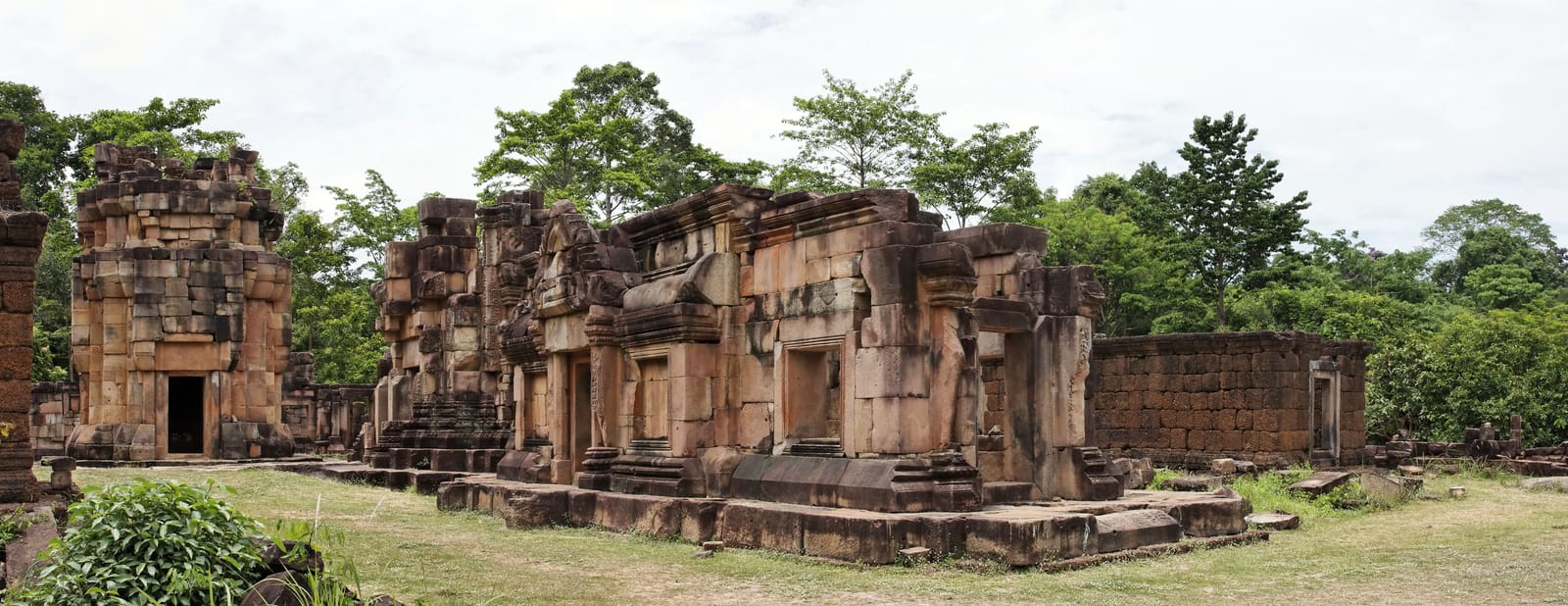
When people think of Khmer temples in Surin, most picture Prasat Sikhoraphum in town first. But for anyone who's genuinely into history, the Ta Muen group is the pin you want to plant on your map at least once. It isn't just a pretty ruin — it's physical evidence of an ancient route linking Angkor (Angkor Wat and Angkor Thom) on the Cambodian side up to Phimai and the Isan plateau. The three temples here each had a different job — religious sanctuary, traveler's rest house, and hospital — lined up along the mountain pass that caravans of the era used to cross the range.
What's in the Ta Muen temple group
A lot of people get the names mixed up. The "Ta Muen temple group" actually refers to three temples in the Ta Muen pass (the Ta Mieng pass), lined up along a single road, anywhere from a few hundred meters to about a kilometer apart. Each was built in a different era for a different purpose, and seen together they bring the picture of an ancient Khmer community along this route into much sharper focus.
Prasat Ta Muen Thom
The largest and most important of the group, built in sandstone around the 11th–12th centuries in the Baphuon style as a Hindu sanctuary. The highlight is a natural Shiva linga formed from a rock outcrop in the floor, still in its original position. Unusually, the temple faces south toward the Cambodian side rather than east like most Khmer temples — this is the detail that leads historians to believe it served as a gateway on the route up from Angkor.
Prasat Ta Muen Tot
A short distance north of Ta Muen Thom, this was an "arogayasala" — a community hospital that King Jayavarman VII ordered built across the kingdom. Made mostly of laterite, it has a single main tower, a library, and a pond. It's smaller than Ta Muen Thom but well preserved and easy to walk around, and it makes you understand how people back then organized care for travelers.
Prasat Ta Muen (the small one)
The smallest of the group, this was a "dharmasala" — a rest house for travelers. It's sometimes called the "house with fire" because it was a roadside stop that kept a fire lit for caravans crossing the pass. Also built of laterite, it's a long hall shape, plain but with its purpose written all over it. It closes out the picture of the old route: this was the place to rest before crossing the border.
Beyond these three, the same district also has Prasat Ta Khwai (some call it Ta Muen Ta Khwai), set on another point along the ridge. It was never finished — what's left is a lone sandstone tower with a raw, deep-in-the-forest feel that travelers who love quiet and a short forest walk really take to. But Ta Khwai also sits right on the border line, and it's an even more sensitive security area than Ta Muen Thom. You have to check with officials before visiting, every time.
Want more out of Surin? Book tours & activities
Booking online ahead on Klook or GetYourGuide is usually cheaper than the gate and skips the queue. Pick only the experiences you actually want — prices and availability are shown live on each site.
Why this place is special compared to other Khmer temples
There are hundreds of Khmer temples in southern Isan, but Ta Muen Thom has a character all its own that you won't find in town. Here's why people who've made it here can't stop talking about it.
- It stands right on the real border line — the temple faces down toward the Cambodian side, so standing in front of it means standing on the seam between two countries. That's a feeling no in-town temple can give you.
- All three functions in one place — sanctuary, hospital, and rest house, lined up along a single road. Walk a few hundred meters and you see the whole system of an ancient Khmer community.
- A Shiva linga in its original position — Ta Muen Thom has a Shiva linga formed from a natural rock outcrop in the temple floor, still in its original spot and never moved. That's hard to find at other temples.
- A forest-and-mountain setting — this isn't a temple in the middle of town surrounded by buildings, but one in the forest on a mountain ridge: quiet, cool air, and a real sense of stepping back in time.
Getting to Prasat Ta Muen Thom
Prasat Ta Muen Thom is in Ta Mieng sub-district, Phanom Dong Rak district, about 80 km from Surin town — roughly an hour and a half to two hours by car. The final stretch runs through a military zone and forest area. There's no direct public transport, so we'd suggest your own car or a hired car with a driver who knows the way.
- From Surin town — take Highway 214 south through Prasat district, then branch onto Highway 2121 heading toward Phanom Dong Rak/Ban Kruat, followed by the Ban Ta Mieng access road all the way to the end at the military base and the temple.
- Total distance — about 80 km, 1.5–2 hours of driving. The final stretch is narrow and winds up the mountain, so drive carefully.
- Combine with other temples — temple fans usually do Ta Muen Thom + Ta Muen Tot + Ta Muen (and Ta Khwai if it's open) in a single day since they're all close together.
- Fuel up and use the restroom beforehand — there are no gas stations or convenience stores near the temple, so it's better to bring your own water and snacks.
Opening hours, admission, and what to bring
During periods when it's open as normal, Prasat Ta Muen Thom is open during the day, roughly 9 a.m. to 3 p.m. (sometimes 8 a.m. to 5 p.m.). Admission is free. But because it's a border area, there are conditions that in-town temples don't have.
- Bring your real ID card — visitors have to show a Thai ID card to confirm they're Thai nationals and swap it for a visitor pass at the checkpoint.
- Foreigners can't enter — during periods of border tension, this area is reserved for Thai nationals with ID cards only. If you're bringing a foreign friend, check ahead.
- Follow military orders strictly — there are restricted zones, no-photo spots, and a set route you must walk. Never go off the path or cross the fence line.
- Hours and openings can change anytime — all of the above applies to normal open periods. If the situation gets tense, it can close immediately with no notice. Always check before you set out.
Best time to go
If it's open, morning around 9–11 a.m. is best — the sun isn't harsh yet, the sandstone isn't scorching, and the light on the temple is lovely. The cool season (November–February) means pleasant mountain weather and you can stay and walk around longer. In the rainy season the final access road can be slippery and foggy.
What else to pair it with in a single day
Because Ta Muen Thom is far from town, if you're driving all that way you'll want to make it count. These are the spots you can pair up on the same route or nearby.
Prasat Ta Muen Tot + Ta Muen
Part of the same group, on the same road, so you can walk straight on from Ta Muen Thom. Catch all three in one spot in under two hours total.
Prasat Ta Khwai
An unfinished sandstone tower deep in the forest on another stretch of the ridge, for those who love raw quiet. But it's a sensitive area, so check whether it's open with officials first.
Prasat Sikhoraphum
An in-town Khmer temple with a beautiful apsara lintel, easy to enter and open daily. Good to stop at on the way back into Surin town, with no border issues.
A Khmer-temple itinerary from Surin town
If you want to go all-in on Khmer temples, here's a two-day plan that covers both the case where Ta Muen Thom is open and the case where it's closed, so your trip isn't wasted. Check whether the Ta Muen group is open ahead of time before you lock in the plan.
The Dangrek crest — the Ta Muen temple group
Elephants, silk, and Surin town (backup plan if Ta Muen is closed)
An honest word on safety
We'd love for you to get to see these beautiful temples, but safety always comes before beauty. If there's news of border tension on the day you plan to go, or officials say it's closed, don't push it — switch to Prasat Sikhoraphum or the elephant-and-silk route instead, and save Ta Muen Thom for next time when things are calm. The temple has stood there for a thousand years; it can wait for us a little longer.
Plan a full trip across all of Surin province
See the Surin travel guide →