🔄 Updated 21 Jun 2026
Samui's temples are spread out all around the island. The northern side around Bophut has a cluster of well-known temples that draw most of the visitors, while the south around Hua Thanon and Bang Kao has quieter ones with fewer crowds and a calmer feel. This guide runs through the northern temples first, then heads south, and finishes with temple etiquette and a two-day route you can tweak yourself. Most are free to enter — only a couple charge a small fee, and we've noted them in each section.
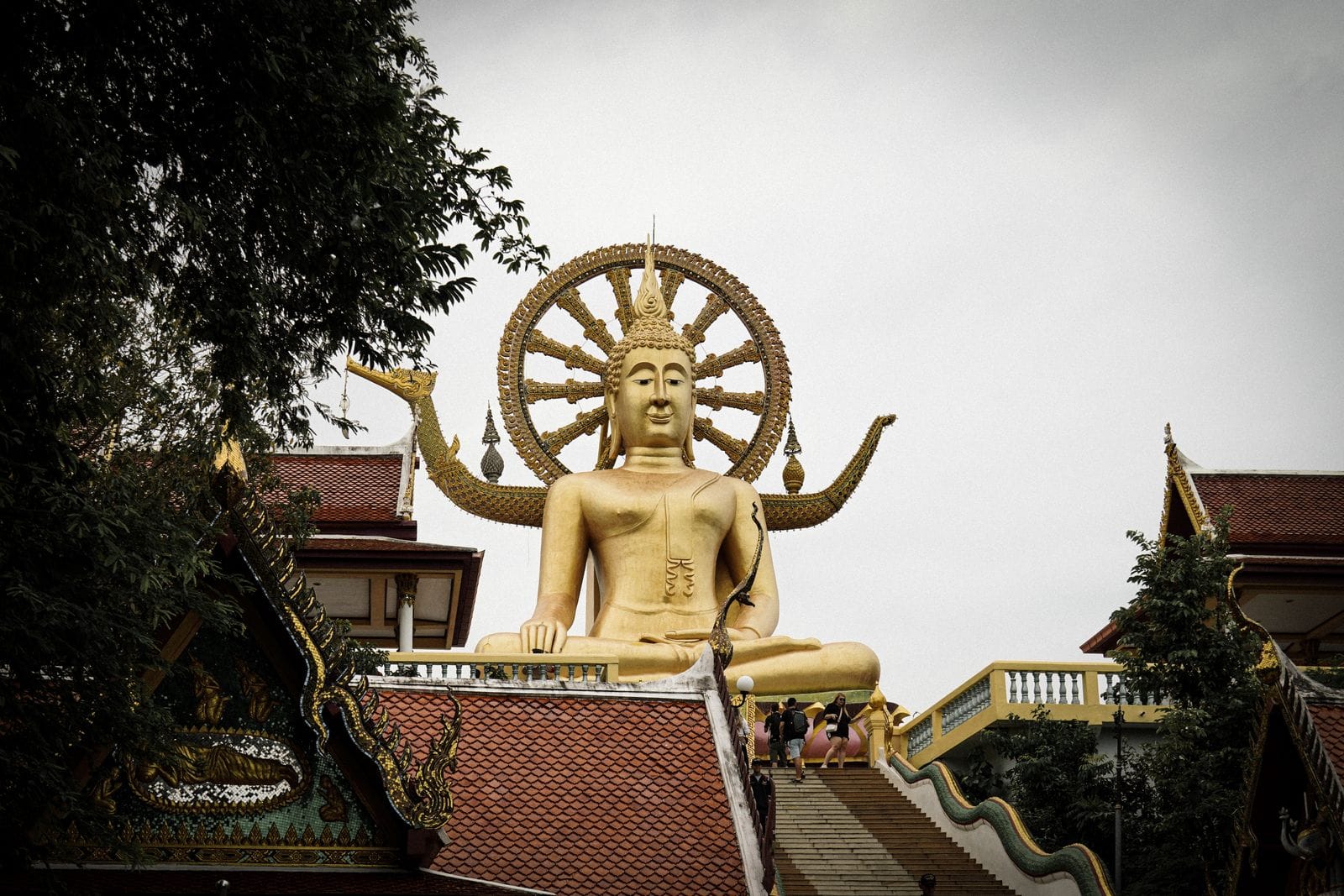
Wat Phra Yai (Big Buddha) — the northern landmark
Wat Phra Yai, the Big Buddha, sits on the small island of Koh Fan in the north near Bophut, linked to the main island by a causeway. The star is a golden seated Buddha in the bhumisparsha (subduing Mara) pose, about 12 metres tall, set on a rise you can see from far away as your plane lands or your ferry comes in. Climb the naga staircase to pay respects at the top and you get a sweeping sea view. For most people this is the first temple that comes to mind when they think of Samui.
- Hours — roughly 06:00–18:00 daily, free entry (donation boxes if you wish to give)
- Dress code — cover shoulders and knees, remove shoes before entering buildings. There are sometimes cover-up cloths to borrow on site but it's not guaranteed, so bringing your own is safer.
- Around the courtyard — souvenir stalls, snacks, and offering sets to grab before heading up to the Buddha
Best time to go
Go in the early morning or near sunset for softer light and fewer people than midday. The stairs and concrete courtyard reflect a lot of heat at noon — if you go in the afternoon, pack a hat and water.
Want more out of Koh Samui? Book tours & activities
Booking online ahead on Klook or GetYourGuide is usually cheaper than the gate and skips the queue. Pick only the experiences you actually want — prices and availability are shown live on each site.
Wat Plai Laem — the 18-armed Guanyin
Wat Plai Laem is only about 1 kilometre from Big Buddha, so it's easy to pair them in one trip. The highlight is a white 18-armed Guanyin statue standing in the middle of a lake, reflecting the blended Chinese-Thai beliefs here. On the other side stands a big white Budai (the Laughing Buddha). The main hall sits on an island in the water, with detailed stucco work and fine murals you can walk around to photograph. People like to buy fish food to feed the fish in the lake as a way of making merit.
- Hours — roughly 07:00–18:30 daily, free entry
- Close to Big Buddha — about 1 km apart, easy to do together. The two temples take around 1.5–2 hours combined.
- Dress code — cover shoulders and knees, same as any Thai temple
Wat Khunaram — the mummified monk Luang Pho Daeng
Wat Khunaram is on the southern side of the island near Ban Hua Thanon, known for the body of Luang Pho Daeng, a monk who passed away in a meditation pose in 1973. His body never decomposed and is kept in a glass case for visitors to pay respects. What most people remember is that he's wearing sunglasses. It's a spot both Thais and foreign visitors stop at to pay respects and learn the story — just enter respectfully and keep your voice down.
- Hours — roughly 08:00–17:00 daily, free entry (donation box)
- Photos — some areas ask you not to photograph the monk's body. Watch for the signs and follow them respectfully.
- Dress code — cover shoulders and knees, keep noise down as it's a place of worship
Know before you go
Wat Khunaram is a sacred place for locals, not a quirky photo stop. Entering quietly and respectfully to pay your respects is the etiquette to keep. If you're bringing kids, explain it to them before you go in.
Wat Sila Ngu (the Red Temple) — a terracotta hall by the sea
Wat Sila Ngu, officially Wat Ratchathammaram, is widely known as the Red Temple. It sits on the southeastern side near Hua Thanon, close to Lamai Beach. The standout is its ordination hall built entirely from terracotta and red sandstone — unlike the usual whitewashed Thai temple — with walls carved in fine detail telling scenes from the life of the Buddha. Behind it, a golden pagoda stands on a rocky terrace by the sea, said to hold relics of the Buddha. It's a pleasant place to walk around taking in the carvings and the sea view.
- Hours — roughly 06:00–18:00 daily, free entry
- Highlights — the red terracotta hall plus the golden seaside pagoda behind it, both great to photograph
- Near Lamai — in the southern zone near Lamai Beach, easy to pair with the Hin Ta Hin Yai rocks
Wat Chaeng — the town temple of Nathon
Wat Chaeng is around Nathon on the western side of the island, the old town and main ferry pier area. It has a school inside its grounds, so it feels like a genuine community temple with few tourists around. The highlights are a large Buddha image in the blessing pose, a fine white-and-gold ordination hall, and a four-faced Brahma shrine behind it. It's a good stop for anyone who wants to see the kind of temple Samui locals actually visit rather than a tourist temple. Worth a stop if you're around Nathon or waiting for the ferry.
- Location — around Nathon on the west coast, near the ferry pier, handy to drop by while waiting for a boat
- Free entry — open through the day, donation box if you wish to give
- Atmosphere — a community temple with a school, more locals than tourists, so keep it respectful
Laem Sor Pagoda — a golden beachfront pagoda in the south
Laem Sor Pagoda, or Wat Phra Chedi Laem Sor, is out at the southern tip near Bang Kao. It's a bell-shaped pagoda covered entirely in golden-yellow tiles — from a distance it looks like solid gold. It stands by a quiet beach with a far calmer feel than the northern temples. Built around 1968 by Luang Pho Jaem, it holds relics of the Buddha inside. There are few people here, so it's good if you want a quiet corner to pay respects and sit looking out at the sea. Nearby there's also a small pagoda on a hill you can climb for a view over the bay below.
- Hours — open through the day, free entry (donation box)
- Location — the southern tip near Bang Kao. The access road is a narrow lane, so drive slowly.
- Quiet and uncrowded — great for escaping the bustle, a golden pagoda paired with a sea view
Secret Buddha Garden (Tar Nim) — sculptures up in the hills
If you want Buddhist art of a different kind, head up to the Secret Buddha Garden, also known as the Magic Garden of Tar Nim, high in the hills in the centre of the island. This isn't a temple but a private sculpture garden that Khun Nim Thongsuk, a durian farmer, began building in 1976 at the age of 77 and kept working on until he died. Statues of Buddhas, deities, and figures from Thai belief are scattered along a stream and waterfalls in the forest. It's shady and cool, a contrast to the seaside temples. The way up is a steep, narrow mountain road.
- Entry fee — around 80–100 THB per person (prices can change, check on site)
- The road up — a very steep mountain road with tight bends. If you're not used to it, take a 4WD or hire a driver — don't push it on a motorbike if you're unsure.
- What to bring — wear comfortable walking shoes; the garden has steps and the ground gets slippery in the rain
About the mountain roads
The road up to the Secret Buddha Garden and Samui's other hill spots really is steep and slippery, especially after rain. Many of the island's motorbike accidents happen on slopes like these. If you're not confident, hire a car or join a jeep tour instead — it's safer and you'll enjoy the trip more.
Temple etiquette — how to dress and behave
Samui's temples are places of worship for locals, not just photo spots. Knowing the basics will let you visit comfortably and avoid accidentally being rude.
- Dress — cover shoulders and knees at every temple. Skip spaghetti straps and very short shorts; keep a cover-up cloth in your bag just in case.
- Shoes off — always before entering an ordination hall or any building housing a Buddha image
- How to sit — inside, don't point your feet toward the main Buddha image. Women should avoid touching monks.
- Sound and photos — keep your voice down, watch for no-photo signs, and respect anyone who's chanting or meditating
- Making merit — give what you wish in the donation box. You don't have to follow vendors hawking amulets if you'd rather not buy.
A temple route — how to lay it out over two days
If you want to cover Samui's main temples without driving aimlessly around the island, split them into a northern zone and a southern zone like this, then adjust to your accommodation and the weather. Drive slowly and watch the steep roads, especially up in the hills.
Northern temples — Bophut
Southern temples — hillside sculptures
Want a well-located hotel as a base for touring temples around the island?
See 10 Samui hotels worth booking →