🔄 Updated 21 Jun 2026
The charm of Samut Prakan is that you can do it without staying overnight — hop on the BTS from central Bangkok and ride it straight down to Pak Nam, then branch out to the sights. The thing that trips people up is that the attractions are scattered in different directions. Some you can walk to from the BTS, some need a ferry across the river, and others mean a short songthaew or bus on top of that. This guide is sorted by where you want to go and whether you'd rather not drive.
BTS Green Line — the main route into Pak Nam
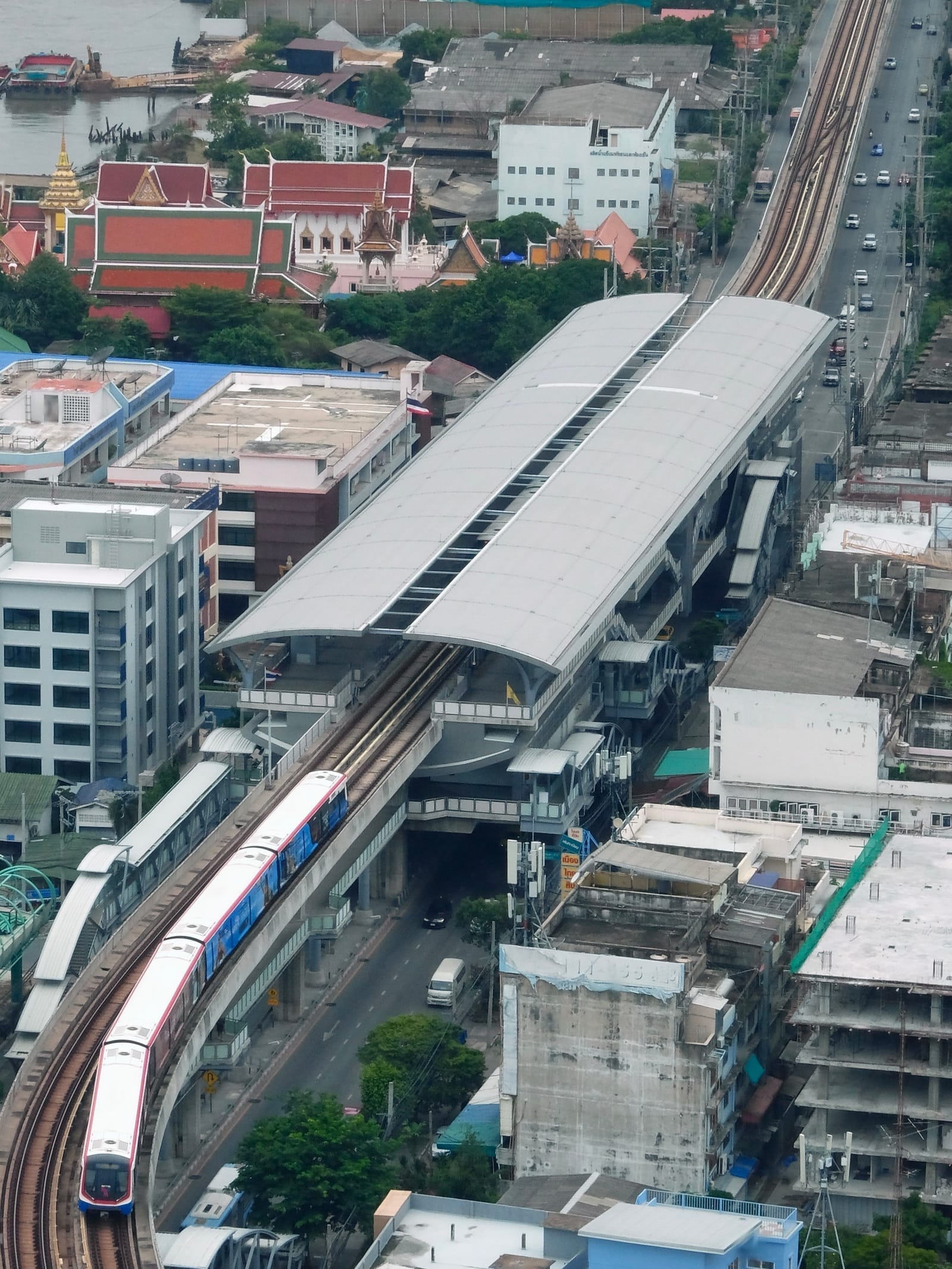
The BTS Green Line's Bearing–Kheha extension is the backbone of the Samut Prakan side. It runs alongside Sukhumvit Road into the heart of the province, with 9 stations inside Samut Prakan. From Bearing inward they are Samrong · Pu Chao · Chang Erawan · Royal Thai Naval Academy · Pak Nam · Srinagarindra · Phraek Sa · Sai Luat · Kheha. The two stations travellers use most are Pak Nam (for the old town, Pak Nam Market, and the ferry pier) and Kheha, the end of the line and the closest stop to Muang Boran and Bang Pu.
- Fares on the extension — distance-based from 1 Nov 2025, starting at around 17 THB and rising with distance to a maximum of about 45 THB on the extension section.
- If you ride in from central Bangkok — the combined fare across the core concession line plus the extension caps at roughly 65 THB.
- Service hours — first trains around 05:15–06:00, last trains around midnight, with only a few minutes between trains at peak times.
- Connections — at Samrong you can transfer to the Yellow Line, and to head into central Bangkok you simply stay on the Green Line without leaving the system.
Which station for which spot
For the Pak Nam old town, the market, and the ferry across to Phra Samut Chedi, get off at Pak Nam station. For Muang Boran or Bang Pu, ride to the end of the line at Kheha and take a short onward ride from there.
The Pak Nam–Phra Samut Chedi ferry
Phra Samut Chedi stands on the opposite bank of the Chao Phraya River from Pak Nam town. Most people get there by ferry, which is both the easiest way and the one with the most atmosphere. From Pak Nam BTS station it's a short walk to Wibun Sri Pier (the Pak Nam Market ferry crossing), where you board the ferry across to Phra Samut Chedi Pier. The crossing takes only about 5 minutes, and once you step off you can walk straight to the chedi.
- Fare — very cheap, around 8 THB per trip for general passengers (up from 6 THB since April 2026); about 4 THB for students and uniformed officials.
- Operating hours — roughly 05:00–21:30, with frequent departures all day, so you rarely wait long.
- Bringing things across — some ferries take bicycles and motorbikes, handy if you want to cycle or ride around on the other side.
- Walking from the BTS — from Pak Nam station you walk through Pak Nam Market to Wibun Sri Pier; it's not far, and you can grab some morning-market food on the way.
Ask at the pier before boarding
Pak Nam pier has both the short crossing to Phra Samut Chedi and boats heading elsewhere. If you're not sure, ask the staff at the pier whether the boat goes to Phra Samut Chedi so you don't end up on the wrong one.
How to get to Muang Boran
Muang Boran (the Ancient City) is a huge open-air museum out around kilometre 33 of Old Sukhumvit Road, on the Bang Pu side. The easiest starting point if you don't have a car is Kheha BTS station, the end of the Green Line. From there you have a few options for the short ride in.
- BTS Kheha + songthaew — from Kheha, take songthaew route 36, which passes the front of Muang Boran; it's only a few minutes' ride.
- BTS Kheha + taxi/motorbike taxi — quicker and more convenient, good if you're in a group or don't want to wait for a songthaew.
- Muang Boran's free shuttle van — runs on Saturdays and Sundays only between Kheha station and Muang Boran, a few times a day; check the latest schedule on Muang Boran's page before you go.
- Driving yourself — there's parking inside Muang Boran, which suits a long visit since the grounds are vast and walking the whole thing is tiring.
The grounds at Muang Boran are enormous — too much to cover on foot in a single day. At the entrance there are trams and bicycles for hire. Set aside the whole day and arrive early. Adult admission is around 400 THB, and it's open daily roughly 09:00–18:00 (double-check the latest price and hours before you go, as promotions and packages that include the tram change from time to time).
How to get to Bang Pu
The Bang Pu seaside resort is out around kilometre 37 of Sukhumvit Road, on the gulf coast. It's a spot for watching seagulls and the sunset over the sea, and Bangkok folk love driving out here in the late afternoon. The seagull flocks are biggest from November to April. If you don't have a car, start at Pak Nam or Kheha and take an onward ride.
- Bus — several routes pass this way, such as 25, 511, 508, 102 and 142. Most get off around Pak Nam Market and then take a Pak Nam–Bang Pu songthaew on top of that.
- BTS Kheha + onward ride — ride to the end of the line at Kheha, then take a songthaew or taxi to Bang Pu, since Bang Pu is just a short way past Kheha along Sukhumvit.
- Pak Nam–Bang Pu songthaew — runs along Sukhumvit, cheap fare, good if you're not in a hurry and want to save money.
- Driving / ride-hailing app — easiest for an evening sunset visit, since songthaews thin out on the way back after dark.
Plan your way back for the evening
Bang Pu is all about the sunset, but once it gets dark the songthaews and buses thin out. If you come by public transport, have a plan for the trip back, or book a ride on an app ahead of time for peace of mind.
Buses, songthaews, motorbike taxis and taxis
Besides the BTS, the province has several bus routes running along Sukhumvit that link to Bangkok, and songthaews are the workhorse for short hops from a BTS station or market to the sights. Fares are cheap, but they're slow when traffic is heavy at peak hours. For very short distances, motorbike taxis are quick and easy to find outside the stations, while regular taxis and ride-hailing apps work fine across the province.
- Bus — cheapest but slow; good if you're not in a hurry and know the exact route. Many run along Sukhumvit.
- Songthaew — the main connector from the BTS/market to the sights, such as route 36 into Muang Boran and the Pak Nam–Bang Pu line.
- Motorbike taxi — fast, good for short hops from a station to a pier or market; agree on the price before you get on.
- Ride-hailing app / taxi — most comfortable if you're in a group, have luggage, or are heading back late from Bang Pu.
Is renting a car worth it?
If you want to see several spots in one day — especially Muang Boran, Bang Pu, Wat Bang Phli Yai Nai and the crocodile farm, which are spread out in different corners — having a car is far more flexible, with no waiting through several songthaew connections. Samut Prakan is right next to Suvarnabhumi, so it's easy to pick up a rental at the airport and drive straight out to explore; there are also the usual rental pickup points in town. The things to watch for are heavy peak-hour traffic on Sukhumvit and the scarcity of parking around Pak Nam Market.
Focus on the old town + ferry
No car needed — take the BTS to Pak Nam, walk the market, then cross the river to Phra Samut Chedi, all in one area.
Just Muang Boran or Bang Pu
Ride the BTS all the way to Kheha, then a short songthaew or taxi — cheap and no parking to hunt for.
Several spots in one day
A rental is more flexible, especially if you're combining temples, the crocodile farm and Bang Pu; allow extra time for Sukhumvit traffic.
Plan a full Samut Prakan trip
See the Samut Prakan travel guide →