🔄 Updated 21 Jun 2026
Samut Prakan sits just south of Bangkok, right where the Chao Phraya River meets the Gulf of Thailand. The sights are spread out — from the seaside Bang Pu Recreation Center to the Ancient City, the Erawan Museum, and on to Phra Samut Chedi and Phra Chulachomklao Fort. Getting around got a lot easier once the BTS Green Line extended all the way to Kheha Samut Prakan. Two things trip people up most often: going to Bang Pu hoping to see the seagulls but arriving in the wrong season, and not checking the Ancient City and Erawan entry fees beforehand and blowing the budget. Know these in advance and you can line up your days and money just right.
What month do the Bang Pu seagulls arrive?
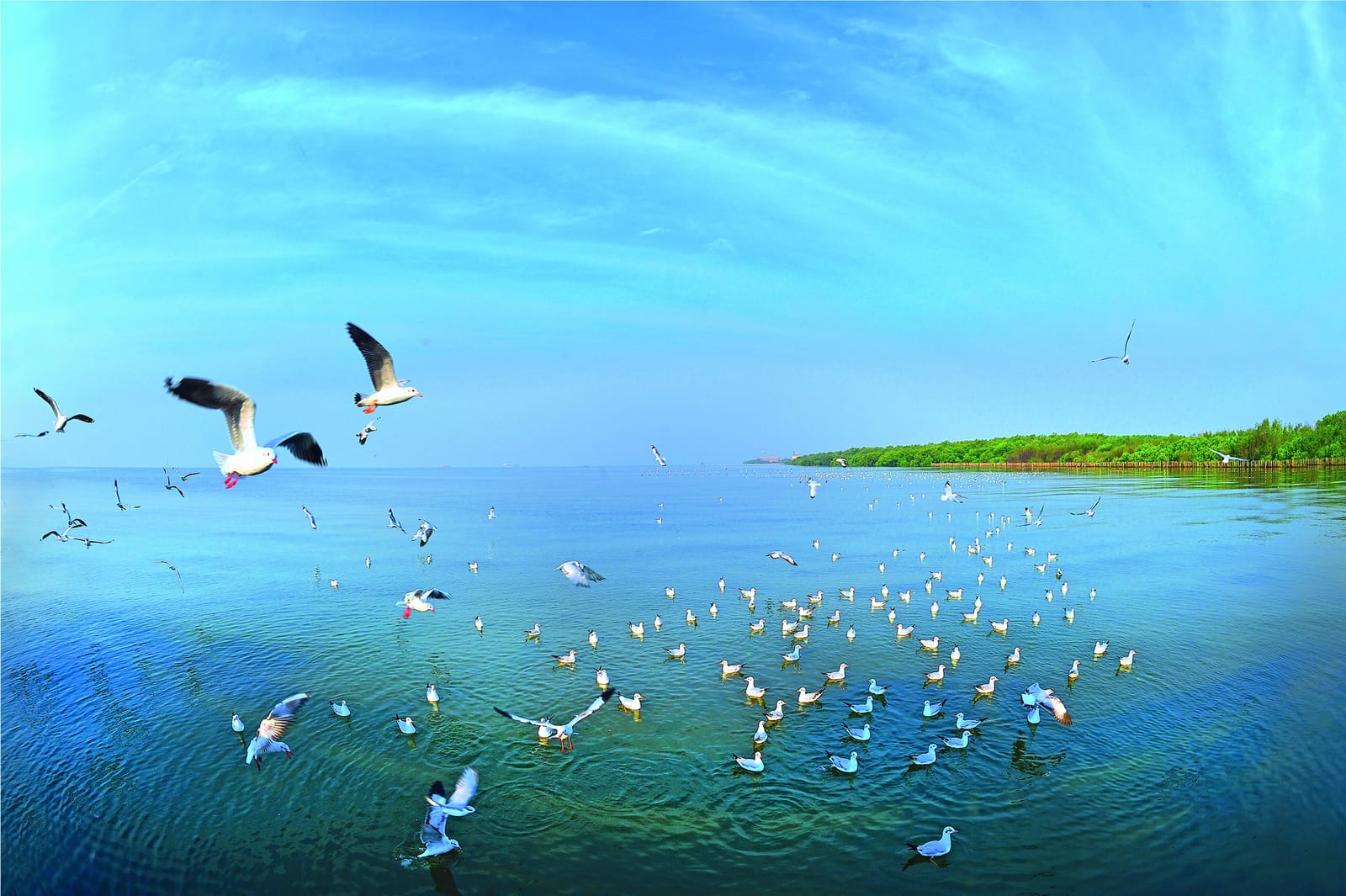
This is the number-one question for anyone thinking about Samut Prakan. The seagulls at Bang Pu are migratory birds escaping the cold from Siberia and northern China, and they only come down to Bang Pu Bay during the cool season into early hot season, roughly October to April each year. Outside that window you won't see a single bird, because the whole flock has already flown back north. If you're coming specifically to see the seagulls, check the calendar first.
The peak — tens of thousands of birds filling the sky — is around December to January, right in the heart of the cool season. Walk out on Suk Ta Bridge stretching into the sea and you'll have seagulls wheeling close enough around you for great photos. At the start of the season (October–November) and the tail end (March–April) the birds are thinner — still there, but not as spectacular as midwinter.
The golden hours for birdwatching
The seagulls come out in force in the late afternoon into evening, roughly 3pm until sunset — which is also when most people come to feed them. Show up then and you get both the sky full of birds and the sunset over the sea in one trip. At midday the sun is harsh and there are fewer birds around.
Bang Pu Recreation Center is free to enter — no admission, open every day. On Suk Ta Bridge there are stalls selling bird food (dried fish / bread) for a few baht. Honestly, weekdays and weekends feel very different here. Weekends are busy and lively with a market, but it's crowded and the parking fills up fast. Weekdays are more relaxed and there are still plenty of birds to watch.
When is the best time to visit Samut Prakan?
The most comfortable stretch is November to February — dry air, gentler sun, so you can walk along the Bang Pu seafront or wander the open-air Ancient City for longer. It also lines up perfectly with seagull season, which makes it the best-value time to come. March to May, on the other hand, is brutally hot; walking in the daytime wears you out fast, especially at the Ancient City, which is wide open with little shade.
June to October is the rainy season — you might catch late-afternoon showers, and some spots by the sea get windy — but you can still do indoor sights like the Erawan Museum or the town markets. If you come during the rains, bring an umbrella and check the forecast before heading out. As for the buzz, everything is fully open on weekends; Bang Nam Phueng Floating Market and the old Bang Phli market only come alive on weekends.
The season in a nutshell
For seagulls at full strength plus good weather, come in December–January — it's the sweet spot. If you're not fussed about the birds, any month works for the Ancient City, Erawan, and the markets; just avoid walking in the midday sun in the hot season.
Entry fees at the main sights — how much to budget
Samut Prakan has both free spots and ones with fairly steep entry fees. If you don't check ahead, the budget balloons easily — especially the two biggest names, the Ancient City and the Erawan Museum. Here are the approximate Thai-resident prices (prices may change; double-check the official pages before you go).
- Ancient City (Muang Boran) — Thai adults around 400 THB, children around 200 THB, with the free tram, bicycles, and boat included · open daily 09:00–19:00. It's a huge site — you can easily spend the whole day.
- Erawan Museum — Thai adults around 250 THB, children around 125 THB · there's a 365 THB annual pass good for 365 days, Thai residents only · open 09:00–18:00.
- Bang Pu Recreation Center (seagull watching) — free entry; you only pay a few baht for bird food.
- Phra Samut Chedi / Phra Chulachomklao Fort — free to visit; the fort has a warship museum and gardens to walk through.
- Old Bang Phli Market / Bang Nam Phueng Floating Market — free entry, you only pay for food and souvenirs; lively on weekends only.
How to save on tickets
The Ancient City and Erawan often have a discounted combo ticket sold through online ticketing platforms — noticeably cheaper than buying at the gate. If you plan to hit both in one trip, look for a combo ticket first; it works out better than paying separately.
Day trip from Bangkok — how to get there and plan the day
The best thing about Samut Prakan is how close it is to Bangkok — you barely need to stay overnight, just an easy out-and-back. Since the BTS Green Line extended down to Pak Nam Station and the end of the line at Kheha Samut Prakan, many of the sights are walkable or a short hop from the station. You can do it all without a car. Here are three day-trip plans you can actually pull off, in three different styles.
Culture route — Erawan + Ancient City
Sea & birdwatching — Bang Pu (best in cool season)
Market & food route (weekends)
What to wear — temples and seafront walks
Samut Prakan is laid-back and casual clothes are fine — just suited to the hot, humid weather and a lot of walking. The thing to watch is visiting temples, because important ones like Wat Bang Phli Yai Nai (Luang Pho To) and Phra Samut Chedi are still active places of worship where people really come to pray.
- Visiting temples — dress modestly, shoulders and knees covered; skip spaghetti straps, tank tops, and shorts above the knee. Pack a light shawl just in case.
- Seafront walks at Bang Pu / Suk Ta Bridge — the sea breeze is strong and there's spray; bring a light jacket, hats can blow off, and watch for dropped items.
- Ancient City — wide open and sunny; focus on comfortable walking shoes, a hat, an umbrella, and sunscreen, since you'll be walking all day.
- Sun protection — many spots are open riverside plazas with little shade; pack a folding umbrella or a hat in every season.
Rough daily budget
Samut Prakan can be done cheaply if you stick to the free spots, but the moment you add the Ancient City and Erawan the budget jumps, since those two tickets together run into the several hundreds. Here are approximate per-person, per-day figures for an out-and-back from Bangkok.
- Getting there from Bangkok — the BTS Green Line into Samut Prakan runs from the tens to low hundreds of baht per ride · songthaews/motorbike taxis a few tens of baht · figure around 100–250 THB round trip.
- Mostly free-sight day — Bang Pu birdwatching + Phra Samut Chedi + markets are all free; whole-day total around 300–600 THB (transport + food).
- With the Ancient City / Erawan — add about 250–400 THB per place in Thai ticket prices; do both and the whole-day budget climbs to 900–1,400 THB.
- Food — street food / noodles at 50–80 THB a plate · riverside seafood at 200–400 THB a meal · Bang Krachao cafés at 60–120 THB a cup.
- Budget total — stick to free spots + Bang Pu birdwatching and you can manage comfortably on around 400–700 THB a day.
Getting around town
For BTS-connected spots like Erawan and Pak Nam, the Green Line is easiest. For Bang Pu you'll need to ride to the end of the line at Kheha and then catch a songthaew. If you're hitting several spots in one day or adding Bang Krachao, a ride-hailing app is more convenient and saves time. For Bang Krachao itself, get in and out by cross-river ferry and rent a bicycle on-site.
SIM, internet, and other small stuff
Samut Prakan borders Bangkok, so mobile coverage is good almost everywhere. Thai residents can use their usual SIM as normal — nothing extra to do. International visitors can buy a tourist SIM right at Suvarnabhumi Airport (which happens to be in Samut Prakan) or at convenience stores; unlimited weekly data packages run in the low hundreds of baht, plenty for navigation, ride-hailing, and bookings.
- Cash — stalls at Bang Phli Market, the bird-food vendors at Bang Pu, and songthaew fares are mostly cash; bring small bills and coins.
- PromptPay / scan-to-pay — many mall shops and cafés accept scan payment, but small stalls and songthaews still lean on cash.
- Parking — Bang Pu and the weekend markets fill up fast; if you drive, go early or allow time to find a spot.
- Restrooms — the main sights have full facilities; some markets charge a few baht, so keep coins handy.
All set? See the full guide to where to stay and what to do in Samut Prakan
See the Samut Prakan travel guide →