🔄 Updated 21 Jun 2026
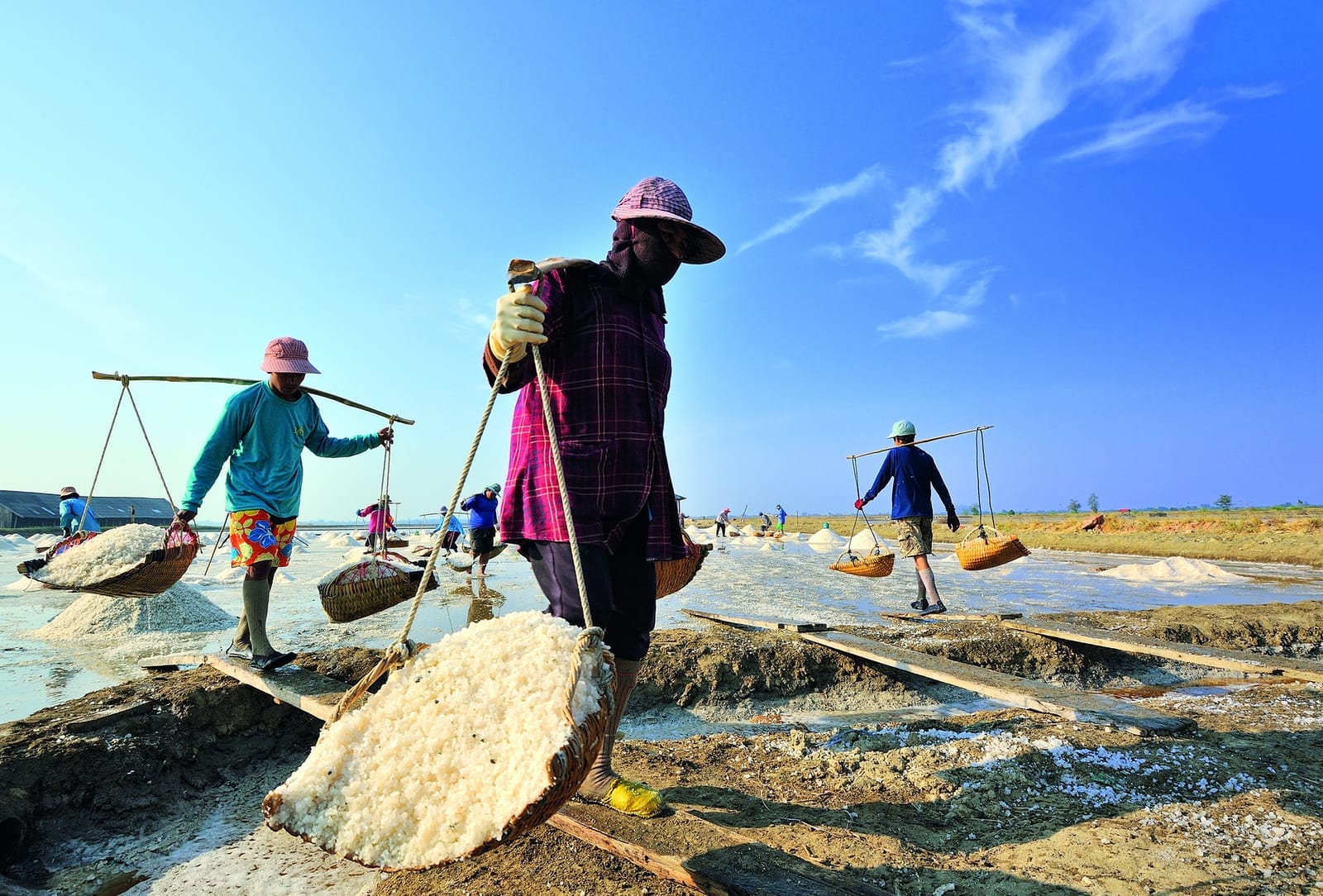
Samut Sakhon is one of the oldest sea-salt farming areas on the inner Gulf of Thailand, especially around Khok Kham and Phan Thai Norasing sub-districts, where the drying flats still stretch out as far as you can see. The real salt-making season is the dry months, roughly November to May. That's when you'll see white salt mounds lined up in rows, farmers raking and gathering the salt, and water in the pans so clear it throws back a reflection. Once the rains come, the pans are left flooded and the scene changes, but you still get lovely reflections of the sky.
The charm of this place is that it's a working area for local people, not a staged check-in spot. So walk and shoot with respect: don't step into the pans or onto the salt mounds, and don't block the little farm trucks hauling salt. Do that and you'll come away with good photos and a smile from the salt farmers.
Why go in the evening
Midday light on the salt farms is harsh and very flat, because it's wide open with no shade, so photos come out glaring and washed out. But once the sun starts to dip from around 3:30 pm onward, the light softens, warm gold and orange tones creep in, and the salt mounds gain depth with long shadows. The real winner is the light reflecting off the water in the pans, which by evening turns into a mirror holding the clouds and the whole blue of the sky.
- Afternoon 15:00–16:00 — light is starting to soften; good for wide shots of the salt flats in rows, the wind pumps, and people at work
- Evening 16:30–18:00 (golden hour) — the magic window: orange light against the white salt mounds, with the sharpest reflections on the water
- Dusk 18:00–18:30 — the sun sets behind the salt flats, the sky shifts to pink and purple, and you can catch silhouettes of the wind pumps
Tip for shooting reflections
Find a pan with still, undisturbed water and no ripples, then drop your camera low and close to the surface to get a full, symmetrical mirror reflection. Wearing white or pale blue helps you blend into the salt-and-sky palette, so the shots come out softer than bold colors would.
Book the activities in your Samut Sakhon trip ahead
Booking online ahead on Klook or GetYourGuide is usually cheaper than the gate and skips the queue. Pick only the experiences you actually want — prices and availability are shown live on each site.
Planning a half-day evening (block day)
This plan is built as a half-day afternoon-into-evening trip. Driving yourself is by far the easiest, since the spots are spread apart and public transport doesn't reach them. From Bangkok, take Rama II Road and you'll reach Samut Sakhon in about 40–60 minutes. We've laid it out as two days with options: the first focuses on Khok Kham on the Samut Sakhon side, the second shifts to Ban Laem on the Phetchaburi side, where the salt fields are even larger. Pick just one day if that's all the time you have.
Khok Kham–Phan Thai Norasing (Samut Sakhon side)
Ban Laem–salt-farm cafe (shifting to the Phetchaburi side)
Photo spots and salt-farm cafes you can actually visit
Beyond walking the dikes to shoot, this area has several cafes that use the salt-farm view as their draw — just the right mood for a break while you wait for the evening light.
Kluea Coffee & Sea Salt Farm
A cafe beside the salt pans in the Khok Kham area of Samut Sakhon, with a swing overlooking the salt farm and a wide, breezy expanse of fields. Coffee and one-plate dishes run ฿100–200 — a good place to sit and wait for golden hour.
Salt Lake De Maeklong
A well-known salt-farm-themed cafe on the Mae Klong–Samut Sakhon border that tells the story of salt farming and mackerel through its menu and setting, with plenty of corners for salt-farm photos.
Khok Kham Salt-Farming Tourism Village
A traditional salt-farming community with a learning point on how sea salt is made, where you can walk and photograph the drying flats and wind pumps. This is the heart of the plan.
Nearby stops to add to the trip
- Phan Thai Norasing Shrine — an old shrine on the bank of Khok Kham Canal, a base point before the salt farms; come to make a wish and see the replica boat
- Phan Thai Norasing Mangrove Nature Trail — a long concrete boardwalk through the mangroves where you can spot mudskippers, fiddler crabs, and shorebirds; best walked in the morning or late afternoon
- Bang Khun Thian Red Bridge — a red wooden bridge reaching out into the sea on the Bangkok side, close by; in cool season you can sometimes spot pods of dolphins
- Mahachai Market / Talay Thai Market — wrap up with fresh seafood and ocean souvenirs before heading home
Before you go
- Season — to see salt mounds and real salt-making, go in the dry season, Nov–May; in the rainy season the pans hold water, so you get sky reflections instead
- Getting there — driving yourself is easiest; public transport barely reaches it. Take Rama II Road from Bangkok, about 40–60 minutes
- What to wear — hat, sunglasses, and sunscreen, because the salt flats throw back very strong glare, plus shoes you don't mind getting dirty
- Etiquette — don't step into the pans or onto the salt mounds, don't block the salt-hauling trucks, and ask permission before photographing people at work up close
- Safety — the salt farms have no lighting, so leave the area before it's fully dark, and bring drinking water and mosquito repellent
Straight talk
The salt farms aren't a theme park — they're a place where people earn their living that happens to welcome outside visitors. The charm is in how simple and wide-open it is. If you're after dramatic, all-out photos, this may not be the place. But if you like a quiet atmosphere, evening light, and real local life, a half-day here is well worth it.
See all the things to do, eat, and stay in Samut Sakhon
Open the Samut Sakhon guide →