🔄 Updated 21 Jun 2026
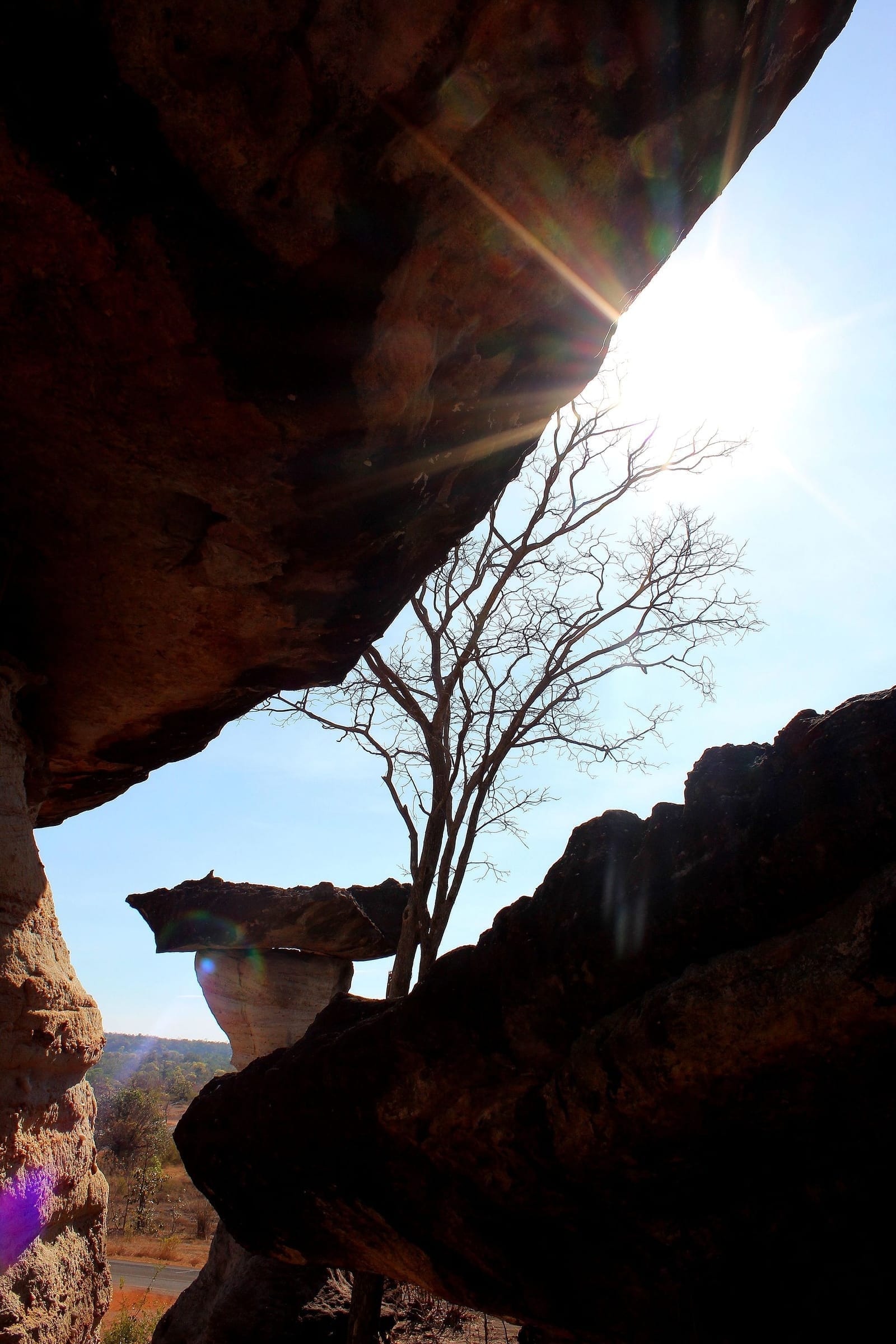
Sao Chaliang is in Huai Phai subdistrict, Khong Chiam district, Ubon Ratchathani, inside Pha Taem National Park. It sits right beside the main road that runs in to the park headquarters and the Mekong viewpoints, so people heading for Pha Taem usually stop here for photos first. The pillars are large slabs of sandstone standing alone on an open rock terrace, shaped like giant mushrooms — you can spot them from the road as you drive up.
The name Sao Chaliang is a variation on the local word sa-liang, which means stone pillar — a plain, literal name for what people saw. Locals looked at the rock slabs standing out on the open terrace and named them after their shape. When it became the official name, it was written as Sao Chaliang, the form everyone uses today.
How the Mushroom Rocks Formed
Each Sao Chaliang pillar is built from two ages of sandstone stacked together. The stem at the bottom is Jurassic sandstone, around 180 million years old, while the cap on top is Cretaceous sandstone, around 130 million years old. These two layers aren't equally hard, so wind and rain have slowly worn away the softer rock at the base until it pinched in, while the harder rock on top stayed spread out. The result is the mushroom — or open-umbrella — shape you see today.
Erosion like this takes so long it's measured in millions of years, and it's still happening every day in ways your eye can't catch. That makes Sao Chaliang both a good photo spot and an easy, hands-on bit of geology. Kids who see it get it straight away — the same rock wears down unevenly, and you end up with a shape like this.
- The mushroom cap — Cretaceous sandstone, around 130 million years old and harder, so it's left spread out on top.
- The stem — Jurassic sandstone, around 180 million years old and softer, worn down until it pinched in.
- Height — the tallest pillar stands around 7 meters above the rock terrace; some are shorter, but that's roughly a two-story building.
- Number of pillars — the main spot has several pillars clustered close together, some standing alone and some in pairs.
Sao Chaliang Khu and Sao Chaliang Lek
In the same area there are spots called Sao Chaliang Khu (the paired pillars) and Sao Chaliang Lek (the small pillars) — similar stone formations in different locations, with different sizes and shapes. If you've got time and want to see them all, ask a ranger or check the park signs for which spots are open and what the walk is like, because some take a bit more hiking to reach.
Want more out of Ubon Ratchathani? Book tours & activities
Booking online ahead on Klook or GetYourGuide is usually cheaper than the gate and skips the queue. Pick only the experiences you actually want — prices and availability are shown live on each site.
The Angles People Love
Sao Chaliang is easy to photograph because it stands on an open rock terrace with no trees in the way, so you can walk almost all the way around it. Most people don't spend long here — around 20–30 minutes is enough to get your shots before driving on to the Pha Taem viewpoint. Here are the angles people tend to go for.
- Looking up from below — stand close to the stem and tilt the camera up so the cap spreads against the sky; this shows the mushroom shape most clearly.
- Standing beside the pillar — put a person next to the rock for scale so you can see it towers several times taller than they are. It tells the story well.
- Late-afternoon shadows — when the sun drops low in the late afternoon, the pillars throw long shadows across the terrace, giving more depth than the flat light of midday.
- Wide shot of the terrace — step back to take in the whole cluster with the open rock around it, so you can see how it stands alone in the middle of the bare ground.
Straight talk
Sao Chaliang is a photo stop on the way, not somewhere you'll spend the whole day. If you're expecting a lot to do, it may feel small — but treat it as a nice bonus before Pha Taem and it's worth pulling over for a short walk. Around midday the sun is harsh and the terrace has no shade at all, so bring a hat and water, and aim for early morning or late afternoon instead to keep it comfortable.
Entry Fee and Opening Hours
Sao Chaliang sits inside Pha Taem National Park, so visiting it shares the same fee as entering Pha Taem, collected at the checkpoint before you reach the area. The prices below are approximate and may change under Department of National Parks announcements, so bring some spare cash.
- Thai visitors — around ฿40 for adults, ฿20 for children, per person (sometimes around ฿20 per person).
- Foreign visitors — around ฿200 for adults, ฿100 for children, per person.
- Vehicle fee — around ฿30 per car; motorbikes are cheaper.
- Opening hours — open for visits around 6:00 a.m.–6:00 p.m. daily, since it's on the same route as the Pha Taem viewpoint.
Pay once, see several spots
The fee you pay to enter Pha Taem covers the sights within the same park — Sao Chaliang, the Mekong viewpoints, and the rock-painting trail — so there's no second charge when you stop at Sao Chaliang. Plan to see them all in one go and you'll get the most out of it.
Getting There from Ubon City
Sao Chaliang is about 90 kilometers from Ubon Ratchathani city, out toward Khong Chiam district, around a 1.5–2 hour drive — the same route as Pha Taem. The road is paved the whole way and a regular sedan handles it fine. The pillars are right by the road just before the park headquarters, with a sign and a roadside car park.
- Private car / rental car — the most convenient option, since the sights around Khong Chiam are spread far apart. From the city, take the road toward Khong Chiam, then turn off following the Pha Taem National Park signs; Sao Chaliang is by the road before the headquarters.
- Motorbike — good for solo travelers or pairs. It's 90 km, so allow extra time and take breaks, and watch out for sun and wind along the way.
- Private hire from the city — if you're not driving, you can hire a car round-trip with stops at various spots around Khong Chiam. Agree on the price before you set off.
- Day tour — Khong Chiam–Pha Taem–Two-Color River packages from several operators usually include Sao Chaliang already, handy if you'd rather not drive yourself.
Because it's all on the same road, most people don't come to Sao Chaliang on its own — they fold it into a one-day Khong Chiam trip. Start with a stop at Sao Chaliang, carry on to the Pha Taem viewpoints and rock paintings, then drop down for river fish at the riverside market and a look at the Two-Color River, the point where the Mun River flows in to meet the Mekong. That makes a neat single day out from the city.
Best Time to Visit
Sao Chaliang works all year because it's an open-air rock terrace — no need to wait for the water levels or the flower season the way you would at a waterfall. But pick the right time of day and you'll be more comfortable and get better photos.
- Morning (7:00–9:00 a.m.) — the sun isn't harsh yet and the air is pleasantly cool; ideal if you've watched sunrise at Pha Taem and stop at Sao Chaliang on the way back out.
- Late afternoon (3:30–5:30 p.m.) — the low sun throws long shadows from the pillars for photos with more depth, and the heat eases off.
- Cool season (November–February) — clear skies and cool air; this is the most comfortable time to explore Khong Chiam, and you can do Sao Chaliang and Pha Taem together over a full day.
- Skip the midday glare — the terrace has no shade, so midday is hot with harsh light. If you have to come then, bring a hat and water.
For slightly better photos
The rock terrace reflects strong sunlight, so if you're shooting around midday, try metering on the person or the pillar rather than the sky to keep the shot from going too dark. Look for an angle with some clouds in the background too — it helps the mushroom shape stand out.
Plan a full Ubon trip — where to stay, eat, and explore
See the Ubon Ratchathani travel guide →