🔄 Updated 21 Jun 2026
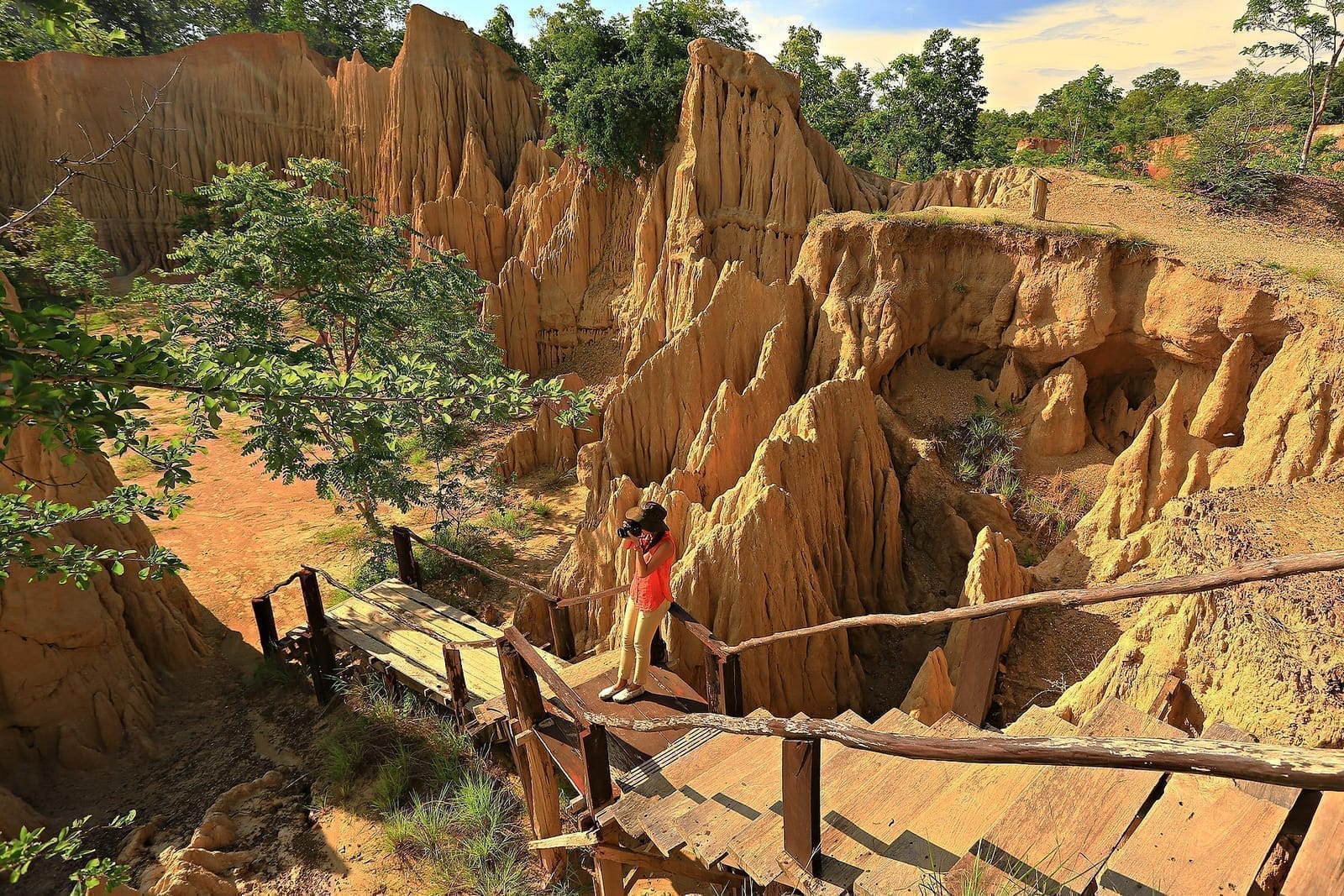
Sao Din Na Noi sits in Chiang Khong subdistrict, Na Noi district, on the western side of Sri Nan National Park. It's a cluster of red-orange laterite-and-earth pillars lined up in ridges, formed as layers of soil built up and were then carved away by water over a very long time. Geologists estimate the soil layers here are roughly 30,000 to 10,000 years old, which is what gives them these strange shapes you rarely see in Thailand. The earth-pillar area covers about 20 rai, easy enough to walk around.
Sao Din vs Khok Suea: what's the difference
The two spots are only about 300 metres apart but look completely different. Sao Din Na Noi is the earth pillars and ravine walls jutting up like columns, with the red-orange soil layers clearly on show. Khok Suea is a basin that drops about 10 metres down from the ridge above, its ravine walls curving in folds like stage curtains. Walk down and stand in the middle of the basin, look up at the rim, and it feels like a miniature canyon.
The name "Khok Suea" comes from an old local story: villagers used to drive tigers that came down to steal their livestock into this deep earthen basin, and the name tiger pen stuck right up to today. Some locals also call the earth pillars "Hom Chom" in the regional dialect.
- Sao Din Na Noi — red-orange earth lined up in columns, walkable around the top, covering about 20 rai
- Khok Suea — a ravine basin around 10 metres deep with folded curved walls; you can walk down and stand in the middle
- Distance between the two — about 300 metres apart, easy to do both in one trip
A safety note
The ground here is loose laterite soil, and some ravine edges are crumbly with no railings. Don't stand too close to the edge or climb the earth pillars. In the rainy season the surface gets especially slippery, so watch your step and you'll be fine.
Want more out of Nan? Book tours & activities
Booking online ahead on Klook or GetYourGuide is usually cheaper than the gate and skips the queue. Pick only the experiences you actually want — prices and availability are shown live on each site.
Best times to go and where to shoot
Light is everything here. The earth glows reddest and most orange in the early morning just after sunrise and in the late afternoon toward evening, when the low angle gives the soil layers depth and warmer tones. Around midday the sun overhead is hot and the colours look flat, so skip that window if you can. As for seasons, the cool months (November to February) are the most comfortable for walking — clear skies and no heat. In the rainy season the soil colour gets deeper, but the paths are slippery.
Inside the Khok Suea basin
Walk down and stand in the middle of the basin so the curved ravine walls wrap around you — this is the angle that feels most like a canyon.
Top of the earth-pillar ridge
Shoot from above to catch the pillars lined up in ridges, with forest and hills behind. Best in the morning light.
Golden hour
Late afternoon near sunset, when the warm light deepens the red-orange of the soil and the shots have more depth than at midday.
Getting there, entry fee, and opening hours
Driving from Nan town, take Highway 101 south through Wiang Sa district, then turn onto Highway 1026 toward Na Noi district, and continue on Highway 1083, where signs point the way to Sao Din Na Noi. It's a little over 60 kilometres from town in total, about an hour and a half of driving. The road is paved the whole way, but the final stretch winds uphill, so drive carefully. A private car or rental is by far the easiest way to get here, since public transport doesn't reach it.
- Sao Din entry fee — a fee of about 20 THB per person (Khok Suea is free to walk into)
- Vehicle fee — at times there's a charge of around 30 THB for cars and 20 THB for motorbikes, depending on the period
- When to visit — it's an open-air daytime site; come in the morning or late afternoon and avoid the midday sun
- Facilities — there's a car park and a few local stalls, but not many, so bring your own drinking water
More to do around Na Noi
Once you're in Na Noi there's plenty more nearby, including Sao Din Phu Lae, which looks similar, and viewpoints around Sri Nan National Park. Bring enough fuel and drinking water, since there aren't many shops along the way.
Plan a full Nan trip covering both the old town and the outdoors
See the Nan travel guide →