🔄 Updated 21 Jun 2026
If you only have a single day and want to visit Sing Buri's temples without rushing, these three are the most balanced set. They sit in and around the Mueang district, not far apart — under half an hour of driving between each stop. Start a little early so the sun isn't harsh and the crowds are still thin. The nice thing is that all three feel different: one stands out for its old reclining Buddha, one for its towering standing Buddha, and one for its craftsmanship — so you never get bored seeing the same thing twice.
The easiest way to get around is your own car or a rental, since the temples are spread out in different directions and local public transport is limited. Coming from Bangkok, drive up the Asia Highway (Route 32) and you'll reach Sing Buri town in about an hour and a half.
One-day timeline — 3 temples, no rush
Wat Phra Non Chakkrasi — the giant reclining Buddha
Wat Phikun Thong + a Mae La snakehead fish lunch
Wat Sawang Arom — a working Buddha-casting workshop
Book the activities in your Sing Buri trip ahead
Booking online ahead on Klook or GetYourGuide is usually cheaper than the gate and skips the queue. Pick only the experiences you actually want — prices and availability are shown live on each site.
Wat Phra Non Chakkrasi — starting with the giant reclining Buddha
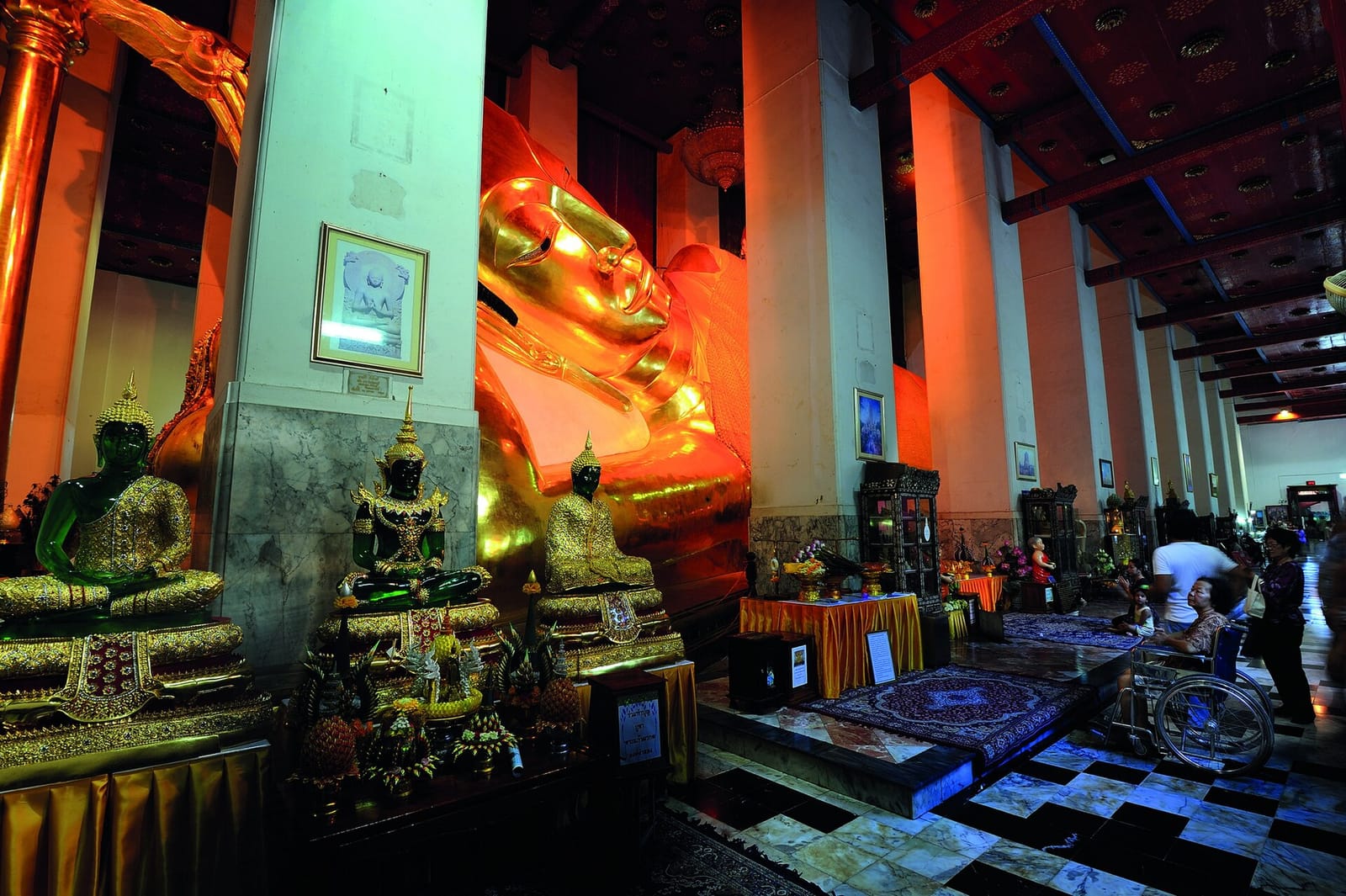
Wat Phra Non Chakkrasi Worawihan, in Chakkrasi sub-district of Mueang district, is a royal temple. The highlight is its huge stucco reclining Buddha, over 47 m long — an old image considered one of the largest in the country. The Buddha sits in a long hall you can walk all the way around, and standing beside it makes you feel tiny. It's a great way to start the day because the hall is airy and the crowds are still light.
- Main place to pay respects — the reclining Buddha in the long hall; people pray here for health and peace of mind
- Phra Kan and Phra Kaeo — old Buddha images in the temple you can stop and pay respects to in the same area
- Atmosphere — a wide temple courtyard with shady trees, easy to walk and photograph without rushing
Tip
Come before 10 a.m. for nice light and gentle sun. The reclining Buddha hall is fairly open, so you can photograph the whole image without crowds in the way.
Wat Phikun Thong — the Great Buddha in blessing pose
Wat Phikun Thong, a royal temple, sits on the bank of the Noi River about 16 km from town. Locals often call it "Wat Luang Pho Phae" because the famous monk Luang Pho Phae once stayed here. The spot that draws the most people is the Great Buddha — Phra Phuttha Suwan Mongkhon Maha Muni, a colossal blessing-pose Buddha covered entirely in gold mosaic and visible from a distance. The grounds also include the Luang Pho Phae museum, where you can walk through his history and monastic belongings.
The Great Buddha
A huge blessing-pose Buddha covered in gold mosaic — you can walk up to pay respects right at the base
Luang Pho Phae museum
Displays of Luang Pho Phae's history and belongings — good for anyone interested in Sing Buri's revered monks
Cosmos flower field
In the cool season around January, the temple opens a cosmos field for photos (only at certain times)
Check before a cool-season visit
The cosmos field isn't there year-round — it mostly blooms around January. If you're coming specifically to photograph the flowers, check the temple's page before you set off to be sure.
Wat Sawang Arom — a temple that still casts Buddha images
Wrap up the trip at Wat Sawang Arom in Ton Pho sub-district, within the town area. What makes this temple special is that it's still a working Buddha-image workshop, carrying on a craft inherited from the Thonburi casting lineage. Walk in and you'll see artisans shaping and finishing actual Buddha images — not just looking at finished pieces. The temple also keeps more than 300 antique nang yai (giant shadow puppets) and has a nang yai museum to visit, making it a place where you can pay respects and watch fine craftsmanship in one stop.
- The casting yard — watch artisans actually at work, a sight you rarely see at ordinary temples
- Nang yai museum — over 300 antique giant shadow puppets, still playable in performances
- Ordination hall and replica Buddha footprint — decades-old work worth a slow look at the details
- Opening hours — Mon–Fri around 09:00–16:00, Sat–Sun 08:30–17:00
What to eat along the way
Since you're in Sing Buri, don't miss Mae La snakehead fish — the firm-fleshed freshwater fish this province is famous for. On the drive back from Wat Phikun Thong into town, you'll pass the Mae La–Bang Rachan area lined with grilled-snakehead shops. In town there are plenty of boat-noodle spots too. Have a filling lunch before the afternoon temple so you can enjoy it on a happy stomach.
Grilled Mae La snakehead fish (Mae La–Bang Rachan area)
Fresh snakehead grilled in salt, firm-fleshed, eaten with seafood dipping sauce and neem shoots with sweet fish sauce. It's the dish people come to Sing Buri specifically to eat. There are several roadside shops — pick the busy one.
Sing Buri boat noodles
Rich nam tok boat noodles, Sing Buri style. Small bowls, so order several. A light bite to keep you going before the next stop.
Sun-dried snakehead fish (souvenir)
Made from Mae La snakehead — fry it up with rice porridge or buy it to take home. You'll find it at roadside shops and town markets.
Tips to keep the day running smoothly
- Use your own car or a rental — the temples are in different directions and public transport is limited, so driving is by far the easiest
- Start early — leaving around 8:30 a.m. lets you hit all three temples, have lunch, and get back before evening with time to spare
- Dress modestly — these are royal temples, so a top with sleeves and knee-length trousers or skirt keeps things respectful
- Bring cash — offering flowers, incense and candles, plus small souvenir shops, are mostly cash only
Want a full-day Sing Buri plan with food and places to stay?
See the Sing Buri travel guide →