🔄 Updated 21 Jun 2026
Sisaket sits along the Phanom Dong Rak mountains that form the Thai–Cambodian border, so it gets the lot: an old Khmer heritage, volcanic soil that grows punchy-flavoured durian, and forested hills with waterfalls in the southern half of the province. Plan it well and a day or two of driving covers several categories in one trip. Below we've split things out by type so you can pick what you like.
Volcanic Durian — the Province's Standout
Volcanic durian is what put Sisaket on the map in recent years. It's grown on the red earth left by ancient volcanoes around the districts of Khun Han, Kantharalak and Si Rattana. That kind of soil is rich in minerals, which gives the flesh (mostly Monthong) a sweet, creamy taste with a milder smell, thick flesh and small seeds. Many orchards open up for you to sit and eat in the grove during the season, which is a different feel from buying off a roadside stall.
Volcanic durian season runs roughly from mid-June to August, with the peak around late June, which usually coincides with the province's volcanic durian festival. If you want to eat it straight from the tree, this is the window. Outside the season most orchards close to visitors.
Suan Ta Toem + Lung Khammee (Ban Sam Khilek, Khun Han)
Two long-running orchards that locals have known for years, in Ban Sam Khilek, Khun Han district. You can sit and eat in the grove during the season, and it's a good spot for photos with the durian trees.
Baan Suan Win Kawa (Kantharalak)
A volcanic durian orchard with its own cafe in Kantharalak district — good if you want both durian and a chill place to sit. Check their opening rounds on their Facebook page before you go.
Buffet-package orchards
Some orchards in Khun Han and Kantharalak sell a package deal — orchard tour plus durian buffet plus lunch — for around 990 THB per person. Good value if you come as a group.
Rough prices
At-the-orchard prices during the season run around 180–250 THB/kg depending on grade, with premium good-looking fruit costing more. If you're buying some to take home, ask the grower to pick fruit that'll be ripe right around your travel day so it doesn't over-ripen in the car.
Want more out of Sisaket? Book tours & activities
Booking online ahead on Klook or GetYourGuide is usually cheaper than the gate and skips the queue. Pick only the experiences you actually want — prices and availability are shown live on each site.
Khmer Ruins — a Thousand-Year Legacy of Lower Isan
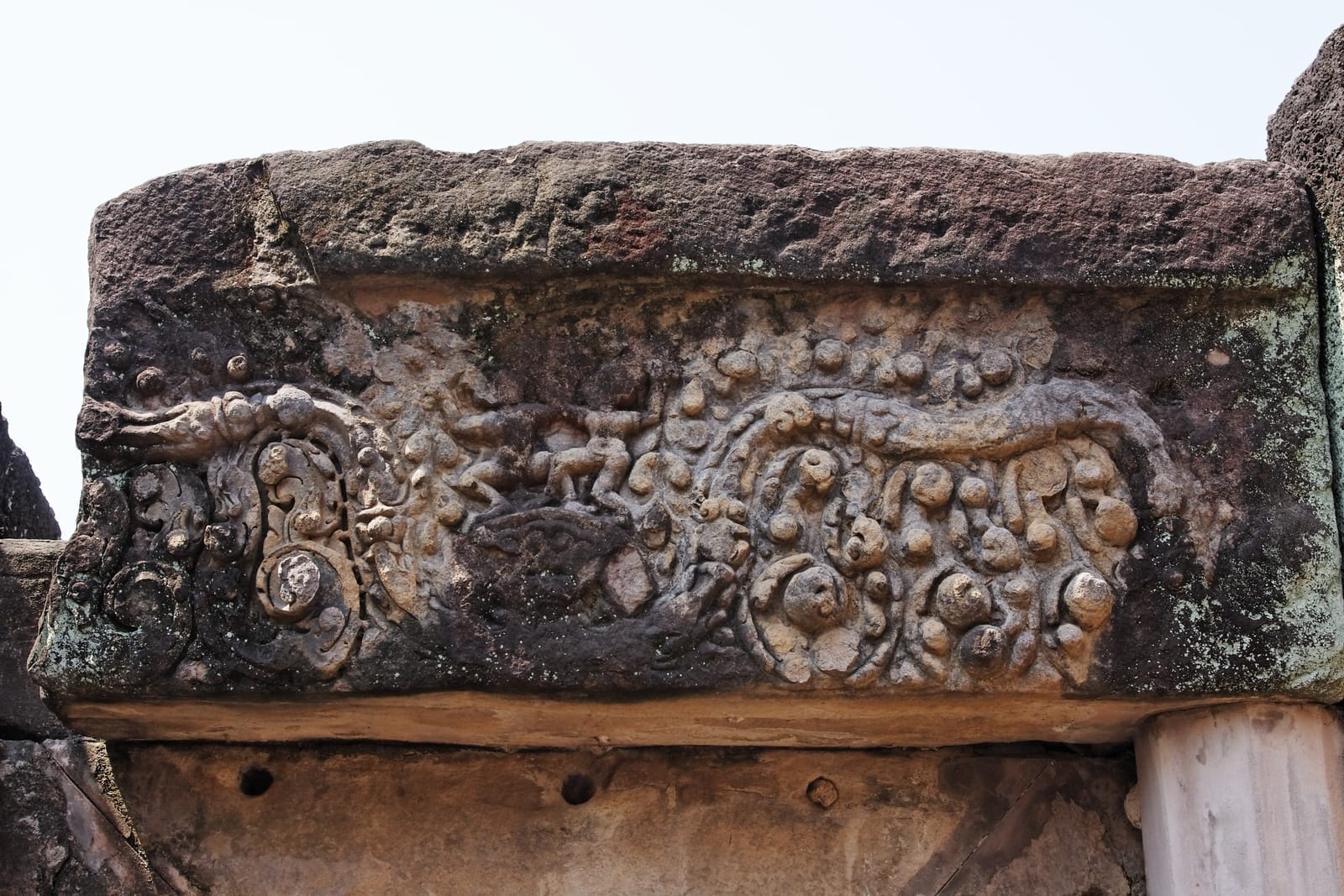
Sisaket sits along the old Khmer civilisation route, so it has stone temple ruins scattered across several districts. Most are free or charge just a few baht to enter, open in the daytime, and far less crowded than the famous ruins over in Buriram — so you can wander at your own pace.
Prasat Sa Kamphaeng Yai
The largest and best-preserved Khmer ruin in the province, built around the 11th century in the Baphuon style and originally a temple dedicated to Shiva. It now stands within Wat Sa Kamphaeng Yai, with its lintels and tower still in good shape.
Prang Ku
A ruin from the reign of Jayavarman VII, thought to have once been an arokayasala (an ancient hospital). It's compact and quick to walk through, making it a handy stop along the way.
Prasat Ban Prasat (Huai Thap Than)
Three brick towers on a laterite base, built around the 11th century and originally housing the Trimurti deities. The atmosphere is quiet, good for anyone who likes places without the crowds.
Prasat Sa Kamphaeng Noi
A small ruin beside the Sisaket–Uthumphon Phisai road where you can quickly take in the lintels and gateway arch. Worth adding if you're passing by.
Prasat Ta Leng
A single sandstone tower with a structure that's still clearly visible — good for those who like to tick off every ruin. It's a bit off the main route, so check the coordinates before you go.
How to make the ruins fun
Try reading up a little on Khmer art beforehand, then look at the lintels to see what story they tell — it makes the visit far more interesting than just standing around for photos. And go in the morning or late afternoon; the midday sun here is harsh and there isn't much shade.
Temples Worth an Easy Stop
Several of Sisaket's temples look different from your usual temple, reflecting the mix of four ethnic groups (Lao, Khmer, Suay and Yer) who live in the province. The two below are the ones people stop at most.
- Million Bottle Temple (Wat Pa Maha Chedi Kaew) — Khun Han district. The whole temple is decorated with over 1.5 million coloured glass bottles, and the highlight is the four-gabled ordination hall in the middle of the water. Open roughly 6:00 AM–6:00 PM, free entry.
- Wat Phra That Rueang Rong — Mueang district. A stupa that blends the styles of the four ethnic groups, with six floors inside; the ground floor is a folk museum, and you can head up for a view over town. It's close to the city, so it's an easy stop.
- Somdet Phra Srinagarindra Park (Suan Somdet Ya) — A public park with a grove of more than 50,000 Lamduan trees, the province's signature flower. Come in March and the Lamduan blooms fill the whole park with scent.
Pha Mo E Daeng + Khao Phra Wihan — Always Check First
Pha Mo E Daeng is a cliff right on the border within Khao Phra Wihan National Park in Kantharalak district. It's known for its wide-open viewpoint, morning sea of mist, and ancient bas-relief carvings over 1,500 years old. It's the reason a lot of people set out for Sisaket in the first place.
Straight talk on the situation
Pha Mo E Daeng and the path up to Khao Phra Wihan have been temporarily closed to tourism since late May 2025 because of tensions along the Thai–Cambodian border, with no firm reopening date. Before you plan a trip there, always check the latest announcements from Khao Phra Wihan National Park and the border situation — don't rely on old information. If it's still closed, switch to another category instead.
Nature and In-Town Check-In Spots
The southern side of the province borders the Banthat mountains, so there are waterfalls and forested hills to explore, while in town there are spots for an easy stroll that work for the whole family.
Samrong Kiat Waterfall
A mid-sized waterfall in the Banthat mountains in Khun Han district, with a shady entrance, parking and shops. Water is at its fullest in the rainy season around September; in the dry season it runs low.
Huai Nam Kham Island + Sisaket Aquarium
An island in the middle of an in-town reservoir, with a freshwater aquarium for the Mekong–Chi–Mun basins and an underwater glass tunnel. Good for taking kids and escaping the heat.
Pha Mo E Daeng (when open)
If the border situation is back to normal and the park has reopened by the time you visit, this is the most rewarding viewpoint and sea-of-mist spot in the province — but always check first.
How to Plan the Trip
If you're short on time, a single day will just about do it, but if you want the ruins, durian and nature all in, two days and one night is about right. Below is a sample to tweak as you like.
Khmer Ruins + Temples
Khun Han — Durian + Million Bottle Temple + Waterfall
Getting around
The sights are spread across several districts and public transport is limited, so this trip is easiest with your own car or a rental. If you arrive by train or bus into town, we'd suggest renting a car or hiring a driver for the day.
Plan a full Sisaket trip — see more places to stay and eat
See the Sisaket travel guide →