🔄 Updated 21 Jun 2026
This plan starts where most people do: you arrive in Sisaket in the late morning, spend day one in the Kantharalak zone first (lots of orchards and a few orchard cafes where you can sit and eat in comfort), then shift to Khun Han on day two, where Phran sub-district is the densest cluster of durian orchards — grab your gifts to take home, then head back. Each day stays in one district because the drive between Kantharalak and Khun Han runs close to an hour; crisscross between them all day and you'll wear yourself out and not eat durian at your own pace. This trip works best with your own car or a rental, since the orchards sit outside town and public transport barely reaches them.
Check before you set off
Durian is a product of nature — it differs year to year. Before driving a long way, call or message the orchard on Facebook/LINE to ask whether they have fruit right now and whether they're open for tasting in the orchard, because early in the season fruit is scarce and pricey, and some orchards aren't open yet; late in the season some close early once they sell out. This year the Kantharalak District Fruit Festival runs 12–21 June and the main Sisaket Volcanic Durian Festival runs 25–29 June at the field in front of the provincial hall — line up your dates with the festival and you'll find orchards gathered in one place.
When to go to catch the orchards in full fruit
Sisaket durian ripens noticeably later than the eastern provinces. The main season runs roughly from late May to early July, and the stretch when fruit is most plentiful and the most orchards are open is mid to late June. If the rains come early or late, it can shift either way — so if you're planning ahead, aim for mid-June first, then call the orchards to confirm. That's the safest bet. Early in the season there's little fruit and prices are high, with some orchards not yet open; late in the season prices drop but some sellers run out first.
- Early season (late May–early June) — scarce fruit, high prices, first of the crop. Good for the impatient who want an early taste, but call to check the orchard is open.
- Mid season (mid–late June) — the peak. Plentiful fruit, most orchards open, lines up with the festival, prices starting to ease. The best window for this trip.
- Late season (early–mid July) — prices drop further, but fruit starts to thin out. Call ahead to every orchard.
How to get there
From Bangkok, take a Southern Isan train straight to Sisaket station, or a bus from Mo Chit. Flying in, land at Ubon Ratchathani airport and drive about an hour and a half. But the durian orchards are outside town, in Kantharalak and Khun Han, and public transport barely reaches them. For this trip you really want to rent a car and drive, or hire a driver for the day. If you genuinely have no car, go during the in-town festival instead — it's far easier to reach.
Book the activities in your Sisaket trip ahead
Booking online ahead on Klook or GetYourGuide is usually cheaper than the gate and skips the queue. Pick only the experiences you actually want — prices and availability are shown live on each site.
The 2-day, 1-night orchard run
Kantharalak zone — taste in the orchard + sit in an orchard cafe
Khun Han zone — Phran sub-district, the dense orchard belt + gifts
Orchards open for tasting, where people actually go
Below are the orchards and volcanic durian buying spots people actually visit in Kantharalak, Si Rattana, and Khun Han. Some are orchards open for a walk-through with a cafe to sit and eat in; some are farmers' storefronts selling fresh-cut fruit. Prices are approximate ranges, depending on grade and time of season — high early, easing in the middle. Call or message every one before you go, because fruit sells out fast.
Win Ka Va Farmhouse & Cafe
A Kantharalak volcanic durian orchard that doubles as an orchard cafe — walk among the trees and sit down to eat fresh durian over a drink, all in one place. Great if you want the real orchard atmosphere rather than just buying to take home. It's the first pin I'd recommend on day one of this plan.
Salete Labeur Orchard
A volcanic durian orchard that sells right at the farm gate — reviewers drop by often. Cut fresh from the tree, pick your own fruit, with a genuine family-orchard feel. Good to stop at while touring Kantharalak–Si Rattana.
Wanarak Orchard
A Kantharalak orchard selling direct from the farm, with volcanic Monthong at more reachable prices than many. Focused on properly tree-ripened fruit. If you want durian to actually eat rather than to photograph, this one's good value.
Mae Si Chan Volcanic Durian Orchard
A Kantharalak orchard with both volcanic durian and volcanic rambutan, selling at the farm gate in season. Handy for picking up several things at once — the rambutan here is grown on the same volcanic soil.
Volcanic Soil Durian, Ban Sam Khilek
An orchard around Ban Sam Khilek in Phran sub-district, Khun Han district — one of the densest durian belts in the district. Cut fresh, sold at the farm gate. A good pin for day two of the plan, since it sits in a zone with many orchards clustered together.
Lung Soem Orchard
A volcanic durian orchard in Phran sub-district, Khun Han, that local authorities have featured. Cut fresh from the tree, and the owner will walk you through the trees. Great if you like supporting small family orchards and hearing the volcanic-soil story straight from the grower.
Chok Mueang Si Volcanic Durian Orchard
A well-known Khun Han orchard selling fresh-cut, graded fruit. Prices run a bit higher because they keep quality tight. Good if you want handsome fruit with firm flesh you'd be proud to give as a gift.
Bun Song Orchard
A Khun Han orchard with clearly separated grades — premium and quality at different prices, and they tell you exactly what you get for what you pay. Good if you want to choose by budget. Cut fresh from the orchard.
Ta Toem Orchard
A small orchard reviewers stop by to taste at often, with a genuine family-orchard feel. The owner walks you through the trees and tells you about the volcanic soil. There isn't much fruit, so go when it's in season to find any.
Roadside stalls along the Khun Han–Kantharalak route
In season, farmers set up stalls along the main roads in and out of the growing area. Prices are negotiable and the selection is varied, but you need a good eye — choose sellers who can name the orchard source, and ask to taste before you buy.
How to buy without getting burned
Always ask to taste first — durian at just-right ripeness is soft but not mushy, sweet and rich without bitterness. Be wary of any seller who won't let you taste at all. Ask how many days ago it was cut; if you want to eat it that same day, choose fruit that's starting to smell. If you're carrying it far, pick fruit that's mature but not fully ripe and let it finish ripening yourself. Buying at the farm gate usually gets you a better price and a clearer source than buying roadside.
Why eat it at the orchard instead of ordering online
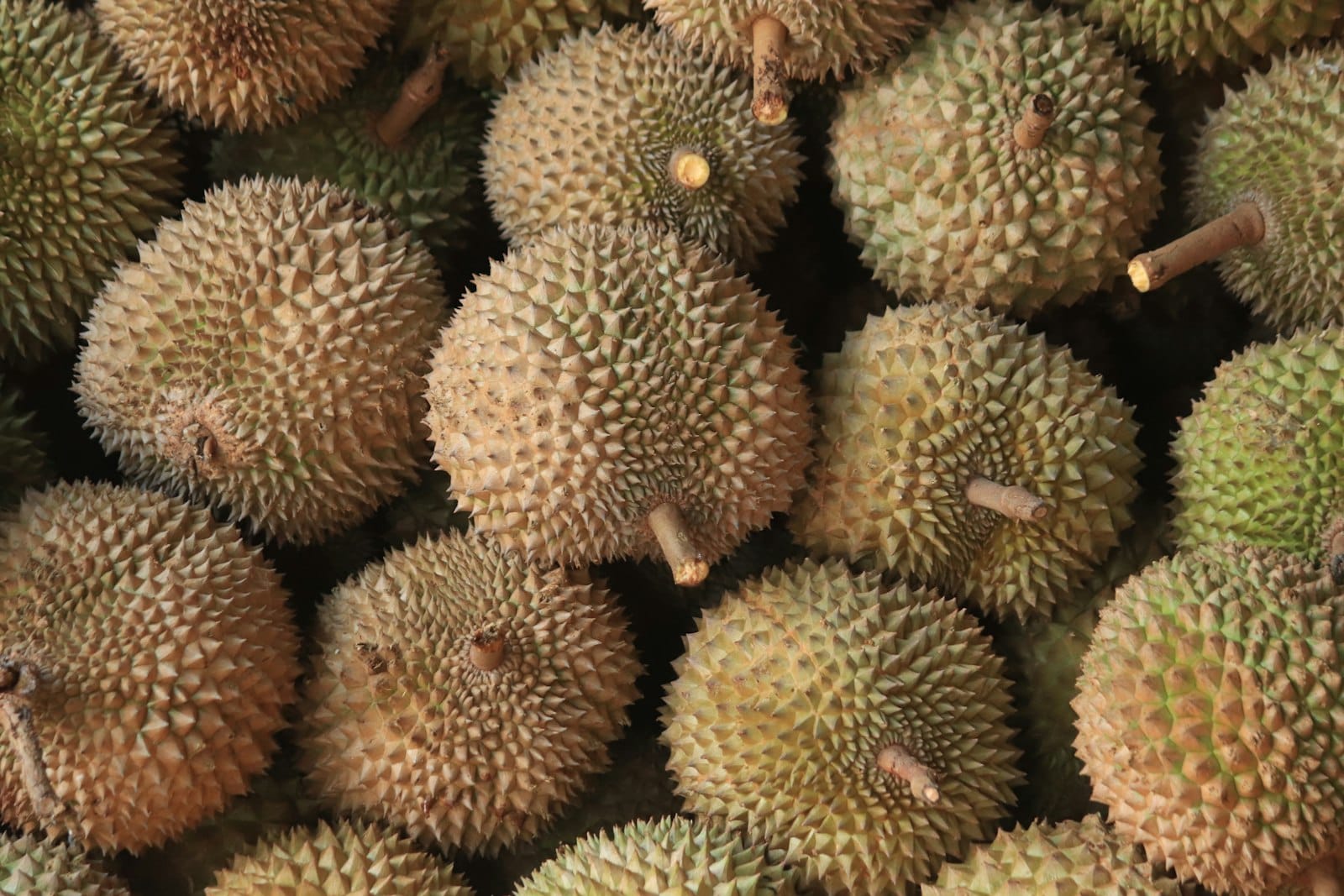
Volcanic durian is mostly the Monthong variety, same as the eastern provinces, but it's grown on old volcanic soil at the foot of the Phanom Dong Rak range — weathered from basalt, sticky red, well-draining, and rich in nutrients. The result is drier flesh, crisp outside and soft within, sweet and rich without being cloying, with a milder smell than usual durian. Plenty of people who normally avoid durian because of the smell can eat this one. Fruit like this you really have to taste at the orchard to understand, because it's cut ripe off the tree and eaten fresh — the flavor isn't the same as buying it and ripening it at home — and you get to see the real trees, talk to the growers, and pick your own fruit too.
- Dry, firm flesh — not mushy; holds its shape when you scoop it
- Sweet and rich without being cloying — just-right sweetness, followed by richness
- Milder smell than usual — many people who fear durian's smell can eat this one
- Cut ripe off the tree — eaten fresh in the orchard, it tastes different from home-ripened
- A GI product — registered to a defined growing area, grown only in Kantharalak, Khun Han, and Si Rattana
Rough budget per person
- Accommodation, 1 night — in-town guesthouses from about 400–700 THB, mid-range hotels 800–1,500 THB
- Car — a self-drive rental runs about 1,000–1,500 THB a day, split among the group, plus fuel
- Durian — taste as you please; budget around 500–1,500 THB, allow more if you're buying fruit to take home or give as gifts
- Food, 2 days — regional food and the evening market run about 400–600 THB for the whole trip
- Attraction entry — the Million Bottle Temple and the stops in this plan are free; just parking or a donation if you wish
When is the volcanic durian festival this year
If you'd rather not drive around hunting orchard by orchard, the season has festivals that bring the orchards together in one place. This year there are two main events: the Kantharalak District Fruit Festival, 12–21 June, in front of the Kantharalak district office, and the main Sisaket Volcanic Durian Festival, 25–29 June, at the field in front of the provincial hall. The main event gathers volcanic Monthong durian from orchards across the area, along with rambutan, mangosteen, OTOP products, and local specialties — come on a festival day and you get it all in one go. But if you want the real orchard atmosphere and the taste of fruit cut fresh off the tree, the 2-day orchard run still has more soul. Festival dates shift each year with the season, so always check the province's announcement first.
If you can't make the festival dates
Many orchards ship volcanic durian online direct from the farm — choose a page that clearly names the growing source and has reviews. But once you're already in Sisaket, tasting it fresh in the orchard has more soul any day. Try aiming for mid-June, when fruit is most plentiful.
Pha Mo I Daeng–Preah Vihear, why they're not in this plan
Many people think of Kantharalak alongside Pha Mo I Daeng and the climb up to Preah Vihear, but this durian trip deliberately leaves them out, because Pha Mo I Daeng in Khao Phra Wihan National Park was announced temporarily closed to tourism from 29 May 2025 amid tensions along the Thai–Cambodian border, and it still depends on the situation there. So this plan focuses on the durian orchards, temples, and food in areas you can visit as normal instead.
If you want to add Pha Mo I Daeng
Before planning to go, always check the latest announcements from Khao Phra Wihan National Park and the border situation — don't rely on old information. If it's still closed on your dates, focus on the durian orchards and temples in this plan instead, and you won't waste the trip.
Can you do it as a day trip or 3 days?
Both work. If you're really short on time, cut it to a single zone — pick either Kantharalak or Khun Han, spend half a day tasting at 2–3 orchards and the other half grabbing gifts and the Million Bottle Temple, and you'll get your fill of durian in one day. If you have 3 days, add Si Rattana, which is also a registered GI growing area, and stop at Samrong Kiat Waterfall or the Khmer ruins around the area. The 2-day, 1-night plan, though, hits the sweet spot for anyone who wants both the Kantharalak and Khun Han orchards without rushing.
Want a well-located hotel in Sisaket town as your base for the orchard run
See the Top 10 Sisaket hotels →