Thailandaddict
Home › Thailand › Sisaket › A Nature Trip in Sisaket Pha Mo I Daeng, Preah Vihear, Waterfalls, Volcanic Soil
⛰️ Sisaket Travel Plan

A Nature Trip in Sisaket
Pha Mo I Daeng, Preah Vihear, Waterfalls, Volcanic Soil

The southern edge of Sisaket runs along the Phanom Dong Rak and Banthat mountain ranges, and it's a corner that anyone who loves the outdoors should see at least once. There are clifftop viewpoints that look straight across into Cambodia, forest waterfalls, durian orchards growing on volcanic soil, and cafés out in the rice fields. This trip is built for the nature crowd over 2-3 days, focused on Kantharalak and Khun Han districts, with timings, entry fees, and real places to eat along the way. But there's one thing we have to be straight about first: Pha Mo I Daeng and the path up to Preah Vihear are currently closed to visitors because of the border situation. So we've built the plan to stay flexible — if it's still closed on the day you go, you won't waste the trip.

⛰️ Clifftop viewpoints💧 Forest waterfalls🌋 Volcanic-soil durian farms
A Nature Trip in Sisaket Pha Mo I Daeng, Preah Vihear, Waterfalls, Volcanic Soil

🔄 Updated 21 Jun 2026

First, let's be clear: almost all of Sisaket's nature is clustered in two southern districts — Kantharalak (home to Pha Mo I Daeng and Preah Vihear) and Khun Han (waterfalls, volcanic-soil durian farms, forest temples). Both are about 1–1.5 hours from the city center, up against the mountains that mark the Thailand–Cambodia border. So this plan takes you south and has you sleep down there, rather than driving back into town every day. The sights are spread out, so a private car or a rental is basically a must for this trip.

The border situation to check before you set off

Pha Mo I Daeng, inside Khao Phra Wihan National Park, has been temporarily closed to tourism since 29 May 2025 due to tensions along the Thailand–Cambodia border, with no firm reopening date — it depends on the situation. Before you plan to go, always check the latest announcements from Khao Phra Wihan National Park and the current border news. Don't rely on old information. The plan below is written two ways — one if Pha Mo I Daeng is open as normal, and one if it's still closed — so you won't waste the trip whichever you run into.

How to get here, and what to drive around in

From Bangkok you can take a Lower Isan train straight to Sisaket station, or a coach from Mo Chit. If you're flying, land at Ubon Ratchathani airport and continue to the city center, about 1.5 hours. From the city, heading south to Kantharalak–Khun Han is another 1–1.5 hours. Public transport in this zone is very limited. The waterfalls and durian farms sit deep in the hills, and public transport barely reaches them. We'd suggest renting a car and driving yourself, or hiring a driver by the day — far more flexible.

The 2-day, 1-night nature plan

If you have two days, this fits nicely. Day one heads south to Kantharalak to pick up the clifftop viewpoints and cafés along the way. Day two runs the waterfall-and-volcanic-durian route around Khun Han, then grabs some souvenirs on the way home. There are plenty of rice-field cafés to stop at en route.

Day 1

South to Kantharalak — clifftop viewpoints and cafés

08:30
Leave Sisaket city, drive south to Kantharalak districtAround 60–70 km, roughly 1–1.5 hours. The last stretch turns green as the Phanom Dong Rak range comes into view.
10:00
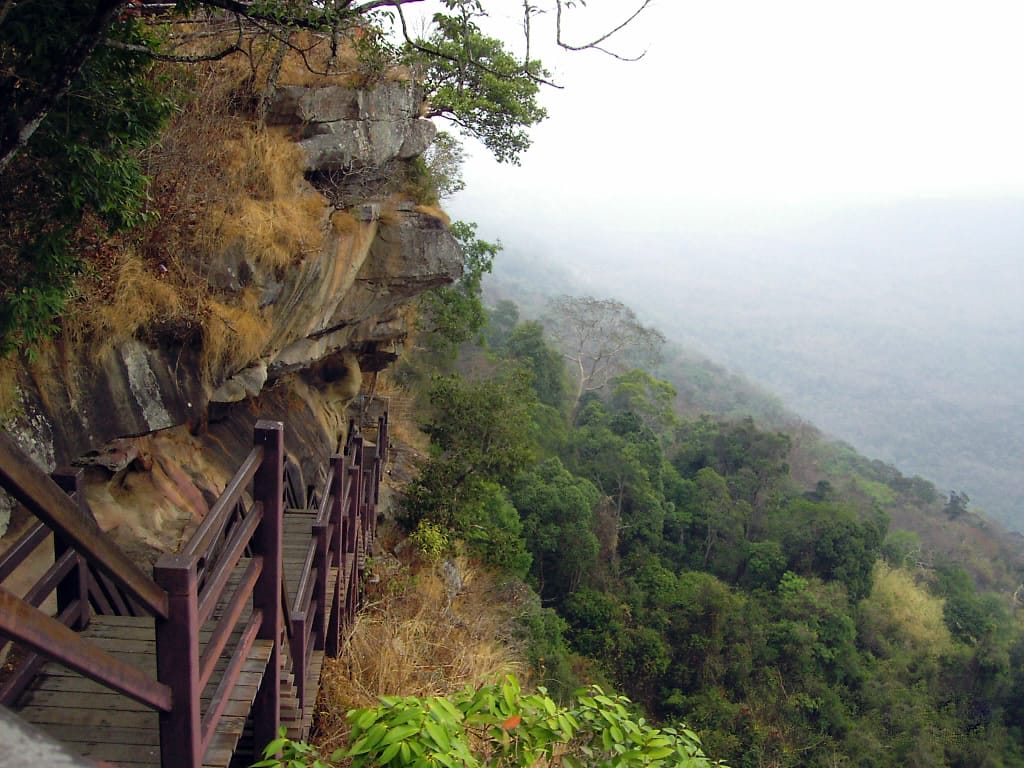
Check the Pha Mo I Daeng–Preah Vihear situation at the entrance to Khao Phra Wihan National ParkIf the park is open as normal on the day you go, Pha Mo I Daeng is a cliff about 300 m long looking out over Cambodian soil, with a bas-relief carving of three deities over 1,500 years old. Entry is normally about 40 THB per person, and the sea of mist is lovely on cold-season mornings. But if it's still announced as closed, don't try to force your way in — skip ahead to the backup plan below instead.
12:00
Lunch in Kantharalak townKantharalak town has plenty of Isan and made-to-order spots. Try local dishes like fried tilapia, larb, and som tam — most plates run from a few tens to low hundreds of baht. Save your energy for the afternoon.
14:00
Sit at a rice-field café around Kantharalak, out of the afternoon sunThe Kantharalak area has several cafés with rice-field and mountain views — like Nata Café on the road to Pha Mo I Daeng, set among the fields, plus a few shady backyard-style cafés. Good for a break when the sun is harsh. Coffee runs about 50–80 THB a cup.
16:00
Wander and shoot the clifftop viewpoints in the softer lightLate afternoon the light goes low and the border-range views look better. Find a spot that's open as normal to take photos before heading to your room. Avoid any areas with no-entry signs or military zones.
18:00
Check into a place around Kantharalak or Khun Han, dinnerThe south has small guesthouses and garden resorts scattered about. If you'd rather keep it simple and central, you can sleep in Sisaket city and drive out early — but that adds travel time.
Day 2

Khun Han — Samrong Kiat waterfall + volcanic-soil durian farms

08:30
Set off for Samrong Kiat waterfall, Khun Han districtThe waterfall is at Ban Samrong Kiat, Bak Dong subdistrict, fed from the Banthat range — a shady forest waterfall with plenty of big trees.
09:30
Wander around Samrong Kiat waterfallThe water drops from a cliff about 8 m high, and you can take the stairs down to the lower tier. It's fullest in the rainy season around September; in the dry season the water is thin. Open roughly 08:30–16:30. If the flow is low, lean into the shady forest walk and photos instead.
11:30
(In durian season, Jun–Aug) Stop at a volcanic-soil durian farm around Khun Han–Bak DongVolcanic-soil durian grows on volcanic earth — sweet and creamy with a milder smell. Many farms let you sit and eat right there. Farm-gate prices run about 180–250 THB/kg depending on grade. Off-season (Sep–May) most farms are closed, so swap this for a temple or café.
13:00
Lunch around Khun Han, then stop at a forest templeTry Wat Lan Khuat (Wat Pa Maha Chedi Kaew), decorated with more than 1.5 million glass bottles, with a four-gabled hall set over water. Open roughly 08:00–17:00, free to enter, dress modestly inside the temple grounds. A shady spot to pause before heading back.
15:00
Grab souvenirs before leaving — durian/seasonal fruit, jasmine rice, volcanic-soil-dyed clothThe south has several specialties: volcanic-soil durian (season only), rambutan and mangosteen from Kantharalak orchards, volcanic-soil-dyed cloth, and Thung Kula jasmine rice you can buy in the city.
16:30
Head backAllow about 1–1.5 hours to drive back into the city. If you're taking the train home, check the schedule ahead. Flying out of Ubon? Allow another 1.5 hours or so to drive to the airport.
🎟️

Book the activities in your Sisaket trip ahead

Booking online ahead on Klook or GetYourGuide is usually cheaper than the gate and skips the queue. Pick only the experiences you actually want — prices and availability are shown live on each site.

🎟️ See all Sisaket tours & activities (Klook)

If you have 3 days, what can you add

If you've got three days, there's no need to rush south on day one. Add a first day for the city side and the Khmer prasat, then head south for the two nature days. That way you see both sides of Sisaket — thousand-year Khmer history and the nature along the mountains.

Extra day (slot in as day one)

City + Khmer prasat before heading south

09:30
Prasat Sa Kamphaeng Yai, Uthumphon Phisai districtThe largest and most complete Khmer prasat in the province, built around the 11th century in the Baphuon style. Free to enter. Go in the morning to dodge the sun, since there isn't much shade.
13:00
Wat Phra That Rueang Rong, a four-ethnicity-blended stupa, in the cityA six-tier stupa; the ground floor is a folk museum telling the story of the Lao, Khmer, Suay, and Yer peoples, and you can climb up for a city view. Free to enter.
15:30
Huai Nam Kham island + Sisaket AquariumAn island in the city reservoir, with a freshwater-fish aquarium and an underwater glass tunnel. Good for escaping the afternoon heat — check the closing time first, as the aquarium shuts in the evening.
18:00
Dinner in the city, rest up, get ready to head south tomorrowThe evening market and city restaurants have plenty of local eats. Try som tam, larb, and grilled meats with sticky rice. Save your energy for the two nature days ahead.

If Pha Mo I Daeng is still closed, where to go for nature instead

The good news is Sisaket's nature isn't just Pha Mo I Daeng. Even if the clifftop viewpoint is closed, there are still waterfalls, forests, and fruit orchards on volcanic soil to visit around Kantharalak–Khun Han that are open as normal. Below are the spots you can use instead if you can't get into Pha Mo I Daeng on the day.

Waterfall

Samrong Kiat Waterfall

A shady forest waterfall at Ban Samrong Kiat, Bak Dong subdistrict, Khun Han district, dropping from a cliff about 8 m high. You can take the stairs down to the lower tier. Fullest in the rainy season. Open roughly 08:30–16:30.

Seasonal

Volcanic-soil durian farms, Khun Han–Bak Dong

Fruit orchards on volcanic soil. From Jun–Aug, many farms let you sit and eat durian on site — sweet and creamy with a milder smell. Farm-gate prices around 180–250 THB/kg.

View café

Kantharalak rice-field cafés

Several cafés with rice-field and mountain views, like Nata Café on the road to Pha Mo I Daeng and shady backyard-style spots. Good for a break when the sun is harsh.

Forest temple

Wat Lan Khuat (Wat Pa Maha Chedi Kaew)

A forest temple in Khun Han decorated with more than 1.5 million glass bottles. The highlight is the four-gabled hall set over water. Open roughly 08:00–17:00, free to enter.

Rough budget per person

  • 1 night's stay — a guesthouse or small resort in the south or city starts around 400–800 THB; a mid-range hotel in the city runs 800–1,500 THB
  • Entry fees — Pha Mo I Daeng is normally about 40 THB per person (currently closed); waterfalls and temples are free or just have a parking/merit-as-you-wish charge
  • Car — a self-drive rental runs about 1,000–1,500 THB a day plus fuel; split it if there are a few of you
  • Food for 2 days — local food, cafés, and markets, about 500–800 THB for the whole trip
  • Souvenirs — volcanic-soil durian (season only), orchard fruit, soil-dyed cloth, jasmine rice; budget as you like

When is the best time for nature in Sisaket

Each season gives a different mood. If you want a sea of mist over the cliffs and cool air, the cold season around November–January in the early morning is the prettiest and most comfortable (assuming Pha Mo I Daeng has reopened). If you want volcanic-soil durian straight from the tree, come mid-June to August — late June peaks, and there's usually a volcanic durian festival. The waterfalls are fullest in the rainy season around September; in the dry season the water thins out a lot. The Isan sun is harsh almost year-round, so walking outdoors in the morning or late afternoon is most comfortable — avoid 12:00–15:00 if you can.

What to eat along the nature route

The south doesn't have a lot of fancy restaurants, but the local food is good and the prices are friendly. With four ethnic groups here, the menu mixes Lao, Khmer, and Kuy. Below are the eats that, once you try them, make it clear why people get hooked. A few older dishes need ordering ahead or are easiest to find during festival season.

1

Volcanic-soil durian (season only)

Seasonal fruit · 180–250 THB/kg

The south's signature, grown on volcanic soil around Khun Han–Kantharalak. Sweet and creamy with a milder smell, thick flesh and small seeds. You can eat it straight from the tree from Jun–Aug.

SeasonalSignature
2

Tilapia with sweet fish sauce and sadao

Main dish · local eateries

Sisaket is known for its farmed tilapia, fried crisp and drizzled with sweet fish sauce, eaten with blanched sadao (neem) — a touch bitter, a touch sweet. Plenty of local spots do it well.

TilapiaSignature
3

Home-style larb-koi and om

Home cooking · all day

Lao-Isan food you'll find at larb-koi shops across the district. Om is an offal stew with seasonal local vegetables, savory and rounded from the spice paste and lemon basil, eaten with hot sticky rice.

Home-styleLao
4

Som tam — bold Sisaket-style

Spicy · snack/side

A local take with a bolder mix and a punchier heat than the usual som tam. Eat it with fried tilapia or grilled chicken at local eateries across Kantharalak–Khun Han.

BoldSignature
5

Pon pla and pla som

Lao-Isan food · side

Homely dishes found in every kitchen. Pon pla is a boiled-fish chili dip eaten with fresh vegetables; pla som is fermented fish fried and eaten with sticky rice. Filling and tasty — order them together.

Home-styleLao
6

Rambutan and mangosteen from volcanic orchards (season only)

Seasonal fruit · farm-gate

Same window as durian — the orchards around Kantharalak–Khun Han have fresh rambutan and mangosteen, picked straight from the tree, sweet and juicy, friendly prices. Good to take home too.

SeasonalSouvenir
7

Coffee at a rice-field café

Café · coffee around 50–80 THB

Cafés with rice-field and mountain views around Kantharalak, like Nata Café and backyard-style spots. Good for a coffee break when the sun is harsh, with a shady feel.

View caféRelax
8

Thung Kula jasmine rice and khao hang

Souvenir · ingredient

Sisaket sits in the Thung Kula Ronghai area, a source of fine jasmine rice. Khao hang is steamed-then-milled paddy that's fragrant and high in nutrients — a good thing to take home.

Thung KulaSouvenir

Getting ready for nature in the south

Wear shoes that handle slippery ground — waterfall rocks get wet and slick. Bring drinking water, a hat, and mosquito repellent, since many spots are in the forest. Fill up on fuel before heading south, as petrol stations out here are far apart. And most important of all, check the Khao Phra Wihan National Park announcements and the latest border news before you set off, every single time. If Pha Mo I Daeng is still closed, switch to the waterfall–durian–temple route and you won't waste the trip.

Want a well-located place to stay in Sisaket city? See options with real reviews

See the Top 10 hotels in Sisaket →

FAQ

Can you visit Pha Mo I Daeng right now?

Pha Mo I Daeng, inside Khao Phra Wihan National Park, has been temporarily closed to tourism since 29 May 2025 due to tensions along the Thailand–Cambodia border, with no firm reopening date. Always check the park's latest announcements and the border news before planning. If it's still closed, don't try to force your way in — this plan has a waterfall route, volcanic-soil durian farms, and forest temples you can visit instead.

If Pha Mo I Daeng is closed, where can you go for nature in Sisaket?

The nature side in the south still has Samrong Kiat waterfall in Khun Han, volcanic-soil durian farms around Khun Han–Bak Dong (Jun–Aug), rice-field cafés in Kantharalak, and Wat Lan Khuat, decorated with more than 1.5 million glass bottles. All are open as normal and sit in the same zone.

Where is Samrong Kiat waterfall, and what are the hours?

Samrong Kiat waterfall is at Ban Samrong Kiat, Bak Dong subdistrict, Khun Han district, fed from the Banthat range. It's a shady forest waterfall dropping from a cliff about 8 m high, with stairs down to the lower tier. Open roughly 08:30–16:30. It's fullest in the rainy season around September; in the dry season the water is thin.

Do you need a car for a nature trip in Sisaket?

Pretty much. The waterfalls, durian farms, and viewpoints in the south sit deep in Kantharalak–Khun Han, about 1–1.5 hours from the city, and public transport is very limited. We'd suggest renting a car and driving yourself, or hiring a driver by the day — far more flexible.

When can you eat volcanic-soil durian straight from the farm?

Volcanic-soil durian season runs roughly mid-June to August, peaking in late June, when there's usually a volcanic durian festival. Many farms around Khun Han–Bak Dong let you sit and eat on site, with farm-gate prices around 180–250 THB/kg depending on grade. Off-season, most farms are closed.

Copyright & Image Takedown Policy

Thailandaddict is created to review and share travel experiences. Where an image is sourced from elsewhere, we credit the source. If you are the copyright owner and prefer that your image not appear on this site, please contact us and we will gladly remove the image or correct the information.

Display


Saved Near me
ไทย English

Search

View my trip →