🔄 Updated 21 Jun 2026
If you drive south along Highway 41 through Chaiya district, you'll spot the Suan Mokkh sign by the roadside around kilometre marker 134. Many people assume Suan Mokkh is just a quiet retreat centre, but it's actually open to the public every day, free of charge, no entry fee. You can wander through the dharma artwork, sit and rest in the shade, or stop for just an hour and still come away glad you did, because the atmosphere here really is different from an ordinary temple.
What kind of place is Suan Mokkh, and why is it so different?
Buddhadasa Bhikkhu started clearing this land in 1932, first staying at an abandoned temple called Wat Traphang Chik before renaming it "Suan Mokkhaphalaram," which roughly translates as the forest garden that gives strength toward liberation. His idea was to use nature as the teacher rather than build grand halls, so the whole place is open forest dotted with boulders, a stream and tall trees, where monks and practitioners live with nature as simply as possible.
Today Suan Mokkh is known worldwide, especially among foreign visitors who come for the vipassana courses. Thai visitors usually come to walk through the Spiritual Theatre, Nalikae Pond and the curved stone court, the three main spots you can cover in a single day.
Before you go in
This is a forest meditation temple, so please dress modestly with shoulders and knees covered, keep your voice low, and silence your phone. If you see a monk or anyone sitting in meditation, walk around them quietly and don't make noise.
Want more out of Surat Thani? Book tours & activities
Booking online ahead on Klook or GetYourGuide is usually cheaper than the gate and skips the queue. Pick only the experiences you actually want — prices and availability are shown live on each site.
The Spiritual Theatre — the highlight you have to see
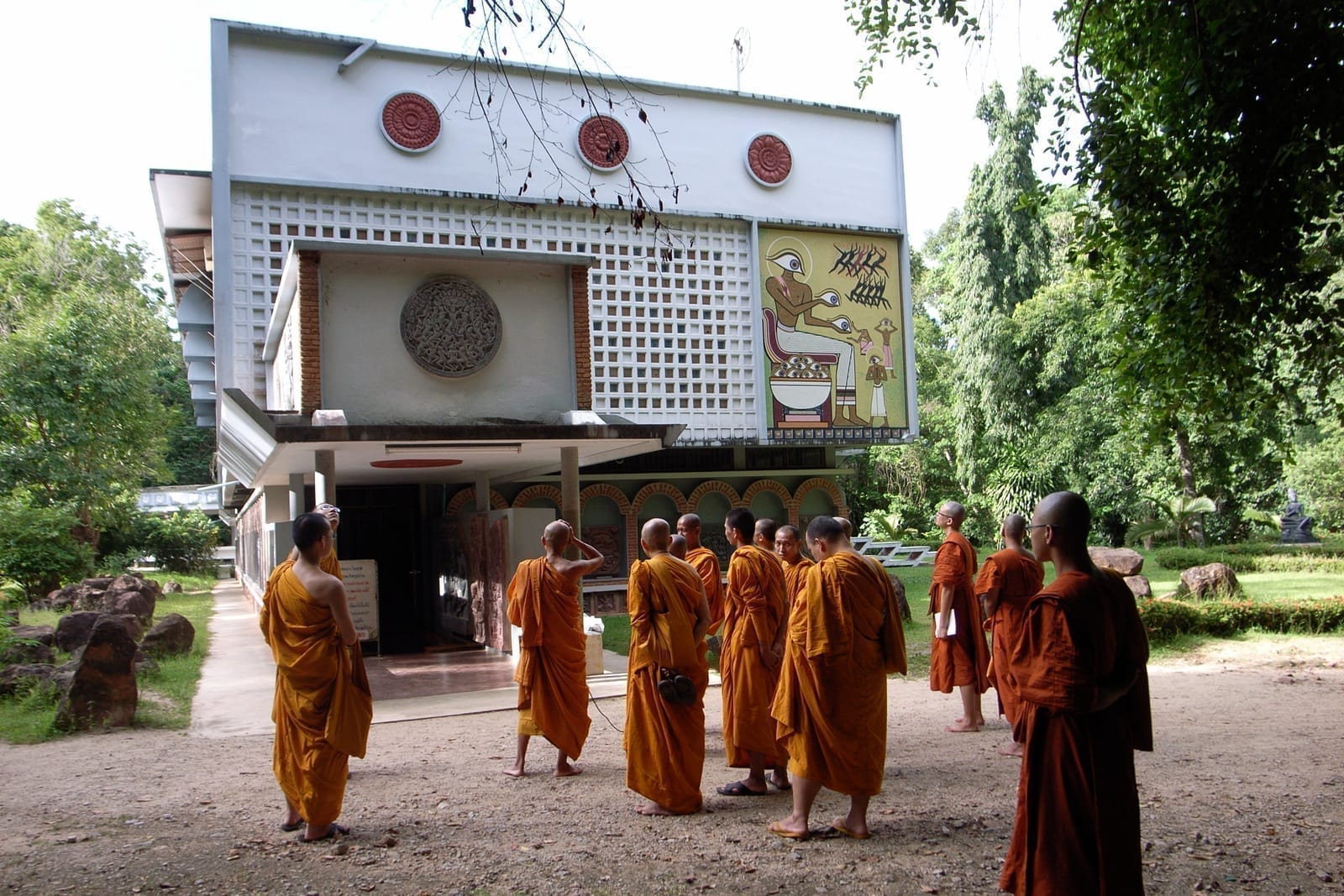
This is the spot people talk about most. Buddhadasa built the Spiritual Theatre around 1962 with an idea that sounded remarkably modern for its time: using "images" to draw people into the dharma without them realising it. Inside is a long building with paintings and dharma riddle murals covering the walls and pillars. Many of them copy Buddhist art from around the world — images from India's Ajanta caves, Zen paintings, Tibetan works — mixed in with riddles Buddhadasa devised himself.
- Dharma riddle paintings — images that look ordinary at a glance but hide a teaching meant to make you stop and think, like the blind men feeling an elephant, or scenes you can read several ways.
- The life of the Buddha series — carved in stone around the outside of the building, telling the story from his birth through to his passing.
- Buddhist art from around the world — India, China, Tibet, Japan, a reminder that the dharma belongs to everyone, not to any single nation.
- Dharma sayings — short teaching signs from Buddhadasa scattered all over the grounds, each one worth a pause.
The trick to seeing it is not to rush past. Stop at each image and work out your own reading of it. Many are deliberately meant to puzzle you so that you keep thinking. If you come as a group, try debating what each one means — it's a lot more fun than just walking through.
Other spots not to miss
Nalikae Pond
A pond in the middle of the park with a small island at its centre, a dharma riddle about nibbana that Buddhadasa left for visitors to interpret. The setting is shady and good for a rest.
The curved stone court
A natural rock platform Buddhadasa used to teach the dharma and meditation, an open-air listening space with no roof, using the sky and the trees as its ceiling.
Monks' huts and forest trails
Shaded forest paths link the different spots, with the monks' simple huts along the way. Walk them to feel the atmosphere of a genuine forest temple.
Workshop and museum
A building holding works and the history of Buddhadasa, where you can learn the story of how Suan Mokkh was founded and his approach to the dharma.
The 10-day retreat at Suan Mokkh International
Across the road from the main temple is the "Suan Mokkh International Dharma Hermitage," which runs a 10-day silent vipassana course every month. People genuinely fly in from all over the world for it. If you're interested, here's what to know first, because this is not a chilled-out holiday — it's serious practice.
- The course starts on the 1st of every month and finishes on the 11th. You have to stay for the whole thing — you can't do half.
- Registration is in person only, on the last day of the previous month (the 31st or whenever the month ends), before 3 pm. You can't book ahead online; it's first come, first served.
- Silent throughout, observing Noble Silence with minimal speech and no phones — you hand in all your electronic devices.
- Very basic accommodation — a private room, but with a hard bed, a straw mat, a wooden pillow and a mosquito net, plus shared bathrooms where you scoop water to wash.
- Two vegetarian meals a day plus an evening drink. No special meals, and you can't bring outside food in.
- It runs on donation — there's no fixed fee, but a suggested donation covers food and lodging.
Straight talk
The 10-day course is genuinely tough for beginners — up at 4 am, hours of seated meditation, alone with yourself in silence all day. Many people want to quit around days 3 and 4. If you're not ready for that, just coming for a day trip to walk the temple still sends you home with the atmosphere and some inspiration.
How to get to Suan Mokkh
Suan Mokkh is in Chaiya district, about 50–60 km north of Surat Thani town. It sits on the northbound side of Highway 41 around kilometre marker 134. Driving yourself is the easiest option since there's a car park.
- Car / motorbike — from Surat Thani town, head north on Highway 41 for about an hour. The Suan Mokkh sign is by the road near km 134, and there's parking inside the temple.
- Train — get off at Chaiya railway station (about 7 km from the temple) and take a motorbike taxi or a blue songthaew on the Chaiya–Suan Mokkh–Phunphin route. The motorbike fare is around 100–200 THB.
- Van / coach — southbound services pass through Chaiya; tell the driver you want to get off in front of Suan Mokkh on Highway 41.
A half day at Suan Mokkh + nearby spots
If you're not joining a course, it's worth planning a half- to full-day trip that takes in the Chaiya sights clustered nearby — better value than driving all this way for just one stop.
Suan Mokkh + walking the dharma art
Wat Phra Borommathat Chaiya + Chaiya souvenirs
Best time to go and things to know
- Go in the morning — cooler, gentler sun, and far more comfortable walking in the forest than in the afternoon.
- Wear comfortable shoes — the paths inside are dirt and stone, and there's a fair bit of walking.
- Bring drinking water and insect repellent — it's real forest, and the mosquitoes are out in force during the rainy season and toward evening.
- No entry fee, but there's a donation box for the temple — give what you feel is right.
- Respect the quiet — people genuinely come here to practise. Keep your voice low, silence your phone, and don't photograph anyone in meditation.
Plan a full trip around Chaiya and Surat Thani
See the Surat Thani travel guide →