🔄 Updated 21 Jun 2026
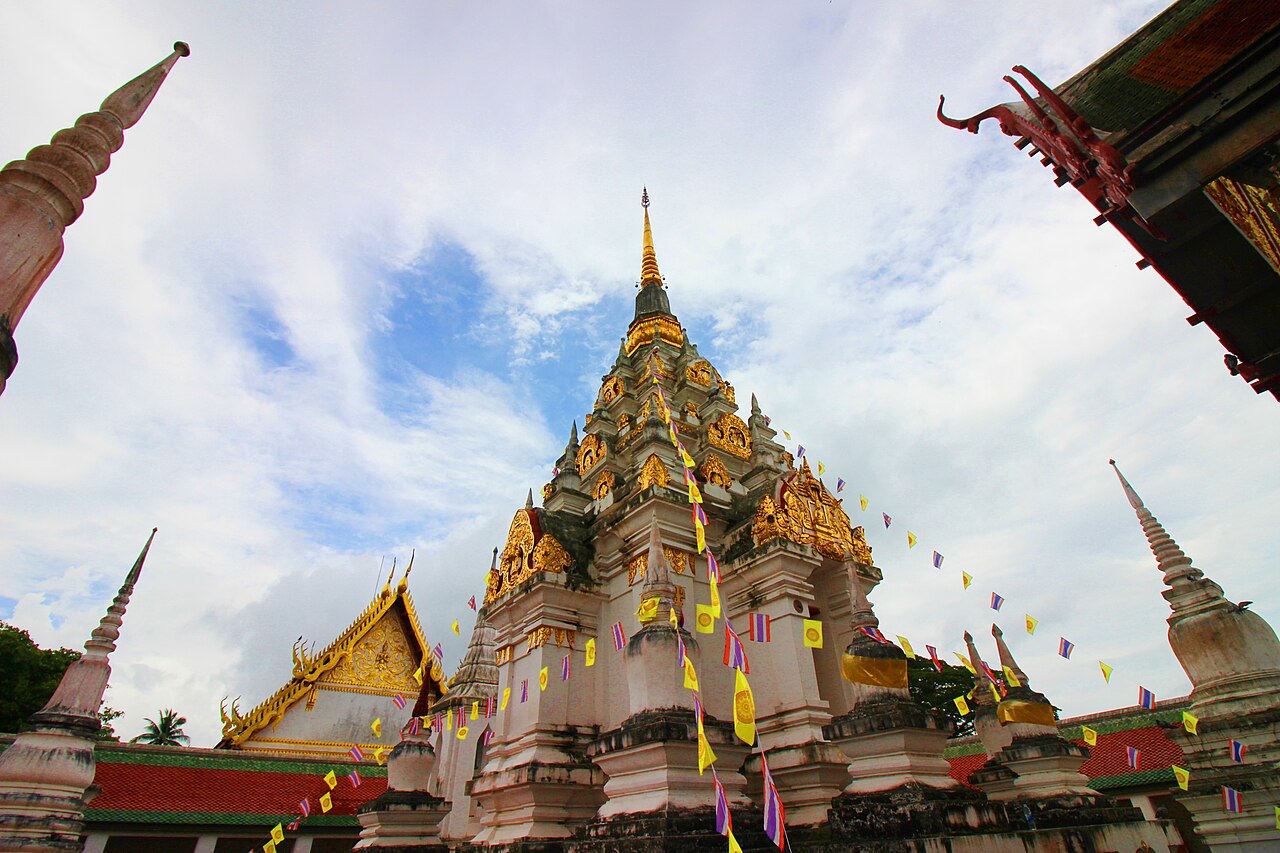
A lot of people pick just one of these temples, when in fact Phra Borommathat Chaiya and the Nakhon Si Thammarat stupa sit on the same main southern route, an easy drive apart. This plan is built so you don't have to rush: day one stays around Chaiya in Surat Thani province, day two shifts south to Nakhon Si Thammarat to pay respects at the Phra Borommathat Chedi, and day three walks the old town of Muang Khon before you head back. Along the way you'll see that the two cities' art comes from different schools entirely — Chaiya is Srivijaya, while Nakhon Si Thammarat has the bell shape of Lankan influence.
Before you set off
This trip is easiest with your own car or a rental from Surat Thani town, because the temple stops are spread along Highway 41 and inside Muang Khon. If you're not driving, you can string together vans and trains, but build in extra time for waiting on departures. Dress modestly with shoulders and knees covered at every stop, since these are all temple grounds.
The route at a glance — how far apart are the two stupas
Chaiya sits about 50–60 kilometres north of Surat Thani town along Highway 41, while the city of Nakhon Si Thammarat lies to the south of Surat. The distance between the two provinces is roughly 130–140 kilometres, about a 2-hour drive. The whole route runs on main roads, which makes it easy to plan one stretch after the other.
- Own car / rental — the most flexible option. Chaiya to Surat Thani town is about 1 hour; Surat Thani town to Nakhon Si Thammarat is about 2 hours. Easy to time your temple visits so you arrive before closing.
- Van route 475, Surat to Nakhon Si — departs Surat Thani town roughly 07:30–16:30, with runs almost every hour. Takes about 2 hours, comfortable, and drops you right in Muang Khon town.
- Southern Line train — the cheapest, with tickets from around 60-odd THB, but slower at roughly 4 hours because you change lines at Khao Chum Thong junction. Good for anyone who isn't in a hurry and wants to watch the scenery.
Base yourself smartly
This plan has you sleeping in Surat Thani town the first night (plenty of places to stay and eat) then moving to Nakhon Si Thammarat town for the second night, so you're not dragging your bag back and forth. If you're starting from Surat Thani Airport (URT), you can set off straight from the city.
Book the activities in your Surat Thani trip ahead
Booking online ahead on Klook or GetYourGuide is usually cheaper than the gate and skips the queue. Pick only the experiences you actually want — prices and availability are shown live on each site.
Day 1 — Chaiya and its Srivijaya-style stupa
Day one goes to Chaiya, an old district north of Surat Thani that was once the centre of the Srivijaya kingdom more than a thousand years ago. The main draw is Wat Phra Borommathat Chaiya Ratchaworawihan, with its thousand-year-old Srivijaya-style chedi — a form you'll only find in a handful of places in Thailand.
Chaiya and Srivijaya art
Mind the museum closing days
The Chaiya National Museum is closed Mondays, Tuesdays, and public holidays. If you're set on seeing the real Srivijaya art, don't put day one on a Monday or Tuesday, or you'll only get to see the chedi from outside.
Day 2 — cross to Nakhon Si for the Phra Borommathat Chedi
Day two is the cross-province day: from Surat Thani town it's about 2 hours south to the city of Nakhon Si Thammarat. The day's main stop is Wat Phra Mahathat Woramahawihan, home to the Phra Borommathat Chedi, a gold-topped bell-shaped stupa that sits at the heart of Muang Khon life. Its shape is clearly different from Chaiya's, drawing on Lankan art.
Cross-province plus Muang Khon's Phra Borommathat Chedi
The Phra Borommathat Chedi is a white inverted-bell stupa with a gold-clad spire, standing tall in the middle of the city. Southerners believe it enshrines a relic of the Buddha. The popular thing to do is circumambulate the stupa and join the cloth-draping ceremony on important days. If you come during the Hae Pha Khuen That festival (around February, on Makha Bucha day), you'll see a procession of phra bot cloth running a kilometre long — a sight you can only catch in Muang Khon.
About going up to the stupa
You can pay respects at the Phra Borommathat Chedi around the lower terrace any day. But going up to bow or drape cloth close to the stupa is only open on Buddhist holy days and Saturdays–Sundays. If you're set on doing the ceremony here, pick the right day and double-check the temple's announcements again before you travel.
Day 3 — Nakhon Si's old town, then home
The last day is an easy walk through Nakhon Si Thammarat's old town before heading back. The inner-city quarter still keeps traces of the old city walls, the city pillar shrine, and old shophouses to wander past. It's a place with a long history that's still very much a working city where people actually live — not a set dressed up for tourists.
City pillar shrine, old walls, and souvenirs
If you've got a spare half-day, Nakhon Si Thammarat has other stops worth a detour, such as Wat Khao Khun Phanom outside town, or for nature lovers, Krung Ching Waterfall in Khao Luang National Park, which is in the same province but fairly far from the city. If you want to add it, budget it as a separate day.
Real opening hours — check before you plan
- Wat Phra Borommathat Chaiya (Surat Thani) — open daily 08:00–16:00, free entry.
- Chaiya National Museum — Wed–Fri 09:00–16:00, closed Mon–Tue and public holidays. Thais 20 THB, foreigners 100 THB.
- Wat Phra Mahathat Woramahawihan (Nakhon Si Thammarat) — temple grounds open roughly 08:30–17:00; going up to bow / drape cloth at the chedi is open on Buddhist holy days and Sat–Sun, roughly 08:00–16:00. Free entry.
- Nakhon Si Thammarat National Museum — usually open Wed–Sun, closed Mon–Tue. Check the latest opening days before you go.
Straight talk on timing
You can pay respects around the terrace of both stupas any day, but where people slip up is the two museums that close Mon–Tue, and going up onto the Phra Borommathat Chedi in Nakhon Si, which is only open on certain days. If you want it all — the temples and the art — building the trip over a Saturday–Sunday works out best.
Pair it up — where to go next
On to Koh Samui or Pha-ngan
Both Chaiya and Surat Thani town sit on the route to Don Sak pier. Finish the temples and hop across to the islands in the same trip.
Nature route to Khao Sok and Cheow Lan
With several days to spare, you can carry on from the temple route to a floating raft house on Cheow Lan Lake — but it's in the opposite direction, so budget a separate day.
Krung Ching Waterfall, Khao Luang
Also in Nakhon Si Thammarat, this is a big waterfall in the Khao Luang forest, good for hikers but far from the city, so add an extra day.
Food from two cities — pay respects, then eat well
The charm of this trip is eating two styles of southern food. On the Surat side it's seafood along the Tapi River and Chaiya salted eggs. In Nakhon Si it's southern-style khanom jeen with a plate piled with fresh vegetable sides, bold gaeng tai pla, khua kling, and herb-laced khao yam — a true southern taste you won't find quite the same anywhere else. Finish with Muang Khon's khanom la as a sweet to take home.
Want a full Surat Thani plan covering the city, the islands, and the food
See the Surat Thani travel guide →