🔄 Updated 21 Jun 2026
Tak splits into two clearly different worlds. The Tak town side along the Ping River is easy going — wander the old Chinese quarter, see the suspension bridge, eat the local specialties — and you can roll up without much of a plan. The other side is Mae Sot–Phop Phra–Umphang, a border highland of forests and mountains with winding roads, long distances, and headline spots like Thi Lo Su that come with their own rules. This article focuses on prepping for people who genuinely intend to reach Tak's wild side.
Best Time to Visit Tak
Tak is doable year-round, but the feel changes a lot depending on when you go — so pick based on what you want to see. If you're after waterfalls and lush green forest, the rainy season is when the water runs full, but you trade that for slippery roads and limits on getting into Thi Lo Su.
November–February (late rains to cool season)
The stretch a lot of people rate as the best for Umphang. Cool, comfortable weather, clear skies, and waterfalls still running well from the rains that just passed. Roads are drier than in the wet season, so driving and hiking are easier. Great for Thi Lo Su, Doi Hua Mot, and early-morning seas of mist.
July–September (mid-rainy season)
Waterfalls are at their fullest and most beautiful of the year, with the whole forest a vivid green, and it's when the Siam tulips bloom. But you'll need to check whether the route into Thi Lo Su is open yet, since the wildlife sanctuary often closes for parts of the rainy season — and wet, slippery roads mean careful driving.
March–May (hot season)
Tak town and Mae Sot are still pleasant to explore — cafes, temples, markets, the old Chinese quarter are all fine. But the waterfalls run low this time of year, and some years bring haze from agricultural burning. If you're here mainly for the towns, this is okay; if you're here for nature, it's not the peak.
Quick takeaway
If you want beautiful waterfalls and good weather at the same time, aim for November–January — it's the sweet spot. If you're coming in the rainy season to see the water at full flow, always phone ahead to check that the Thi Lo Su route is open with the wildlife sanctuary first.
How to Reach Thi Lo Su — What to Know First
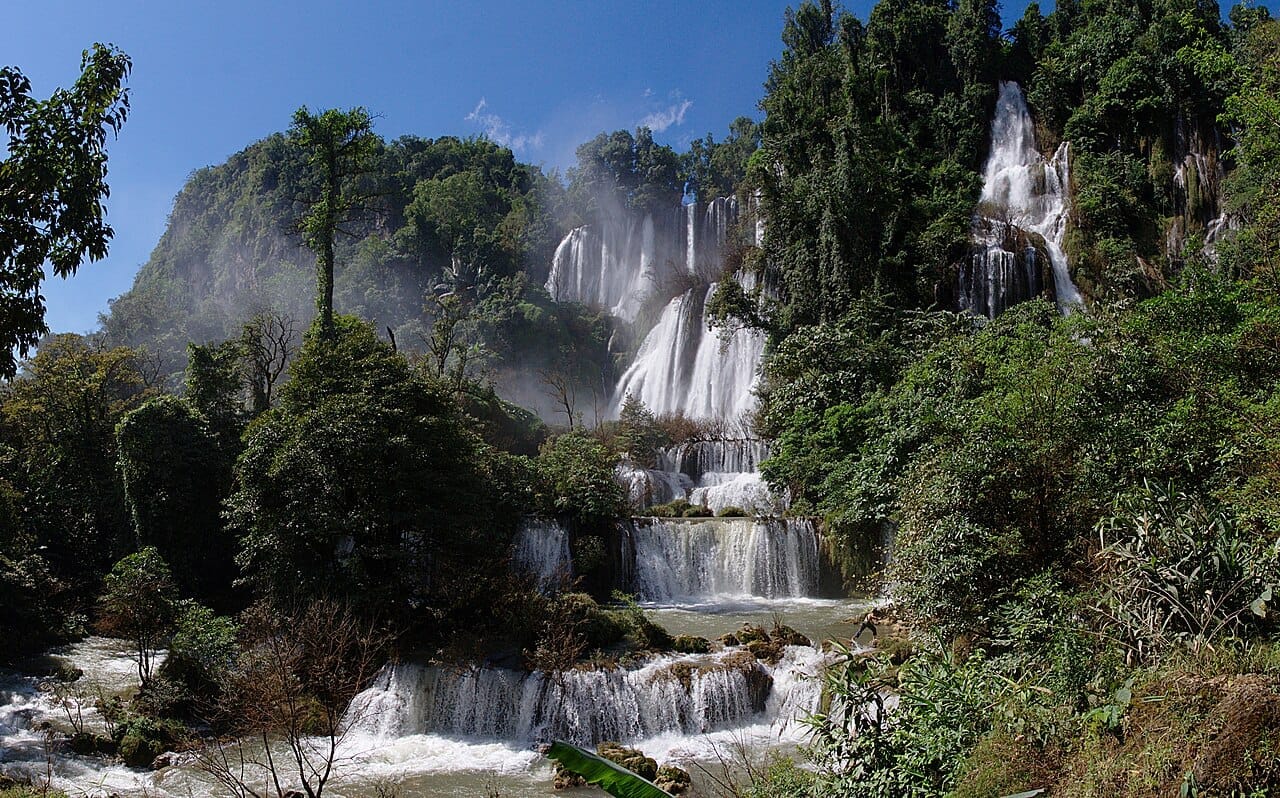
Thi Lo Su is a waterfall many people rate as one of the biggest and most beautiful in Thailand, sitting inside the Umphang Wildlife Sanctuary. Getting there isn't just a case of driving up and walking in — there are conditions around the season, the permit, and the type of vehicle you can use, which is why most people go with a local tour that handles all of it for you.
Thi Lo Su's Open and Closed Season
The Umphang Wildlife Sanctuary has a closed period in the rainy season to let the environment recover, generally closing around June–August and then reopening to visitors in early September (it opened on September 1 most recently). So if you're planning for the middle of the rainy season, don't buy your vehicle ticket or book a tour until you've confirmed it's open.
- Jun–Aug — the route is usually closed for recovery (check the announcement each year; it's not fixed)
- Sep onward — open to visitors, water still full from the rains, forest green
- Dec–May — the road in is at its most accessible; this is Umphang's high season
- Call ahead — Umphang Wildlife Sanctuary, tel. 0-5550-8780 / 06-5002-7637 during office hours
Getting Your Entry Permit
Entering Thi Lo Su requires a permit and registration with the Umphang Wildlife Sanctuary, plus an area entry fee. If you go with a tour, the operator arranges the permit and handles the fee as part of the package, so you don't have to chase paperwork yourself. If you're going independently, you'll need to contact the checkpoint and register through the proper steps — which is more of a hassle and requires a vehicle that can make it in, so very few people do it that way.
Straight talk
For most people, going with a local tour in Umphang is the easiest option, because they sort out the permit, fees, 4x4 vehicle, guide, and accommodation all together — so you don't risk getting all the way there and not being allowed in.
The 4x4 Vehicle and Why It's Needed
The final stretch before the waterfall is a dirt track through the forest, roughly 25 km from the checkpoint, and only four-wheel-drive (4x4) vehicles are allowed in — because the route is rough, steep, and slippery in the rainy season. Regular sedans and standard two-wheel-drive vehicles can't make it. Local tours use 4x4 pickups to shuttle this section, and some programs even include a rubber-raft float down the river as part of the trip.
- The ~25 km forest section — 4x4 only (the tour provides it)
- Rainy season — the track gets slippery and some stretches mean walking instead; check with the operator how far you can actually reach
- Private car — you can drive as far as Umphang town and your accommodation, but switch to a tour vehicle for the waterfall section — it's safer
Highway 1090 — the 1,219 Curves to Brace For
The Mae Sot–Umphang route is Highway 1090, famous for how winding it is, with around 1,219 curves in total. The distance from Mae Sot to Umphang is a little over 160 km, but it takes 4 hours or more to drive, because it's left-right and up-down curves almost the entire way. If you get carsick easily, prepare for this one in particular.
- Allow extra time — at least 4–5 hours each way if you're driving; don't rush it
- Carsickness — take motion-sickness medicine before you set off, sit up front, look at the distance, and avoid looking at your phone along the way
- Vehicle condition — brakes and tires need to be in good shape; fill the tank before heading into the mountains, as gas stations along the way are few
- Driving time — avoid driving at night or during heavy rain, when visibility is poor and the road is slippery
If you'd rather not drive yourself
There are vans and buses running Mae Sot–Umphang every day — more relaxing than driving it yourself as a first-timer. And if you take a Thi Lo Su tour, most already include a pickup from a meeting point in Umphang.
Rough Budget
A Tak trip budget is very flexible, depending on whether you're just doing the town and Mae Sot or going deep to Thi Lo Su. The biggest single cost is usually the nature tour, while accommodation and food in town stay wallet-friendly. The figures below are rough ranges to help you budget in advance — actual prices shift with the season and group size.
- Accommodation — budget guesthouses/chain hotels start around ฿300–600 per night; resorts in Umphang run a bit higher
- Food — local spots and markets around ฿200–300 per person per day, easily enough for three meals
- Thi Lo Su tour — packages including the 4x4, guide, fees, and accommodation start around ฿2,990–3,490 per person (more or less depending on the number of days and the meeting point)
- Getting around the province — split fuel if you drive yourself, or budget vans/songthaews per trip
- Rough total — town plus Mae Sot over 3 days can be kept to the low thousands of baht per person; add a Thi Lo Su trip and budget roughly ฿3,000 more on top
What to Wear in Tak
What you wear depends on which side you're visiting and the season. Exploring Tak town and Mae Sot, dress casually as usual — but if you're heading into the Umphang forest or to Thi Lo Su, you'll need clothes you can rough it in, plus layers for the cool early mornings and nights at altitude.
- Town exploring — breathable clothes, comfortable walking shoes, an umbrella/sun hat
- Hiking/waterfalls — sneakers or hiking shoes you can get wet, a long-sleeve top for sun and branches, and long pants you can move freely in
- Cool season (Nov–Feb) — add a warm layer for mornings and nights on the mountain; temperatures drop a lot more than in town
- Temples — dress modestly, shoulders and knees covered, when visiting the Burmese-style temples on the Mae Sot side
What to Pack in Your Bag
Some things are hard to buy once you're in the Umphang forest, so bringing them from town gives you peace of mind — especially personal medication and anything waterproof.
- Motion-sickness medicine — really important for the 1,219-curve route; take it before you leave
- Personal meds + basics — painkillers, antihistamines, mosquito repellent, and your own prescriptions; pharmacies in the forest are scarce
- Waterproof bag/phone pouch — for the raft float and waterfall spray
- Flashlight/power bank — signal and power are unreliable in some spots; charge up full
- Rain jacket — even in the cool season, allow for rain on the mountain
- Cash — card/PromptPay acceptance isn't widespread in Umphang; carry cash for the tour, food, and souvenirs
- Sun protection — sunscreen, hat, sunglasses, especially if you go up Doi Hua Mot for the morning sea of mist
One last tip
Save the wildlife sanctuary's phone number and your booked tour's number on your phone, and screenshot your accommodation details to keep them offline — because the signal can drop out on parts of Highway 1090 and in the forest.
Ready? See the full Tak travel guide, every angle covered
See the Tak guide →