🔄 Updated 21 Jun 2026
Temples in Thailand are about far more than paying respects. Each one gathers craftsmanship, art and the local history of its area into a single place. Some are centuries-old royal temples that have stood beside Bangkok since the founding of the Rattanakosin era, some are contemporary works of art an artist designed top to bottom, and some are sacred stupas that whole regions travel to bow before. So we've arranged these 20 temples by region, to help anyone planning a temple-focused trip decide which route to take.
The order in this list follows region and ease of travel; it does not mean temple number 1 is more beautiful or more sacred than number 20. Every temple here is already considered a landmark of its province by Thais and visitors alike.
Temples in Bangkok and Central Thailand
If it's your first time in Thailand, Bangkok and Rattanakosin Island are a good place to start. The first three royal temples sit side by side along the Chao Phraya River, close enough to cover in a single day on foot and by cross-river ferry. The other central-region temples include both famous in-town temples and old temples within historic city districts.
Wat Phra Si Rattana Satsadaram (Wat Phra Kaew)
The temple within the Grand Palace grounds that houses Phra Phuttha Maha Mani Rattana Patimakon, the Emerald Buddha, a revered image carved from a single piece of green jade. The ordination hall and surrounding cloisters are covered in coloured glass mosaic and intricate gold patterns. No monks reside here; it's used for important royal ceremonies, and entry is included in the same ticket as the Grand Palace.
Wat Phra Chetuphon (Wat Pho)
An old temple best known for its giant gilded Reclining Buddha, about 46 metres long, with the soles of its feet inlaid with mother-of-pearl showing the 108 auspicious signs. Wat Pho is also the birthplace of traditional Thai massage and a school of traditional medicine, with inscribed texts and hermit-exercise statues scattered throughout, which is why it's regarded as an open-air centre of Thai knowledge.
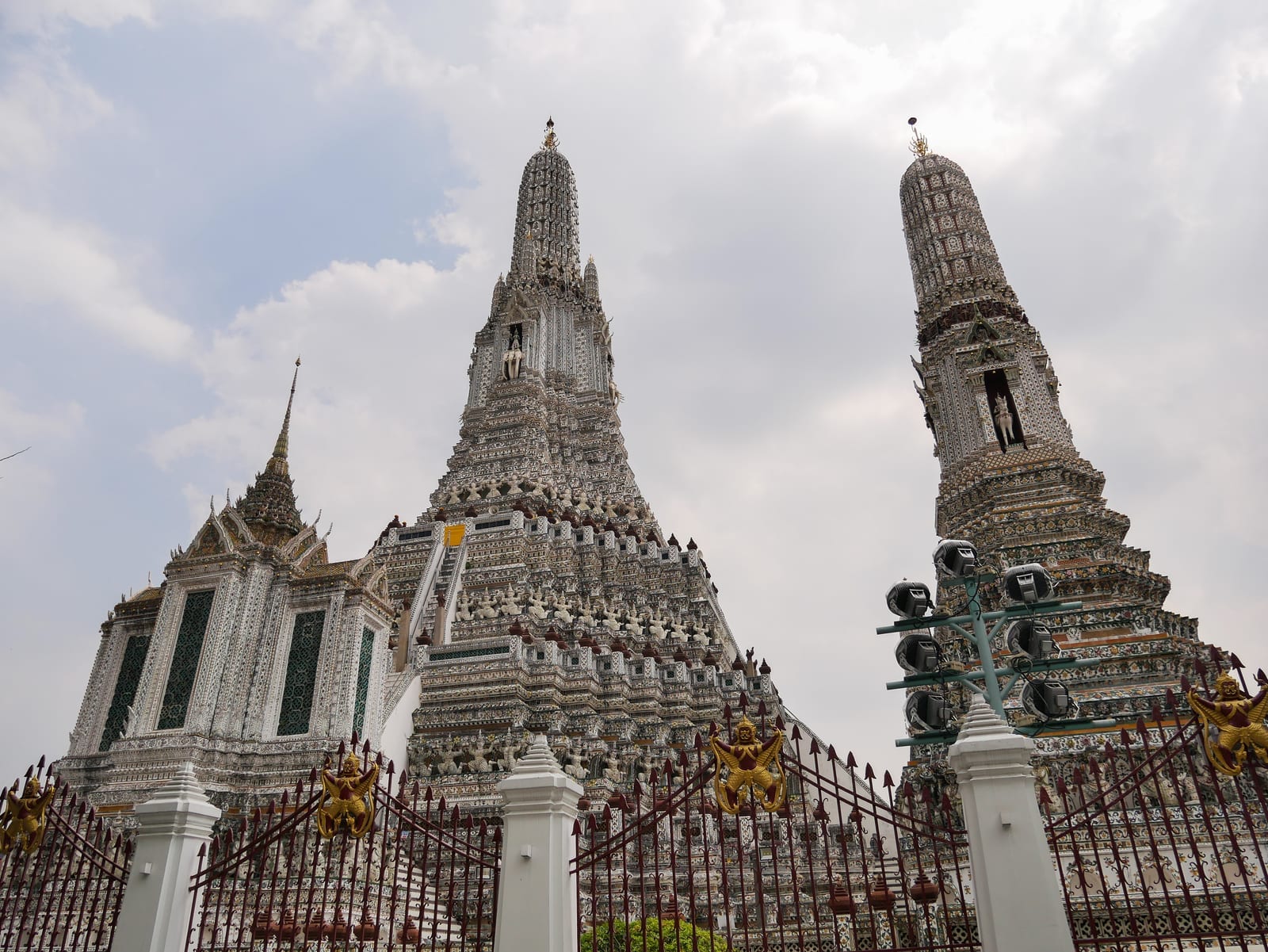
Wat Arun Ratchawararam (Temple of Dawn)
A temple on the Thonburi bank with a large central prang about 80 metres tall, decorated all over with glazed porcelain and seashells arranged into floral patterns. You can climb the steep stairs to the terrace partway up the prang. The most popular photo spot is from across the river at sunset, when the orange light catches the spire. It's an easy cross-river ferry ride from Tha Tien, near Wat Pho.
Wat Benchamabophit (the Marble Temple)
A royal temple whose ordination hall is built entirely from white Italian marble, which is how it earned the nickname the Marble Temple. It was designed by Prince Naris and blends Thai and Western styles neatly. The cloister around the hall displays Buddha images in various postures from across the country. The atmosphere is calm and far less crowded than the riverside temples.
Wat Mahathat, Ayutthaya
A ruined temple in the middle of Ayutthaya Historical Park, a UNESCO World Heritage Site. The image the whole world remembers is the sandstone Buddha head wrapped in the roots of a banyan tree, which has become a symbol of Ayutthaya. The grounds also hold the main prang and old stupa bases where you can walk among the traces of the former capital. It's about a 1.5-hour drive from Bangkok.
Tips for the Bangkok route
Wat Phra Kaew, Wat Pho and Wat Arun sit close together along the river. Start at Wat Phra Kaew in the morning to dodge the midday heat and crowds, then walk over to Wat Pho, and take the cross-river ferry from Tha Tien to Wat Arun in the late afternoon, so you get both the temple and the sunset view.
Want more out of Thailand? Book tours & activities
Booking online ahead on Klook or GetYourGuide is usually cheaper than the gate and skips the queue. Pick only the experiences you actually want — prices and availability are shown live on each site.
Temples in Northern Thailand
The North is the land of Lanna. The temples here range from ancient hilltop temples where people climb up to pay respects to a stupa, to contemporary art temples that local artists designed themselves until they became the image people picture of the province. Chiang Mai and Chiang Rai are the two main stops visitors don't skip.
Wat Phra That Doi Suthep, Chiang Mai
The sacred temple that anchors Chiang Mai, set on Doi Suthep mountain. The Lanna-style stupa is clad in gleaming gold and visible from far off. You can climb the roughly 300-step Naga staircase or take the funicular up. The viewpoint terrace out front looks down over the whole city of Chiang Mai. Both Chiang Mai locals and visitors come here to make offerings.
Wat Rong Khun (the White Temple), Chiang Rai
An all-white temple studded with sparkling mirror glass, the work of artist Chalermchai Kositpipat, who has built and maintained it over several decades. The bridge crossing to the white ordination hall represents the passage from desire to release. It's a photo spot with long queues, and the strong late-morning sun makes the white reflect especially beautifully.
Wat Rong Suea Ten (the Blue Temple), Chiang Rai
An ordination hall in deep blue offset with gold, the work of Sala Nok, a student in Chalermchai's lineage. Inside are mural paintings and a white principal Buddha image that stands out against the blue walls so vividly it sticks in your memory. It's in town across the Kok River, easier to reach than Wat Rong Khun, and the two pair up nicely in one day.
Wat Phra Singh, Chiang Mai
Wat Phra Singh is an old temple in central Chiang Mai that houses Phra Phuttha Sihing, an important image people flock to bathe during Songkran. The highlight is the Lai Kham assembly hall, whose walls are painted with murals telling Lanna life in fine gold patterns. It's in the old town, an easy walk on to other temples inside the moat.
Wat Pongsanuk, Lampang
An old temple in central Lampang. The highlight is the Wihan Phra Chao Phan Ong, an open wooden hall on a low mound ringed by thousands of small votive Buddha images, which is where the name comes from. Inside are Buddha images seated facing the four directions, with craftsmanship that blends Lanna, Burmese and Chinese art. It received a UNESCO conservation award in 2008.
What to know before heading up the mountain
Wat Phra That Doi Suthep sits on a mountain where the air is cooler than in town, so bring a light jacket. From dawn through mid-morning the sky is usually clear, good for photographing the stupa. The art temples in Chiang Rai get strong sun by late morning, so dress comfortably and pack an umbrella or hat to enjoy the visit more.
Temples in Isan (Northeastern Thailand)
Isan has sacred stupas that the whole region, and people crossing the Mekong from Laos, travel to honour. Several of them are believed to be birth-year stupas, so people go to pay respects according to their own zodiac year. There are also modern temples designed so handsomely they've become check-in spots for their provinces.
Wat Phra That Phanom, Nakhon Phanom
A sacred stupa on the bank of the Mekong River. The stupa is a square tower about 53 metres tall, topped with a golden tiered umbrella, and is said to enshrine a relic of the Buddha's breastbone. It's the birth-year stupa for those born in the Year of the Monkey and the day stupa for Sunday, and people on both sides of the Mekong come to bow before it nonstop. The wide plaza in front lets you see it from far away.
Wat Phra That Choeng Chum, Sakon Nakhon
An old temple in central Sakon Nakhon. The stupa is a white Lan Xang-style chedi with a gold spire, built over a Buddha footprint according to legend. It's revered by the people of Sakon Nakhon and the wider Isan region, and inside is Luang Pho Phra Ong Saen, a Buddha image that anchors the town. It has the lively feel of an in-town temple that people still come to worship at.
Wat Chedi Chai Mongkhon (Wat Pha Nam Yoi), Roi Et
A hilltop temple in Nong Phok District. The highlight is the great Phra Maha Chedi Chai Mongkhon, a large white-and-gold chedi tens of metres tall, ornately decorated inside with several levels you can climb for views of the surrounding forest and hills. Isan locals like to come here to make merit and take photos with the giant chedi.
Wat Ban Rai, Nakhon Ratchasima
The temple of Luang Pho Khun Parisuttho, a revered monk known across the country. Today it has the Thep Witthayakhom shrine, decorated end to end with contemporary art telling the life of the Buddha, in both stucco reliefs and multicoloured mosaic tiles. It's become a place people stop to pay respects and take in the craftsmanship when driving through Korat.
Wat Thung Si Mueang, Ubon Ratchathani
An old temple in central Ubon. The highlight is the scripture library set in the middle of a pond, a wooden building for storing texts, built over water to keep out termites and fire, blending Thai, Burmese and Lao styles handsomely. Inside the ordination hall are old murals depicting Isan village life of earlier times. Good for anyone who enjoys fine craftsmanship.
About birth-year stupas
Isan locals like to visit the stupa of their own birth year; for example, Phra That Phanom is the stupa for the Year of the Monkey. If you're planning an Isan trip across several provinces, check which stupa matches your birth year and stop by to pay respects. You'll get both peace of mind and a route that fits together nicely.
Temples in Southern Thailand
The South has one of the oldest temples in the country, and a mountain temple you have to climb on foot in exchange for sea views. The two temples below are the main landmarks of Nakhon Si Thammarat and Krabi that temple-minded travellers shouldn't miss.
Wat Phra Mahathat Woramahawihan, Nakhon Si Thammarat
An old temple that anchors Nakhon Si Thammarat, which southerners call Phra That Mueang Nakhon for short. The main relic chedi is a Sri Lankan-style bell-shaped stupa with a gold-clad spire, said to enshrine relics of the Buddha. It's a focal point of faith for southern Thailand and is on the tentative list for World Heritage nomination. The surrounding cloister is lined with Buddha images to pay respects to.
Wat Tham Suea (Tiger Cave Temple), Krabi
A cave temple known for its roughly 1,200-step staircase up to a summit that holds a Buddha image and a Buddha footprint. Anyone who makes it to the top gets a 360-degree view of rice fields, limestone hills and the Andaman Sea. It's a temple for the adventurous, where you trade effort for the view, suited to people who want both merit and a workout.
Old Temples in Historic Cities
The last three temples are within old-town districts and historical parks. Some are ruined temples where only the chedi frames and open-air Buddha images remain, but their age and quiet atmosphere keep travellers coming to feel the traces of the past.
Wat Mahathat, Sukhothai
The central temple of Sukhothai Historical Park, a UNESCO World Heritage Site. The highlight is the lotus-bud chedi, a shape unique to Sukhothai art, surrounded by smaller chedis and a large stucco Buddha image. The grounds are spacious and shady, and you can rent a bicycle to ride around the old city.
Wat Chaiwatthanaram, Ayutthaya
A temple on the bank of the Chao Phraya River in Ayutthaya, laid out as a large central prang ringed by satellite prangs and smaller chedis according to a cosmological plan. It's especially beautiful in the evening and at night when the ruins are lit. It's a favourite spot for photos and for wearing traditional Thai dress on a stroll, and it sits within the Ayutthaya World Heritage zone.
Wat Phra That Lampang Luang, Lampang
An old Lanna temple on a low mound in Ko Kha, considered one of the most complete examples of Lanna architecture. The open main assembly hall has a finely detailed stucco archway gate, and the stupa is a gilded chedi. There's also the story of the inverted reflection of the stupa, cast through a hole in the hall wall, that people make a point of going to see.
Temple Etiquette and Dress Code
Every temple in this list is a sacred place. Even where a temple is a popular photo spot, people still come to genuinely worship there. Appropriate dress and manners help you visit with an easy mind and avoid being turned away from important areas.
- Dress modestly — cover your shoulders and knees, and avoid spaghetti straps, tank tops, and short shorts or skirts. Royal temples like Wat Phra Kaew are very strict about this; if you're not dressed properly you may have to rent or buy a wrap at the entrance.
- Take off your shoes before entering buildings — before stepping into an ordination hall, assembly hall, or any building housing a Buddha image, always remove your shoes and hat.
- Don't point your feet at a Buddha image — when sitting, fold your legs to one side or tuck your feet in; don't stretch your feet out toward the principal Buddha image.
- Women should not touch monks — if you want to offer something, place it on the receiving cloth or pass it through a man.
- Keep your voice down and your manner composed — avoid loud noise, and check before taking photos that it's allowed; some halls prohibit photography in the area of the principal Buddha image.
Getting ready before a temple visit
Opening hours and entry fees at each temple can change around festivals or important ceremonies, so it's worth checking the latest information again before you travel. Keep a light shoulder wrap in your bag and you'll be able to enter any temple without wasting time hunting for a rental at the gate.
Want to plan a full trip around Thailand? Pick a province and start browsing places to stay.
See the Thailand travel guide →