🔄 Updated 21 Jun 2026
If you come down to Narathiwat and want to see something you can't find anywhere else, Toh Daeng Peat Swamp is the answer. It's the largest and most intact freshwater peat swamp Thailand has left. The real forest spreads across several districts — Sungai Kolok, Tak Bai, Sungai Padi, and Mueang Narathiwat — but the part open to the public for nature walks is around the Sirindhorn Peat Swamp Forest Nature Study Center in Puyo subdistrict, Sungai Kolok. They've built a proper wooden boardwalk here, so you can walk deep into the forest without ever wading through mud.
A peat swamp differs from an ordinary forest in that the ground holds standing water all year round, and the soil is decomposed plant matter that has built up into peat several meters deep. These conditions support plants and animals found nowhere else, ones that have adapted to live in the acidic water. A peat swamp this intact is genuinely rare in Thailand. Walk in and you'll feel it right away — the air is humid, cool, and noticeably quieter than outside.
Read before you travel
Narathiwat sits in Thailand's deep south border region. Before you go, check the latest news and official safety advisories, and plan to travel during daylight. This is a predominantly Muslim-Malay area, so dressing modestly and following the advice of locals will make your trip smoother and shows respect to the people who live here.
The boardwalk through the swamp
The highlight here is the nature trail — a raised wooden boardwalk above the swamp water. The main route runs about 1,200 meters in a loop back to where you started, with a flat, easy surface that works for kids and older walkers alike. Along the way there are interpretive signs at intervals naming the plants and explaining the peat swamp ecosystem. A few sections rise into towers you can climb to look out over the canopy and across the forest from above — a good spot for birding and for photos.
- Main route — a roughly 1,200m boardwalk that loops back to the start, an easy 45 min–1 hour at a relaxed pace
- Canopy tower / bird hide — a few sections have towers you can climb to view the treetops and scan for birds from above
- Side trails — there are also a medicinal-plant trail and a sago museum trail to add on if you have time
- Fine on your own — the route is clearly marked and easy to follow, but if you want deeper insight, ask the center staff about a guided walk
Want more out of Narathiwat? Book tours & activities
Booking online ahead on Klook or GetYourGuide is usually cheaper than the gate and skips the queue. Pick only the experiences you actually want — prices and availability are shown live on each site.
Swamp plants and big trees you'll meet
Toh Daeng Peat Swamp has more than 400 plant species, many of them swamp specialists you rarely see in other forest types. Walking the boardwalk you'll pass tall, straight-trunked trees with buttress roots fanning out to brace them in the soft soil, alternating with dense layers of understory growth. The whole place is shaded and green.
- Lumphi palm — a swamp palm whose fruit is eaten and made into desserts, a classic plant of southern peat swamps
- Sago palm — a swamp palm whose trunk starch locals use in cooking; the center has a whole trail telling the sago story
- Red kepau palm — a handsome understory palm found in the peat swamps around here
- Wa hin, mahang and other swamp hardwoods — big trees that grow in the wet peat soil and shade the trail the whole way
Look closely
The swamp floor is dark tea-colored water from the tannins released by decaying plants — it isn't dirty, it's just the natural character of a peat swamp. Look down beneath the boardwalk and you'll spot fish and small aquatic creatures that can live in this acidic water.
Birds and wildlife — why birders make the trip
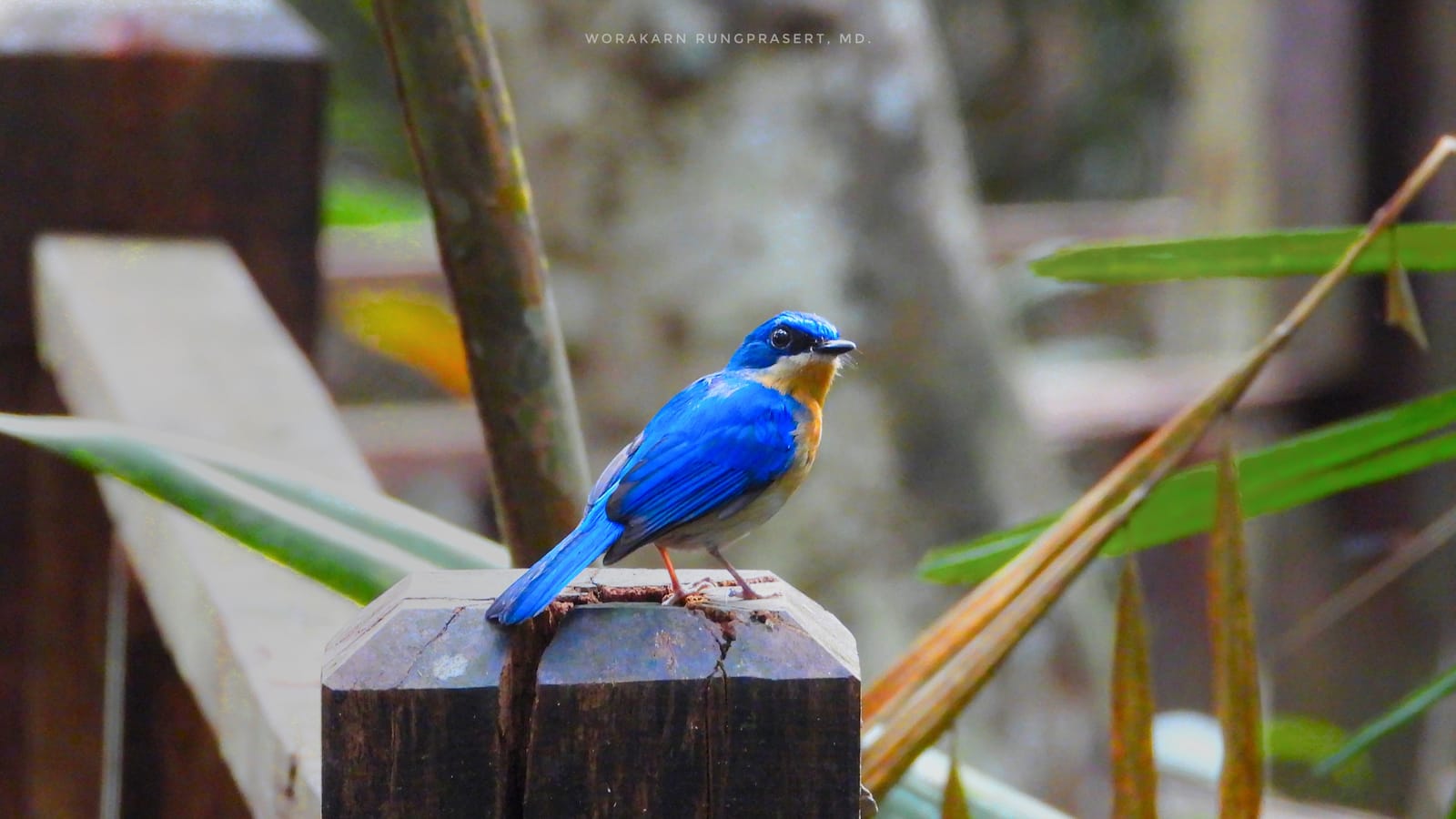
Toh Daeng Peat Swamp is a birding site that the camera-and-binoculars crowd rate highly. Nearly 200 bird species have been recorded here, and the star is the black hornbill, a small hornbill that is 1 of the 13 hornbill species found in Thailand and seen mainly in the peat swamps around here. Plenty of people travel a long way specifically to wait for a sighting of it. Beyond the black hornbill, there are many other swamp birds to watch up in the canopy.
Beyond birds, this swamp is home to more than 200 animal species — mammals, reptiles, and aquatic life — including rare ones like the false gharial (the long-snouted crocodile) that lives deep in the swamp. Ordinary visitors won't see these big animals up close, but their presence reflects just how intact the ecosystem here still is.
- Best time for birding — early morning right after the center opens, when the air is cool and birds are out feeding and calling the most
- Bring a camera / binoculars — birds sit high in the canopy, so a zoom lens or binoculars help a lot
- Walk quietly — keep the talking down and you'll have a better chance of seeing birds and wildlife
Hours, entry fee, and contact info
- Hours — open daily, roughly 8:00 AM–4:00 PM (last entry around 3:30 PM in some periods, to allow time for the walk back)
- Entry fee — no admission charge, as it's a government research and nature study center
- Location — Sirindhorn Peat Swamp Forest Nature Study Center, Puyo subdistrict, Sungai Kolok district, Narathiwat province
- Facilities — an exhibition building to learn from before the walk, plus restrooms and parking
- Check before you go — the center at 098-010-5736, or TAT Narathiwat at 0-7352-2411
Call ahead if it's a long drive
Opening hours and some sections of the trail can change with the flood season or for maintenance work. If you're driving a long way, call the center or TAT Narathiwat before you set out so you don't waste the trip.
Getting there and planning your visit
The center is in Sungai Kolok district, about 10 km from the town center and roughly 60–70 km from Narathiwat city. Having your own car or a rental is by far the easiest option, since public transport doesn't reach this spot conveniently. Anyone already staying in Sungai Kolok has the advantage — it's just a short drive out — and it pairs well with a stroll around Sungai Kolok town on the same day.
- From Sungai Kolok — about a 10 km drive, under 20 minutes; best to head out early before it heats up
- From Narathiwat city — about 60–70 km, allow roughly an hour and a half of driving
- Pair it up — walk the swamp in the morning, then explore Sungai Kolok town in the afternoon or evening for street art and southern food
- Come prepared — wear comfortable walking shoes and bring mosquito repellent, drinking water, and a hat; the swamp is humid and there are a fair few insects
A relaxed half-day in the swamp
If you want the full atmosphere, a half-day morning trip is just right. Start at the exhibition building to get a feel for the peat swamp, then head out onto the boardwalk while the sun is still gentle.
Swamp walk + Sungai Kolok town
If you've got another half-day, follow it with a walk around Sungai Kolok town — street art on the walls near the border crossing, a café to rest in, or some local snacks to take home before you head back.
Want a full Narathiwat itinerary and what pairs with what?
See the Narathiwat travel guide →