📝 Written 3 Jul 2026 · ✅ Fact-checked 3 Jul 2026 · prices and schedules can change — check with the operator before booking
Maha Sarakham sits at the center of Isan, a university city known as the region's seat of learning. Its attractions lean toward history, faith, and community life rather than commercial tourism. The highlight is Phra That Na Dun, a white Dvaravati-style stupa that holds relics of the Buddha and has earned the title of Isan's Buddhist center. There's also Ku Santarat, a laterite Khmer sanctuary that once served as a hospital chapel; the century-old Kae Dam wooden bridge stretching across a lake; and the Ban Mo pottery village, where earthenware has been made by hand for over 200 years.
Below we've picked out the activities and sights that come up most often in reviews, along with the best times to visit and what to know before you go. Most sites are free to enter and spread across several districts. Phra That Na Dun and Ku Santarat are in Na Dun district, about 65 km from the city center. Kosamphi Forest Park has long-tailed macaques that are best enjoyed by observing quietly — don't feed them, don't get close. The rare crab at Doon Lampan is best seen in the rainy season, and having your own car makes all of this much easier.
Phra That Na Dun (Isan's Buddhist Center), Na Dun District, Maha Sarakham

Phra That Na Dun is a large ivory-white stupa in Na Dun district, in the southern part of Maha Sarakham province, built in a style modeled on Dvaravati-era architecture. It stands roughly 50 meters tall at the center of a wide open plaza that locals call Isan's Buddhist Center. Its significance stems from the discovery of Buddha relics enshrined in a three-tiered reliquary — gold, silver, and bronze — unearthed from an ancient mound on this very site in 1979. The stupa was later built over the find to house the relics, making it the province's foremost pilgrimage destination, drawn to by Isan locals and traveling pilgrims alike.
The surroundings are calm and quiet, with a spacious plaza that's easy to walk, ideal for bringing older relatives to pay respects and photograph the stupa against the sky. Nearby is the Chanpasri Historical Study Center and museum, which tells the story of the ancient Dvaravati-era city in this area — worth combining into a single trip if you're curious about the origins of the excavated artifacts. The drive from Maha Sarakham city takes about an hour, on paved roads the whole way; driving yourself is the most convenient option since public transport doesn't reach here often. Without your own car, arrange a rental or hired driver from the city in advance.
The most popular time to visit is morning to late morning, when the sun isn't too harsh and the light is best for photographing the stupa. The major annual event is the Phra That Na Dun Worship Festival, held around February–March, featuring merit-making, alms-giving, and cultural activities — expect much bigger crowds during this period. Dress modestly, avoiding shorts and sleeveless tops out of respect for the religious site. Bring a hat and umbrella, as the open plaza offers almost no shade, and carry drinking water since there aren't many shops in the area, especially outside festival season when some may be closed.
- Maha Sarakham's foremost pilgrimage landmark — a tall, ivory-white Dvaravati-style stupa that's genuinely photogenic and meaningful to pay respects at
- Free admission, with a spacious, easy-to-walk plaza suited to families and older travelers, in a calm, quiet setting
- Historically significant as the resting place of Buddha relics genuinely excavated on-site from the Dvaravati era
- Close to the Chanpasri Historical Study Center and museum — easy to combine into one trip
- About 65 km from the city, with infrequent public transport — a car or rental is the most practical way to get here
- The open plaza has almost no shade, and midday sun can be intense — bring a hat, umbrella, and water
- Few shops or amenities nearby, and some may be closed outside festival season
Ku Santarat — Laterite Hospital Chapel from the Era of King Jayavarman VII (Na Dun District, Maha Sarakham)
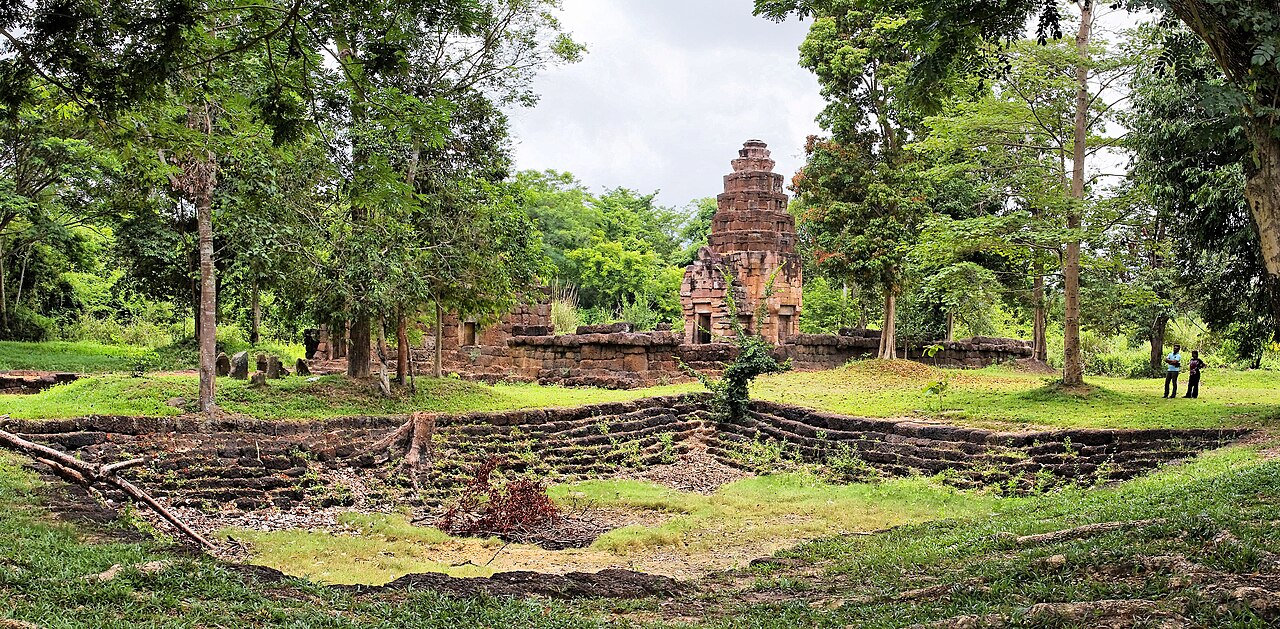
Ku Santarat is a small Khmer ruin that remains fairly well preserved, located in Ban Ku, Ku Santarat subdistrict, Na Dun district, about 4 kilometers from the district center. The sanctuary is built of laterite, facing east, on a square plan, with a boundary wall surrounding it and a reservoir (baray) in front. It's believed to date from the reign of King Jayavarman VII, around the 18th Buddhist century (12th–13th century CE), in Bayon style. Its original function was as an "arokayasala," or community hospital chapel, part of that Khmer king's practice of building such chapels across cities throughout his kingdom. The Fine Arts Department registered it as an ancient monument in 1935 (B.E. 2478).
What sets Ku Santarat apart from the larger Khmer temples is its compact size and peaceful atmosphere — far less crowded than the famous sanctuaries in southern Isan. You can walk the whole site comfortably in under an hour. Inside the central tower, a base once used to house an icon has been found, a feature specific to hospital chapels of this kind, while some unfinished sandstone carvings reveal bare stone that was never fully worked, offering a glimpse into the construction process of Khmer craftsmen. Importantly, Ku Santarat lies on the same route as Phra That Na Dun and the Chanpasri Historical Study Center, so you can plan a single continuous loop covering the whole ancient Chanpasri city area in half a day — ideal if you want the full picture of this historic zone.
Admission is free, with a parking area and information signs at the entrance. Getting here is easiest with your own car or a rental, as public transport is hard to come by. Morning or late afternoon light makes for more comfortable walking and photography, since the site is an open plaza with little shade — bring a hat, umbrella, and water. As this is a genuine ancient monument that deserves care, avoid climbing on or touching fragile sections. Visitors who aren't especially into history may find this spot small and quick to see, but paired with Phra That Na Dun and the nearby museum, it rounds out a culturally rich trip well worth the drive.
- The laterite sanctuary remains fairly well preserved, clearly showing the hospital-chapel layout, boundary wall, and reservoir — an easy way to understand Bayon-era Khmer architecture
- Free admission, no fee, with a parking area and information signs at the entrance
- On the same route as Phra That Na Dun and the Chanpasri Historical Study Center — easy to combine into a single half-day loop
- Peaceful, uncrowded atmosphere, easy to walk around and photograph in a short amount of time
- Compact in size, taking under an hour to see — those less interested in history may find it small and modest
- An open plaza with intense sun and little shade — bring sun protection
- Public transport is hard to reach here — a car or rental is the most convenient way in
Kae Dam Wooden Bridge — A Century-Old Community Bridge Across the Kae Dam Reservoir Amid Lotus Fields, Kae Dam District

The Kae Dam wooden bridge is an old community bridge in Ban Kae Dam, Kae Dam district, Maha Sarakham province, said by locals to be over a century old. The bridge stretches roughly 450 meters across the Nong Kae Dam reservoir, connecting the village side with farmland and Wat Dawadueng on the far bank. It was originally a route locals used to cross the water for farming and to reach the temple, and it later became a favorite stop for photographers drawn to its simple, rural Isan charm — a wide expanse of water, seasonal lotus fields in bloom, and a long line of wooden planks cutting a beautiful stretch across the surface. It has become an image many people associate with the best of Maha Sarakham, considered a lesser-known check-in spot within the broader Isan region.
The Kae Dam wooden bridge is most beautiful in the early morning and in the evening before sunset, when golden light spills across the water and reflects the bridge and lotus plants in soft tones. Many people arrive before dawn to catch the sunrise over the reservoir, while the fullest lotus blooms tend to appear during the rainy season into early winter, giving a rare view of the bridge cutting through a sea of lotus flowers. Walking the bridge feels calm — you'll hear the wind and waterbirds, and see locals paddling boats to fish, a still-natural way of riverside life. There are small community coffee shops and food stalls nearby for taking in the view. Entry is free, making it a great stop for anyone driving through Maha Sarakham who wants a quiet spot for beautiful photos without the crowds.
A few honest things to know before you go. Most importantly, the Kae Dam wooden bridge is old and undergoes periodic repairs — parts may be closed for renovation or rotten planks removed, so you may not be able to walk the full length, or it may be temporarily closed. Check community tourism pages, the Kae Dam district page, or ask locals to confirm it's open before setting out, so you don't waste the trip. Second, the deck is wood without a handrail along the entire length — some planks may be slippery or damaged, so walk carefully, wear shoes with good grip, and keep a close eye on young children and older travelers. Third, the area is open and exposed to full sun — midday gets very hot with almost no shade, so avoid visiting around noon and go in the morning or evening instead, bringing a hat, sunglasses, water, and insect repellent. Finally, it's about 25 kilometers outside the city and public transport is inconvenient — driving yourself or renting a car from Maha Sarakham city is much more practical.
- A century-old community wooden bridge, stretching roughly 453 meters across the Kae Dam reservoir amid lotus fields — beautiful, rare rural Isan photo opportunities
- Free admission, no fee — a great stop while driving around Maha Sarakham
- Peaceful, uncrowded atmosphere with close-up views of the reservoir, lotus fields, and riverside community life
- Golden light at dawn and dusk reflects off the water, making it a locally recommended sunrise/sunset photo spot
- An old wooden bridge under periodic repair — some sections may be closed or unwalkable, so check conditions and confirm it's open before every visit
- The wooden deck can be slippery or damaged in places, with no handrail along the full length — walk carefully and watch young children and older travelers closely
- An open, sun-exposed area with little shade during the day; about 25 km outside the city with limited public transport, so having your own car helps
Kosamphi Forest Park — Watch a Large Troop of Macaques Along the Chi River (Kosum Phisai District)

Kosamphi Forest Park is a riverside forest along the Chi River in Kosum Phisai district, covering about 125 rai, declared a forest park in 1976. What draws people here is the troop of long-tailed macaques — several hundred strong — living in this forest, including some rare golden-furred individuals among them. It's a favorite spot for both Isan locals and visitors from further afield who come to watch the monkeys. The park also has a suspension bridge over the river and a short, shaded nature trail lined with large trees, comfortable for walking and photography — a good half-day stop while touring Maha Sarakham. The atmosphere is a genuinely natural riverside forest rather than a zoo enclosure, so the monkeys move freely in their own habitat.
Admission is free. From Maha Sarakham city, follow Highway 208 about 28 kilometers to the Kosum Phisai intersection, then follow the signs in for about 450 meters; there's parking on-site. Most visitors come to watch the monkeys and stroll along the river. At times you'll see locals or vendors near the park entrance feeding the monkeys, but it's better for visitors to simply observe from a distance rather than hand-feed them, since wild macaques accustomed to receiving food from people tend to approach closely, grab belongings, and some can become aggressive at the sight of a food bag or plastic bag. Watching from a distance is safer and helps prevent the monkeys from becoming overly dependent on humans for food.
A few honest things to know before you go. First, these are genuinely wild monkeys, not tame caged animals, so there's a real chance of being bitten, scratched, or having belongings snatched if you get too close or are seen holding food. Keep food, water bottles, glasses, and phones tucked away, and don't tease or stare down larger monkeys. Second, on hygiene: contact with or being bitten/scratched by a monkey carries disease risk — wash any wound and see a doctor promptly if it happens, don't let it go untreated. Third, keep young children close, since kids are often excited to feed or touch the monkeys, which is riskier than for adults. Fourth, the best time to visit, with fewer people and cooler weather, is in the morning, when the monkeys are out foraging and easy to spot; during the rainy season, paths can be slippery and mosquitoes more numerous, so wear shoes with good grip and bring insect repellent.
- Watch a large troop of several hundred wild macaques along the Chi River up close in a natural setting, with a chance of spotting rare golden-furred individuals in the mix
- Free admission, with parking available; not far from Maha Sarakham city — a good half-day stop
- A suspension bridge over the river and a short, shaded nature trail make for comfortable walking and photography
- A genuinely natural riverside forest where the monkeys roam freely in their own habitat, unlike watching monkeys in a zoo enclosure
- These are genuinely wild monkeys, with a real chance of being bitten, scratched, or having belongings snatched if you get too close or carry visible food — keep valuables tucked away
- Contact with or being bitten/scratched by a monkey carries disease risk — avoid hand-feeding and keep young children close
- Facilities remain basic; paths can be slippery and mosquitoes plentiful during the rainy season, and spotting the rare golden-furred macaques depends on luck — not guaranteed every visit
Ban Mo Pottery Village — A Red Clay Handicraft Village Over 200 Years Old (Tambon Khwao, Mueang District)

Ban Mo, in Tambon Khwao, is a village where nearly every household has made red clay pottery for over 200 years, and it remains the only traditional pottery village left in Maha Sarakham province. The charm here is watching potters at genuine work — kneading local red clay, hand-shaping it on the wheel, adding decorative patterns, sun-drying, and firing in outdoor kilns. The pottery made ranges across items used in real Isan kitchens: large water jars and pots, clay rice-cooking pots, hotpot vessels, and sukiyaki pots used by restaurants. Walking around the village, you'll see clay pots drying outside nearly every house — a scene of community life that's becoming increasingly rare.
What makes this spot worth visiting isn't just watching — it's trying pottery-making yourself. Many households and the community's pottery development group are happy to let visitors sit at the wheel and shape clay themselves, with a potter on hand to teach basic techniques. Kids especially enjoy getting to play with clay without worrying about the mess. Anyone wanting a souvenir can buy directly from the makers, priced from a few dozen baht up to a few hundred per piece depending on size and difficulty — cheaper than buying through a middleman and a direct way to support the community. The work here favors plain, traditional red clay finishes rather than glazed factory ceramics, giving it a distinct craft character that also works well for home decor or as planters.
A few honest things to keep in mind before visiting. This is a genuine working village, not a tourist attraction set up to receive visitors, so there's no entrance fee, no visitor center or café, and signage may not be very clear. Some households may be busy shaping or firing pottery — greet them and ask permission before taking photos or trying the wheel, and respect their workspace. The liveliest activity happens in the morning to late morning; during the rainy season, shaping and drying work may be interrupted since it depends on sunshine. Pottery is fragile and fairly heavy — if buying a large piece, prepare padding and pack it carefully in the car. Driving or renting a car is the most convenient way to get here, as public transport doesn't reach Tambon Khwao easily.
- See traditional red clay pottery-making that's been passed down for over 200 years, at the only remaining pottery village in Maha Sarakham
- Free admission, with the chance to try the potter's wheel yourself, guided by a community craftsperson — great for kids and craft lovers
- Buy pottery directly from the makers for roughly ฿50–200, cheaper than a middleman and directly supporting the community
- Just about 4 km from the city — an easy half-day stop to capture a slice of Isan community life that's becoming increasingly rare
- A genuine working village with no visitor center, café, or tourist-facing amenities, and signage may not be clear
- Public transport doesn't reach Tambon Khwao conveniently — driving or renting a car is best — and shaping/drying work may be interrupted during the rainy season without sunshine
- Pottery is fragile and fairly heavy — large pieces need padding and careful handling on the way back
Doon Lampan Wildlife Non-Hunting Area (Home of the Rare Crab), Na Chueak District — Walk the Nature Trail to See a Purple-Shelled Freshwater Crab Found Nowhere Else on Earth

The Doon Lampan Wildlife Non-Hunting Area is located in Na Chueak district, Maha Sarakham province — a small freshwater swamp forest in the middle of the Isan plain, fed year-round by natural springs (the word "doon" refers to this kind of spring). It was declared a wildlife non-hunting area under the Wild Animal Reservation and Protection Act in 1999, covering about 343 rai. What makes this forest special is that it's the world's only known habitat of the rare crab (scientific name Thaipotamon chulabhorn), a freshwater crab with a purple shell resembling a mangosteen rind, orange-yellow eye rims and walking legs, and white-tipped legs. Locals also call it "pu paeng." Doon Lampan forest is therefore both a conservation area and a learning site tied closely to the Na Chueak community for generations.
Visiting here means walking a roughly 2-kilometer concrete nature trail through moist evergreen and mixed deciduous forest with high humidity, home to over 246 plant species and local herbs to learn about along the way. The path is flat with regular information signs, suitable for families and anyone who doesn't want a strenuous hike. The rare crabs dig burrows in the damp soil under tree cover, foraging at night within about a meter of their burrow entrance, feeding on leaf litter, earthworms, and small insects. The best time to spot them easily, at their most vividly colored, is during the rainy season from roughly June to September, which is also their breeding season — they emerge more often near their burrows and on damp ground. In the dry season, they tend to retreat deep into their burrows and are much harder to find. Visiting shortly after rainfall gives you the best chance of spotting them.
Because this is a wildlife non-hunting area, viewing follows a strict observe-only policy — no catching, no collecting, and absolutely no removing crabs from the area, since this species is found only here and in limited numbers. Stay on the designated path, don't step off into the forest floor or disturb burrow entrances, so as not to interfere with breeding and foraging. Walk quietly, speak softly, and rely on your eyes rather than approaching to catch them. Anyone wanting photos should use a zoom lens rather than getting close. The area is a humid forest, so expect mosquitoes and possibly leeches during the rainy season — wear long sleeves, long pants, closed shoes with good grip, apply insect repellent, and carry water. Visiting in the morning or evening keeps the heat manageable and gives a better chance of seeing the crabs out and about compared to the hotter midday hours.
- See the rare crab, a purple-and-orange-shelled freshwater crab found only in Doon Lampan forest anywhere in the world — a genuinely one-of-a-kind natural experience
- A roughly 2-km concrete nature trail, flat with information signs, comfortable walking suited to families and those who don't want a strenuous hike
- No mandatory entrance fee, plus the chance to learn about the freshwater swamp-forest ecosystem and over 246 plant species along the way
- A conservation-minded way to travel, observing the crab in its genuine habitat and supporting protection of Maha Sarakham's rare native species
- Seeing the crab depends heavily on season — in the dry season they retreat deep into their burrows and are hard to spot, so a rainy-season visit is needed for an easy sighting
- About an hour from the city with no convenient public transport — a car or rental is necessary
- A humid forest with mosquitoes and possible leeches during the rainy season — cover up and bring insect repellent, and never catch or touch the crabs
Kaeng Loeng Chan — A Reservoir and Health Park at the Edge of Maha Sarakham City (Sunset Views, Exercise, Cycling)

Kaeng Loeng Chan is a large reservoir at the western edge of Maha Sarakham city, in Kaeng Loeng Chan subdistrict, Mueang district, near Mahasarakham University. It was originally built as a water source for agriculture and household use, and the area along the reservoir's edge has gradually developed into a public and health park that locals genuinely use in daily life. A road runs along the water for walking, jogging, and cycling, shaded by large trees, with waterside pavilions and open lawns for picnics. In the same area there's also a fisheries station and freshwater fish-breeding facility open for visitors to stop by. In the evenings you'll see people exercising, families letting kids run around, and others simply relaxing by the water after work.
What locals love most is the sunset, since the wide, open water faces west, catching the evening light in long golden-orange reflections across the surface — a relaxed spot for casual photos, no need to dress up. Many reviews agree the atmosphere is especially good in the cool season, when the air is pleasant and some years feature flower beds planted along the reservoir's edge for extra color. There's no entrance fee, and access is unrestricted; costs are limited to food and drinks from roadside vendors or bike rental if you want to cycle a loop — making it an inexpensive, easy-to-reach evening activity for anyone touring Maha Sarakham at a relaxed pace.
A few honest things to keep in mind, based on real visitor accounts: Kaeng Loeng Chan is more a local recreation spot than a tourist attraction with full facilities, and some corners of the park and paths are better maintained than others. During the dry season, water levels can drop, exposing wide banks — the view differs quite a bit from when the reservoir is full — and afternoon sun can be fairly intense in the open area. The best time to visit is the evening before sunset; avoid the harsh midday sun or find shade instead. If visiting after dark, check on path lighting and consider bringing a companion for peace of mind. Overall, it's a low-key stop that fits well with Maha Sarakham's secondary-city travel style — not a grand highlight, but a memorable riverside sunset atmosphere.
- Free, no fee, at the edge of the city near Mahasarakham University — easy to reach and park
- A wide, west-facing expanse of water makes for a locally favorite sunset viewpoint, with easy, relaxed photos
- A waterside road, shaded trees, and pavilions make it ideal for walking, jogging, cycling, and family picnics
- Genuine Tripadvisor reviews average around 4.2 out of 5, with many praising the riverside atmosphere and cool-season weather
- More a local recreation park than a tourist attraction with complete facilities — some corners are better maintained than others
- During the dry season, water levels drop, exposing wide banks — the view differs from when the reservoir is full
- An open area with intense afternoon sun — best visited in the evening, and check path lighting if arriving after dark
Phra Phuttha Ming Mueang (Standing Buddha Image), Wat Suwannawat, Kantharawichai

Phra Phuttha Ming Mueang, known affectionately to locals as "Luang Pho Phra Yuen" (the revered standing Buddha), is a standing red-sandstone Buddha image enshrined at Wat Suwannawat, Ban Khok Phra, Tambon Khok Phra, Kantharawichai district, Maha Sarakham, about fourteen kilometers north of the city along the road toward Mahasarakham University. The image is carved entirely from red sandstone, standing roughly eight sok tall (a traditional Thai unit of measure), in a style blending Dvaravati art with local craftsmanship, hands raised in the abhaya mudra (gesture of granting protection) — a signature feature of ancient standing Buddha images in this part of Isan. Kantharawichai itself is an ancient town over a thousand years old, and this Buddha image has long been revered as a guardian figure of the town by both Kantharawichai and Maha Sarakham locals.
What makes Phra Phuttha Ming Mueang especially interesting is the legend of the "twin standing Buddhas" of Kantharawichai. As the story goes, the town once suffered a severe drought, so residents banded together to build two standing Buddha images to pray for rain — the men's group building one and the women's group building the other, finishing at the same time. The image enshrined at Wat Suwannawat is Phra Phuttha Ming Mueang, while its twin, Phra Phuttha Rup Yuen Mongkol, stands at another temple in the same district. According to the legend, once both were completed and celebrated, the rains came right on schedule. Today both images remain spiritual anchors for the community, visited by people seeking blessings for rain, prosperity, and general good fortune. During festivals, the community holds an annual worship ceremony with gold-leaf application.
For travelers, this is best as a brief stop along the way rather than a full-day destination — about twenty to forty minutes is enough to pay respects, take photos, and walk around the shrine hall. Admission and worship are free, with only a donation box for merit-making. The appeal here lies in the quiet, aged authenticity of the image, which is genuinely rare to see — this isn't a site decked out for tourism, so most visitors are locals and merit-making pilgrims. Since it's on the same route as Mahasarakham University, it pairs neatly with the nearby university museum, giving you both merit and a dose of Isan history in a single trip. Before heading out, note that the shrine hall's opening hours can be irregular, and sometimes you'll need to ask temple staff or a monk to open it. Getting here is most convenient with your own car or a rental, since public transport doesn't reach this spot often.
- A rare, centuries-old standing Buddha image in a Dvaravati style blended with local craftsmanship, a beloved guardian figure for Kantharawichai and Maha Sarakham locals
- Free admission and worship, with a short visit time — a good merit-making stop along the way for families and travelers passing through
- On the same route as Mahasarakham University, pairing neatly with the nearby university museum for a single trip
- A calm, quiet, uncrowded atmosphere with an engaging legend of the twin rain-praying Buddha images to take in
- A brief, worship-focused stop rather than a tourist site with amenities or activities — not much to keep you occupied for long
- Getting here is most convenient with your own car or a rental, as public transport rarely reaches this spot
- Shrine hall opening hours can be irregular, sometimes requiring you to ask staff or a monk to open it before getting close to the image
Mahasarakham University Museum (MSU Museum) — Telling the Story of MSU and Isan Culture in the City of Learning

The Mahasarakham University Museum sits on the MSU campus in Khamriang, Kantharawichai district, established in 1999 with a dual purpose: telling the story of the university's founding and serving as a site for learning about local Isan culture. The exhibits center on MSU's development from its early days into a major university of the Isan region, interwoven with the way of life, wisdom, traditions, and everyday objects of Isan people that the museum has collected and studied. For anyone thinking of Maha Sarakham as a city of learning, or "Taksila," as it's sometimes called, this museum shows how that city of learning preserves and passes on local stories.
The museum occupies a well-sized building that you can walk through in about one to one and a half hours — ideal for anyone who enjoys a quiet museum, reading the signs and studying the exhibits without rushing. Getting here yourself is convenient, since it's within the university and has parking. One thing to plan around is the opening hours: the museum is open only Monday to Friday, roughly 8:30am–4:30pm government hours, and closed on weekends and public holidays, so anyone planning a weekend trip to Maha Sarakham needs to schedule their visit here on a weekday. Groups or those wanting a guided tour should submit a request letter or call ahead about a week in advance for a smooth visit.
The honest upside is that admission is free and you'll get local knowledge that's hard to find written up elsewhere, but keep in mind this is a university museum focused on content and academic material, not a flashy attraction with lots of photo spots. Visitors expecting an interactive, modern museum may find the displays somewhat plain. The real appeal is in understanding the roots of the city and the university, making it well suited to history and culture enthusiasts, families teaching kids, and anyone already visiting MSU. During special events like "Night at the Museum," there are performances, markets, and cultural activities that add more life than a typical day — worth checking the university's page beforehand if interested.
- Free admission, with parking available on the university campus — easy to reach on your own
- In-depth knowledge of MSU's history and local Isan culture and wisdom that's hard to find written up elsewhere
- A well-sized museum you can tour in about 1–1.5 hours, ideal for anyone who likes a quiet, unhurried museum visit
- Fits the picture of Maha Sarakham as a 'city of learning,' helping you understand the roots of the city and university — great for teaching kids
- Open only Monday to Friday, closed weekends and holidays — weekend travelers need to plan a weekday visit
- A university museum focused on academic content rather than a flashy attraction with lots of photo spots
- Groups wanting a guided tour must submit a request letter or call about 7 business days ahead — not convenient for walk-ins
Chanpasri Historical Study Center (Isan House Museum, Na Dun) — Learn About the Ancient Dvaravati City in the Phra That Na Dun Area, Na Dun District, Maha Sarakham

The Chanpasri Historical Study Center is a learning site within the grounds of Phra That Na Dun, or the Isan Buddhist Center, in Na Dun district, Maha Sarakham. Its purpose is to tell the story of the ancient city of Chanpasri, a Dvaravati-era city dating roughly to the 13th–16th Buddhist centuries that once stood in this area. The exhibition inside is organized into several sections covering the spread of Buddhism into Isan, the discovery of Buddha relics the size of grains of rice enshrined in a bronze stupa — the very find that led to the construction of Phra That Na Dun — and the discovery of numerous Dvaravati-era terracotta votive tablets known as the Na Dun hoard. Anyone interested in archaeology will get a fuller picture of how this part of Isan was once home to an ancient settlement.
This site suits visitors who are already at Phra That Na Dun and want a deeper understanding of the site's background, rather than simply walking past the stupa. Touring the exhibition helps you see how the Buddha relics were discovered and connects that to the ancient city plan, moats, earthworks, and the cluster of ancient monuments scattered around Na Dun, including the various sanctuaries nearby. Displays include replica objects, site plans, and video media summarizing the excavation, making for an engaging, quick visit. What many people appreciate most is that admission is free, adding knowledge to a pilgrimage trip without extra cost — a good way to close out the day after walking around the Isan Buddhist Center grounds.
A few honest things to know before you go. First, this is quite far from Maha Sarakham city — expect about an hour's drive south toward Na Dun district, and your own car is the most convenient way to get here since public transport is hard to come by. Second, opening hours are somewhat limited and it may be closed on some days — allow extra time and call ahead, especially during long holidays, since staff aren't always on duty. Third, the exhibition isn't especially large and most signage is in Thai — visitors expecting a large metropolitan-style museum may find the content fairly concise, but as a complement to understanding Phra That Na Dun, it's well worth the time. Visit in the morning to early afternoon while the sun isn't too strong, and combine it with a visit to the stupa and nearby ancient sanctuaries in the same trip for a full dose of both merit and knowledge.
- Free admission, no entrance fee — adds knowledge to a Phra That Na Dun pilgrimage trip at no extra cost
- Located within the same grounds as Phra That Na Dun (Isan Buddhist Center) — easy to combine into one trip with no extra travel
- Tells the story of the ancient Dvaravati-era city of Chanpasri and the discovery of the Buddha relics — great for history and archaeology enthusiasts
- Features replica objects, ancient city plans, and video media that make the exhibits easy to understand quickly
- About an hour from Maha Sarakham city with limited public transport — best suited to those with their own car
- Opening hours are limited and it may close on some days — call ahead, especially during long holidays
- The exhibition isn't large and most signage is in Thai — those expecting a large-scale museum may find the content concise
Where to Stay in Maha Sarakham?
Choose a place to stay in Maha Sarakham city or near the university for easy access to sights around the province. Compare prices across 3 sites before booking.
Search Hotels on AgodaBook Activities & Tickets in Advance
Sights are spread across several districts, and Phra That Na Dun is far from the city — booking a car or package in advance makes getting around much easier.
💡 What to Know Before Visiting Maha Sarakham
Phra That Na Dun and Ku Santarat are in Na Dun district, about 65 km from the city, and can be visited as a single loop. Dress modestly, go in the morning or late afternoon to avoid harsh sun, and stop by the nearby Chanpasri Historical Study Center.
Kosamphi Forest Park in Kosum Phisai district has wild macaques (some with golden fur). Observe them without feeding or getting close, to avoid bites and to keep them from becoming dependent on humans. Keep valuables tucked away.
The Kae Dam wooden bridge in Kae Dam district is a century-old bridge crossing a reservoir, beautiful for photos in the morning and evening. It's undergone periodic repairs, so walk carefully and check conditions before you go.
The rare crab, with its orange claws and purple shell, is found only at the Doon Lampan Wildlife Non-Hunting Area in Na Chueak district — a local species found nowhere else. It's most visible during the rainy season; observe it in its habitat and never catch or remove it.
How to Plan a Worthwhile Maha Sarakham Trip
Maha Sarakham is easy to see in 1–2 days. On the first day, focus on the ancient-sites-and-merit-making route to Na Dun district: pay respects at Phra That Na Dun, see Ku Santarat, and visit the Chanpasri Historical Study Center. On the second day, stay close to the city: head to Kosamphi Forest Park in the morning to watch the monkeys (from a distance), stop by the Ban Mo pottery village to try your hand at making pottery, then relax in the afternoon at Kaeng Loeng Chan or visit the Kae Dam wooden bridge. Maha Sarakham combines well with Khon Kaen, Roi Et, and Kalasin.
Ready to visit Maha Sarakham? Start by choosing where to stay in the city
See Maha Sarakham Hotels →