📝 Written 3 Jul 2026 · ✅ Fact-checked 3 Jul 2026 · prices and schedules can change — check with the operator before booking
Nong Bua Lamphu sits in upper Isan, a small province defined by mountains, cave temples, and the lake above the Ubolratana Dam. The highlight is Wat Tham Klong Phen, a forest temple in the Luang Pu Khao Analayo lineage set among rock formations and quiet woods. There's also Phu Kao-Phu Phan Kham National Park with the Phu Aen Skywalk and the Chong Khao Khat viewpoint overlooking the lake, the large hillside Erawan Cave reached by a long staircase, the historic Lan Xang-era Suwannakhuha cave temple, and prehistoric rock paintings on Phu Kao.
Below we've picked the activities and sights that come up most often in reviews, along with the best time to go and what to know before you visit. Most of the attractions are temples and parks that are free or charge only a small entry fee. Since sights are spread outside the town, having a car helps a lot. The Phu Kao-Phu Phan Kham viewpoint is prettiest in the evening, and the forest turns color around November. Tao To Waterfall only flows during the rainy season (June–October).
Wat Tham Klong Phen — Forest meditation temple of Luang Pu Khao Analayo at the foot of Phu Phan (wax figure museum and relics amid natural rock formations)

Wat Tham Klong Phen is a forest meditation temple that locals consider the most important landmark in the province. It sits at the foot of the Phu Phan mountain range, right along Highway 210 about 13 kilometers from town heading toward Udon Thani, so it's easy to reach since it borders the main road — just a short turn-off to the car park. This is where Luang Pu Khao Analayo, a forest monk in the lineage of Luang Pu Mun Bhuridatto revered across Isan, once resided and passed away, giving the temple a quiet, shaded atmosphere befitting a forest temple. Large trees and oddly shaped natural rock formations are scattered throughout the grounds, some boulders big enough to walk under, making the mood clearly different from temples in town — a good fit for anyone wanting a peaceful spot to pay respects and stroll without rushing.
What most visitors make a point of seeing are the temple's two museum halls. One displays wax figures of Luang Pu Khao and other meditation-lineage teachers, while the other holds his relics and personal belongings for visitors to pay respects to and learn his history. There's also a large reclining Buddha image and a seated principal Buddha image set among the natural rock clusters, blending art with stone and forest. You can wander for half a day; the temple grounds are fairly spacious and in some sections you can drive close to the main points, so older visitors can enjoy it without walking too far. Entry is free, with donations left to individual discretion.
A few honest things to know before visiting: this is a working meditation temple, so dress modestly, keep noise down, and be respectful, especially inside the museum and the relic hall. Public transport doesn't reach the temple easily — the simplest option is to drive yourself or rent a car/motorbike from Nong Bua Lamphu town. Midday heat can be intense even with tree cover, so bring water and a hat. Shops and restrooms are limited, as is typical for provincial temples. For a quiet atmosphere and good light, go in the early morning or late afternoon, and avoid long holidays and major Buddhist holy days when it gets busier. Many visitors combine this stop with other sights along the Nong Bua Lamphu–Udon Thani route in a single trip, since it sits right along the way.
- Free entry, with a quiet, shaded forest atmosphere and oddly shaped natural rock formations scattered across the grounds, unlike temples in town
- Two museum halls — one with wax figures of Luang Pu Khao and one holding his relics — offer a place to pay respects and learn history
- Spacious grounds let you drive close to the main points, so it's an easy, short walk for older visitors and families
- Right on Highway 210 between Nong Bua Lamphu and Udon Thani, easy to combine with other stops in one trip
- Public transport doesn't reach easily; you'll need to drive yourself or rent a car/motorbike from town
- Shops and restrooms are limited, as is typical for provincial temples — bring your own water
- Midday heat can be intense in hot season even with shade, and long holidays/major holy days bring bigger crowds
Phu Kao-Phu Phan Kham National Park (Phu Aen Skywalk + Chong Khao Khat Viewpoint)

Phu Kao-Phu Phan Kham National Park spans a shared area between Non Sang District in Nong Bua Lamphu and the Khon Kaen side, with the park headquarters sitting right on the Ubolratana Dam reservoir. The point everyone talks about most right now is the Phu Aen Skywalk, a walkway jutting out from the cliff face that lets you take in a panoramic view of the reservoir waters and mountain ranges. It's a new landmark completed only a few years ago, open from around six in the morning until six-thirty in the evening. Another must-see is Chong Khao Khat, a ridge-top viewpoint about 275 meters high, looking down over the vast lake — many say it's one of the most beautiful viewpoints in the whole Isan region, and it's best visited in the evening to catch the sunset over the water.
Getting around here requires your own vehicle, since the various points are spread across the park and there's no public transport reaching them. The road up to the viewpoints climbs the mountain, so check your car and brakes are in good shape before heading up. Park entry fees are split between Thai and foreign rates, with Thai adults paying around twenty baht and foreigners more — bring cash to pay at the checkpoint. Inside the park there's also a lakeside campground at Laem Samran for anyone wanting to stay overnight, enjoy the cool air, and wake up to a lake view in the morning. The best time for colorful dry dipterocarp forest and pleasant weather is around November, the start of Isan's cool season, when the sky is clear and visibility is at its best.
A few honest things to prepare for: this is a natural attraction with still-limited facilities. Restaurants and shops inside the park are few, so bring water and snacks in the car, especially if you plan to stay for sunset at Chong Khao Khat. The skywalk and viewpoints can get windy and sun-exposed during the day, so wear comfortable walking shoes and bring a hat and sunscreen. On long holidays it can get crowded and parking fills up fast — arriving early or avoiding major holidays makes for a smoother visit. Also check each point's closing time in advance, since some close before actual sunset — plan your timing carefully if you want to capture the best light.
- The Chong Khao Khat viewpoint sits on a ridge about 275 m high with sweeping views of the Ubolratana reservoir — best at sunset
- The Phu Aen Skywalk juts out from a cliff face, giving great panoramic photos over the water and mountains
- Park entry is inexpensive (about ฿20 for Thai adults), and there's a lakeside campground for overnight stays
- Around November the dry dipterocarp forest changes color and the cool-season air is at its best, with clear skies and sharp views
- A private vehicle is required — no public transport reaches the area, and the roads up to the viewpoints demand a car in good condition
- Facilities, restaurants, and shops inside the park are limited, so bring your own water and food
- Some points close before actual sunset, and long holidays bring crowds with parking filling up fast — go early or avoid major holidays
Wat Tham Suwannakhuha — A Lan Xang-era cave temple with Luang Pho Phra Chai Chettha (a seven-headed Naga Buddha), Suwannakhuha District

Wat Tham Suwannakhuha sits in Suwannakhuha District, Nong Bua Lamphu, an ancient cave temple tied to the history of the Mekong basin and the old Lan Xang kingdom. The main draw for visitors is Luang Pho Phra Chai Chettha, a seven-headed Naga Buddha image in Lan Xang style enshrined inside the cave. Legend holds that King Chai Chettha of Vientiane had it built, and ancient inscriptions found around the temple have helped archaeologists connect the site to that era. The surrounding limestone range holds around forty caves, some open for visitors to see stalactites, stalagmites, and Buddha images placed within their chambers, making this a place for worship, history, and a bit of nature exploration all at once.
The charm here is its calm and its authenticity — it hasn't been dressed up into a commercial attraction. Most visitors are devotees and history buffs wanting to see a genuine Lan Xang Naga Buddha, along with locals stopping by to make merit. Touring the caves doesn't take long; some stretches of path are rocky with steps, but nothing too strenuous. Entry is free, with only a donation box for temple upkeep. It suits anyone planning an easy-going Nong Bua Lamphu trip who wants a stop with a story to tell, not just a photo spot. Visiting in the morning or late afternoon when the sun isn't as harsh makes for more enjoyable exploring, and it's worth setting aside time to sit and take in the mountain views around the temple too.
A few honest things to know before visiting: the temple is fairly far from Nong Bua Lamphu town, and the easiest way to get there is with your own car or a rental, since public transport is scarce and infrequent. Lighting inside the cave is limited, and some spots need a phone flashlight to see by. The cave floor is damp and slippery in places, so wear shoes with good grip. As this is a sacred site and a working temple, dress modestly, cover your shoulders and knees, and keep your voice down around the Buddha images. Facilities like restaurants and shops are scarce, so bring your own water. Anyone interested in the inscriptions and Lan Xang history should read up a little beforehand, since there aren't many explanatory signs on site — it'll help you appreciate what you're looking at.
- You can pay respects to Luang Pho Phra Chai Chettha, a genuine seven-headed Naga Buddha in Lan Xang style, tied to the legend of King Chai Chettha of Vientiane
- A historical site with ancient inscriptions and about forty limestone caves to explore — merit-making, history, and nature in one place
- Free entry with a calm atmosphere that still feels authentic, not dressed up for commercial tourism
- Touring doesn't take long and the paths aren't too difficult, suiting both families and travelers passing through Nong Bua Lamphu
- Far from Nong Bua Lamphu town, with scarce and infrequent public transport — most convenient with your own car or a rental
- Lighting inside the cave is limited, sometimes requiring a flashlight, and the cave floor is damp and slippery in places
- Explanatory signs and facilities such as restaurants and shops are scarce — bring water and read up in advance
Erawan Cave (Wat Tham Erawan) — A limestone hillside cave for prayer and cave-mouth views, Na Wang District
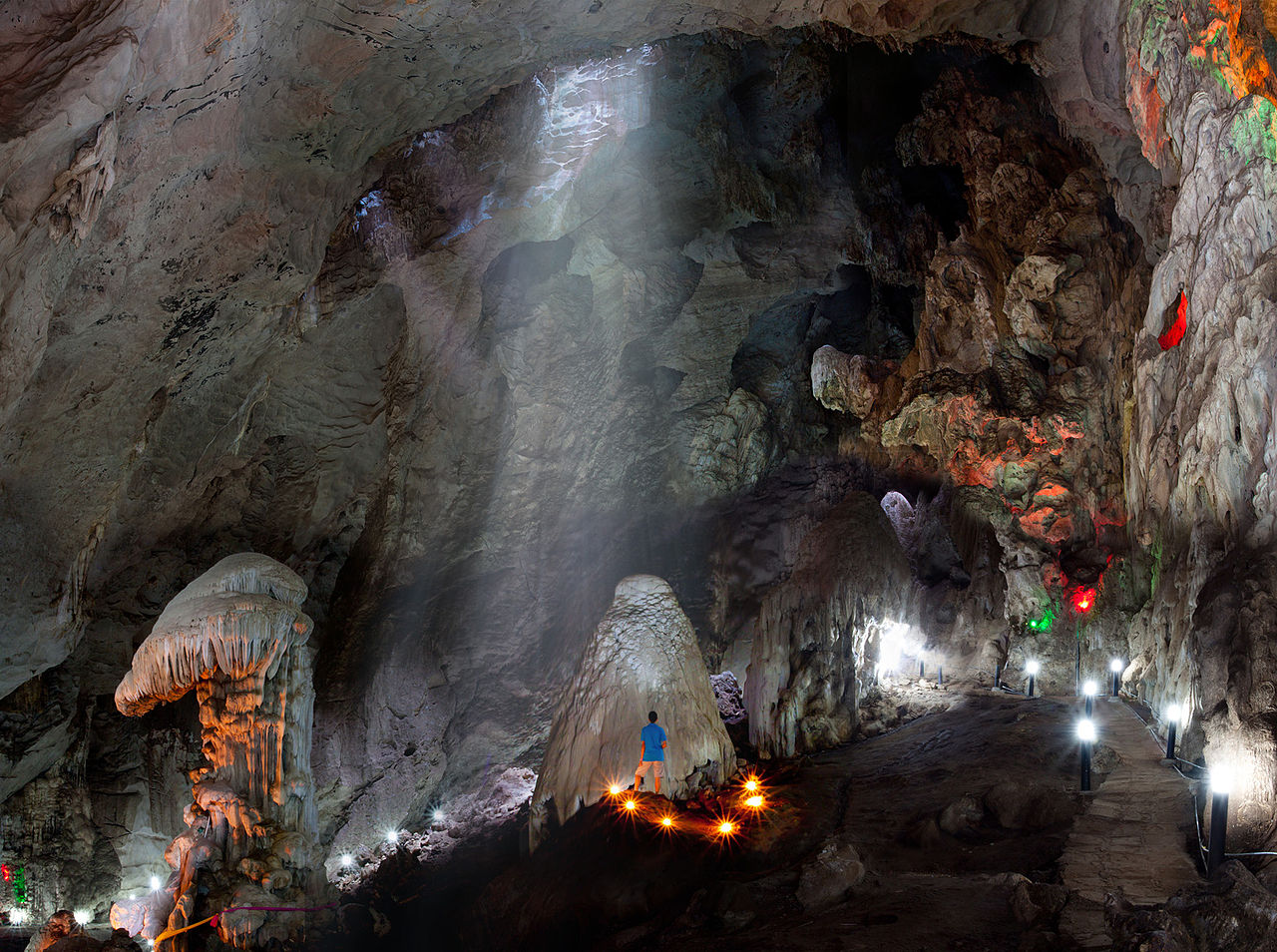
Erawan Cave, or Wat Tham Erawan, sits in Na Wang District in the north of Nong Bua Lamphu, near the border with Loei province. It's a large limestone cave set on a limestone mountain range that, from a distance, resembles a crouching elephant — hence the name Erawan, after the mythical three-headed elephant. The temple and car park sit at the foot of the hill, and from there you climb roughly 600-plus concrete stairs winding up the mountainside to the cave mouth, with rest pavilions along the way to catch your breath. At the cave mouth stands a large Buddha image, and the wide-open cave opening looks out over fields and villages far below — both a place of worship for locals and a photo spot for out-of-town visitors.
The appeal here is getting both merit and a view. Since entry is free and it's not too far off the Udon Thani–Loei route, many travelers add it as a stop on an upper-Isan trip. Inside the cave are stalactites, stalagmites, and chambers to explore, and the air inside is noticeably cooler than outside. The liveliest time is the Erawan Cave hill-climbing merit-making festival held every year around April, with processions and merit-making activities up the "stairway to heaven." If you want quiet, avoid the festival period and long holidays — go in the morning before the sun gets strong for an easier climb, and aim to arrive before 3pm since the cave closes to visitors according to operating hours.
A few honest things to know before visiting: several hundred stairs take real effort — anyone with knee problems, older visitors, or those with young children should pace themselves and take it in stages. Bring water up with you since there's little available at the top. Some spots inside the cave are quite dark with insufficient light, and the floor can be damp and slippery in places, so wear shoes with good grip and watch your footing. Some reviews note the cave itself isn't as large or grand as expected — if you set expectations very high you may feel a bit underwhelmed, but as a free hillside prayer-and-view stop, most people say it's worth the effort. This is a temple, so dress modestly, remove your shoes, and be respectful when entering the area with the Buddha image.
- Free entry, not far off the Udon Thani–Loei route, making it a convenient stop on an upper-Isan trip
- A spacious limestone cave with a large Buddha image to pay respects to, and a cave mouth opening onto far-reaching field views
- Combines merit-making with exercise from the climb — the air inside the cave is cooler than outside, with rest pavilions along the way
- Ranks near the top of things to do in Nong Bua Lamphu on Tripadvisor and holds a Travelers' Choice award
- Requires climbing several hundred stairs, which takes real effort — those with knee problems, older visitors, or families with young children should pace themselves
- Some spots inside are dark with insufficient light, and the floor can be damp and slippery in places — watch your step and wear shoes with good grip
- Some reviews note the cave isn't as large or grand as expected — setting expectations too high may lead to disappointment
Wat Phra Phutthabat Phu Kao + Prehistoric Rock Paintings (Tham Achan Sim, Tham Muem) on Phu Kao, Non Sang District
Wat Phra Phutthabat Phu Kao sits on the Phu Kao mountain range in Non Sang District, serving both as a temple with a Buddha footprint to pay respects to and as a gateway to one of Nong Bua Lamphu's most fascinating archaeological sites. Around the temple, sandstone rock shelters and low caves are scattered across several spots. On some rock-shelter walls, such as Tham Achan Sim and Tham Muem, prehistoric rock paintings from roughly three to four thousand years ago still survive — depicting human figures, fish, handprints, and various symbols in red ochre pigment, traces of the ancient people who once lived in this area. Climbing up to see them gives you both a sense of the sacred and a reminder that the land of Isan carries a longer history than you might think. Beyond the rock paintings, the area is filled with sandstone boulders weathered by wind and rain into striking shapes, some stacked on top of each other like natural pagodas — worth a full day of leisurely exploring.
The appeal here is the quiet and the untouched nature of it, without the crowds seen at other famous Isan attractions, so you can explore the rock shelters without jostling for space. The trail up to the rock paintings is a short hiking path, with some sections requiring a bit of scrambling over rocks and a gentle incline, so wear sneakers or hiking shoes with good grip. Bring enough water, since there are no shops up top. The most comfortable time to visit is cool season into early hot season, roughly November to February, when it's not too hot and the trail isn't slippery; during the rainy season the rocks get slippery and the vegetation overgrown, so extra care is needed. Morning visits give softer light and cooler air than the afternoon.
A few honest things to know before visiting: the site is fairly remote with no public transport, so you'll need your own car or a rental. The final stretch of road climbs the mountain and is narrow and steep in places, so check your vehicle's condition and fill up on fuel beforehand. Directional and explanatory signage for the rock paintings is limited, and some spots are hard to find without asking locals or temple staff first. Some of the rock paintings have faded with time and require careful looking and good light to make out clearly — never touch or pour water on the rock walls to try to make the images clearer, as this accelerates their deterioration. Facilities such as restrooms and restaurants are limited, so handle those needs and stock up on supplies from the district town beforehand, and allow enough travel time so you're not rushed.
- See genuine prehistoric rock paintings thousands of years old — human figures, fish, handprints, and symbols from ancient Isan
- Free entry with a quiet atmosphere and few crowds, letting you explore at your own pace
- Beyond the rock paintings there's a Buddha footprint to pay respects to and striking naturally weathered sandstone formations
- A short hiking trail suited to history and nature lovers wanting to avoid crowded attractions
- Remote with no public transport, requiring your own car or a rental — the final stretch of mountain road is narrow and steep in places
- Directional and explanatory signage for the rock paintings is limited, making some spots hard to find without asking locals first
- Some rock paintings have faded with time and require careful looking, and restrooms and restaurants in the area are limited
Nong Bua Public Park & King Naresuan Shrine

Nong Bua Public Park centers on a large lake in the middle of Nong Bua Lamphu town that holds water year-round. Roads and walking paths circle the lake for locals to stroll, exercise, and relax in the evenings, making it a kind of community hub that anyone passing through can easily stop at. What elevates this beyond a simple park is the King Naresuan Shrine sitting by the lake, a cluster of wooden Thai-style pavilions with tiered roofs that townspeople hold in high regard. It was built to commemorate the time King Naresuan the Great is said to have led his army through and stopped at Nong Bua Lamphu during the Ayutthaya period, making it a landmark that both locals and visitors stop by to pay respects and make wishes.
One thing people often mention is the large number of chicken figurines arranged around the shrine. Tradition holds that when a wish made here comes true, the person returns with a chicken figurine as an offering of thanks, and by now there are hundreds of them, an image people associate with the site. Anyone wanting to pay respects can bring flowers and incense — there's no entry fee of any kind. Visiting in the evening before sunset catches the light beautifully on the lake's surface, ideal for a leisurely stroll and photos. Every year on January 25th, the province holds a ceremony of offerings and worship, when the atmosphere here gets especially lively.
The upside is that it's right in the middle of town, easy to reach, easy to park, and doesn't take long to cover both the park and the shrine. It makes a good short stop on the way to other places in Nong Bua Lamphu. That said, it's honestly worth remembering that this is a town public park, not a major attraction with full facilities — shops and restrooms are limited, and midday sun during hot season is fairly strong with little shade, so mornings or evenings are recommended. This spot suits anyone wanting a quiet taste of town life and to visit a shrine locals genuinely believe in, rather than expecting flashy activities. Approach it with the right expectations and it becomes a relaxing stop with a real sense of the town.
- Right in the center of Nong Bua Lamphu town, easy to reach, easy to park, and a quick stop on the way to other places
- Free entry — stroll by the lake and visit the shrine comfortably, good for families or solo travelers
- The King Naresuan Shrine is a sacred site locals hold dear, with a distinctive tradition of offering chicken figurines in thanks for granted wishes
- A good sunset-viewing spot in the evening, with a pleasant atmosphere for photos
- It's a town public park, not a major attraction — you can cover it quickly
- Facilities such as shops and restrooms are limited
- Midday sun during hot season is strong with little shade, so avoid visiting around noon
Nong Bua Lamphu City Pillar Shrine (Phra Wo-Phra Ta Shrine) — A central-town landmark and starting point for a walk through the old quarter
The Nong Bua Lamphu City Pillar Shrine sits right in the center of town, serving both as a spiritual anchor for residents and a historical landmark that tells the story of the town's founding in a single stop. Many people call it the Phra Wo-Phra Ta Shrine, after the two leaders locals regard as the founding ancestors of the town. Local legend tells of Phra Wo and Phra Ta leading people to settle by a large lake filled with blooming lotus flowers, which later became the source of the name Nong Bua Lamphu ("lotus lake"). Standing before the shrine and reading the accompanying history plaque, it becomes clear why the town's name and these two figures remain so closely tied in local memory.
The shrine itself is a pointed-roof Thai-style building with a calm atmosphere, where locals regularly stop by to pray and make vows, especially before a long journey or starting something new. Its location works well for visitors too, since it's near Nong Bua Public Park, the town's green lung, Wat Si Khun Mueang, an old temple central to the province, and the town market, all within comfortable walking distance. That makes it a good starting point for a walking tour of town — pay respects at the shrine, walk on to the temple, stop by the lakeside park, then finish with food at the market, all in a single morning. There's no entry fee, parking is convenient, and no booking is needed.
A few honest things to know before visiting: first, this is a sacred site that locals hold in deep respect, so dress modestly, remove hats and sunglasses when paying respects, and keep your voice down when others are praying. Second, midday sun in Isan is quite strong and hot, so mornings or evenings make for more comfortable sightseeing around town. Third, the shrine itself doesn't take long to see, so if you're in Nong Bua Lamphu, plan to pair it with nearby spots like Nong Bua Park or in-town temples to make the most of the trip. Fourth, the area around the shrine is a community district with traffic passing through, so be careful crossing the street and find proper parking before setting off on foot. Offering items like flowers and incense are sold by small nearby vendors at your discretion, with no obligation to buy.
- Free entry with convenient parking and no booking required — stop by any time of day
- Centrally located, within walking distance of Wat Si Khun Mueang, Nong Bua Public Park, and the market — a good starting point for a town walking tour
- You'll learn the origin of the town's name and the story of Phra Wo and Phra Ta, the founders of Nong Bua Lamphu, from a single history plaque
- A calm atmosphere, and a genuine spiritual anchor where locals really do come to pray
- The shrine itself doesn't take long to see — pair it with nearby spots like Nong Bua Park or in-town temples to make the trip worthwhile
- As a sacred site, you'll need to dress modestly and stay respectful — not a casual photo-op spot
- Midday sun in Isan is strong and hot, and the area around the shrine has traffic passing through, so be careful crossing streets and finding parking
150-Million-Year-Old Shell Fossil Museum and Non Than Dinosaur Park (Shell Fossil & Dinosaur Museum, Non Than)

The 150-Million-Year-Old Shell Fossil Museum sits in Ban Huai Duea, Tambon Non Than, within Mueang Nong Bua Lamphu District. It began when a sand-pit excavation happened to uncover large numbers of fossilized bivalve shells turned to stone. Geologists later surveyed the site and dated the fossils to roughly 150 million years old, along with remains believed to belong to dinosaur ancestors found in the same rock layer. The province then developed the area into a learning center and museum. Inside, the exhibits are divided into 6 zones, starting with a welcome zone featuring the Non Than dinosaur family, a zone exploring the universe with a model solar system, a zone on the origin of life on Earth, a predator kingdom zone, a "wonders of discovery" zone showing a real wall of shell fossils, and a zone tracing the predators — a continuous walk-through that feels like stepping back to prehistoric times.
The appeal here is seeing shell fossils embedded in rock right at the spot where they were discovered, not just replicas, giving kids who love dinosaurs and anyone interested in geology a clear picture of how fossils form and are preserved in stone. Outside the building is an open-air dinosaur park with several dinosaur models set up for photos, ideal for families with young kids to run around in an open space. The museum is open daily roughly 08:30–16:30 (closed some Mondays — check ahead). Entry is very cheap, around 20 baht for Thai visitors and 50 baht for foreigners, with young children priced by height or free. It's easy to reach by private vehicle and not far from Nong Bua Lamphu town, making it a good stop en route to other sights in the province.
A few honest things to prepare for: this is a mid-sized local museum, so some information panels and displays may be a bit dated compared to bigger dinosaur museums like Phu Wiang or Sirindhorn. Anyone expecting interactive touchscreen exhibits may find it fairly simple. Some of the outdoor dinosaur models show wear from years of sun and rain. Midday sun is very strong, so bring an umbrella, hat, and water for the outdoor park, and check opening hours since it can close on Mondays or public holidays. But given the low entry cost and how rare a learning site like this is, it's good value for families and anyone passing through Nong Bua Lamphu.
- See shell fossils roughly 150 million years old embedded in rock right at the spot where they were found, not replicas
- 6 zones to walk through continuously, with an outdoor dinosaur park for kids to run around and take photos
- Very cheap entry (around 20 baht for Thais), making it good value learning for families
- Easy to reach by private vehicle, not far from Nong Bua Lamphu town, and a good indoor activity to escape sun or rain
- A mid-sized local museum, with some information panels and displays a bit dated
- Some outdoor dinosaur models show weathering from sun and rain, and midday sun is very strong
- Sometimes closed on Mondays and public holidays — check the schedule before traveling
Tao To Waterfall Forest Park (a forest waterfall along Highway 210 + Chao Pu Lup Shrine)

Tao To Waterfall Forest Park is one of the closest forest waterfalls to Nong Bua Lamphu town, sitting along Highway 210 on the Nong Bua Lamphu–Udon Thani route, about 3 kilometers from town. Its highlight is a stepped rock waterfall cascading through shaded, cool forest. It's a short walk from the car park to the falls, making it a good spot to break up a journey and change the scenery, rather than a big waterfall requiring a long hike. Within the same area is the Chao Pu Lup Shrine, a sacred site respected by locals, so many visitors take the chance to pay respects and make a wish for good fortune while they're there. Some spots in the forest park also offer views out over Nong Bua Lamphu town in the distance.
The best time to visit is rainy season, roughly June through October, when water volume is at its highest and the current runs strong, giving a fuller waterfall and fun splashing. Outside the rainy season, water levels drop substantially and some years it nearly dries up, leaving just rocks and shaded trees. If you specifically want to see the waterfall, check recent reviews or ask locals about water conditions before setting out, as visiting in the wrong season can be disappointing. Entry is free, with a rest area and small food stalls near the entrance on some days. It's easy to reach right off the main road, and driving yourself or renting a car gives the most flexibility. Most visits wrap up in one to two hours.
A few honest things to prepare for: outside rainy season, the water flow can be much less than photos in reviews suggest, so don't expect a full waterfall year-round. The rocks around the falls get slippery easily, especially when there's water, so wear non-slip shoes and watch your footing on the rocks. On holidays or festivals, locals often come to relax and play in the water, so it can get busy with limited parking. Please help keep the forest clean by taking your trash with you and not leaving food scraps on the rocks, since this is a free park maintained on a limited budget. This spot works best as a supplementary stop rather than a standalone highlight — pairing it with nearby sights like the King Naresuan Shrine or the in-town museum makes for a more worthwhile visit.
- Right off Highway 210, just about 3 km from town, an easy stop along the Nong Bua Lamphu–Udon Thani route
- Free entry, with a short walk from the car park to the waterfall
- Shaded, cool forest with the Chao Pu Lup Shrine to pay respects at and a town viewpoint in the same area
- Rainy season brings a strong, fuller waterfall for splashing and photos, with visits wrapping up in one to two hours
- Outside rainy season, water is often low or nearly dry, which may not match photos in reviews
- Rocks around the falls get slippery when wet — watch your footing and wear non-slip shoes
- A small, low waterfall best treated as a supplementary stop rather than a standalone highlight, with crowds and tight parking on holidays
The Reservoir Above Ubolratana Dam, Phu Phan Kham Side (viewpoints, sunset, and riverside fish restaurants, Non Sang District)

The reservoir above Ubolratana Dam is a vast freshwater expanse forming the southern edge of Nong Bua Lamphu province. The side locals use to access it is the Phu Phan Kham area in Non Sang District, where the water stretches so wide you can barely see the opposite shore, with mountains forming a backdrop that makes it feel like a sea in the middle of Isan. Worth clarifying up front: the actual Ubolratana Dam ridge that many people picture lies within Khon Kaen province, while the Non Sang side of Nong Bua Lamphu is the shoreline used for viewing, dining, and swimming — not the dam structure itself. Most visitors come here for the lakeside atmosphere rather than to see the dam itself.
The main appeal of the Phu Phan Kham side is the evening hour, as it's a spot where you can watch the sun gradually set behind the mountain range, casting light across the water's surface. The lakeshore, such as Had Non Yao beach, has restaurants and long dining pavilions where the local specialty is fresh freshwater fish from the dam — grilled, fried, or in spicy soup — reasonably priced when shared among a group. Some spots offer banana boats and raft rentals for sitting out on the water. The reservoir also serves as a fish breeding ground and a known fishing spot for locals, so you'll often see people casting lines along the shore. For an even higher vantage point, Phu Kao-Phu Phan Kham National Park up the hill has viewpoints and the skywalk looking down over the whole lake, though that requires driving up the mountain and a separate park entry fee.
Things to prepare for: this is a natural, rural-style destination, not a fully built-up tourist attraction. Some shoreline restaurants aren't fully open, especially on weekdays when there are fewer visitors. Water levels rise and fall depending on the season and dam releases — during dry season the water can drop, widening the beach and forcing restaurants to shift along the waterline, while rainy season brings fuller water and pretty views but unpredictable sun and rain. The most convenient way to get around is with your own car or a rental, since public transport barely reaches the lakeside spots. Go in the late afternoon to catch the evening light, bring mosquito repellent and a sun hat, and if you want the freshest fish, ask the restaurant what's in season that day, since the catch changes daily.
- Vast water stretching as far as the eye can see with a mountain backdrop, feeling like a sea in the middle of Isan, especially at sunset
- Free entry to the Phu Phan Kham side and lakeshore, ideal for relaxing by the water without an entry fee
- Shoreline restaurants serve fresh freshwater fish from the dam at reasonable group prices, with banana boats/rafts available at some spots
- A known local fishing spot, with viewpoints/skywalk within Phu Kao-Phu Phan Kham National Park nearby for those wanting an elevated view
- A rural-style natural destination with limited facilities — some shoreline restaurants aren't fully open, especially on weekdays
- Water levels rise and fall with the season and dam releases, so the shoreline and restaurant locations can shift during dry season
- Public transport barely reaches the lakeside spots — you'll almost need your own car or a rental to visit comfortably
Where to stay in Nong Bua Lamphu?
Choose a hotel in Nong Bua Lamphu town for easy travel, or in the Nong Sawang-Non Sang area near the reservoir. Compare prices across 3 sites before booking.
Search hotels on AgodaBook activities & tickets in advance
Sights are spread outside town and require climbing hills, so booking a car or package in advance makes getting around much easier.
💡 Know before you visit Nong Bua Lamphu
Wat Tham Klong Phen is a forest temple in the Luang Pu Khao lineage, at the foot of Phu Phan on Highway 210, about 13 km from town. It has a wax figure museum and a Buddha image amid rock formations, with a quiet atmosphere — dress modestly and stay respectful.
The Phu Aen Skywalk and Chong Khao Khat viewpoint within Phu Kao-Phu Phan Kham National Park overlook the Ubolratana reservoir, at their best in the evening for sunset, with the forest changing color around November. Have a car and check opening hours.
Erawan Cave in Na Wang District is a large hillside cave requiring a fair climb up stairs to reach the cave mouth, which has a Buddha image and wide views. Bring comfortable walking shoes and water — best for those who can handle the climb.
On Phu Kao are rock shelters with prehistoric paintings (Tham Achan Sim, Tham Muem) thousands of years old, along with Wat Phra Phutthabat Phu Kao, both within the national park and fairly remote — have a car and ask about directions in advance.
How to plan a worthwhile Nong Bua Lamphu trip
Nong Bua Lamphu works well as a comfortable 1–2 day trip. Day one, focus on temples and caves: visit Wat Tham Klong Phen in the morning, continue to Suwannakhuha Cave and Erawan Cave, then relax in the evening at Nong Bua Park and the King Naresuan Shrine in town. Day two, focus on nature: head to Phu Kao-Phu Phan Kham National Park to see the Phu Aen Skywalk, the Chong Khao Khat viewpoint, and the rock paintings on Phu Kao, then stop by the 150-million-year-old shell fossil museum. Nong Bua Lamphu also combines well with Udon Thani, Loei, or Khon Kaen.
Ready to visit Nong Bua Lamphu? Start by choosing where to stay in town.
See hotels in Nong Bua Lamphu →