🔄 Last checked 27 Jun 2026 · details and hours can change — check the venue before you go
📍 All restaurants on the map
Tap a pin for the spot + nearby stays
The charm of Kamphaeng Phet is that it's a relaxed World Heritage city on the Ping River with its best sights packed close together. Most highlights sit in the town area and on the Nakhon Chum side, just a few minutes' drive across the bridge. At the centre of it all is Kamphaeng Phet Historical Park, listed by UNESCO as a World Heritage Site alongside Sukhothai and Si Satchanalai. Reddish-brown laterite temple ruins, large Buddha images, and the aranyik (forest-monastery) group — such as Wat Chang Rop and Wat Phra Si Iriyabot — sit quietly among tall shady trees, so you can walk and shoot photos all day. Cross the Ping River to Nakhon Chum and you'll find the gleaming golden Mon-Burmese-style chedi at Wat Phra Borommathat, a fixture of the town for over 600 years. Nearby there's the Nakhon Chum Retro Market, where vendors in traditional Thai dress sell old-fashioned sweets, riverside cafés for catching the evening breeze on the Ping, and a golden-teak Thai House Museum to stroll through in a shady garden. There's plenty here for the spiritually inclined, the old-town wanderer, the nature lover, and the photographer.
This list includes the pins you shouldn't miss in Kamphaeng Phet — like Kamphaeng Phet Historical Park, one of UNESCO's World Heritage cities, which preserves Sukhothai-era monuments both inside the old city walls and in the aranyik group; Wat Phra Borommathat Nakhon Chum, a royal temple enshrining Buddha relics that the spiritually minded make a point of visiting to pray; Na Boon Bridge at Wat Thung Sanun Rattanaram, running 356 metres in each of four directions across green rice fields toward the shrine of the rice goddess Phra Mae Phosop; Phra Ruang Hot Spring, where you can sit on a bamboo bench and soak your feet in warm mineral water in a shady garden; the deep-blue Blue Pond nicknamed the Grand Canyon of Kamphaeng Phet; and Khlong Lan Waterfall, a large cascade roughly 100 metres tall in a national park where you can wade in. Scroll through spot by spot and map out your own route.
Kamphaeng Phet Historical Park
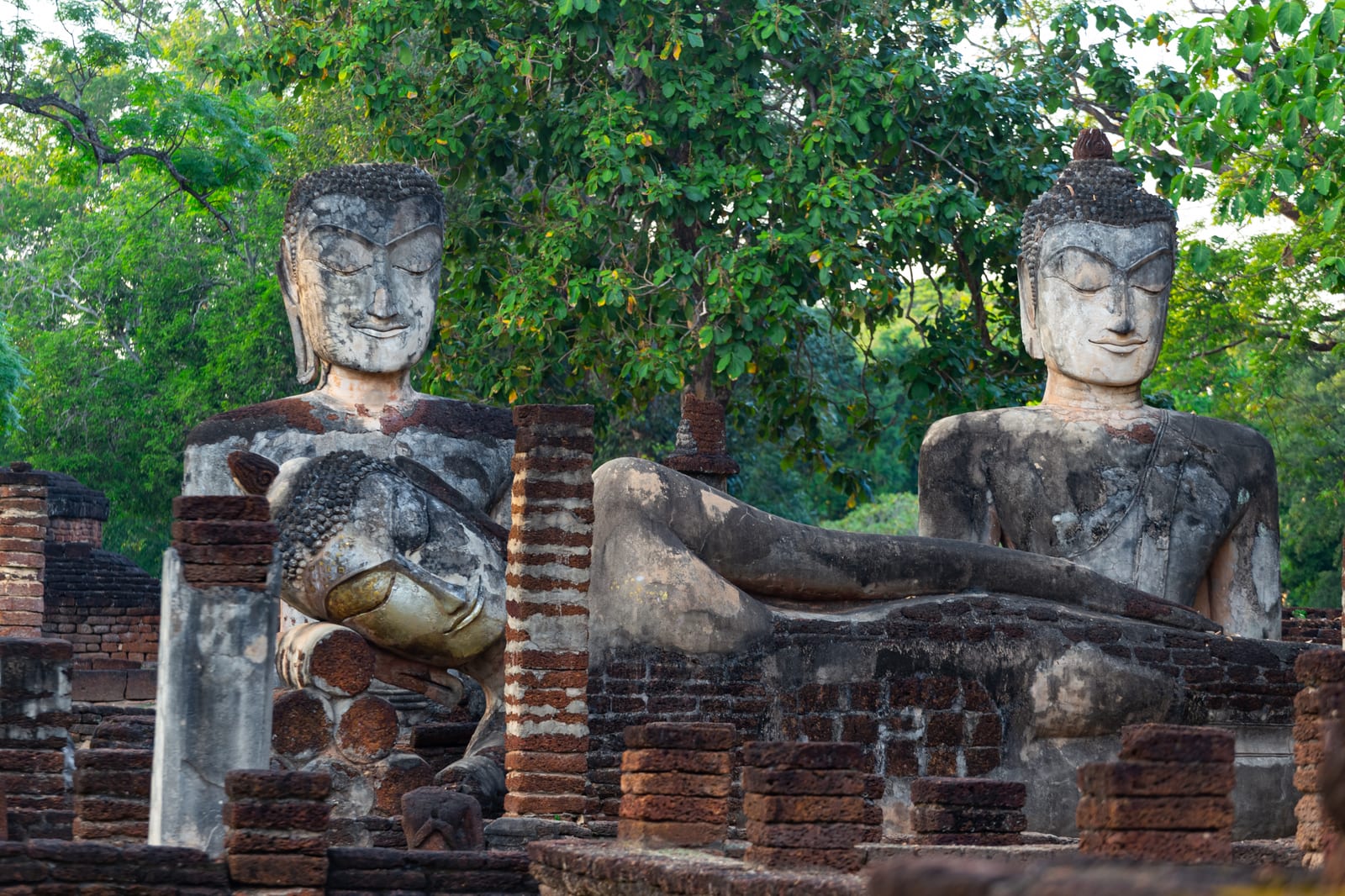
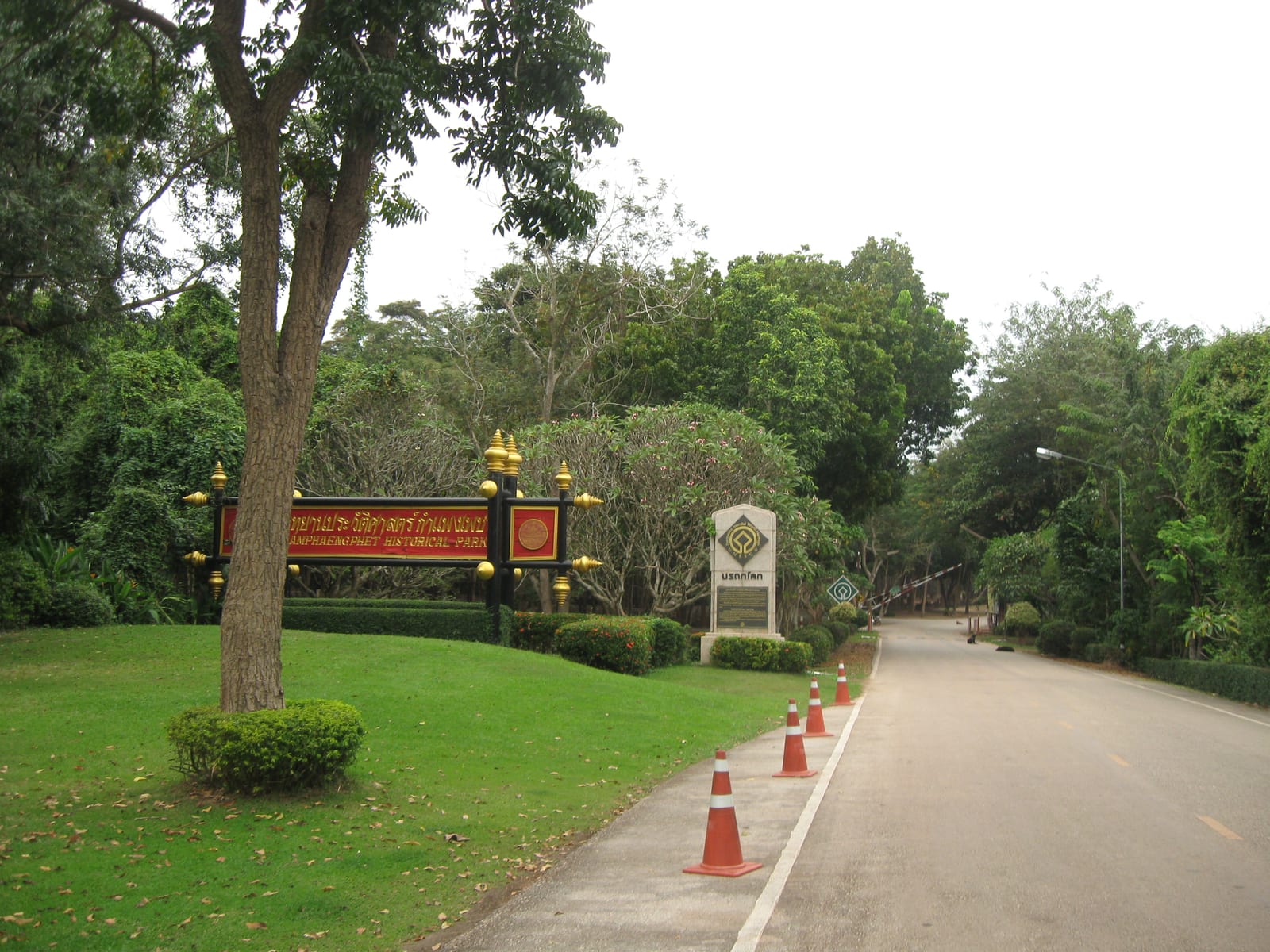
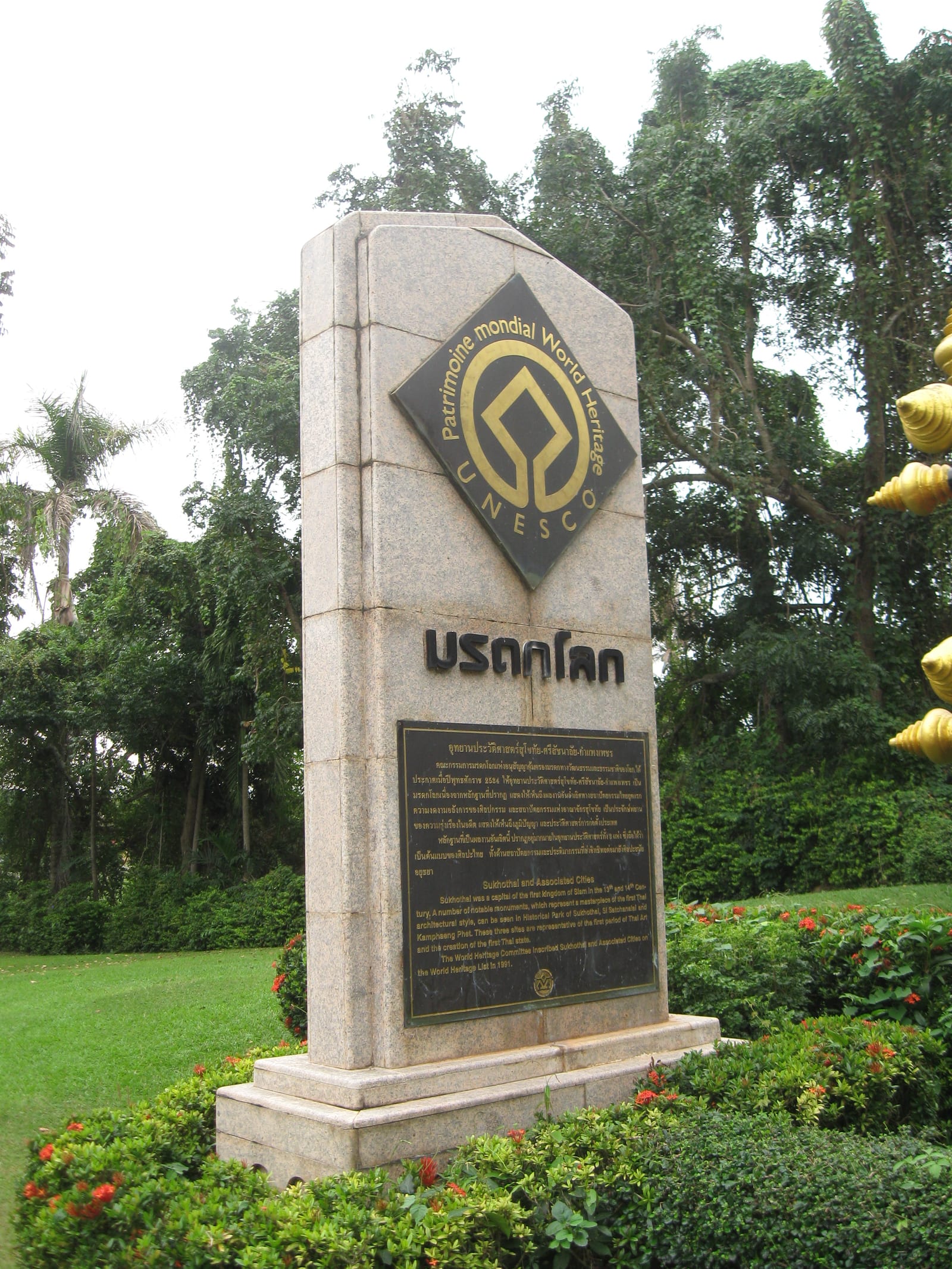
If you like walking among old temple ruins in shady forest, Kamphaeng Phet Historical Park is a place to visit at least once. It's a UNESCO World Heritage Site, inscribed together with Sukhothai and Si Satchanalai under the name 'Historic Town of Sukhothai and Associated Historic Towns.' The draw is Sukhothai-era laterite ruins and Buddha images scattered across the woodland — ideal for anyone who loves history, atmospheric photography, and a setting that isn't as crowded as Sukhothai. Many reviews agree that the trees here are plentiful, keeping it cooler and more pleasant to walk than other sites.
The highlights fall into two zones. Inside the old city walls are Wat Phra Kaeo, a large central royal temple, and the adjacent Wat Phra That. But the real must-see is the aranyik zone outside the walls: Wat Chang Rop, a bell-shaped chedi on a broad base ringed with half-body stucco elephants, and Wat Phra Si Iriyabot, whose mondop enshrines Buddha images in the four postures — standing, walking, sitting, and reclining — with the standing figure still showing its graceful outline. Many reviewers warn that the paths are sand mixed with gravel and dry leaves, so wear comfortable walking shoes.
Entry is 20 baht for Thais and 100 baht for foreigners; if you drive into the aranyik zone, add 50 baht per vehicle. Open daily 08:30–16:30. The park is in Tambon Nong Pling, a few kilometres from the old-town centre on the east side of the Ping River. In the evening, some spots near the city walls are lit up, and the monuments stay beautiful into the night.
It's popular because it's a World Heritage site that's still quiet, letting you take it all in without competing for photo angles. Just know that the area is large and the sun is strong — in the hot season, come in the early morning or late afternoon, bring water and a hat, and allow enough time to walk both zones in full.
Wat Phra Borommathat Nakhon Chum (Royal Temple)
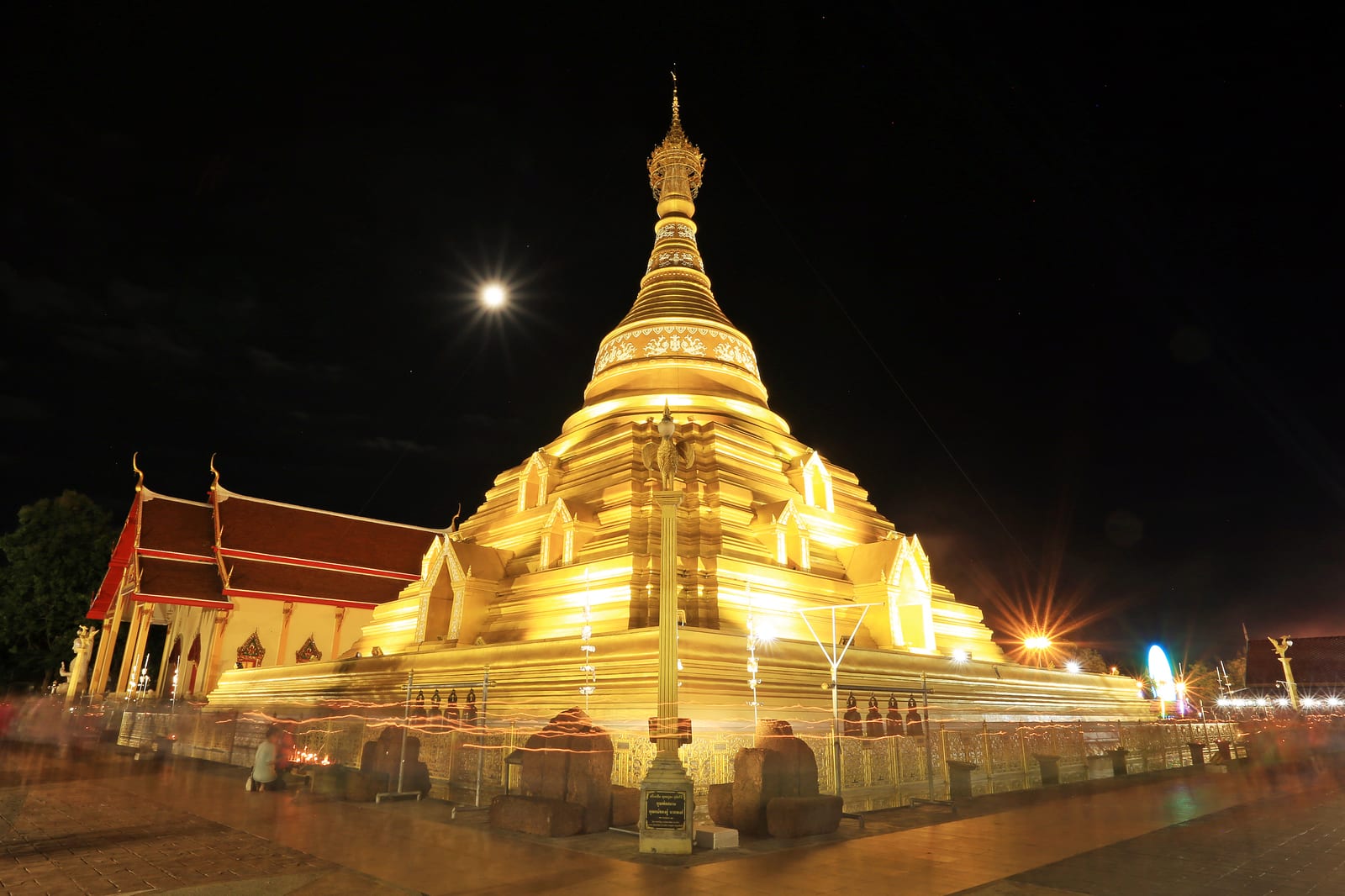
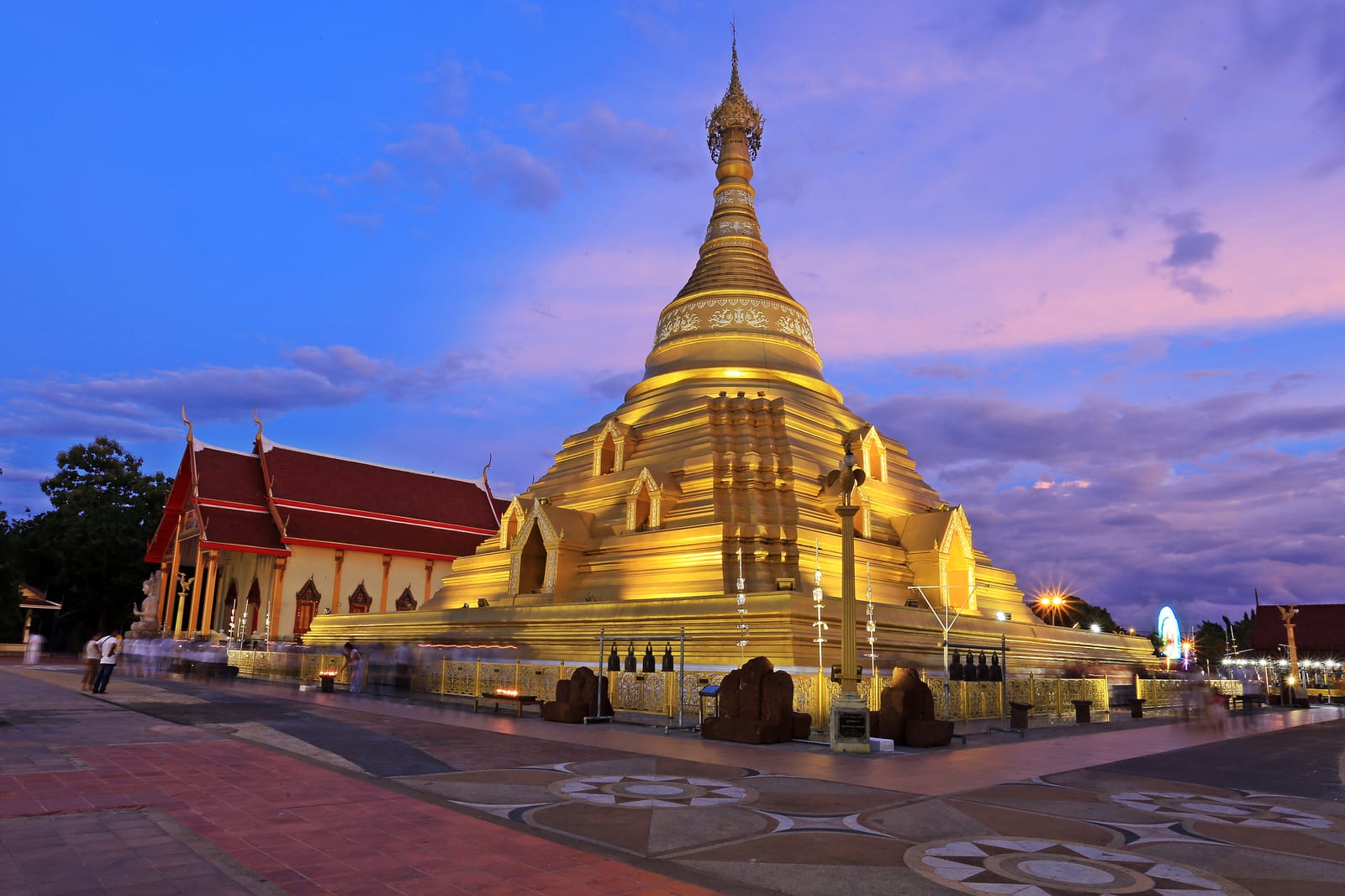
If you come to Kamphaeng Phet and want to pay respects at the temple locals consider truly 'of the town,' Wat Phra Borommathat Nakhon Chum ranks near the top for residents here. The temple sits on the west bank of the Ping River in the old town of Nakhon Chum, built together with the town in the Sukhothai period, over 600 years old. The highlight, visible from afar, is a great Mon-Burmese-style chedi gilded gold from top to bottom, enshrining nine Buddha relics. It was originally three lotus-bud chedis on a single base, before Phraya Taka and Pha Po — timber-trading magnates in the reign of Rama V — restored and encased it in the Mon form you see today. It suits the spiritually inclined who come to pray, and anyone who enjoys old temples with a story.
Beyond the golden chedi, genuine Google reviews — scoring it as high as 4.7 — often mention how shady, clean, and orderly the temple grounds are, and how kindly the monks share its history. Besides circling the chedi, don't miss the reclining Buddha viharn (Phra Phuttha Saiyat), the old ubosot, and the large stone Dharmachakra in the temple courtyard. Photographers will find the golden chedi striking against the sky, especially in the soft light of early morning or evening.
Budget-wise you can relax: entry is free, with no admission charge. The temple is not far from the town centre and the Ping River bridge, easy to reach by car or bus, with convenient parking. Reviews note it's open all day, but to enter the viharn and pay respects properly, come around 08:30–16:30 when staff are on hand and the buildings are all open. If you visit in February, you'll catch the annual Phra Borommathat Nakhon Chum homage festival, which is especially lively.
A note for out-of-towners: this is a royal temple and deeply revered by locals, so dress modestly, remove your shoes before entering the viharn, and keep your voice down. If you're planning a Nakhon Chum outing, make this your first stop and follow it with the Nakhon Chum Retro Market or the historical park across the river. It's a worthwhile stop for the devout, for history lovers, and for anyone who wants a beautiful golden-chedi photo in Kamphaeng Phet.
Phra Ruang Hot Spring (Bueng Sap)
If you've been out all day in Kamphaeng Phet and want somewhere to unwind in a Thai style, Phra Ruang Hot Spring (Bueng Sap) is what locals like to recommend. It's in Moo 3, Tambon Lan Dok Mai, about 13 km from town toward Phran Kratai — a natural hot spring bubbling up from underground at five points, around 58°C (measured between 40 and 65°C depending on the spot), certified clean and safe by the Ministry of Public Health. It suits the wellness-minded, families, older visitors, and anyone who wants a Thai-style onsen soak at an easy price.
The must-do is sitting on a bamboo bench and soaking your feet in the hot mineral pool in the shady garden — it's free, and the spot people like most because you can sit and catch the breeze for a long while. If you want a full soak, there are private mineral bath rooms to rent, and you can follow up with a relaxing Thai massage. The grounds have a pretty flower garden for photos, a Phra Ruang shrine to pay respects at, and, at times, pedal boats for the kids.
The cost is very low: free entry, free foot-soak, a private mineral bath room around 50 baht, and a soak or mineral bath around 30 baht. Open daily 08:00–17:00. Most reviews praise it as clean, quiet, and uncrowded, with attentive staff — a good half-day stop before heading on to Sukhothai.
A couple of things to know: the water really is hot, especially at the source points, so ease in slowly and watch small children. Early morning and evening have the best air, and on weekdays it's quiet and easy to stroll. The Google review score sits around 4.3 from over a thousand raters, showing it's a genuinely popular rest stop in Kamphaeng Phet.
Na Boon Bridge, Wat Thung Sanun Rattanaram
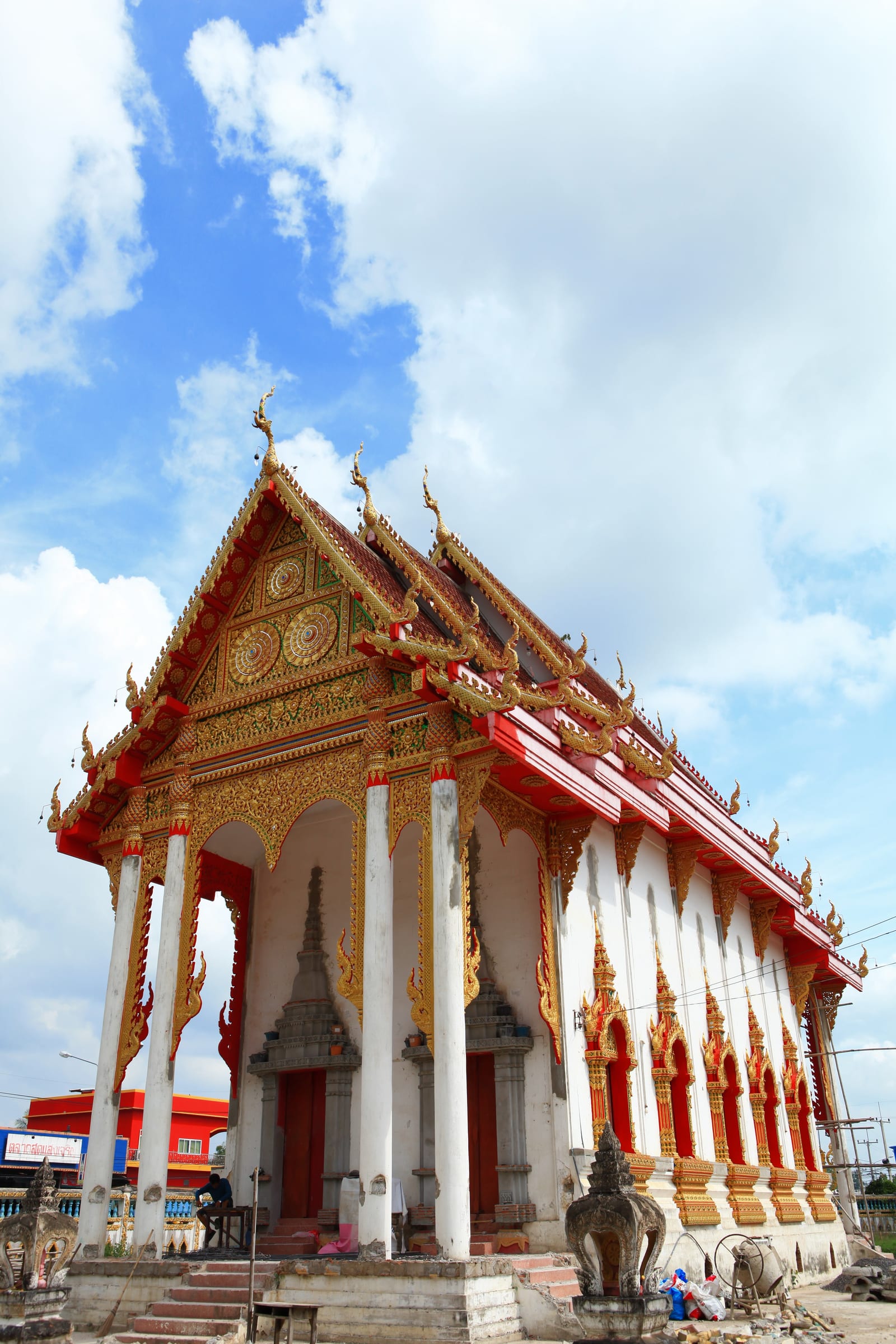
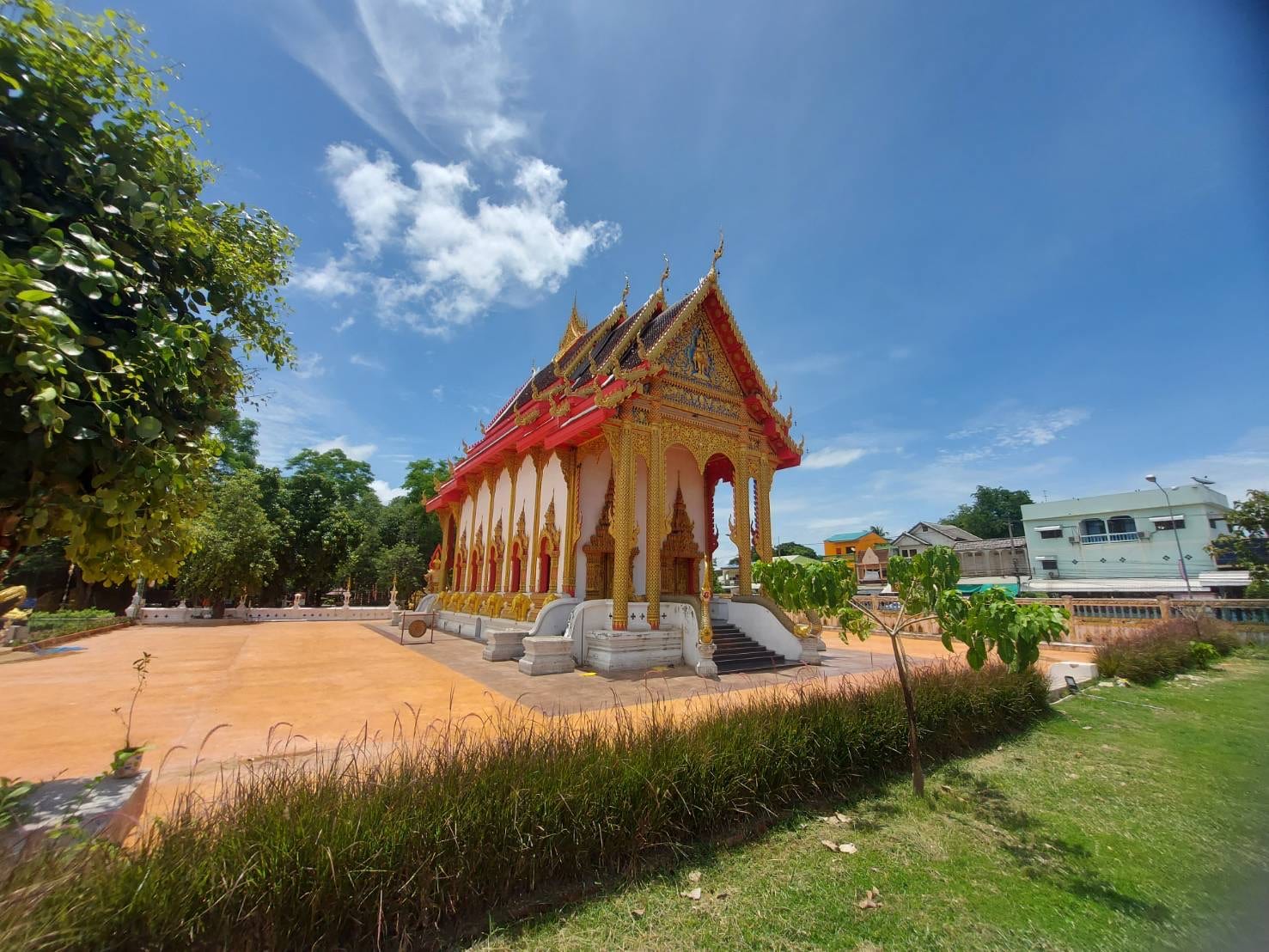
If you want a Kamphaeng Phet spot that gives you green views and a chance to make merit at the same time, Na Boon Bridge at Wat Thung Sanun Rattanaram in Tambon Rahan, Bueng Samakkhi District, is a place many people mention. The highlight is a wooden bridge called 'Saphan Bun Yorot' that runs 356 metres from each of four directions, converging in the middle of the fields where the shrine of the rice goddess Phra Mae Phosop stands. It was originally built as a walking meditation path for practitioners, which is why it's known as one of the longest walkways in the lower North. It suits anyone who loves a peaceful setting, families, and photographers after an unusual frame.
The must-do is climbing the field-viewing tower for an aerial-style shot of the wooden bridge against green rice fields stretching to the horizon in every direction. People who've been agree the morning breeze is pleasantly cool, while the evening has beautiful light and sunsets over the fields. Beyond the bridge, the temple has sacred images to pay respects to — Luang Pho Phra Chao Bun Lan, the Phra That Khao Lueak, and a naga sculpture. Visitors typically walk the bridge, take photos, then finish by praying for abundance and good fortune.
The budget is nothing to worry about: entry is free, within the temple grounds, and you can donate as your faith moves you. It's at Ban Thung Sanun, Moo 4, Tambon Rahan, Bueng Samakkhi District, open roughly 08:00–19:00 daily. One thing to know is that the beauty depends on the rice season — the fields photograph best when they're deep green. The midday sun is fairly strong in the open, so bring a hat and water and come in the morning or evening for comfort. This spot rose to fame for the rare sight of a wooden bridge in the middle of the fields, paired with merit-making — which is why it has become a popular check-in in Kamphaeng Phet.
Nakhon Chum Retro Market
If you want to meet Kamphaeng Phet in a slower, warmer version of itself, the Nakhon Chum Retro Market is worth a stop. It's a cultural walking street in the old Nakhon Chum community, across the Ping River from the town centre and near Wat Phra Borommathat Nakhon Chum. The market runs about 200 metres around the Nakhon Chum three-way junction. The signature sight is vendors in traditional Thai dress selling from bamboo benches, among old timber shophouses and a retro atmosphere that makes you feel like you've stepped back in time. It suits anyone who likes to graze and stroll, photographers, and travellers who want genuinely local food rather than a standard market.
Food is the real star here. The must-tries are Nakhon Chum local dishes that are hard to find elsewhere — Nakhon Chum-style cassia leaf curry (kaeng khi lek), old-recipe boat noodles with well-balanced broth and noodles, and old-fashioned sweets like honeycomb cake (khanom rang phueng), dok din cake, retro ice cream, and miang kham with roasted coconut. Beyond food, there's bamboo basketry and banana-leaf craftwork, and at times folk performances to enjoy as you walk. Many genuine reviews agree there's 'so much to eat,' the market is easy to walk, and it's not so packed that it feels cramped.
You'll need to plan a little for timing, because this market isn't open every day — it runs only on the Friday, Saturday, and Sunday of the first week of the month, from about three in the afternoon onward. If you're going, check that your visit falls on the first week of the month so you don't miss it. Entry is free, with no charge, and a budget in the low hundreds is plenty to graze and stroll; most items are affordably priced, community-market style.
People love it because it feels like the real thing — not a staged tourist market, but an old community that's still alive. Pair it with paying respects at Wat Phra Borommathat in the same trip. Just know it's a small market you can finish fairly quickly, weighted toward food over souvenirs, and open in the evening — come as the sun softens for the most comfortable stroll.
🛏️ Well-located hotels in Kamphaeng Phet
Covering Kamphaeng Phet's spots — in town, on the Nakhon Chum side, and out in the districts — all in one day is fairly tiring. Booking a night in Kamphaeng Phet town is easier: wake up early to walk the World Heritage historical park while it's still quiet, then drive around all day without rushing. Locations near the historical park and along the Ping River are the easiest to get around from. Compare prices and reviews for Kamphaeng Phet hotels ahead of time to get a good-value room, especially during the Nop Phra Len Phleng festival or long weekends, when rooms fill up fast.
🔍 Check Kamphaeng Phet Hotel Prices (Agoda)The Blue Pond (Sa Morakot, Kamphaeng Phet)
If you think Kamphaeng Phet is all old temples and laterite stone, the Blue Pond (which many call Sa Morakot, the Emerald Pond) will change your mind the moment you reach its rim. It's a large laterite-earth pit dug about 8–10 metres deep, filled with graded blue water — teal-green in the shallows deepening to dark blue in the middle — set against orange-red earthen walls that wind and rain have carved into ridges and layers like a small canyon, which is why people nicknamed it the Grand Canyon of Kamphaeng Phet. It's ideal for photographers, anyone who likes an unusual angle, and travellers who want a quiet nature stop between old-town sights.
The must-do is standing on the rim to shoot the blue water against the earthen walls — this is the angle that made the place popular on social media. The water is at its bluest under strong sun, when the light brings out the colour. The blue is believed to come from rain leaching minerals from the soil into the water, which changes the colour according to the minerals. One key point many reviews stress in unison: do not swim here under any circumstances — the water is deep, cold, and highly acidic, and it can be life-threatening. This is a place to view and photograph only.
On getting there, honestly, this spot isn't a fully developed attraction, as it sits on private land. The trick people who've been recommend is to drop a Google Maps pin at 'Wat Si Yothin,' not the pond's name, since the coordinates can be off. About 300 metres past the temple, turn into Soi 8 and follow the dirt track to the end. This stretch is red dirt that turns to mud when it rains, and low sedans struggle — a higher-clearance vehicle is better, or go in the dry season.
There's no entry fee; it's free to visit. People usually go at midday under strong sun for the best water colour, or in the morning or evening to avoid the heat. The pond is only about 3–4 km from Kamphaeng Phet Historical Park, so it fits nicely as an extra stop on a single day in the old town. It became known through an under-the-radar angle people follow each other to shoot, but bear in mind the water colour shifts with the season and rainfall — at times the grass grows over and the water isn't as blue as in the photos. Go without over-high expectations and you'll enjoy it more.
Shiva Shrine + Kamphaeng Phet National Museum
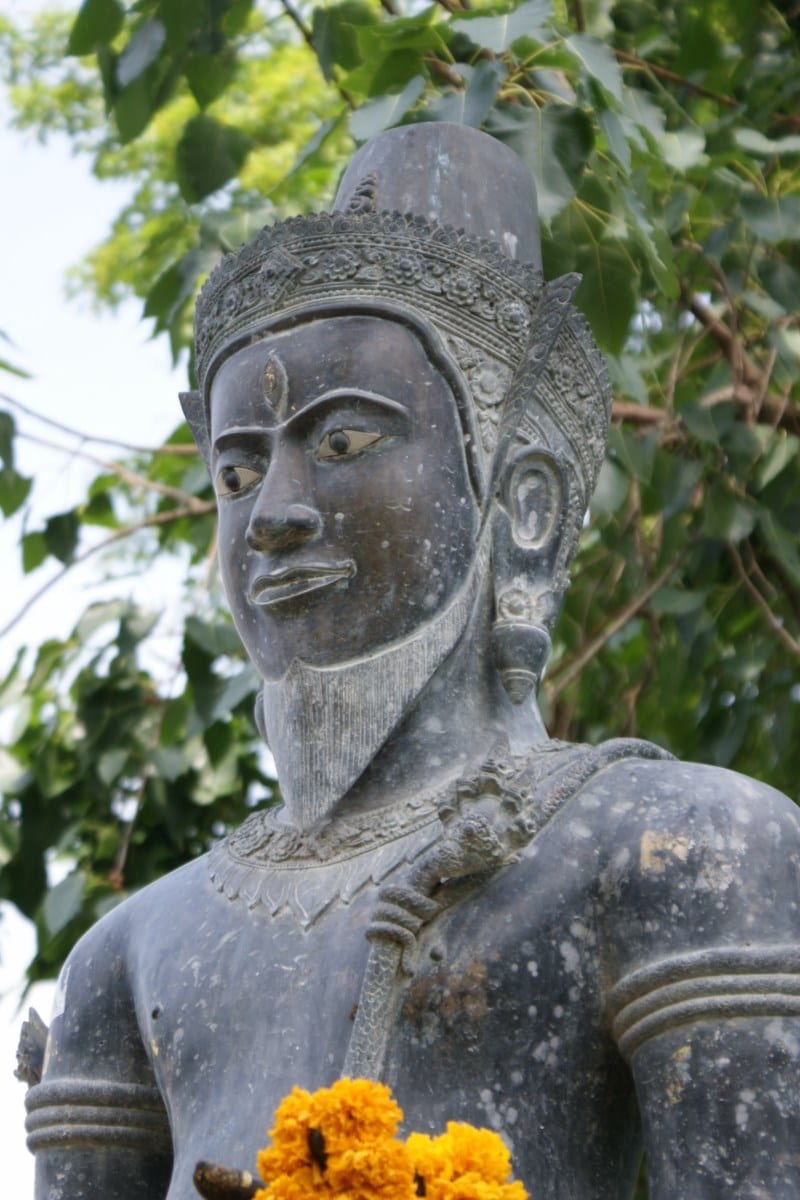
If you come to Kamphaeng Phet and want to understand the city more deeply, the Shiva Shrine is a stop you shouldn't skip. It's the only ancient Hindu shrine within the old city walls, in Tambon Nai Mueang. The shrine is a square laterite base raised about 1.5 metres, facing east, on which stands a bronze standing image of Shiva. The one you see is a replica cast for people to pay respects to; the original, about 210 centimetres tall, is a bronze work in Ayutthaya style with Bayon-Khmer influence. Its base carries an inscription giving the year 1432 in the Mahasakarat era, corresponding to 2053 BE, recounting that Chao Phraya Si Thammasokarat installed it to protect the people and animals of the city — a fine piece of evidence from the early Ayutthaya period.
The real highlight is walking the two spots together, because the original bronze Shiva was moved for safekeeping to the adjacent Kamphaeng Phet National Museum in Soi Pin Damri, just a few steps away. There you can see the bronze image up close, along with many Sukhothai-Ayutthaya antiquities unearthed in this city. Reviewers often say you can both pay respects at the shrine and pick up history at the museum in a single trip. It suits history and culture lovers, and anyone who enjoys paying respects at sacred sites for good fortune.
Budget-wise it's very easy: the Shiva Shrine is free, open for veneration daily during the day. The museum normally charges 10 baht for Thais and 30 baht for foreigners, open around 09:00–16:00 (closed Mondays and Tuesdays per the museum system, so check before you go). There's currently a renovation project with entry temporarily free — call or check the Fine Arts Department's page to confirm dates and times before travelling, as opening hours may change.
The location is convenient, within the old city, less than 2 km from town — a few minutes' drive from the in-town market, with easy parking and shady, quiet surroundings. It's popular because it combines three things in one spot: the sacred, the ancient (inscription-level history), and a good museum next door. Just know the image at the shrine is a replica — to see the original you need to enter the museum — and during Songkran there's a water-pouring ceremony over the image.
Banyakad Cafe
If you're in Kamphaeng Phet and want somewhere to sit and relax by the Ping River, Banyakad Cafe is the name in-town locals mention most. The café is in Soi Khao Khwai 1 Soi 5, Tambon Nai Mueang — central, but facing right onto the Ping River. It's done in a European-modern style, with both a glasshouse zone with cool air conditioning for those who dislike the heat, and an open-air riverside zone with canvas beds to recline on and watch the water flow. It suits couples, groups of friends, or families who want to settle in for a long while.
The highlight many say you shouldn't miss is coming in the evening to wait for sunset over the Ping River — the light is beautiful and the atmosphere quietly romantic, which is why several reviews call it the café's best photo spot. Popular drinks include the iced latte and strawberry smoothie, while for something sweet there's coconut cake, red velvet, and passion-fruit soda to alternate with the savoury dishes, which you can order as a proper meal.
On budget, coffee and cake run to the low hundreds per person, but a full meal moves to around 101–250 baht a head. Some honest reviews note a few menu items are a touch pricey and the food is just okay, so most people come mainly for the view and the atmosphere. Parking is spacious, there's Wi-Fi, credit cards are accepted, and pets are welcome.
The café is open around 10:30–21:00 (sometimes closed Mondays — check the page before you go). With its riverside location in the town centre, relaxed atmosphere, and photogenic corners, it's become a popular local café. Its Google Maps score sits around 4.5 from several hundred reviews. Come in the late afternoon to secure a riverside canvas-bed spot in time for the sunset.
Thai House Museum (Kamphaeng Phet Provincial Museum, Chaloem Phra Kiat)
If you've been walking the old city walls and the historical park until the heat sets in, this is a good place to change the pace, because it's a cluster of golden-teak Thai houses set in a shady garden on roughly 25 rai, within the old city walls in Tambon Nai Mueang, right next to the Kamphaeng Phet National Museum — an easy walk from one to the other. The buildings were constructed to mark the Golden Jubilee celebrating the 50th anniversary of King Rama IX's accession, and HRH Princess Maha Chakri Sirindhorn presided over the opening in 1997.
The charm here is the golden-teak houses raised on high posts in the central-Thai style, with cool airy underspaces and porch and wooden-stair corners that give an old, traditional-house feel — good photo spots that come out well without needing to set anything up. Inside, everyday objects, ways of life, and local Kamphaeng Phet arts and culture are on display, enough to picture how people here have lived. It suits anyone who prefers a slow atmosphere over a hurried sightseeing stop.
Another part many don't expect is a banana-cultivar garden inside, holding hundreds of varieties collected here — edible bananas, ornamental bananas, and rare types you don't often see — making it one of the country's larger banana collections. It's a pleasant, informative stroll.
Entry has no ticket charge; you donate as your faith moves you. Opening days and times may change, so it's worth checking the Facebook page 'ruanthaimuseum' before you set out, so you don't miss it.
Khlong Lan National Park (Khlong Lan Waterfall)
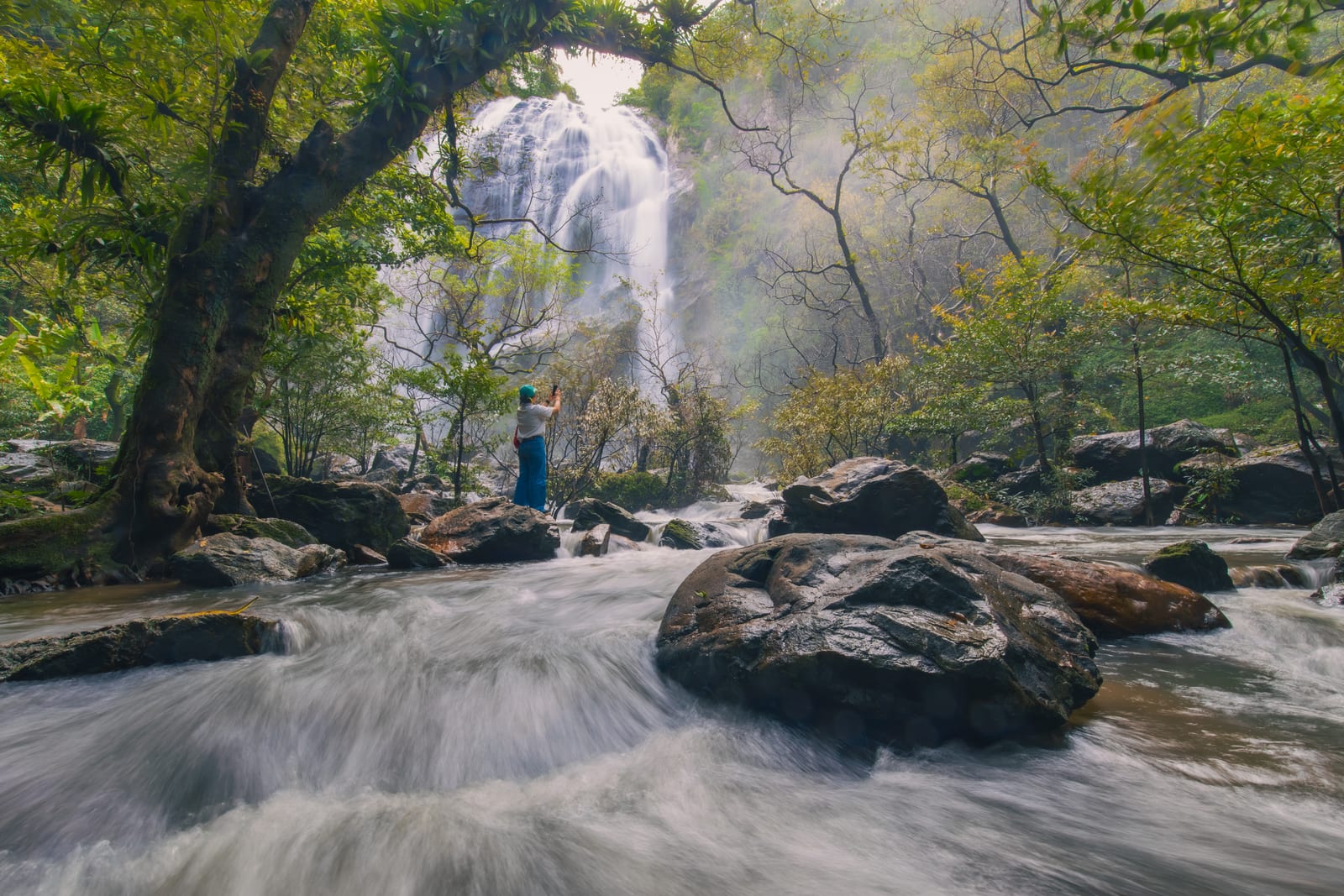
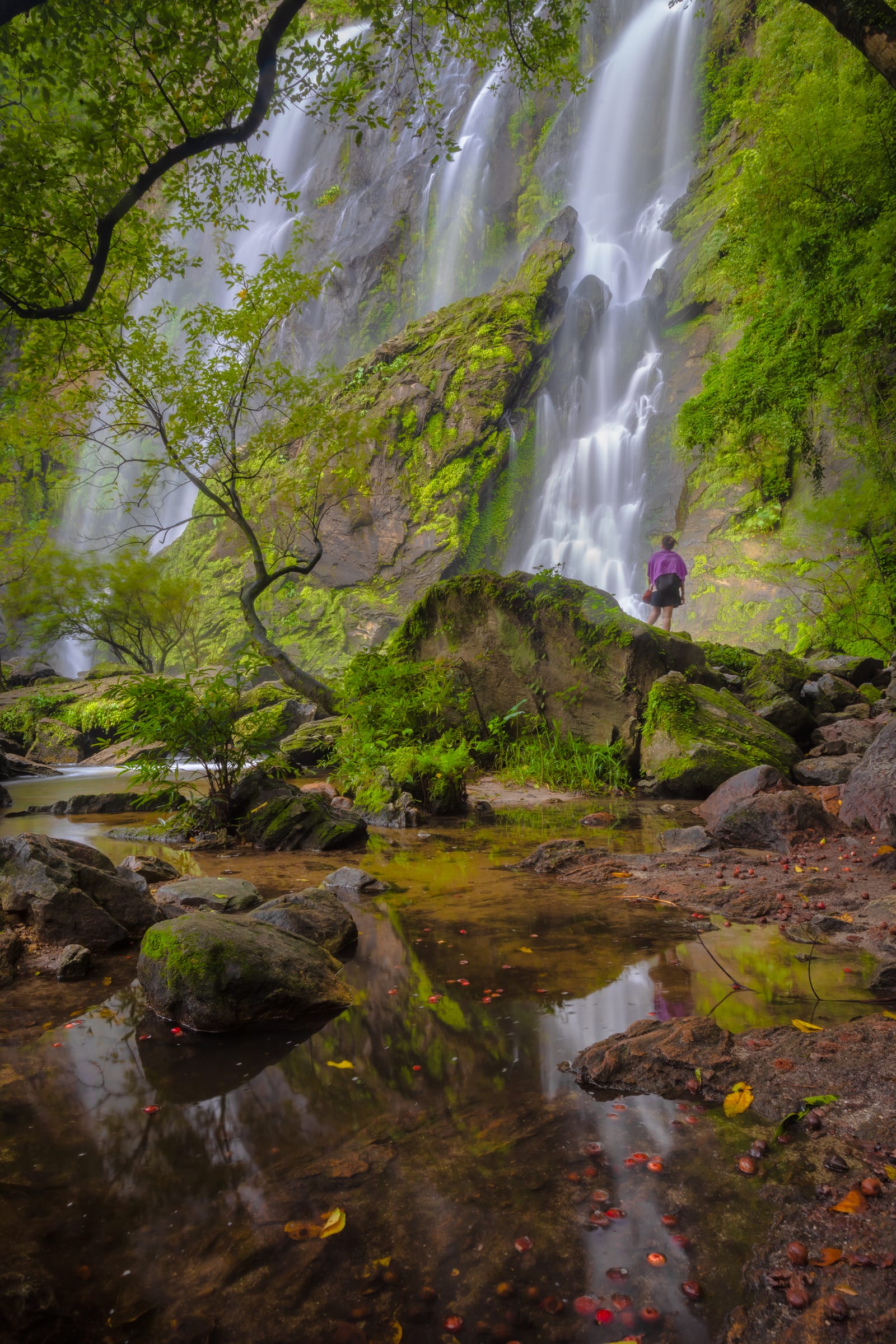
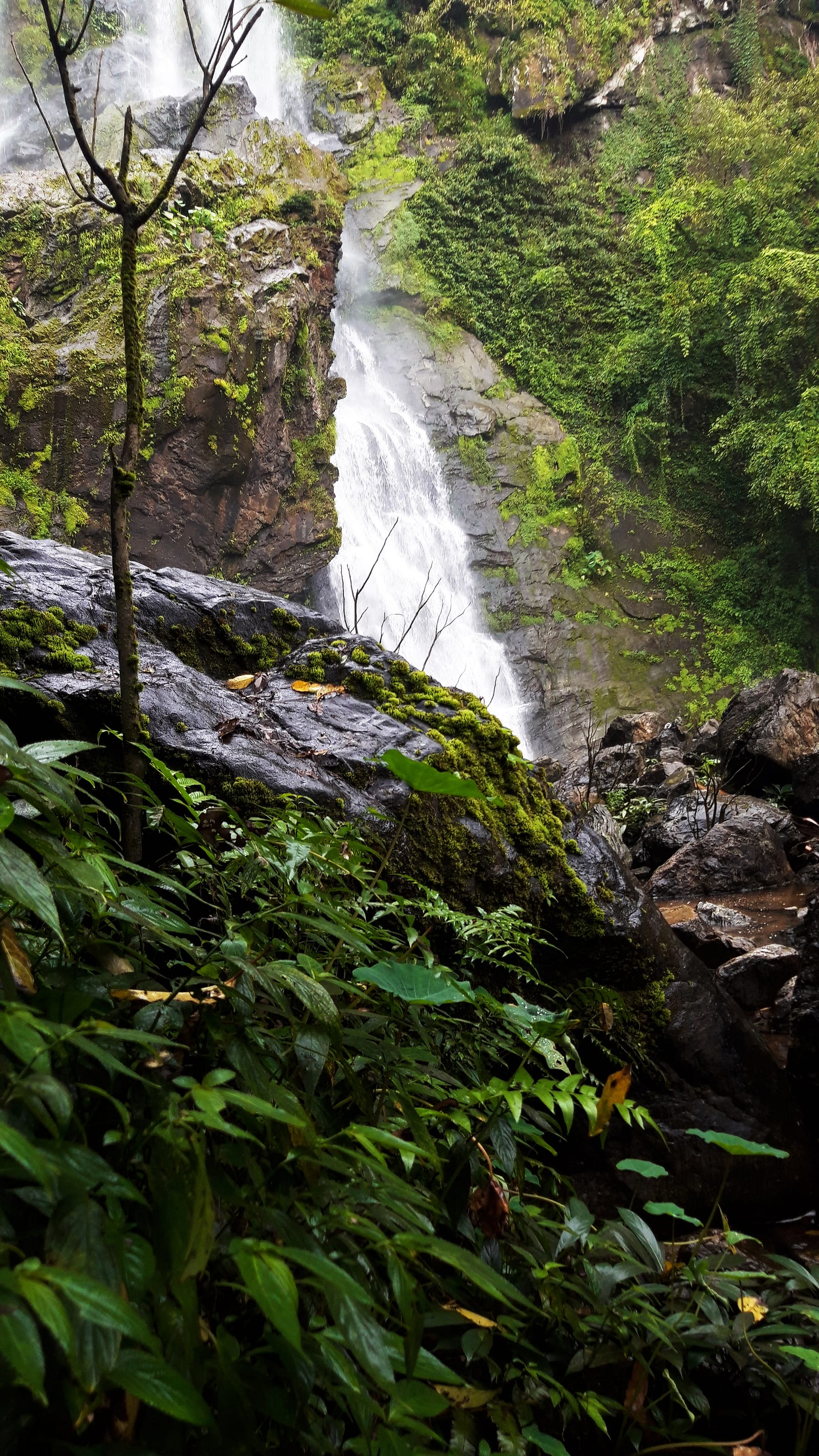
We'll close out the Kamphaeng Phet list with a nature pin that visitors never stop talking about — Khlong Lan National Park, whose star is Khlong Lan Waterfall, a large flow dropping from a cliff about 100 metres high and nearly 40 metres wide, a white curtain of water you can take in fully even from a distance. It's in Tambon Khlong Lan Phatthana, Khlong Lan District, about 60 km west of Kamphaeng Phet town. It suits families, campers, and anyone who wants to escape the city into green forest without the hardship.
The must-see is the waterfall itself, which is very easy to reach — under a hundred metres' walk from the car park and you're there. Below the falls is a wide pool you can wade into, the water clear and cool; many reviews say hearing the falls before you even see them is already a joy. If you like walking, there are nature study trails through the forest to continue on, and a shady, quiet campground beside a flowing stream where you can fall asleep to the sound of water and birdsong.
Entry is 40 baht for Thai adults, 20 baht for children, and 30 baht per vehicle (foreign adults 200 baht). Open daily around 08:00–16:30. Pitching your own tent is 30 baht per person per night, with tents and bedding available to rent, and the park also has bungalows. Facilities are complete — car park, shops, a coffee shop, and restrooms.
One thing to know: weekdays are quiet and comfortable, but long weekends get very crowded. Come in the morning for beautiful light and rainbows in the spray. Late rainy season into early cool season is when the water is fullest and greenest. The park bans foam and single-use plastic, and food is not allowed near the falls. The Google review score is as high as 4.7 from over a thousand raters, showing it's a waterfall genuinely worth the long drive.
Book Tours and Tickets for Kamphaeng Phet in Advance
Kamphaeng Phet's attractions are spread across several spots — the World Heritage historical park, temples, and Khlong Lan Waterfall. Booking entry tickets and guided tours in advance through Klook or GetYourGuide is more convenient — no queuing at the entrance, and a guide who takes you to several spots in one trip without planning the route yourself. Perfect for international travellers who want a guide to tell the story of the World Heritage city and drive them out to the waterfalls or hot springs with peace of mind.
💡 Know Before You Go: Kamphaeng Phet
Kamphaeng Phet's attractions are spread across town, the Nakhon Chum side across the Ping River, and outlying districts like Khlong Lan. Grab is scarcer than in big cities, so self-driving or renting a car with driver is far more flexible. Big spots like the historical park and Wat Phra Borommathat Nakhon Chum have spacious parking.
Shops at the Nakhon Chum Retro Market, the Thai House Museum by the Ping, and most roadside food stalls take cash, so keep small bills on hand. Riverside cafés and larger shops accept QR payment, but for markets and street-food stalls, cash is a surer bet.
Walking the historical park and the aranyik group in the morning means cooler air, fewer people, and softer sun for comfortable photos. The Ping riverside cafés and the Thai House Museum are best in the evening for the sunset and an after-dark grazing stroll. Ordering it this way makes for an easy day with good photos throughout.
Wat Phra Borommathat Nakhon Chum, Na Boon Bridge at Wat Thung Sanun Rattanaram, and the monuments in the historical park are sacred places where people genuinely come to pay respects. Dress modestly, cover shoulders and knees, remove your shoes before entering a viharn, and keep your voice down within temple precincts.
Kamphaeng Phet still sees few international tourists. Local shops and the retro market mostly have Thai-only menus, so a translation app or pointing at photos of dishes makes ordering easier. Kamphaeng Phet people are kind and friendly — a smile goes a long way.
Kamphaeng Phet is one of UNESCO's World Heritage cities, together with Sukhothai and Si Satchanalai. Most monuments are built of Sukhothai-era laterite. Knowing a little of the history before walking Wat Phra Kaeo, Wat Chang Rop, and the aranyik group makes it more meaningful and gives your photos more of a story.
Plan Your Kamphaeng Phet Day to Get the Most Out of It
Kamphaeng Phet's best sights cluster almost entirely in the town area and on the Nakhon Chum side, so an easy day trip works well. Start early at Kamphaeng Phet Historical Park before the sun gets strong, walk Wat Phra Kaeo and Wat Phra That inside the city walls, then drive on into the aranyik group to see Wat Chang Rop and Wat Phra Si Iriyabot under the tall trees. Nearby, the Shiva Shrine and the National Museum let you stop for the bronze Shiva image and Sukhothai-Ayutthaya antiquities. At midday, cross the Ping River to Nakhon Chum, pay respects at the golden Phra Borommathat chedi, then walk the Nakhon Chum Retro Market for old-fashioned sweets (liveliest on weekends). In the afternoon, stop at the Blue Pond or Na Boon Bridge across the fields for aerial-style shots. Close the evening at Banyakad Cafe on the Ping River, waiting for the sunset, and follow with an evening market by the Ping for a grazing stroll. If you have two days, drive out to Phra Ruang Hot Spring to soak your feet, or to Khlong Lan Waterfall in the national park to the west.
Covering Kamphaeng Phet's spots — in town and on the Nakhon Chum side — all in one day is fairly tiring. Booking a night in Kamphaeng Phet town is easier: wake up early to walk the historical park while it's quiet, then drive around without rushing. Locations near the historical park and along the Ping River are the easiest to get around from.
See well-located hotels in Kamphaeng Phet