🔄 Last checked 25 Jun 2026 · details and hours can change — check the venue before you go
📍 All restaurants on the map
Tap a pin for the spot + nearby stays
If you had to name the most richly varied province in Northern Thailand, Mae Hong Son would be near the top. It packs every kind of experience a traveler looks for into a single destination. At Pang Ung, early mornings bring mist drifting over a reservoir ringed with pine trees and white swans gliding across the water, quiet enough to hear your own thoughts from a bamboo raft. Drive a little further and you reach Ban Rak Thai, a Yunnan Chinese village perched on a lakeside hill, where terraced tea plantations, clay houses, and a bowl of pork and mantou dumplings over a pot of oolong define a whole afternoon. In the city center, twin Shan-style temples — Wat Jong Kham and Wat Jong Klang — cast golden reflections on Nong Jong Kham lake after dark, and Wat Phra That Doi Kong Mu sits high above the valley offering one of the province's finest panoramas. Then there's Pai, with its historic bridge, canyon sunsets, and a walking street that hums every night.
Each attraction on this list carries a name that locals are proud of and visitors have kept returning to for years. Pang Ung is the lake in the Royal Project Pang Tong 2 that became the defining image of the City of Three Mists. Sutong Pae Bridge is the longest woven-bamboo bridge in Thailand, built by monks and villagers from Ban Kung Mai Sak as an act of faith. Doi Mae U-Kho's Mexican sunflower fields are the largest in the country, turning the whole hillside gold from mid-November to December. Tham Lot in Pang Mapha is one of the few places in Thailand where you raft through a mountain on a bamboo float, with bats, fish, and stalactites overhead. Each place has its own mood — plan by season and aim to see them all in one great trip.
Pang Ung (Royal Project Pang Tong 2)
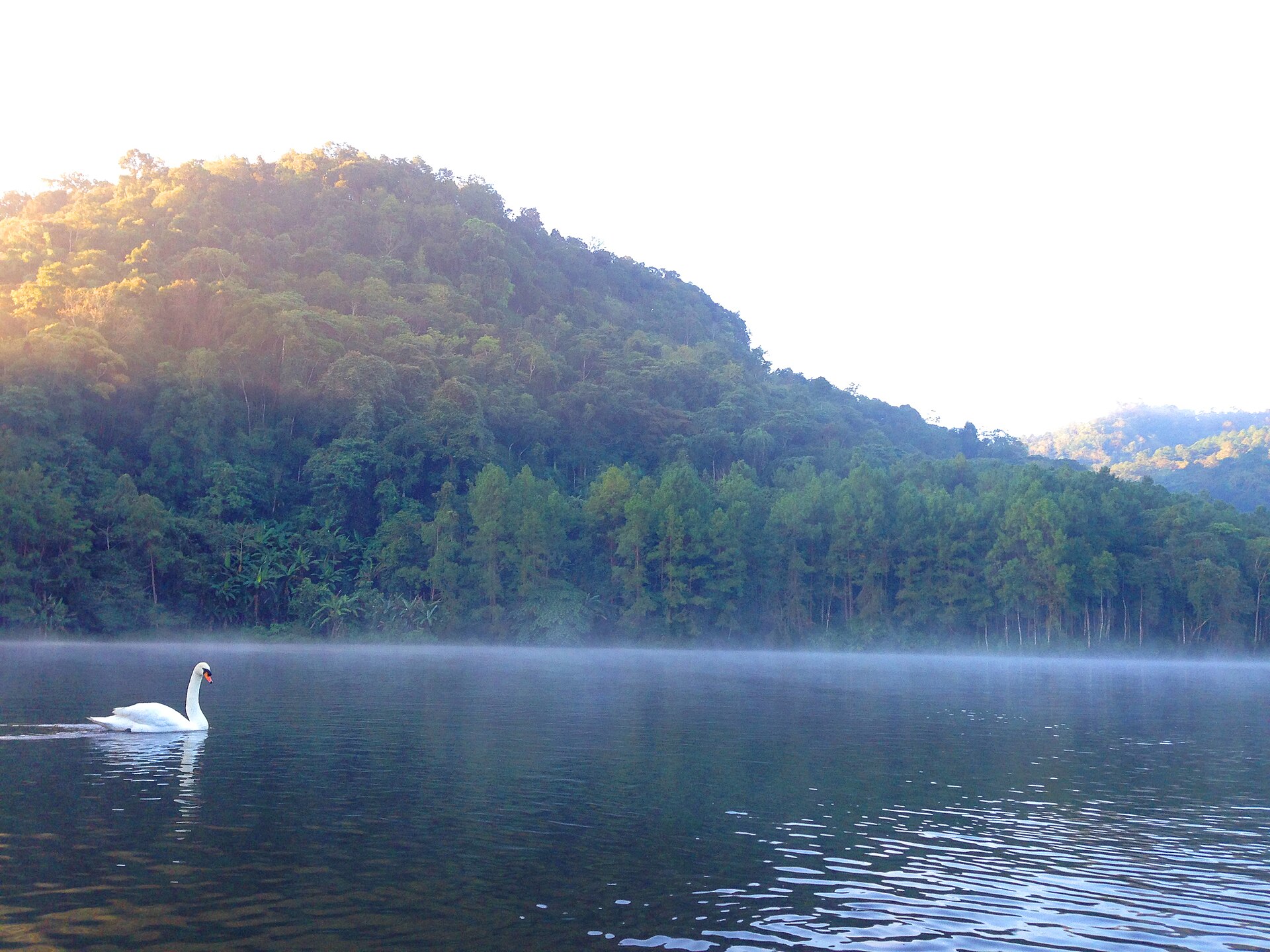
Pang Ung — officially called the Royal Project Pang Tong 2 — is a reservoir sitting about 1,127 meters above sea level in a mountain valley, ringed on all sides by two-needle and three-needle pines planted along the waterline. Locals have long nicknamed it "Thailand's Switzerland." It suits anyone who wants to escape the noise and breathe cool, quiet mountain air, couples after a romantic setting, or campers who want to wake up to mist in a pine forest. The real magic happens on cold winter mornings, when fog rolls out as a sheet across the water, white and black swans glide on the surface, and early light filters through the treetops — a scene that review after review describes as something you have to see in person.
The thing not to miss is the bamboo raft ride through the morning mist. Each raft takes two people with life jackets provided; the fee is 150 THB per boat and the ride lasts about 30 minutes. The most photogenic window is around 7am — come later and the mist starts to thin. Many visitors also enjoy walking the perimeter of the reservoir in the morning, feeding the swans, taking photos among the pines, and stopping for a warm coffee at the adjacent Ban Ruam Thai village. Pang Ung connects easily with Ban Rak Thai, the Yunnan Chinese village, in a single day trip.
The entrance fee for Tham Pla-Pha Suea National Park (which Pang Ung falls within) is 20 THB for adults and 10 THB for children — genuinely cheap. Overnight camping is possible on the grounds at about 30 THB per person if you bring your own tent, or you can rent tents and bungalows. The location is in Mok Jam Pa Subdistrict, Mueang Mae Hong Son, about 44 km from town — roughly an hour by car on a winding mountain road. Allow extra time and drive carefully.
Pang Ung's appeal is heavily seasonal. The most rewarding window is winter, November through February, especially December and January when the mist is thickest and temperatures can drop to 8–12°C before dawn. Pack enough warm layers. Outside the cold season, some reviews report lower water levels and a quieter, lonelier feel. If mist and fog are the goal, come in winter and arrive early.
Ban Rak Thai (Yunnan Chinese Village)
Ban Rak Thai is a Yunnan Chinese village deep in the Mae Hong Son mountains, founded by descendants of the 93rd Division of the Republic of China Army who settled here and turned to growing tea for a living. The scene everyone remembers is the lake at the heart of the village, ringed by yellow-walled Yunnan-style clay-and-thatch houses with terraced tea gardens climbing the slopes above. It suits people who like a slow, quiet atmosphere, photography enthusiasts, and anyone wanting to escape the heat into genuinely cool air — the village sits at about 1,776 meters, and on cold nights the temperature can drop to single digits.
The thing not to miss is renting a traditional wooden boat on the lake in the early morning when the mist is still low. Many visitors rent Chinese costumes to photograph against the red pavilions and the water. For food, you have to try the pork and mantou — soft steamed buns dipped in a rich pork broth — alongside a pot of hot oolong tea that most lakeside shops let you taste for free before buying. Other Yunnan dishes you'll find around the market include dried mushrooms, stir-fried hill vegetables, and Chinese-herbal chicken stew. Review after review calls the flavors genuinely authentic.
Entry into the village is free — walk around, sip tea, and take photos at no cost; only add-on activities have a fee, such as a tea garden tour at around 40 THB, boat rides from a few hundred THB up, and Chinese costume rental at around 100 THB. Open daily approximately 07:00–19:00. The location is in Mok Jam Pa Subdistrict, Mueang Mae Hong Son, right on the Myanmar border, about 44 km from town on a twisting mountain road. Reviews consistently warn to drive in daylight and check your vehicle beforehand.
Ban Rak Thai is popular because it offers a style of Chinese village atmosphere you simply can't find anywhere else in Thailand, paired with lake views, tea terraces, and winter cold that feels just right during the cool season. Peak demand runs from late rainy season through early in the year — accommodation fills fast. Book ahead, pack warm layers, and if you want the best mist, get on the water early in the morning.
Mae Hong Son Walking Street (Nong Jong Kham) + Wat Jong Kham–Jong Klang
If you have only one evening in Mae Hong Son, this is where to spend it. The Mae Hong Son Walking Street runs along Nong Jong Kham lake in the town center, directly in front of Wat Jong Kham and Wat Jong Klang. Many visitors call it one of the most beautiful and serene walking streets in Thailand — it lacks the overwhelming crowds of bigger tourist towns, and most of the people eating here are locals, which gives the whole thing an unscripted, genuine feel. Good for couples, families, or solo travelers who want a relaxed evening walk with affordable food.
The highlight not to miss is the atmosphere after dark. Once the temples light up after 6pm, the gold-spired Shan-style chedis cast their reflections perfectly on the still surface of Nong Jong Kham. It's the image that appears on more Mae Hong Son postcards than any other, and international reviewers consistently call it magical. The food is surprisingly cheap — pad thai, oyster omelette, fish balls, grilled squid, grilled corn, baked sweet potato, and street snacks including fried insects with kaffir lime leaves. One side of the street faces the water with tables for lakeside dining; the other side sells Shan and hill-tribe handicrafts, clothing, jewelry, and souvenirs.
Budget-wise, it's very easy — a group of three can eat well for under 200 THB. No entry fee, free to walk and photograph. The location is on Singhanat Bamrung Road in the town center, walkable from most guesthouses in the area. Open approximately 17:00–22:00. During the cool season (Nov–Mar) it runs every night; outside the cool season it's typically Friday and Saturday only.
Timing tip: arrive around 6:30–7pm when the sky is not yet fully dark but the temple lights are already on — you can capture both the lit chedis and their mirror reflection at once. Popular stalls can sell out, so come at the start of the evening if you have a particular dish in mind. After finishing the walk, consider stepping inside Wat Jong Klang to see its old carved wooden figurines depicting the Vessantara Jataka.
Wat Phra That Doi Kong Mu
If you have time for just one spot in Mae Hong Son, many locals will tell you to go up Wat Phra That Doi Kong Mu. The town's spiritual landmark sits on a hill to the west of the city center, about 1.5 km up a paved road from the Phraya Singhanat Racha monument. Its star feature is a pair of white Shan-Burmese-style chedis — the larger one built in 1860 to enshrine a relic of Moggallana, the smaller one built by Phraya Singhanat Racha, the city's first governor. Ideal for anyone who wants to pay respects and catch a sweeping city view at the same time.
The real draw is the panorama. From the temple terrace, nearly 360 degrees of Mae Hong Son opens up — on clear mornings a sea of mist fills the valley below, which many reviewers call the province's definitive postcard shot. At midday you can see the airport runway and watch planes take off. In the evening it's a sunset viewpoint, and once night falls the illuminated chedis glow from above while the city lights spread out below. Both the view down to the city and the view up from the city show the temple to dramatic effect.
Entrance is free, no fees charged. Open from around 5am to 9pm daily. Drive or ride up and park at the top; there's a small coffee shop near the summit. Those who want to walk can use the staircase. The temple holds a Google rating of 4.6 from over 4,000 reviews, consistently near the top of Mae Hong Son's attraction lists.
If mist is the goal, arrive before sunrise — the viewing window for thick mist is roughly 5:40–8am. The hilltop is cool and windy at dawn, so bring a jacket. Mist is thickest during the late rainy to early cool season transition; some days the clouds move in and block the view entirely — that's the nature of mountain weather. As this is a sacred site, dress modestly when you enter the temple precinct.
Tha Pai Historical Bridge
Tha Pai Historical Bridge is a green iron truss bridge spanning the Pai River that many visitors call the "gateway to Pai," since it stands beside Highway 1095 at km 88, about 9 km before the town center. Virtually everyone driving in from Chiang Mai passes right by it and stops to stretch and take photos. Good for history enthusiasts, photography, and families wanting a comfortable roadside break before tackling the last stretch of 762 curves into town.
The bridge has a story worth knowing. It was built during World War II when Japanese forces used Pai as a supply corridor to Myanmar. The iron framework you see today is actually the old Nawarat Bridge that once spanned the Ping River in Chiang Mai — it was dismantled and reassembled here after the original bridge at this site was destroyed by flooding. The highlights are walking across the wooden deck, photographing the green iron frame, and reading the historical plaque at the bridgehead. Many visitors come in the morning or evening when the light is softer than the harsh midday sun.
Entry is free, open 24 hours. The only money you spend is on coffee and snacks. Shops at both ends of the bridge sell souvenirs, clothing, and riverside café seating. Some spots offer rafting and riverside camping. Google rates it 4.2 stars from over 2,600 reviews — most people enjoyed the atmosphere and the story, though some reviews note honestly that if you set aside the history, it's a fairly modest bridge and 20 minutes is enough.
One thing to know: the bridge is old and some wooden planks overlay the original frame — walk with care, especially with children or in heels. During high season (Nov–Feb) crowds are heavy and roadside parking is tight. For a clean shot with no one in frame, come early in the morning for soft light and quiet. It's a stop that costs only 20–30 minutes but leaves you with both photos and a piece of wartime history to carry home.
🛏️ Book a stay in Mae Hong Son
Seeing everything in Mae Hong Son takes more than one night. Staying in town gives you easy access to Doi Kong Mu in the morning and the walking street at night. Those focused on the Pai side should base themselves there for easy access to Tha Pai Bridge, Pai Canyon, and the walking street. Compare prices across multiple booking sites before you commit — especially in the cool season when rooms fill up fast. Booking ahead gets you the best locations at the best rates.
Pai Canyon (Kong Lan)
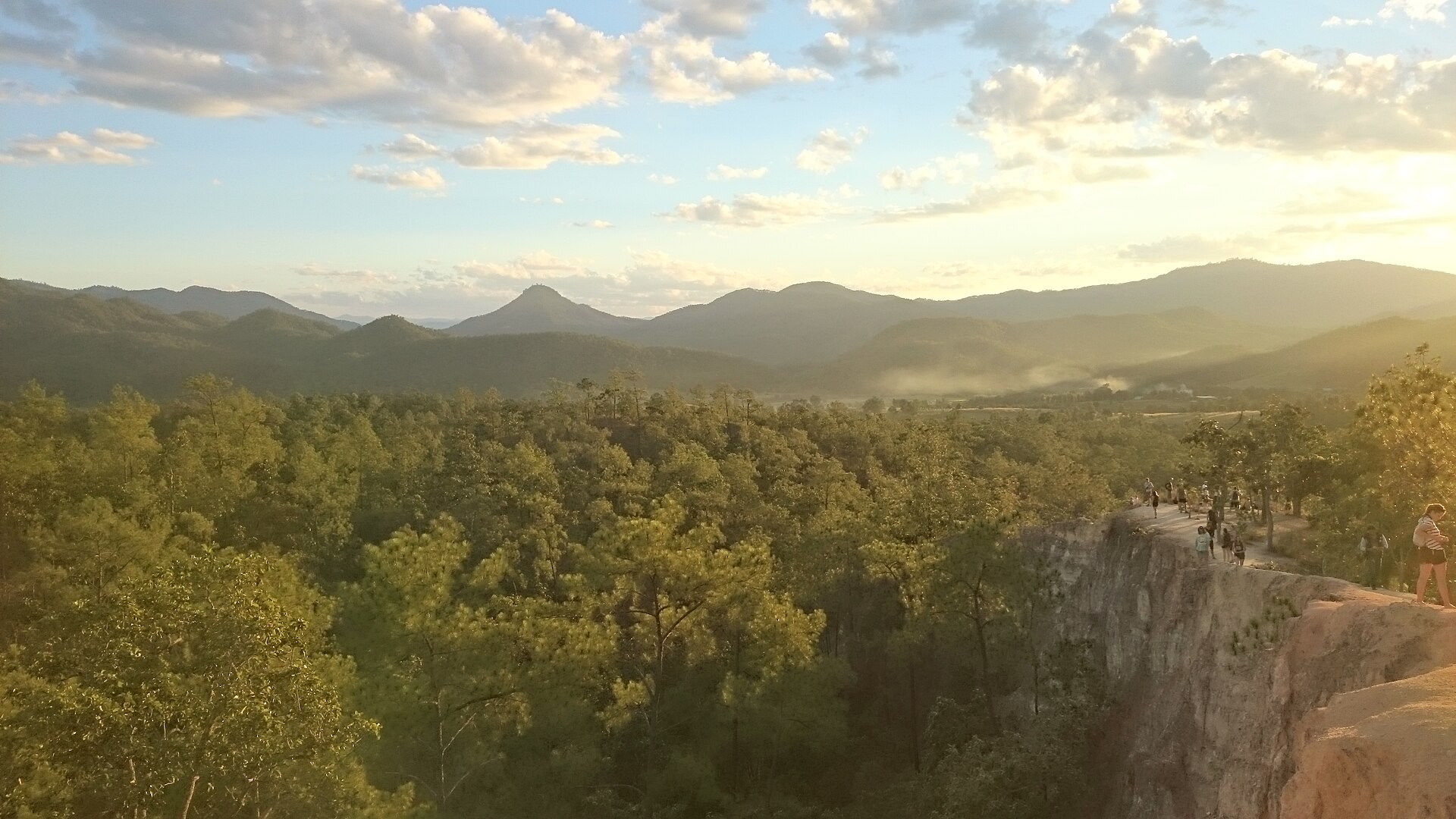
Pai Canyon — known locally as "Kong Lan" — is a dramatic red-earth gorge in the middle of open countryside that has become Pai's defining natural landmark. Years of rainwater erosion carved the hilltop soil into deep channels separated by narrow ridges, creating a scaled-down grand canyon effect. Anyone who enjoys an adventurous walk, open views, and a strong photo without a long hike will find exactly what they want here. From Pai town it's only about 8 km down Highway 1095.
The draw is the "narrow ridge" — a long, thin path running between deep drops on both sides, some sections barely wide enough for one person. Reviewers consistently confirm it gets the heart beating. Those who are uncomfortable with heights can stay at the front viewpoint area and still get excellent views. More adventurous visitors follow the ridge system deeper in; at the far end the views open completely in all directions. What brings the biggest crowds is the sunset — the sun drops slowly behind the ridgeline, and it's consistently rated as Pai's top place to watch it.
Entry is free — no admission charge, no parking fee (there's a donation box for bridge maintenance). Open daily approximately 06:00–18:00. The golden window is arriving around 4pm, walking the ridges, and catching the sunset at the far end. Google ratings sit at around 4.5 stars from many thousands of reviews.
A few things to know: the ground is sandy soil and slips easily, especially on the narrow ridges. Wear good-grip trainers. Stay away from the edges of the drops. In the rainy season the ground is even slippier and the soil may crumble. Walk slowly, carry water because the sun is strong, and if you're bringing children or a large group, hold hands on the narrow sections.
Tham Lot, Pang Mapha
Tham Lot — also called Tham Nam Lot by locals — is a giant limestone cave in Pang Mapha District with the Nam Lang River flowing straight through the mountain and out the other side. The signature experience is boarding a small bamboo raft and floating along the underground stream into the darkness, guided by a local who holds a lantern and poles you through. Inside, the cave is silent, cool, and vast — many visitors describe it as "stepping into another world." Perfect for nature lovers who want an active experience, light adventurers, and families who want children to see a real cave rather than just walk past one.
The cave divides into three connected chambers: Tham Sao Hin (Column Cave), which holds stalactites and stalagmites up to 20 meters tall with walls textured like popcorn; Tham Tukkata (Doll Cave), with strangely shaped rock formations reached by a steep ladder; and Tham Phi Maen, the highlight you enter by raft, containing pieces of ancient teakwood coffins over 2,000 years old. Not to miss: around dusk, thousands of swifts swoop back to their roosts at the cave mouth while bats stream out to hunt — a spectacle many reviewers say is worth waiting for. Fish are visible swimming in the stream throughout.
The main costs are a guide fee of 150 THB per person plus a raft fee of 300 THB per boat (capacity 1–4 people), totalling around 450 THB per boat for the full three-cave tour. Cheaper options exist for shorter trips. Best value when you come in a group of 3–4 to share the raft. Located beside Highway 1095 at around km 138–139, Tham Lot Subdistrict, Pang Mapha — easy to stop on the Pai–Mae Hong Son route, about an hour from Pai. Open daily 08:00–17:00; large car park, restaurant, and toilets on site.
Tham Lot is popular because it's one of the few river-cave rafting experiences in Thailand that remains genuinely wild, with real archaeological value (prehistoric human remains have been found here). Visit during the dry season, November through May, to access all three chambers — in the rainy season rising water may limit access to Tham Sao Hin only. The raft is narrow with nothing to hold; sit still and keep balanced. Wear closed-toe shoes with grip because the cave ladders are steep and wet. Bringing a small flashlight lets you see the stalactites more clearly than the lantern alone.
Doi Mae U-Kho Mexican Sunflower Fields
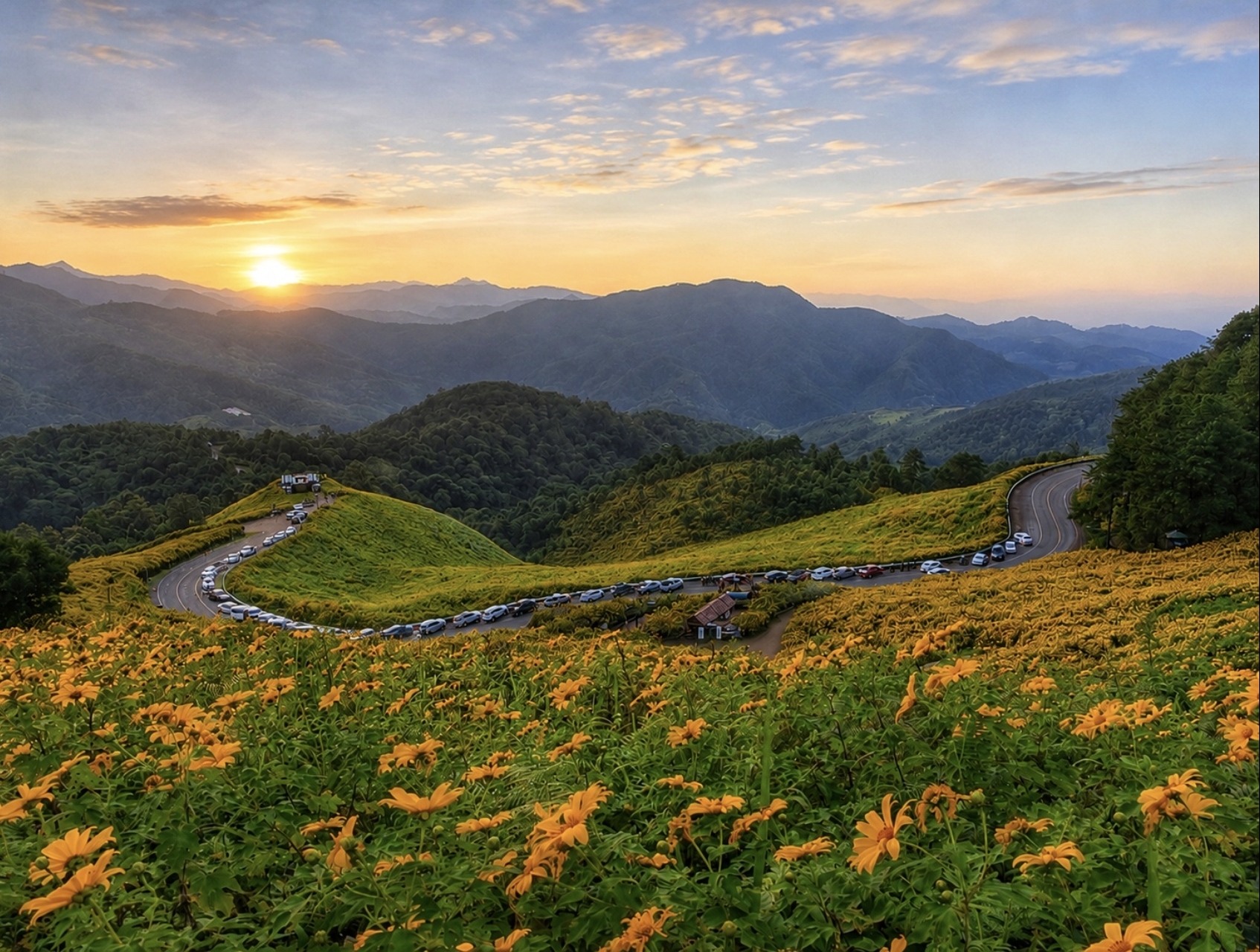
When people think of Mae Hong Son in winter, many picture the Doi Mae U-Kho sunflower fields first — a thousand-plus rai of Mexican sunflowers (bua tong) blooming on a 1,600-meter mountain in Khun Yuam District. These are the largest fields of their kind in Thailand. The flowers grow taller than a person's head and sweep across interlocking hillsides in rolling waves of yellow. Ideal for photographers, nature lovers, and families who want cool mountain air and a sea of color.
The highlight that everyone talks about is the ridge viewpoint, where the sunflower fields spread 360 degrees around you, with the rolling terrain visible across the hillsides and a winding road threading the valley below. Reviews consistently say early morning and late afternoon light is most beautiful — clear skies, good air, golden tone. Those who want to stay overnight can pitch a tent at the campsite (toilets, car park, and food stalls are available). A bamboo walkway lets you photograph from multiple angles. Stalls sell hill-tribe products and OTOP items.
The fee structure is very light — the open grounds are free to enter and walk; the bamboo walkway costs about 10 THB per person. If you camp and bring your own tent it's about 50 THB per person, or rent a tent with bedding for roughly 350 THB. The fields officially open in mid-November (usually from November 11) and peak from mid- to late November through early December. Open approximately 06:00–18:00 daily. Located about 25 km from Khun Yuam town along rural road Ms.4009/1263.
The road up is steep and winding with many bends — reviews warn to drive carefully, check your brakes, and verify the car is road-ready. Those who prefer not to drive can charter a local songthaew from Khun Yuam. Weekends and long holidays get congested. For a more relaxed visit, come on a weekday. And don't forget a warm jacket — it stays cool up on the mountain all day.
Sutong Pae Bridge
Sutong Pae Bridge is a woven-bamboo footbridge that stretches across the rice paddies of Ban Kung Mai Sak, Pang Mu Subdistrict, about 8 km from Mae Hong Son town. Monks and villagers wove it together to connect the village with Wat Phu Somanaram, so the monks could walk their alms route across the paddies without difficulty. "Sutong Pae" is Shan for "prayer fulfilled" — people come to stand in the middle and make a wish. The bridge is roughly 500 meters long and 2 meters wide, regarded as the longest woven-bamboo bridge in Thailand. A great fit for those who like quiet atmospheres, photography enthusiasts, and anyone wanting to feel the real spiritual fabric of Mae Hong Son.
The unmissable moment is early dawn — around 05:30–06:30am — when monks walk their alms route in a single file across the bridge through thin morning mist hanging over the rice fields. It's a scene that shows up in almost every Sutong Pae review, and those who make the early wake-up call say it justifies every minute. You can bring cooked rice to offer to the monks on the bridge. Another favorite angle is walking all the way to the far end and climbing the temple mound — from there you can look back down the full length of the bridge against the expanse of paddy. The paddies are most vividly green from September through October; by November–December the rice turns gold before harvest, then after harvest the fields open and flatten.
Entry is free, with only a donation box to support the repair of the bamboo, which needs seasonal replacement. Small coffee shops, souvenir stalls, and rental parasols for photos sit at both ends. The drive from town is short, but the final stretch into the village is a narrow lane. Open all day, but the most rewarding windows are early morning and late afternoon near sunset.
Worth knowing: bamboo can be slippery and some sections are uneven underfoot — walk with care, especially after rain. Move gently; don't jump or put unnecessary stress on the bridge, since local villagers maintain it themselves as a structure of faith. Midday sun on the bridge is intense with almost no shade — bring a hat and water. This is one of the spots almost no one visiting Mae Hong Son skips, because it combines rice-field views, silence, and a story of devotion all in one place.
Pai Walking Street (Pai Walking Street)
If you come to Pai and don't walk the Pai Walking Street at night, you haven't really arrived. Once the sun drops, Chaisongkram Road in the heart of town closes to traffic and fills with stalls stretching almost a kilometer down both sides, then branching off toward the river. The atmosphere is mountain-hipster: warm string lights, acoustic guitar drifting softly in the background, steady foot traffic. It works for everyone — couples who want a slow evening, groups of friends after food, or solo travelers happy to wander for hours. Real Google reviews rate it around 4.5 stars from over 2,500 reviews, and international visitors on Tripadvisor call it one of the best night markets in Thailand to walk through.
The highlights are the food. Stroll and graze on Thai street food, Northern dishes like khao soi and nam ngiaw noodles, Western bites, desserts, fruit smoothies, and vegetarian and vegan options that are easy to find here. There are also particular stalls that international visitors mention — house-made gyoza and fresh-cooked specials among them. On the other side, handmade crafts, jewelry, postcards, printed T-shirts (around 100 THB each), and art from local artists make for easy browsing. You can easily lose track of time.
Budget: no entry fee, food dishes from a few tens of THB, and an evening of eating and shopping comes in well under a few hundred THB all-in. Located right in the center of Pai town — easy walking distance from guesthouses in the area. Stalls begin setting up around 6pm and run until late. The liveliest window is around 8–9pm. During the cool season (Nov–Feb) it runs every night and draws the biggest crowds. In the hot and rainy seasons it's typically Friday–Saturday only.
Worth knowing: on weekdays outside the cool season, the street can be sparser than photos suggest. For the full experience, come on a weekend or during the cool season when the weather is perfect for an evening stroll. International visitors make up a noticeable share of the crowd — some say Pai feels more tourist-oriented than it used to, but the relaxed, unpretentious charm of walking, eating, and browsing is still very much intact.
Book tickets and tours for Mae Hong Son
Mae Hong Son's attractions are spread across the mountains and the roads are winding. If you're not driving yourself, booking a guided tour with transport through Klook or GetYourGuide lets you cover Pang Ung, Ban Rak Thai, and other spots in a single day without worrying about the route. Places like Tham Lot in Pang Mapha already require a local guide and raft poler — booking in advance guarantees your slot and saves you negotiating at the gate.
💡 What to know before visiting Mae Hong Son
The attractions are spread far apart on mountain roads. Grab is almost nonexistent in this province. Renting a car or booking a tour with transport is far more flexible. In town you can walk, but Pang Ung, Ban Rak Thai, and Doi Mae U-Kho all require driving up into the hills.
Entrance fees, raft rides, and stalls at markets and street-food spots mostly run on cash. On hilltop sites the internet signal is unreliable — don't rely solely on QR payment. Withdraw cash before leaving town.
Mist and sea-of-fog at Pang Ung and Doi Kong Mu are finest at dawn. Tham Lot should be visited before the afternoon since it closes around 4pm. Going early also helps you avoid crowds and the long raft queue during the cool season.
Wat Phra That Doi Kong Mu and Wat Jong Kham–Jong Klang are sacred sites. Cover shoulders and knees. If you go to watch the monks' alms round at Sutong Pae Bridge in the morning, keep quiet and don't stand in the monks' path.
Shops and restaurants on the Pai side and in the town center often have English menus and staff who can communicate. On hilltop sites and in smaller villages, you may need gestures or a translation app. Saving place names in Thai to show drivers is easier than explaining verbally.
Mae Hong Son sits in a valley and mornings and nights are noticeably cooler than the lowlands, especially at Pang Ung, Ban Rak Thai, and Doi Mae U-Kho. A long-sleeve top or light jacket makes a real difference.
Planning your Mae Hong Son trip to get the most out of it
Mae Hong Son divides neatly into zones — plan by zone and you'll save a lot of driving. Northern zone — Ban Rak Thai road: cover Pang Ung and Ban Rak Thai in a single day. Head out before dawn to catch the mist at Pang Ung (best around 7am), then swing by Ban Rak Thai for a late-morning tea. Town center: Wat Phra That Doi Kong Mu is best at dawn for the sea of mist (around 05:40–08:00am), then save Nong Jong Kham walking street and Wat Jong Kham–Jong Klang for the evening when the temple lights reflect on the lake.
Pai and Pang Mapha are in opposite directions — plan these as a separate day or stay overnight in Pai. Collect Tha Pai Bridge and Pai Canyon (go to the canyon in the afternoon for the sunset), then close the night on the Pai Walking Street. Tham Lot in Pang Mapha should be visited before early afternoon since the guides and raft polers start heading home around 4pm. If you're visiting in mid-November through December, don't miss the Doi Mae U-Kho sunflower fields in Khun Yuam — they're right on the Chiang Mai–Mae Hong Son road.
Exploring Mae Hong Son fully takes several nights to cover the town, Pai, and Pang Mapha. Staying in the town center near Nong Jong Kham puts you within walking distance of the walking street. Staying in Pai keeps you close to Tha Pai Bridge and the walking street. Compare prices across multiple booking sites before committing for the best deal.
Check stays in Mae Hong Son