🔄 Last checked 25 Jun 2026 · details and hours can change — check the venue before you go
📍 All restaurants on the map
Tap a pin for the spot + nearby stays
When most people think of Nakhon Pathom, Phra Pathom Chedi comes to mind first — and rightly so. The old town revolves around the massive golden chedi at its center, which is illuminated dramatically at night and surrounded by a food market from evening onwards. Walk in, pay your respects, and you can head straight to dinner without moving your car. Drive out toward Sam Phran and Rai Khing and the whole atmosphere shifts to a riverside life along the Tha Chin. There are riverside temples for paying respects and feeding fish, old wooden floating-market buildings at Don Wai and Lam Phaya where you ride a boat between the two and eat along the way, and then Wat Sam Phran with its towering pink cylinder building wrapped in a giant green dragon — a photo spot that international visitors fly in specifically to see. For those who like art, Nakhon Chai Si has the Thai Human Imagery Museum, with lifelike fiberglass figures you can barely tell apart from real people, and Woodland Mueang Mai, a 140-rai woodcarving museum on the river.
The highlights here carry real weight. Phra Pathom Chedi is one of the tallest chedis in Thailand and has been the city's sacred landmark for centuries. Wat Rai Khing is a royal-grade temple where people from across Central Thailand come to pay respects to Luang Pho Wat Rai Khing. Sanam Chandra Palace is the residence of Rama VI in a shaded park beside Silpakorn University, which has become one of the city's favorite running and walking grounds. Phutthamonthon is a 2,500-rai Buddhist park with a large walking Buddha sculpture designed by Silpa Bhirasri. And Woodland Mueang Mai holds over 2,000 pieces of woodcarving that the Tiwphaingam family has collected over generations. Every attraction in Nakhon Pathom is easy to reach — they are all within about an hour's drive of Bangkok.
Phra Pathom Chedi (Wat Phra Pathom Chedi Ratchaworamahawihan)
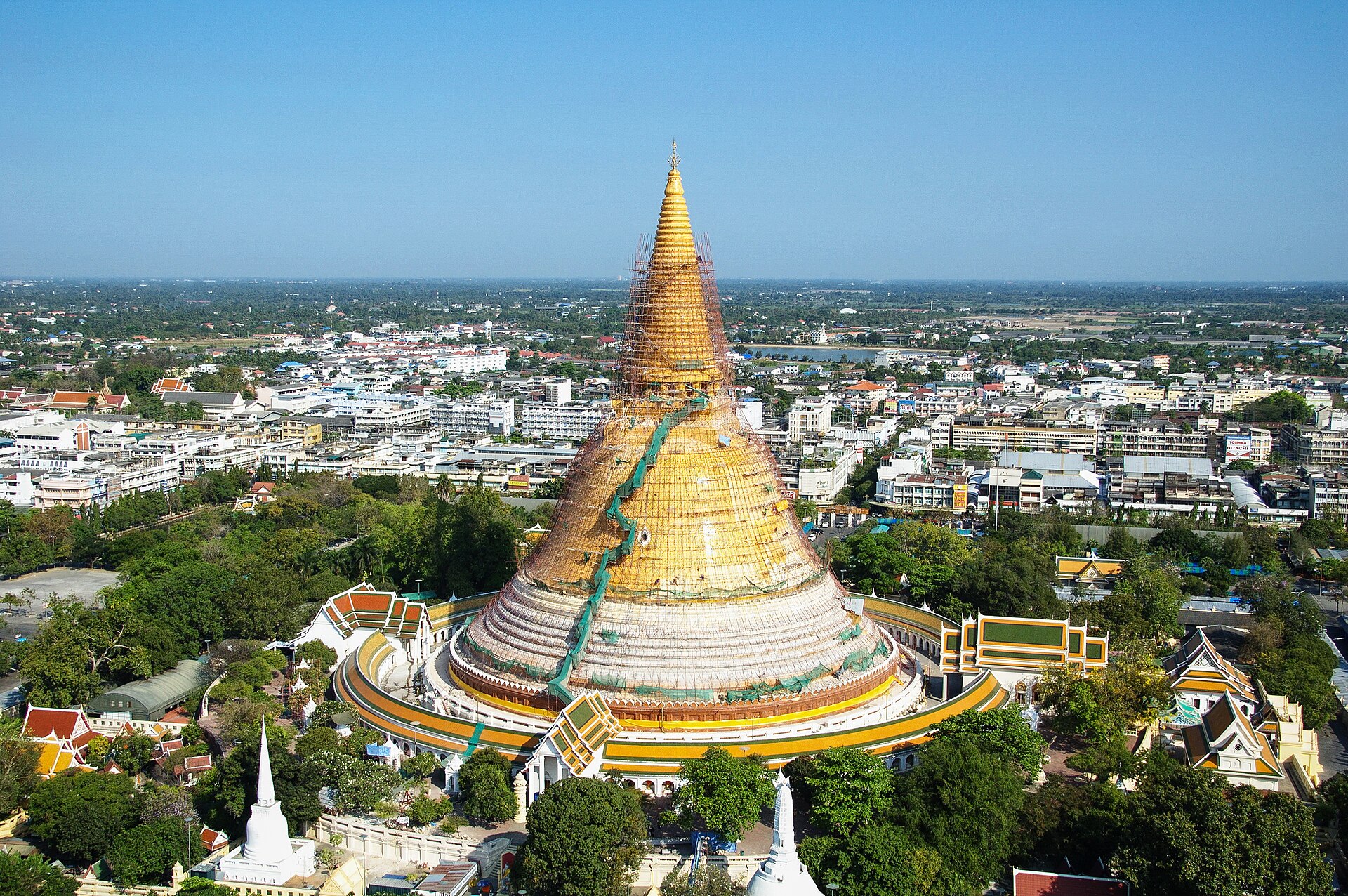
Phra Pathom Chedi — which Nakhon Pathom locals call simply "the Chedi" — is a massive inverted-bell-shaped golden stupa standing roughly 120 meters tall. It is one of the tallest and largest chedis in Thailand and serves as the city's symbolic landmark, appearing on the provincial seal. Driving into the city from any direction, the golden spire rises above the rooftops from a considerable distance. It works for everyone: temple pilgrims, history enthusiasts, architecture lovers, and families who want a gentle afternoon walk without rushing.
The things not to miss: first, climb up and pay respects to Phra Ruang Roj Rit, a beautiful standing Buddha image in the abhaya mudra enshrined in the vihara on the northern side. Then walk the circumambulatory path around the chedi, ring the bells along the gallery corridor, and find the photography corners that review after review confirms look good from every angle. The real highlight comes at dusk — once the lights come on and illuminate the whole stupa in golden brilliance, it becomes the most-photographed scene in the province.
Entry is free. There is a wide car park around the grounds. The chedi is open approximately 06:00–20:00 daily. Once evening comes, a market stretches out all around the chedi serving food from around 17:00 onwards — savoury dishes, sweets, oyster omelette, snacks, fried insects with kaffir lime leaves, shaved ice. Popular stalls attract long queues; patience is needed. The combination of temple visit and market in the same spot is exactly why this remains the province's most visited attraction.
Nakhon Pathom locals will tell you the best strategy is to come in the early evening: arrive before sunset, walk around the chedi, then let the market warm up around you. Dress modestly as this is a sacred site. During major festivals and the annual fair (around mid-November) the crowds are large and parking is harder — a weekday evening is more relaxed.
Wat Sam Phran (Wat Mangkon Taka Fa)
Drive about 40 km west of Bangkok and you'll spot a tall pink circular building with a massive green dragon coiling around it as if it's about to launch into the sky. That's Wat Sam Phran — which people have nicknamed "Wat Mangkon Taka Fa" (the Sky-Climbing Dragon Temple). The building stands roughly 80 meters tall across 17 floors and serves as the dragon's residence pavilion. It's the kind of landmark you recognize immediately, and international visitors fly in specifically to photograph it. A great match for anyone who loves unusual architecture, photography, and places with a genuine sense of power that you don't find at ordinary temples near Bangkok.
The highlight not to miss is climbing inside. The entrance to the upper levels is hidden inside the dragon's body — you walk up a winding inclined passage into the interior, then all the way to the rooftop terrace that serves as a viewing platform looking out over the surrounding fields. A lift is available for those who prefer not to walk. Beyond the tower, the temple grounds also hold a large outdoor Buddha statue and rows of smaller images inside the ordination hall — worth photographing from both a long distance for the full dragon silhouette and up close for the scale details.
On entrance fees: most genuine reviews agree that there is a maintenance contribution of about 80 THB, though some visitors report it is free for Thais or by voluntary offering. The lift costs a small additional fee per trip. Open daily from around 08:00–18:00. Reviews consistently recommend arriving in the morning when the heat is lower and the temple is less crowded. Wear comfortable walking shoes — there is a fair amount of climbing.
Worth knowing: many visitors say the tower looks most dramatic and impressive viewed from a distance, and some sections inside show their age. There may be donation requests along the way — carry a little cash for this. Overall it remains an attraction well worth stopping for: you get a completely one-of-a-kind photo and a temple visit in the same stop, ideal for a day trip from Bangkok or as part of a Nakhon Pathom loop.
Wat Rai Khing (Royal Temple)
Wat Rai Khing is an old royal-grade temple on the Tha Chin River in Sam Phran District, about 30 km from Bangkok. People from across Nakhon Pathom and Bangkok drive in regularly to pay respects to the principal Buddha image, Luang Pho Wat Rai Khing — a seated Mara-subduing image that people specifically believe in for career, business, and good fortune wishes. A simple trip: go in the morning, pay respects, walk the riverbank market, and return before lunch. Children to elderly, everyone can spend a full morning here without running out of things to do.
The highlight that reviews mention most often is the fish sanctuary in front of the ordination hall, where large striped catfish swim in the hundreds in a protected zone. Buy bread or fish food at the riverbank stalls and toss it in — children love it. Around the temple, there's also a market and riverside restaurants with produce and food stalls, especially active on Sundays when local farmers paddle boats loaded with fresh produce right up to the temple's waterfront. One thing not to miss: take the boat from Wat Rai Khing to Don Wai Floating Market — the fare is a few tens of baht per person and reviewers consistently say it's more fun than expected, offering a quiet look at the river-bank life as you drift between the two markets.
Entry is free. The only costs are donations, fish food, merit-making, and food from the market. Location: Rai Khing Subdistrict, Sam Phran, along the Tha Chin River. There are multiple access roads and a wide car park. Open approximately 08:00–17:00 daily (boat service stops around 16:00). The ordination hall has its own opening and closing time; the outer grounds have broader access.
This temple has been popular for generations because it is a sacred city landmark, review after review calls it clean, shaded, and worth coming back to, and you can cover temple visit, river walk, food market, and a boat ride in a single morning stop. During major festivals, especially the annual fair (around Songkran), expect large crowds and congestion. For a quieter visit, come on a weekday morning and dress modestly when entering the ordination hall precinct.
Don Wai Floating Market
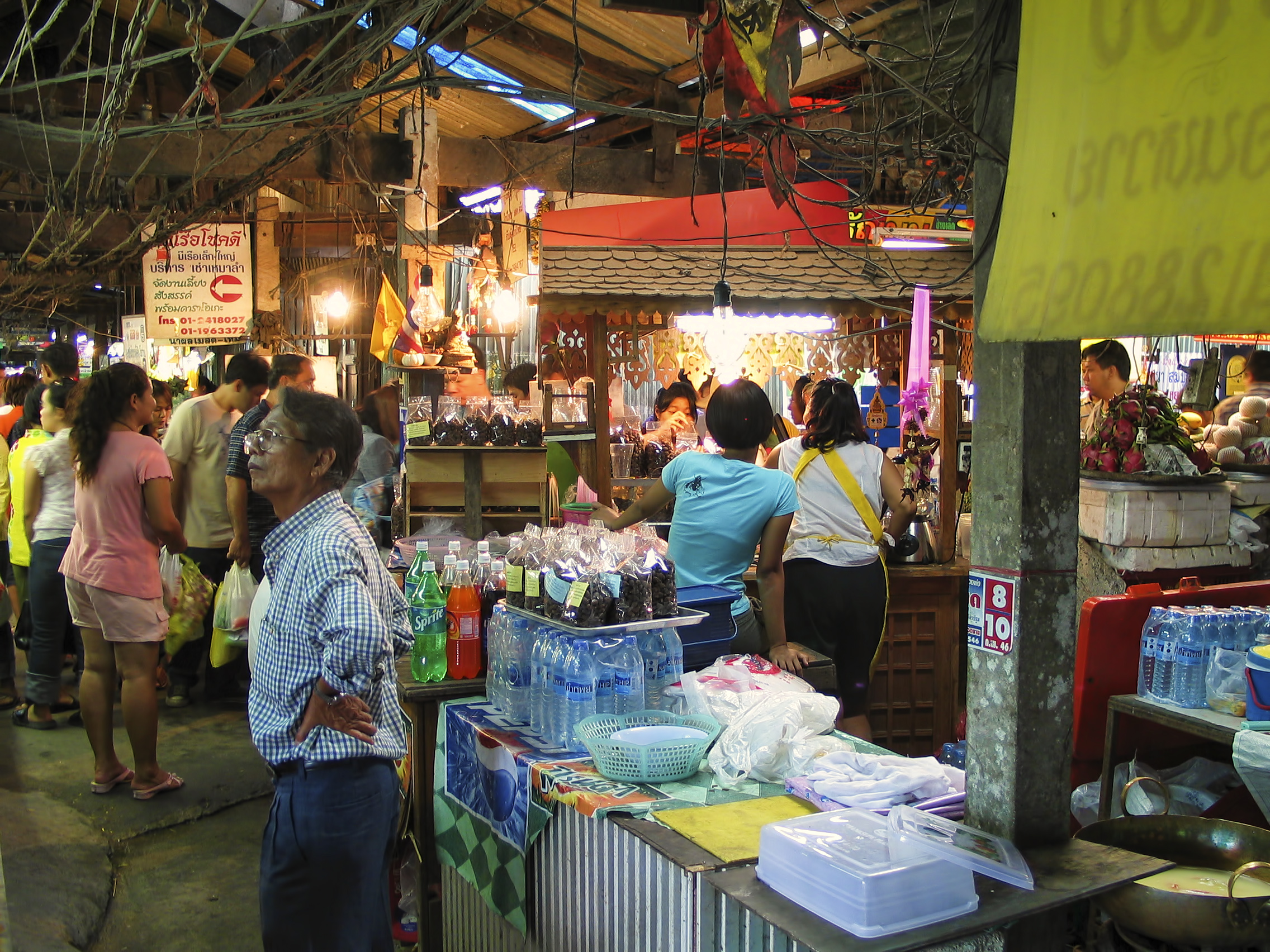
Don Wai Floating Market is an old market on the Tha Chin River in Bang Krathuek Subdistrict, Sam Phran, Nakhon Pathom, about an hour from Bangkok. Dating back to the reign of Rama VI, the wooden shophouse buildings run along the riverbank under a continuous roof that keeps the walkway shaded even in direct sun. A strong fit for anyone who wants to escape the city and spend a morning eating Thai food in a genuinely traditional setting, families bringing elders, or visitors who like the atmosphere of old riverside markets that haven't been staged entirely for tourists.
The highlight people mention most is the food, especially the braised duck — an old recipe that has become the market's signature dish, with multiple vendors making competing versions. Also popular: old Thai sweets like khanom tan, khanom mo kaeng, thong muan, ba chang, salted mackerel, dried sausage, and coconut ice cream. The activity not to miss is the boat ride along the Tha Chin River: some boats connect directly to Wat Rai Khing temple at a few tens of baht per person — reviews say it's more fun than expected for the price, offering a quiet look at the old river-bank life as you drift along.
Budget-wise, it's relaxed: entry is free, no admission charge. Walking and grazing your way through runs well under a few hundred THB per person. Fresh produce from local orchards is also cheap. Open daily approximately 08:00–17:00, though reviewers recommend Saturday–Sunday or holidays when more stalls are open and the atmosphere is livelier. On weekdays some shops close and the crowd is smaller, which has its own charm.
Worth knowing: weekends can get crowded and the walkway is narrow. Coming early in the morning avoids the worst of the squeeze. Parking is wide and easy. This is one of the most reliably revisited floating markets near Bangkok precisely because the food is good, the prices are honest, and that riverside air is genuinely hard to find in the city.
Sanam Chandra Palace
Sanam Chandra Palace is the residence of Rama VI in the center of Nakhon Pathom, about 2 km from Phra Pathom Chedi, beside Silpakorn University. A great fit for people who want to stroll through an old royal palace and grounds without driving to Bangkok, with several palace buildings that blend French and traditional Thai architecture beautifully. The highlights visitors mention most are Chalermontri Hall in cream French-style, Tub Khwan Residence in a traditional Thai house elevated on piles, Phiman Pathom Throne Hall, the Ganesh Shrine where people come to pay respects to Phra Phikhanet, and the monument to Ya Le, the loyal dog of Rama VI whose story is closely tied to the king's life.
The real charm that makes this more than a palace tour is that the grounds serve as the city's green lung and exercise park. Reviews repeatedly point out that the lawns are wide, the old trees are dense, and the shade is deep. The loop around the grounds measures roughly 1 km exactly, making it one of the most popular running routes in the city, especially in the cool early mornings and evenings. Jogging past the palace buildings is the kind of experience you can't find anywhere else easily.
On admission: if you want to enter the palace hall and interior buildings, there is a fee — 30 THB for Thai adults, 10 THB for children, 50 THB for foreigners. Tickets are sold from approximately 09:00–15:30; the halls close at 16:00. The outer grounds for walking and running are free, open mornings and evenings. The total budget for a visit here is extremely modest or essentially zero if you are only walking the park. Some buildings prohibit photography inside; food, alcohol, and pets are not allowed in the grounds.
For a full Nakhon Pathom day, this pairs easily with Phra Pathom Chedi and the town-center market in a single day. Dress modestly when you enter the palace precinct. If you want both the morning mist in the grounds and the lit chedi at night, plan the day so this is your morning stop and the chedi is your evening one.
🛏️ Where to stay in Nakhon Pathom — close to the main attractions
Covering multiple attractions in Nakhon Pathom in one trip is much easier if you stay overnight rather than driving back to Bangkok each evening. Staying in the city center near Phra Pathom Chedi, Sanam Chandra Palace, and Central Nakhon Pathom puts you within walking distance of the best spots. If you're spending most of your time on the Sam Phran–Sala Ya riverside side, the area along the Tha Chin is more convenient. Compare prices across booking sites before committing — pick the location that matches your planned stops.
🔍 Check Nakhon Pathom hotel prices (Agoda)Central Nakhon Pathom
If you want an air-conditioned place to walk around in central Nakhon Pathom with good food and photogenic spots, Central Nakhon Pathom is the first answer many people give. This is the province's first mixed-use development, opening on 30 March 2024 as the 42nd branch of Central Pattana. What sets it apart from an ordinary mall is the eco-concept: Solar Rooftop panels, EV charging points, and over 300 original trees preserved in situ on the grounds. A good fit for families, café lovers, or anyone who wants a relaxed place to meet friends without driving into Bangkok.
The highlight not to miss is the 4-rai Urban Park — a semi-outdoor green space with the first sky jogging track in Thailand on the upper level. You can jog up there or take photos with city views. There are seasonal flower garden zones and a pet park where you can bring your dog. A popular photo spot is the giant balloon and rotating art installations scattered through the grounds, plus the mall's orange-pomelo mascot. The building itself was inspired by Phra Pathom Chedi, matching its golden-yellow tones, and from some angles inside the mall you can actually see the chedi itself.
For food, the two-floor dining zone is well stocked: MK, Sizzler, Yayoi, Bar-B-Q Plaza, Bonchon, plus first-in-province entries and more than 60 local outlets. Central department store, Tops, Power Buy, SuperSports, a cinema, and Jetts Fitness are all under one roof. No entry fee; one meal runs roughly 150–400 THB depending on the restaurant. Both indoor parking and outdoor lots are available.
The location is on Phet Kasem Road, Sanam Chandra Subdistrict, near the city center — about an hour from Bangkok. Open daily 10:00–21:00. Google rates it at 4.7 stars; reviewers comment that the mall feels fresh, clean, and has a Nakhon Pathom identity. Weekends and holidays get crowded and parking can take a little patience. A weekday morning visit is more relaxed.
Thai Human Imagery Museum
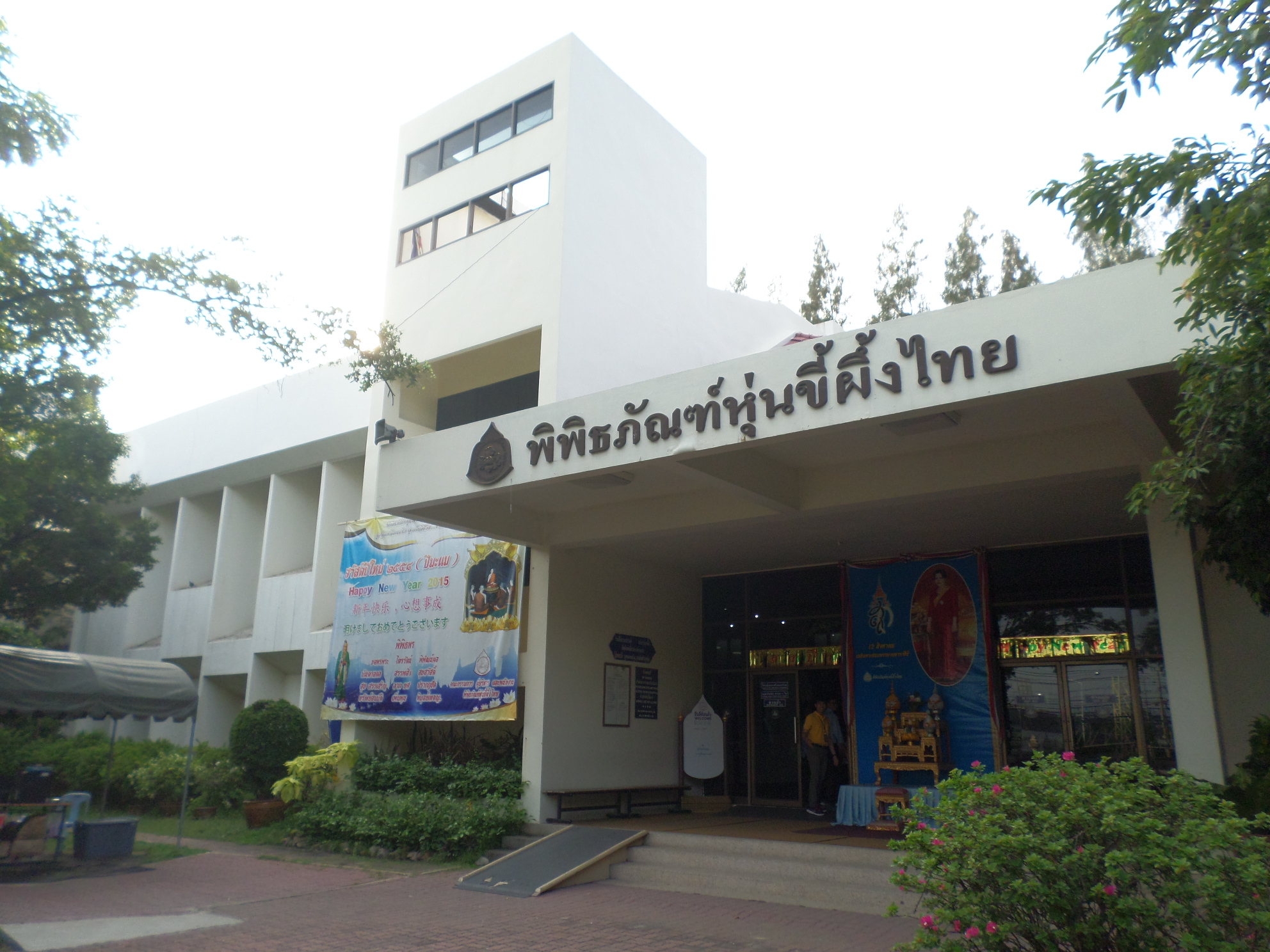
If you assume a wax figure museum means celebrity statues, this place will change your expectations. The Thai Human Imagery Museum in Nakhon Chai Si is entirely Thai-made: Ajarn Duang Kaeo and her team spent over ten years developing a fiberglass formula (more durable in tropical heat and humidity than actual wax), producing figures so close to living people that visitors regularly start talking to them by mistake. Open since 1989, it's a strong fit for families bringing children to learn history in a vivid hands-on way, photography enthusiasts, and devotees who want to pay respects to revered monks.
The highlights that reviewers return to most are the Chakri Dynasty kings set, with Ramas I through IX seated together in a single room — the most photographed corner in the museum. The monks' zone is equally compelling: figures of Somdet Phra Phutthajarn (Toh) and Luang Phu Suk are so accurate that some visitors report goosebumps. Beyond these are figures of world historical figures including Gandhi, Lincoln, and Churchill, plus a Thai daily-life and rural scene zone that represents traditional family life, traditional games, and countryside settings in extraordinary detail. The total display holds around 125 figures, with more added regularly.
Entry fees: Thai adults 80 THB, children (under 130 cm) 40 THB; students in uniform and monks enter at a discounted rate; foreign adults 300 THB, children 150 THB. Open daily; weekdays 09:00–17:30; Saturdays, Sundays, and public holidays 08:30–18:00. Getting there from Bangkok is straightforward: drive straight along Borom Ratchachonnani Road (Pinklao–Nakhon Chai Si direction) to km 31 — the museum sits on the main road with a car park. From Nakhon Pathom city it's about 20+ km on the same road toward Bangkok.
Tips from people who have been: budget 1–2 hours to walk through comfortably; two floors, well air-conditioned, a genuine relief from the heat. Many visitors say to look carefully — in some places a figure is positioned among real staff or real props in a way that makes it genuinely hard to distinguish. If you're bringing young children, tell them in advance that these are figures, not real people — some are lifelike enough to be startling. This combines well with Phra Pathom Chedi or a floating market into a single day, since it's on the same road corridor.
Phutthamonthon
If you want to leave Bangkok without driving far, Phutthamonthon at Sala Ya is a park that people revisit again and again. It's a 2,500-rai Buddhist park so wide you can walk all day without covering it completely. The anchor is Phra Si Sakyamuni Dasabalayan, a graceful walking Buddha image roughly 16 meters tall, designed by Silpa Bhirasri. The composition of the robe — which appears to move as if caught in a stride — is what draws architecture and sculpture lovers. A good match for pilgrims, exercise enthusiasts, and families who want children to run around freely in a safe open space.
What reviews consistently praise is the shade and quiet. The trees are dense, ponds are distributed throughout for sitting beside and feeding fish, and the air inside the park is noticeably cooler than the surrounding city by several degrees. The brick-paved paths are wide and suitable for walking, jogging, and cycling. It is one of the most popular running parks for Nakhon Pathom residents and those living on the western side of Bangkok. Beyond the Buddha image, there's a marble pavilion housing thousands of Tripitaka stone tablets, a Bodhi tree, and a stone Dhamma Wheel to walk past and explore.
Budget: fully free, including parking. Open daily approximately 05:00–18:00. The most recommended windows are early morning and late afternoon when the light is right and the heat is lower. Small breakfast stalls near the entrance sell congee, fresh fruit, coconut water, and coffee for an easy refuel after your walk. This park consistently scores high on Google with thousands of reviews, reflecting genuine local affection.
Worth knowing: the grounds are very large and different points of interest are spread far apart. If you don't want to walk the whole thing, renting a bicycle at the entrance or driving in and parking near the Buddha image is more practical. Occasionally there are religious broadcasts or ceremonies on a speaker system. On major Buddhist holidays the park gets crowded — avoid these if you want quiet. Bring a hat, sunscreen, and water, as shade is spaced unevenly. Dress modestly, as this is a Buddhist site.
Wat Lam Phaya Floating Market
Wat Lam Phaya Floating Market is a community market on the Tha Chin River in Lam Phaya Subdistrict, Bang Len District, Nakhon Pathom — open only on Saturdays, Sundays, and public holidays, about an hour and a quarter by car from Bangkok. A good fit for people who want to escape the city on a weekend and eat well in relaxed riverside surroundings. The distinguishing thing about this market is that it is genuinely run by locals and not staged primarily for tourists: there's a large fresh-produce zone outside where local gardeners bring vegetables and fruit from their orchards at very good prices, and then a pontoon zone right on the river where you sit, eat, and watch the water go by.
The things not to miss food-wise are the local home-cooking specialties: roast duck, pad thai with large prawns, oyster omelette, khanom jeen noodles, charcoal-grilled seafood, and a range of old Thai sweets including pla krim, bua loi, piak pun fresh coconut, thong yip, thong yot, and krachai dumpling with taro, yam, or bamboo filling — all made fresh daily. Prices start in the low tens of baht per item. Another highlight reviewers specifically call out is the boat ride along the Tha Chin to the neighboring riverside temples at around 60–80 THB per person — children can also feed fish from the floating pontoon.
Entry is free. A comfortable eat-and-walk budget is around 150–300 THB per person. The setting is a community over a hundred years old; there is a local-history museum inside the temple showing old household objects, open on weekends. Location: in front of Wat Lam Phaya, on the riverbank. Open approximately 08:00–17:00 (some stalls start earlier). The market is popular because it covers eating, merit-making, and a family outing all in one stop.
Worth knowing: the market only opens on weekends and public holidays — come on a weekday and you'll find it quiet and almost empty. Some reviews note that the real scene is less dramatic than photos suggest, since many stalls are on solid ground rather than actually floating. Some souvenir items cost more than in town. Come early, mid-morning to early afternoon, to avoid the midday heat and have the best selection. If you want to take the boat, confirm the fare before boarding.
Woodland Mueang Mai
Woodland Mueang Mai is an enormous woodcarving museum on the Tha Chin River in Nakhon Chai Si, spread across more than 140 rai. A strong fit for art lovers, those who enjoy a shaded park walk, and anyone wanting a day trip from Bangkok within an hour's drive. The defining feature is the Tiwphaingam family collection of over 2,000 woodcarving pieces accumulated over multiple generations — from ancient wooden columns and carved works to large sculptural pieces — organized into storytelling zones that feel less like a museum and more like stepping into a fantasy wood city.
The two-floor museum building divides into about 10 rooms, progressing through tree roots, wildlife, townspeople, and into belief and religion zones. The highlights reviewers mention most often are the Phaya Naga Cave — entirely carved from theptharo wood into multiple postures of the great serpent at extraordinary detail — and the Christian art room, which holds carved Stations of the Cross and a large-scale Pietà in wood that several visitors describe as enormous and breathtaking. After the museum, the grounds open into wide gardens, fantasy photo spots, and a riverfront section with Woodland Kitchen for coffee and Thai food with a river view.
On price: multiple reviews flag this as "slightly expensive for Thais" (Thai pricing is lower than foreigner pricing), but most people who actually walk through rate it as worth it, given the craftsmanship and quality of curation across every zone, and the warm and attentive service. Google rates it around 4.6 from thousands of reviews; it holds the number-one spot on Tripadvisor for Nakhon Chai Si — reflecting consistent satisfaction from those who make the trip.
Location: Don Faek Subdistrict, Nakhon Chai Si. Very close to Bangkok — about an hour to an hour and a half drive. Open Mon–Fri approximately 09:00–17:00; Sat–Sun until approximately 21:00. The grounds are large with both indoor and outdoor sections — wear comfortable shoes and budget at least half a day. After the galleries, a stop at the riverside restaurant rounds the trip off neatly.
Book tickets and tours for Nakhon Pathom
Nakhon Pathom's attractions are spread across several districts but are all reachable in a day. If you don't want to drive yourself or plan your own route, a guided day trip from Bangkok covering Phra Pathom Chedi, a Tha Chin floating market, and key temples with transport included is the easiest way to cover multiple stops. Book tickets and packages in advance through Klook or GetYourGuide — clear pricing, no queuing at the gate. Works well for international visitors who want to see several places comfortably.
💡 What to know before visiting Nakhon Pathom
Attractions are spread across multiple districts with limited public transport between them, especially on the Sam Phran–Rai Khing–Bang Len side. Renting a car or calling Grab from the city center is more flexible. Within the city center near Phra Pathom Chedi you can walk comfortably.
Don Wai Floating Market, Wat Lam Phaya Market, and the nightly market around the chedi all run mostly on cash — they are small stalls without card readers. Some accept QR PromptPay, but keeping small bills on hand is much easier. Most food items cost a few tens of baht.
Don Wai and Lam Phaya markets are liveliest on Saturday–Sunday mornings to early afternoon — come late and things start running out. Phra Pathom Chedi and Phutthamonthon are best visited in the early morning or late afternoon to avoid the midday sun. The nightly market near the chedi picks up after 6pm.
Phra Pathom Chedi, Wat Rai Khing, and Wat Sam Phran are sacred sites. Cover shoulders and knees. Remove shoes before entering any building or the chedi terrace. Carrying a light scarf or sarong as a backup is convenient.
Central Nakhon Pathom and major food chains have English menus. Street-food stalls and floating markets operate mostly in Thai — point at what you want, or use a translation app. Vendors are friendly and happy to help.
Most casual restaurants and street-food stalls include everything in the listed price. At sit-down restaurants or cafés, leaving a little change is appreciated but never obligatory. It is not a mandatory custom.
Planning your Nakhon Pathom trip to make the most of one day
Nakhon Pathom divides naturally into two zones — plan by zone and you won't waste time doubling back. Zone 1 is the city center: start the morning at Phra Pathom Chedi (pay respects and walk around), then continue on foot or drive 2 km to Sanam Chandra Palace — walk the grounds or go inside the palace halls, then grab lunch at Central Nakhon Pathom. Come back for the nightly market around the chedi at around 5pm when it opens, with food stalls in every direction.
Zone 2 is the Sam Phran–Rai Khing–Nakhon Chai Si riverside — best for those who want floating markets and temple visits by the water. Start at Wat Rai Khing (pay respects, feed the fish, walk the market), continue to Wat Sam Phran for the dragon tower photos, then close the day at Don Wai Floating Market which is liveliest on Saturday–Sunday. Wat Lam Phaya is further out in Bang Len — open only on weekends — good if you have a second day. Anyone with two days can add Phutthamonthon and Woodland Mueang Mai on the second round.
Covering Nakhon Pathom's attractions in one trip is more comfortable with an overnight stay rather than rushing back to Bangkok the same day. Staying near the city center and Phra Pathom Chedi is the most convenient location. The Sam Phran–Sala Ya side works for those focused on the Tha Chin riverside. Compare prices across several booking sites before committing for the best deal.
🔍 Check Nakhon Pathom hotel prices (Agoda)