🔄 Last checked 28 Jun 2026 · details and hours can change — check the venue before you go
📍 All restaurants on the map
Tap a pin for the spot + nearby stays
Yala's charm is that you get two worlds in one province. The first zone is Betong, a town in the valleys at the very south of Siam where the air stays cool almost year-round. Wake before dawn and head up to wait for the sea of mist on the Aiyerweng skywalk — a clear glass floor jutting out over the middle of the valley with views across the Hala-Bala forest and Bang Lang Dam, looking all the way over to the Malaysian side. Come back down into Betong town and you'll find the giant postbox and the marble clock tower in the middle of the intersection; soak at the egg-boiling hot spring, walk through the Piyamit Tunnel in the forest, photograph the Winter Flowers Garden, then check in at the Southernmost Point of Siam sign and OK Betong. The other zone is Yala city, with Wat Khuha Phimuk in a cave beneath a cliff, Suan Khwan Mueang in the middle of town, and bright bird-themed street art on the old buildings. Mountains, merit-making, cafés, and check-in spots — all in one trip.
This list includes the pins you shouldn't miss in Yala, like the Aiyerweng sea-of-mist skywalk, which has become Betong's number-one landmark; Wat Khuha Phimuk (Wat Na Tham), which enshrines a Srivijaya-era reclining Buddha over 1,200 years old inside a cave beneath a limestone cliff; the Piyamit Tunnel, hand-dug in the era of the Communist Party of Malaya and now open as a museum in the forest; and Bang Lang Dam with the Hala-Bala lake, nicknamed the Amazon of ASEAN. If you prefer strolling in town, there's Suan Khwan Mueang (Phru Ba Koi) with its zebra-dove singing arena, and Yala's bird-themed street art, a favourite check-in spot. Scroll through the details spot by spot and plan your own route.
Aiyerweng Sea-of-Mist Skywalk

If you come to Betong and don't go up the Aiyerweng sea-of-mist skywalk, locals say you haven't really arrived. This is a clear-glass-floor viewpoint set atop Microwave Hill, around 2,038 feet above sea level. The walkway juts out from the tower more than 60 metres into the middle of the valley, ending in a circular balcony with a clear glass floor you can look straight through to the treetops below. On clear days you'll see a soft white sea of mist rolling over the Hala-Bala forest, with distant views of Bang Lang Dam and the mountain range on the Malaysian side. What many people love is that the sea of mist appears almost year-round — you don't have to gamble the way you do on the northern peaks. It's ideal for anyone who wants sweeping views without a long forest trek.
The highlight you can't miss is walking out to the very end of the glass bridge and turning back for a photo with the sea of mist as your backdrop, plus climbing to the top level of the tower for the 360-degree view. Sunrise is the golden minute, when the mist is thickest and the light is at its best. Nearly every visitor review agrees on one thing: you have to come early. The mist usually thins out after around eight in the morning, and people who arrive late often see nothing but bare mountain views. Mornings up here are quite cold and windy, so bring a warm jacket or a wrap for comfort.
To visit, park at the lower lot and walk up about 500 metres, or take a motorcycle taxi or shuttle up for a few dozen baht per person. Entry is roughly 40 baht for Thais and 200 baht for foreigners, plus 30 baht for the anti-slip socks you must wear on the glass. Numbers per round are capped for safety. Open daily from 05:30 to 16:30. To catch the mist in full, aim to arrive by around five in the morning. Up top there's a small café serving hot coffee and snacks to warm up with while you wait for the morning light.
This is one of the top landmarks in Yala and Betong, scoring as high as 4.6 stars on Google from several thousand visitors. Good to know: the final stretch of the mountain road is fairly narrow and winding, so take extra care if you're driving yourself, and long weekends get very crowded. Arriving early gets you both the best mist and a shorter queue.
Thailand's Largest Postbox & Betong Clock Tower

If you come to Betong and don't stop to photograph the giant postbox and the clock tower at the intersection, it's as if you haven't quite made it to Betong. This spot is the true centre of town, at the clock-tower intersection on Sukhayang Road, where a red reinforced-concrete postbox stands tall — about 290 cm high (nearly 320 cm including base and top) and said to be the largest in Thailand. It suits anyone who wants a photo with the town's signature landmark: families, couples, and lovers of old things with a story to tell.
The charm here is the history. This postbox was built before World War II by Mr Sanguan Chirachinda, a former postmaster who later became mayor of Betong, intended as a symbol of communication for a town that was once hard to reach. In the old days a radio speaker was mounted on top to broadcast government news to residents. What amazes many people is that the postbox still works today — you can post a letter and it will be sent. The clock tower in the middle of the roundabout, meanwhile, is built from Yala marble and has stood alongside the town for a long time.
Something not to miss is the time around dusk: from September to March, thousands of swallows come to perch on the wires around the clock tower, a sight many reviews call striking. At night the clock tower is lit beautifully, and during festivals it's decked out in full display lighting. Google reviewers give the clock tower an average of 4.5 from over 2,100 reviews, showing that people really do make a point of stopping here.
No need to worry about budget — it's free to visit and photograph, a public space in the middle of town you can stop by any time of day. Restaurants, cafés, and souvenir shops are all within easy walking distance. Good to know: this is a roundabout with traffic, so take care and time your shots well if you're photographing in the road. Coming in the morning or evening means gentler light and softer sun than at midday.
Wat Khuha Phimuk (Wat Na Tham)

If you come to Yala wanting to see something unlike an ordinary temple, Wat Khuha Phimuk — which locals habitually call Wat Na Tham — is the place to stop. Its distinction is that it's a temple inside a cave beneath a large limestone cliff, enshrining a large Srivijaya-era reclining Buddha (Phra Non) over 1,200 years old, which villagers call Pho Than Banthom, roughly 81 feet long. The special detail is a naga spreading its hood above the Buddha's head, rarely seen on other reclining Buddhas. It's a great fit for merit-makers who love to pay respects and make wishes, history enthusiasts, and families who want to bring children to see a real cave.
Besides the reclining Buddha, don't miss Pho Than Chao Khao, the guardian giant of the cave, standing around 6 metres tall and holding a skull-topped club — imposing from the moment you start up the path. Inside, the cave is a wide hall, naturally cool and comfortable, with stalactites, stalagmites, and several ancient Buddha images to walk among. If you're the adventurous type, continue on to the dark cave a short distance further, which has several sacred spots to make wishes and a sacred well and pool deeper inside. Volunteer youths are usually on hand to guide you and tell the stories.
On fees, the temple and the main cave are free, while the dark cave has a small maintenance charge of around 20 baht per person — well worth it for a guided cave walk. It's located in Tambon Na Tham, Mueang Yala District, about 7–8 km from town, easy to drive to with parking available. Open daily from around 08:00 to 17:30. Coming between morning and late afternoon is best, when the air is pleasant and the light in the cave is bright enough.
This temple is popular because it packs several things into one place: an ancient temple bound to the province, a thousand-year-old reclining Buddha, beautiful limestone caves, and the legend of the guardian giant passed down over generations. This spot is also considered evidence of the flourishing of Buddhism in the Srivijaya era in the southern lands. Good to know: dress modestly, as this is a sacred place; some stretches of the cave floor are slippery and dark, so wear comfortable walking shoes; and if you dislike tight spaces or are afraid of bats, prepare yourself a little — though overall it's not as daunting as many people imagine.
Bang Lang Dam & Hala-Bala Lake

If you think Yala is only about towns and temples, try driving out to Bannang Sata District and you'll find another world — Bang Lang Dam, an 85-metre-tall, 430-metre-long rock-fill dam with a clay core, built by EGAT across the Pattani River to form a vast deep-green lake ringed by the mountains of the Hala-Bala forest, which many habitually call the Amazon of ASEAN. It's ideal for families, groups of friends, and anyone who loves quiet, uncrowded nature. You get the dam view, the lake view, and the cool air of a rainforest, especially after rain when a thin mist drifts over the mountains.
The highlight you shouldn't miss is getting on a boat or raft out onto the water. Locals say that coming to Bang Lang without taking a boat is like not arriving at all, because boats have been the way of life for the valley people for generations. The popular route stops at Ko Thuat, an island revered by both Thai Buddhists and Muslims, where people come to pay respects and ask for luck — about 15–20 minutes from the pier — before circling round to view the dam crest from the water, passing the clear streams flowing out of the Hala-Bala forest. A well-known local souvenir is pla kradot (dried freshwater fish), crisp and not fishy, available plain or fried with salted egg.
Budget-wise it's not expensive for a group. A private boat charter runs about 1,500 baht per boat, seating up to 10 people, and takes around 2 hours. Some operators have small packages starting in the low hundreds if you only go to Ko Thuat. Food on the boat is charged separately, roughly 150 baht per person. The viewpoint on the main road you can drive up to for free, with parking, restrooms, and a shaded pavilion to sit and catch the breeze.
It's located in Tambon Khuean Bang Lang, Bannang Sata District, Yala, a natural stop on the way up to Betong (about 2 hours away). Open roughly 08:00–18:00. For a boat trip, call ahead to book the boat owner, as departures are limited (around 09:00, 11:00, 13:00, 15:00). Good to know: allow extra travel time, as the roads are mountainous and can be slippery in the rainy season, and the water is at its most beautiful and green during high-water periods. Wear non-slip shoes and have your camera ready — you'll get views you won't find anywhere else in the south.
Betong Hot Spring

Betong Hot Spring is a natural hot spring in a mountain valley in Tambon Tanoh Maero, about 5 km from Betong town along Highway 410, and it's a stop almost everyone who comes to Betong makes. The water here rises from underground at nearly 80 degrees Celsius — hot enough to actually boil eggs. The surroundings are quiet and peaceful, with shady trees and neatly landscaped walkways. If you want somewhere to relax without an entry fee, this is a great fit, because it's free to enter and you can stroll and soak your feet at your leisure.
The highlight you can't miss is the egg-boiling pool: put eggs in a basket, lower them into the boiling spot, and in just a few minutes you've got hot soft-boiled eggs to eat fresh at the pool's edge. Another spot people love is the mildly sulphuric mineral foot bath, where you can dip your legs and ease your tiredness. If you want a proper soak, there's a newer soaking-pool zone and a hydrotherapy building. Genuine reviews say the water is clear, the pools are clean, there are several to choose from at different temperatures, and vendors selling eggs and snacks are conveniently nearby.
On cost, it's very light: entry and foot-soaking are free, while the soaking pools and hydrotherapy carry a small charge. Open from early morning at 05:30 through to 20:00 daily. For a relaxed atmosphere with fewer people, come in the morning or towards evening, when the air is pleasant and the steam rising off the water makes for lovely photos.
Good to know: the source water in the pools is very hot — never dip your hands or feet into the boiling spots, and keep close watch if you're with children, soaking only in the designated pools. This spot scores around 4.1 on Google from over two thousand five hundred reviewers, showing it's a popular Betong check-in where you can both relax and bring home some nice photos.
🛏️ Hotels in Yala — Pick a Base by Your Route
Yala has two zones to visit that sit at opposite ends. If your trip focuses on the sea of mist and nature, we suggest staying a night in Betong so you can wake before dawn to make the Aiyerweng skywalk in time, and be close to the hot spring, the Piyamit Tunnel, and Betong town. On the day you tackle Wat Khuha Phimuk, Suan Khwan Mueang, and the street art, moving to a stay in Yala city is more convenient. Book ahead on long weekends, as Betong accommodation fills up fast.
🔍 Check Yala Hotel Prices (Agoda)Piyamit Tunnel
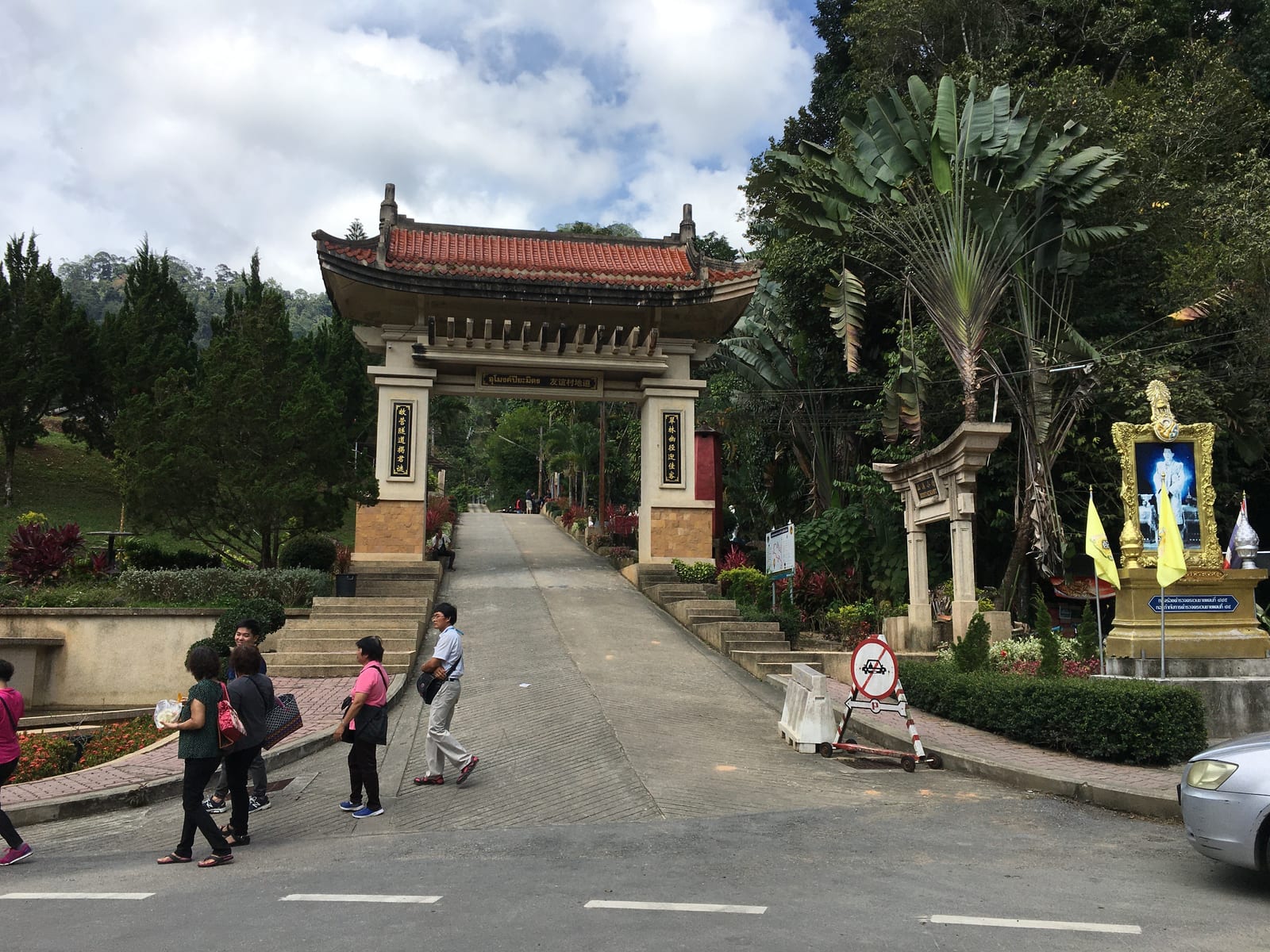
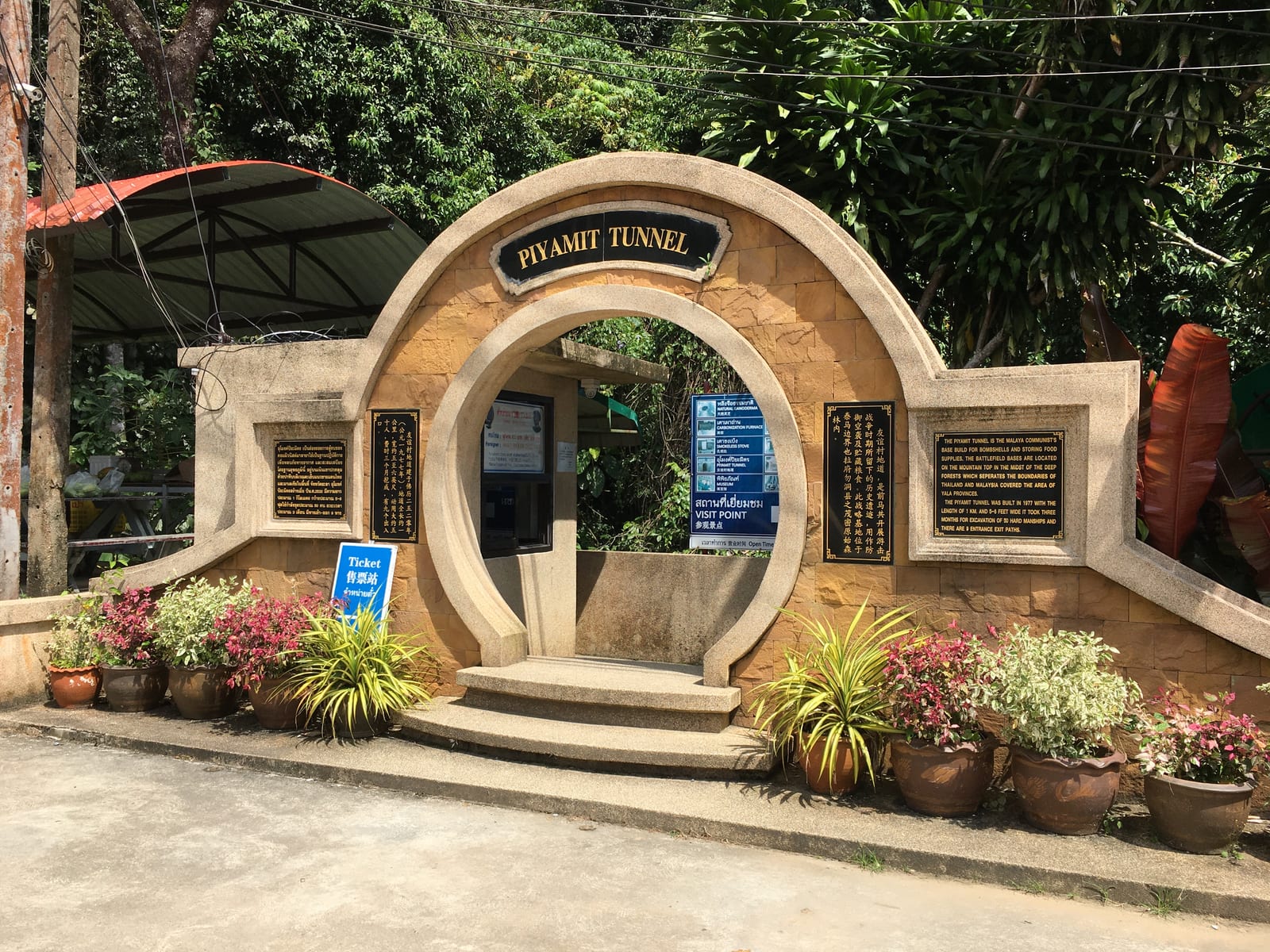
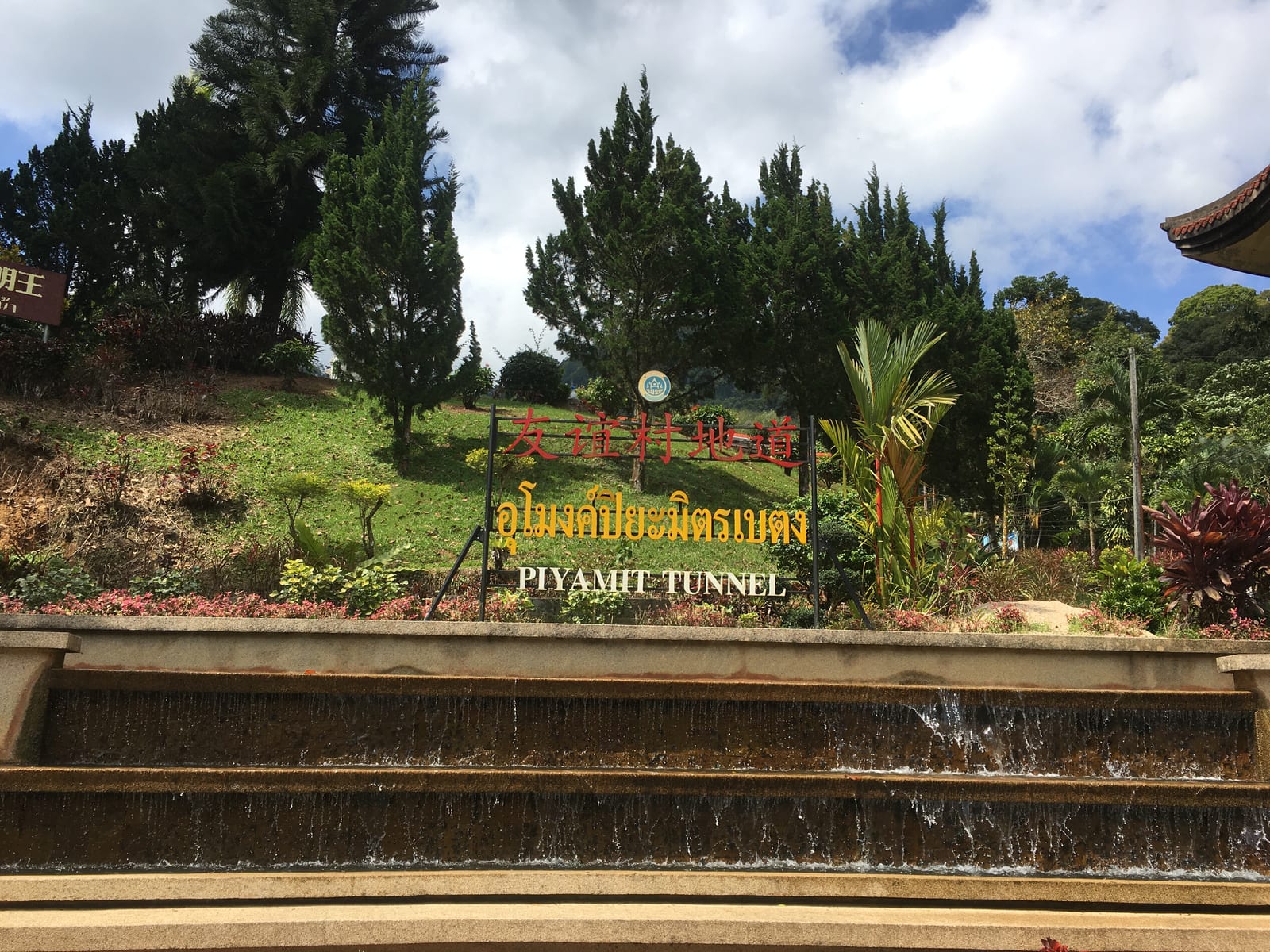
If you come to Betong wanting an attraction unlike anywhere else, the Piyamit Tunnel is the answer. It's an earthen tunnel that former members of the Communist Party of Malaya dug by hand in 1976 to use as a shelter and supply store deep in the forest, more than 1 kilometre long in total, with several entrances all connected to each other. Today it's open as a museum in the forest where you can walk through and see the real thing. It's a great fit for history lovers, families who want to bring children to learn, and anyone who enjoys a gentle forest walk.
The highlight you can't miss is the tunnel itself, which you can actually walk through — inside it's narrow, dark, and cool, giving you a sense of the lives of the people who once lived here. There's a meeting room and a storage room on display. Another spot many people mention is the 'thousand-year tree', a giant banyan with an enormous root system at the end of the forest trail — most reviews say this part is beautiful and remarkable, some going so far as to call it astounding. Before you reach the tunnel there's also a museum building recounting the history of the Communist Party of Malaya, and a small Chinese shrine to stop at.
Entry is around 40 baht for Thais and 60–80 baht for foreigners. Open daily 08:00–16:30. It's located in Ban Piyamit, Tambon Tanoh Maero, about 25 km from Betong town — roughly 40 minutes by car, or just 20 minutes on from the hot spring. Expect to spend about 45 minutes to 1 hour actually visiting.
Good to know: you have to climb stairs and fairly steep paths, and several reviews warn that elderly visitors or those with bad knees may find it tiring — wear trainers and bring water. It's popular because it's a historical attraction you won't find elsewhere; its Google score stays consistently good and it ranks among the things to do in Betong.
Suan Khwan Mueang (Phru Ba Koi)

Suan Khwan Mueang — which Yala locals habitually call Phru Ba Koi — is a large public park in the heart of the city run by Yala City Municipality, covering around 207 rai and developed from what was originally a peat wetland. What sets it apart from ordinary parks is the big lake in the middle, covering nearly 70 rai, with a mock beach along the water, a sports park, and a zebra-dove singing arena said to be a large, standard-grade arena for the south. If you're visiting Yala city and want a place to relax without leaving town, this fits well — it's just a few hundred metres from Yala's city pillar shrine, an easy walk or short drive on.
People who've been agree the loveliest time is the evening. The walkways are shaded by big trees, pleasant for strolling or a workout, and as the sun softens you'll see the sunset reflected on the water's surface — very beautiful. Many bring families to pedal the paddle boats on the lake, feed the fish, or let the kids run at the playground. If you like photography, there are waterside corners and the mock beach to keep shooting.
Entry is free — no gate charge — with parking around the park; the paddle boats are rented separately. Around the park are restaurants, cafés, and food trucks that set up in the evening, so you can find something to eat nearby. Open daily around 08:30–17:00. For a quieter atmosphere, come on a weekday in the morning or late afternoon, as weekends are busier.
This place is popular because it really is like the lungs and gathering point of Yala's people, not a set-piece built for tourists. Coming here you'll clearly see local life: people working out, families bringing children to play, and dove-keeping enthusiasts tending their zebra doves. Good to know: bring mosquito repellent if you come by the water in the evening, and check when the zebra-dove singing competitions are on if you want to see the distinctly local buzz.
Yala Bird City Street Art
If you come to Yala and want nice photos in the middle of town without driving anywhere far, Yala Bird City Street Art is a place to stop. It's a street-art district in the old town centre around Nuan Sakun Road in Tambon Sateng, where a group of young Yala locals came together to bring the old building walls to life as an open-air gallery — around 14 murals in all, by well-known Thai street artists such as Alex Face, October 29, Mue Bon, and BigDel. The main theme is 'birds', a symbol of Yala rooted in its long history of bird-keeping, which is how the name Bird City came about. It's a great fit for photographers, couples, families, or anyone who enjoys a relaxed art walk.
The highlight you can't miss is Alex Face's rabbit-character wall, which many people come specifically to photograph, along with brightly coloured birds of many species scattered across buildings and small lanes. Each piece tells a story of the way of life and diversity of Yala's people through the linework. You can walk around and photograph them all in a short time, since they're within a radius of about 100 metres. Genuine reviews in travel-guide circles agree it's a 'check-in you have to stop and photograph' and a landmark that makes Yala's cityscape look much brighter.
Cost is very wallet-friendly, as it's free to visit and open to walk around 24 hours (though morning or evening is best for good light and cooler temperatures). There's street parking, and it's centrally located across from the Colosseum Yala area, so you can walk on for coffee or something to eat in the old town. Reviews are good too, sitting around 4.6 on Trip.com, and it has ranked among Yala's popular attractions on Tripadvisor.
A few things to know: some pieces are down lanes and scattered across buildings, so look for the TAT map of the 14 spots or explore the side lanes and you'll find more than you would just walking straight through. Some walls may be faded or partly blocked by objects over time, but overall it's still a worthwhile downtown photo corner that gives you a genuine Yala art-town feel.
Winter Flowers Garden (Betong Cold-Climate Flower Garden)
If you come to Betong and want to see cold-climate flowers blooming across the hills — something you'd never expect in the south — the Winter Flowers Garden (or the Betong Cold-Climate Flower Garden) is a place to stop. It's located in the Piyamit 2 village area, Tambon Tanoh Maero, a garden under the royal-initiative project of HRH Princess Sirindhorn, taking advantage of Betong's elevation of around 800 metres above sea level, where the air stays cool almost year-round, so cold-climate flowers really do grow. It suits photographers, families bringing elders or children to stroll, and anyone who wants to escape the heat and breathe cool air.
The highlight is the multicoloured flower beds tiered in layers — chrysanthemums and potted plants totalling over 40 varieties, blooming in rotation to keep flowers on show year-round. Most reviews praise the garden as spacious and well-organised, with plenty of photo corners, and the green valley backdrop makes almost every angle come out beautifully. There's also a tram to tour the garden for those who don't want to walk far, and a Chinese-style boat ride to view both banks. At times they release dry-ice mist to give the cool, winter-themed atmosphere.
Entry for Thais is 40 baht for adults and 20 baht for children (about 100 baht for foreign tourists), which counts as wallet-friendly. Open daily around 07:30–17:00. Inside there's a zone selling plants, flowers, and agricultural products, plus accommodation and a restaurant out front for anyone who wants to stay overnight and catch the cool morning air.
Good to know: the garden is about 19 km from Betong town, requiring a drive up the mountain; some stretches are fairly steep, but the road is good and the views are lovely all the way. Come in the morning while the air is still cool and the sun is soft for the best photos, allow enough time to walk the whole area as it's fairly large, and check the opening hours once more before you set off.
Southernmost Point of Siam Sign & OK Betong
If you make it to Betong and don't take a photo with the 'Southernmost Point of Siam' sign, locals will tease you that you haven't really arrived. This sign is a marble slab engraved with the outline map of Thailand in bold gold, standing right at the Betong customs checkpoint, exactly where Thai soil meets the Malaysian border. Stand here and look across and you'll see the Malaysian checkpoint on the other side — the 'end of the country' feeling really lands. It suits anyone who likes collecting signature landmarks, families, or groups of friends who've driven a long way south and want a photo confirming they've reached the southernmost point travellers can access.
The popular move is to do both signs on one trip. On the way in, before you reach town, you'll find the 'OK BETONG' sign at the entrance on Highway 410 — a big welcome sign with the OK Betong lettering, a welcome arch, and a kilometre marker all in one photo spot, like the first pin telling you 'you've reached Betong'. The Southernmost Point of Siam sign, meanwhile, is saved as the closing highlight of the trip at the checkpoint. Many genuine reviews say the checkpoint area is clean, with flowers arranged around the sign and photos coming out nicely, though it's busy on holidays and you may have to wait your turn a little.
Both spots are free — no entry fee, free to photograph. The Southernmost Point of Siam sign is inside the checkpoint zone; if you want to drive up close, just tell the officers you've come to photograph the southernmost point. Good to know: check the checkpoint hours first, because if you arrive after operating hours the photo spot may be closed. OK Betong is open daily around 07:00–20:00. The two are on opposite sides of town — the OK sign at the entrance, the Southernmost sign at the far end by the border about 7 km from town — so allow a little driving time.
A detail many people don't know: the name 'Southernmost of Siam' is a symbolic tourism title; geographically, Thailand's actual southernmost point lies further in. But this sign at the checkpoint is where ordinary visitors can most easily reach and photograph, so it's become a popular landmark that both travel media and Betong locals treat as the town's signature image. Paired with OK Betong — which Betong takes pride in as the only district in Thailand with its own vehicle licence plate — these two signs are a check-in almost every Betong trip stops for.
🎟️ Tours and Tickets for Yala-Betong, Easy to Book with No Queue
Many of Yala's attractions are in the forest or up in the mountains and hard to reach on your own — the Aiyerweng skywalk, Bang Lang Dam and the Hala-Bala forest, and the Piyamit Tunnel among them. If you're not driving yourself or want to make the most of the day, booking a Betong tour with transfers and a local guide lets you cover several spots in one trip without planning the route yourself. Compare tour packages and boat tickets in advance through Klook or GetYourGuide so you don't have to gamble on boat departures or waste time queueing on the day.
💡 Know Before You Go: Yala
Some spots in Yala city are walkable to each other, but Betong is about 140 km away on a winding mountain road, and places like Aiyerweng and Bang Lang Dam are outside town. Grab is almost non-existent — we suggest renting a car, hiring a car with driver by the day, or booking a tour with transfers.
The Aiyerweng skywalk is at its best around sunrise, so leave your accommodation by four or five in the morning to arrive before daylight. The air on the mountain is cold — bring a warm jacket and socks (sold on site for 30 baht, since you have to take off your shoes to walk on the glass floor).
Entry fees, sock fees, temple offerings, the Bang Lang Dam boat trip, and most local shops take cash. ATMs exist in Yala city and Betong, but are hard to find at forest attractions — bring enough cash with you.
Wat Khuha Phimuk is a sacred place with a thousand-year reclining Buddha — dress modestly, cover your shoulders and knees, and remove your shoes where required. Yala is a multicultural Muslim-Buddhist area, and dressing neatly makes for a more comfortable visit.
The Southernmost Point of Siam sign and OK Betong are right by the Malaysian border checkpoint. If you plan to cross into Malaysia, carry your passport and check the checkpoint opening hours ahead, as this is a border area with its own rules.
Betong has a large Thai-Chinese community, and you'll hear Chinese, Thai, and local Malay. Thai works generally; English signs and menus appear at main attractions and city restaurants, while small community shops may have only Thai — a translation app helps.
Tips to Plan a Yala Trip That's Worth It
The route that works best is to split it into a Betong zone and a Yala city zone. If you focus on Betong, stay a night, wake at four or five in the morning to wait for the sea of mist at the Aiyerweng sea-of-mist skywalk (entry 40 baht, foreigners 200 baht, plus 30 baht for socks) in time for the morning light, then come down to soak and boil eggs at the Betong hot spring, walk through the Piyamit Tunnel (40 baht), and stop at the Winter Flowers Garden. In the afternoon, cover central Betong — Thailand's largest postbox and the marble clock tower — and drive out to check in at the Southernmost Point of Siam sign and OK Betong at the border checkpoint.
If you have another day, cover the Yala city zone and the route in between: stop at Bang Lang Dam and Hala-Bala Lake in Bannang Sata (viewpoint free, private boat charter around 1,500 baht for up to 10 people), then head into Yala city to pay respects to the Srivijaya-era reclining Buddha at Wat Khuha Phimuk (Wat Na Tham — main temple free, dark cave around 20 baht), stroll in the evening at Suan Khwan Mueang (Phru Ba Koi), and follow the bird-themed street art on Nuan Sakun Road in the old town. Two days is enough to cover the mountains, the lake, the temples, and the town.
Yala has the Betong zone in the valleys and Yala city, which sit at opposite ends, so booking accommodation to suit your route is the most convenient. Stay a night in Betong to go up and wait for the sea of mist before dawn, then move to a stay in Yala city the next day.
See Well-Located Hotels in Yala