🔄 Last checked 25 Jun 2026 · details and hours can change — check the venue before you go
📍 All restaurants on the map
Tap a pin for the spot + nearby stays
Ask a Bangkoker for the one neighborhood where you can walk and eat well across every style from morning to late night, and a lot of them will say "Phra Nakhon Old Town" — because this is the innermost old district of Bangkok, from Khao San Road that travelers worldwide know, on to Banglamphu, Phra Athit Road by the river, Dinso Road near Sao Ching Cha, all the way to Ratchadamnoen, a historic avenue. The charm of this area is old shops that have stood in the same shophouses for decades sitting right next to new places opening for the backpacker crowd. Walk a few steps and you can go from a hot plate of pad thai to late-night rice soup to a royal-Thai spread in an air-conditioned room — that's what sets the Old Town apart from other eating neighborhoods. It gathers food from many eras and many price points into an area you can cover entirely on foot.
This list has places backed by real time on the clock and real awards — Thipsamai Pad Thai (Pratu Phi), the legendary pad thai with roots going back to World War II that once won a Michelin Bib Gourmand; On Lok Yun, an old-school breakfast spot beside the Chalermkrung Theatre that has served kaya toast and traditional coffee for nearly a century; Methavalai Sorndaeng, royal-Thai food on Ratchadamnoen Avenue open since 1957, still pressing fresh coconut milk and making khao chae in season; and Karim Roti-Mataba, the famous mataba spot in front of Phra Sumen Fort that has stood on Phra Athit Road for decades. On the snacks-and-dinner side there's Krua Apsorn curry crab, Mont Nom Sod kaya toast by Sao Ching Cha, Pad Thai Fai Ta Lu fired over high flame, Jira Yentafo, and Pengpeng Rice Soup, a Banglamphu original — closing with Kanom Bueang Mae Prapha at the Tor Ngek Chuan store, royal-recipe kanom bueang over 60 years old — scroll down to see them one by one, then pick where to start your first meal.
Thipsamai Pad Thai (Pratu Phi)
When it comes to legendary pad thai in Bangkok, the first name that comes to mind is "Thipsamai Pad Thai (Pratu Phi)," an old shop on Maha Chai Road, opposite Wat Thepthidaram in the Phra Nakhon district, that has been open since around 1966 (selling from a stall before that, since the 1950s) until it earned a place in the Michelin Guide. It's a perfect fit for anyone exploring the Old Town and Ratchadamnoen, or staying near Khao San, who wants to try the original pad thai that visitors from all over the world fly in to eat. It's an easy walk from the Ratchadamnoen area, pinned at 13.7548, 100.5041.
The dish to order is the "Chantaburi-noodle pad thai with prawn fat wrapped in egg," the star of the shop — sun-dried Chantaburi noodles stir-fried with house-rendered prawn fat, then wrapped in a thin, pretty sheet of egg with big, fresh sea prawns set on top (this plate runs about 150 baht). On a budget, order the "plain Chantaburi-noodle pad thai with egg" at around 90 baht and you'll still eat well. If you want it loaded, there's the "deluxe pad thai" on a big plate, and the one you can't miss — the "fresh-squeezed orange juice" in a big bottle that many say beats the pad thai itself, with a cold coconut water to cool you down.
The flavor, going by real reviews, lands much the same way: the shop seasons it on the milder, slightly oily side and leaves you to adjust to taste. The prawns are big and fresh, and watching them wrap the egg at the griddle is a show in itself. Some knock the noodles for being a touch soft and the price for running higher than ordinary pad thai, and some find it a bit sweet, but most give it to the fresh orange juice and the sense that this is the original. On Wongnai it scores around 3.7 stars from several hundred reviews, and it ranks number one for one-plate dishes in the Phra Nakhon district.
Good to know before you go: evenings and nights bring long lines, especially on weekends, and you may end up standing along the road or by the griddle to wait, since the seating inside isn't large. To skip the queue, try the afternoon. It currently opens around 09:00–23:30 and is "closed on Tuesdays," takes credit cards and offers delivery, with a per-head spend of roughly 101–250 baht. Foreign visitors can relax — there's an English menu and the staff are used to international customers.
On Lok Yun
If you wake up early and wander the Old Town around Sao Ching Cha and Wang Burapha and want a breakfast that fills you up with atmosphere to match, "On Lok Yun" at the mouth of Charoen Krung Soi 4 is one of the first names Bangkokers bring up. The shop has been open since 1933 — over 90 years — an old-school coffee shop and American-style breakfast spot with a Thai-Chinese touch, set in a pre-war shophouse where time seems to have stopped: wood-and-glass cabinets, ceiling fans, old chairs, and seating on two floors. It suits anyone who wants a retro breakfast, who wants to bring a foreign friend to experience old-school coffee-shop culture, or who needs to refuel before heading on to Pahurat, Sampeng or Khao San. It's just a few minutes' walk from MRT Sam Yot, Exit 3.
The dish to order is the "kaya toast," the star of the shop — soft, fine-textured bread spread with an old-recipe kaya that's nicely fragrant with coconut and not overly sweet; many reviews say it pairs perfectly with the traditional coffee. Follow it with "soft-boiled eggs" cooked to a lovely runny yolk, splashed with soy sauce and white pepper, and the pan-egg/ham set that comes loaded with bacon, ham, chicken sausage and Chinese sausage, with a smoky sweet-salty character all its own. If you've got a sweet tooth, try the butter-sugar toast and the iced-milk toast, finishing with strong traditional coffee or tea. Most items run about 30–100 baht, kaya toast 38 baht a slice, soft-boiled eggs 30 baht, the loaded egg set around 90–100 baht, with a per-head spend that rarely tops a little over a hundred baht — great value for a legendary shop in the heart of town.
On flavor, reviews are fairly mixed. Fans will tell you the kaya is fragrant, the bread soft, the soft-boiled eggs done well, and the charm of the old setting hard to find elsewhere, while others see the flavor as middle-of-the-road for an old-school coffee shop rather than a wow, and a few dishes come out a touch oily — keep that in mind. Good to know: the shop is open 06:00–14:30 every day, focused on morning to afternoon, and weekends and holidays get packed, so you may wait around 15–30 minutes for a table and your food. The tables are fairly close together, there's no proper parking, and the MRT is by far the easiest way. What keeps it popular across generations is that it's a legendary breakfast that's plenty tasty, kindly priced, and serves up the old-Bangkok atmosphere that lands in every photo.
Methavalai Sorndaeng
If you're after a truly legendary Thai restaurant in the Old Town, Methavalai Sorndaeng is one of the first names Thai-food lovers think of. The restaurant has been open since 1957, on the corner of Ratchadamnoen Klang Avenue with a view of the Democracy Monument, serving refined central-Thai royal cooking so well that it has held a Michelin star since 2019. It suits anyone who wants old-recipe Thai food as a full spread, taking elders out, celebrating a special meal, or bringing a foreign friend to feel the charm of a retro Thai dining room you can't find anywhere else anymore.
The dishes reviews mention most and that you shouldn't miss are the fried fish cakes, springy and bouncy in their signature way, and the golden cups (krathong thong), crisp and packed full, easy to keep eating. Many order the mixed appetizer set (around 440 baht) that brings golden cups, fish cakes, hoi jor and crispy noodles all on one plate. Another standout is the sour curry with lotus stems and grouper — said to be one of the first places to bring lotus stems into a southern-style sour curry — bold and well-rounded, sour and spicy and full of aromatics. If you like rice dishes, go for the rice baked with Chinese olives or the rice with shrimp paste, served with all the trimmings; squeeze on lime, toss it together and the crisp shallots make it fragrant. And in the hot season they usually have seasonal khao chae to try too.
Most reviews praise the flavor as "genuinely Thai, well cooked," and the setting as a time capsule sending you back decades — the decor, the tableware, and classic Thai music played live at certain times. The per-head spend runs around 251–500 baht, fair for Michelin-level quality. Note that the shop gets busy, especially at dinner and on holidays, so calling ahead to book (02-224-3088) is the more relaxing move.
Important to know: the original dining room on Ratchadamnoen is currently closed for a major renovation, but the restaurant is still open as usual, having moved to serve at Methavalai Residence just behind the old shop — the same hands and the same menu, the whole set. Open daily 10:30–22:00, with parking at the back, and easy to reach since it's in the heart of the Old Town, near Khao San and the landmarks around Rattanakosin Island. That's why it stays a favorite where both Thais and visitors pin a spot to come eat traditional Thai food.
Krua Apsorn (Dinso branch)
When it comes to "crab" in the Old Town, the first name Bangkokers think of is Krua Apsorn, the Dinso Road branch — a Thai restaurant with a grandmother's touch that has been open since 1996, passing a family recipe down through the generations, once cooking for the royal court and listed in the Michelin Guide for several years running. The shop is a small air-conditioned shophouse near the Democracy Monument and Banglamphu, perfect for anyone who wants genuinely skilled Thai cooking in a homey setting where you don't have to dress up, and an easy stop while exploring Khao San and Sao Ching Cha.
The dish to order is the one that made the shop famous — crab omelette souffle, a fluffy omelette crisp outside and soft inside, packed with big chunks of crab meat that reviews agree nearly every table orders — and the crab in curry powder and yellow-chili crab, where the crab meat is firm, sweet and balanced just right against the heat. If you like vegetables, try the yellow curry with lotus stems and prawn, a bold broth led by sourness, with stink beans stir-fried with prawn and minced pork that's fragrant with stink-bean aroma, and miang kana, a sour-sweet-salty appetizer. Finish with the fragrant coconut ice cream for just a few baht a cup.
It's not cheap if you order the crab dishes — a crab plate runs about 500–600 baht, the crab omelette souffle around 139 baht, and the stir-fried stink beans 229 baht; if you come with several people and share, it averages about 250–400 baht a head. Reviewers warn the plates aren't large, so coming with a group and ordering several dishes is better value and lets you try more. Seating is limited and weekend lunches get packed, so if you don't want to wait, come before opening time or order takeaway.
It's at 169 Dinso Road, near Bangkok City Hall, open Monday–Saturday 10:30–19:30, closed Sundays. Parking is hard to find, Old Town style, so public transport or parking around Lan Khon Mueang is recommended. The reason this place stays so popular is the old-recipe Thai cooking that's getting harder to find, plus the Michelin name that guarantees you won't leave disappointed.
Karim Roti-Mataba
If you're wandering Phra Athit Road in Banglamphu, opposite Phra Sumen Fort and Santichaiprakarn Park, and you spot a queue in front of a small shop with someone frying roti at the griddle, that's Karim Roti-Mataba — a legendary spot open since around 1943, started by Karim, a Muslim of southern-Indian descent, and now handed down through the generations for over 80 years. It's a halal restaurant that blends Indian-Bengali roti with Thai curry, becoming a destination for both visitors stepping off the Chao Phraya boat and longtime locals of the neighborhood. It's a great fit for anyone who wants a first meal or an afternoon bite around the Old Town and Khao San — the real thing, with a story behind it.
The dish to order is the chicken mataba and beef mataba — thin fried dough wrapping a packed filling, eaten with a sweet-sour ajat dipping sauce; many reviews agree the beef mataba is so good you'll order it twice. For the sweet tooth, don't miss the cheese-and-milk roti, banana roti or chocolate roti. If you like eating with rice, there's massaman, curry and green curry to ladle over rice or dip your roti into, plus chicken biryani and beef or chicken soup. The note many people share is that the flavor leans sweet, especially the massaman and the various curries — some love it, some find it too sweet, so order several things to share for the full range.
Prices are accessible — mataba starts in the low hundreds per piece (around 79–89 baht), sweet roti in the sixties, chicken biryani around 99 baht, averaging about 100–250 baht per person if you order several things. The note from real reviews is that the mataba pieces aren't very large, so if you're really hungry you may need several, and the total creeps up.
Downstairs is an open kitchen, hot and bustling, with small tables and chairs, but if you want to sit comfortably there's an air-conditioned room upstairs. Open daily 09:30–22:00, easy to reach since it's right on Phra Athit Road, an easy walk from Khao San or the Phra Athit pier. Parking is a bit hard to find, Old Town style, so come in the late morning or late afternoon to dodge the busiest hours.
🛏️ Stay overnight in Khao San & Phra Nakhon and eat through several meals with no rush
If you want to hit all 10 places without racing the clock, staying a night in Khao San & Phra Nakhon is well worth it — many stays sit around Khao San Road, Banglamphu and along Phra Athit Road, within walking distance of nearly every famous spot on this list. Wake up, start your first meal at On Lok Yun, then graze your way through the day into the night. There's everything from backpacker hostels in the low hundreds to boutique hotels in charming old riverside buildings. We've compared prices across Agoda, Booking and Trip.com so you can pick the one you like best and that's best value, all in one place.
Mont Nom Sod (Dinso / Sao Ching Cha branch)
When it comes to toast and fresh milk in the Old Town, the name "Mont Nom Sod," Sao Ching Cha branch (Dinso Road, opposite Bangkok City Hall, near the Giant Swing) is one of the first locals think of, because this is the original branch that has been part of the neighborhood for over 50 years. It's a great fit for anyone exploring the Old Town, making merit at the temples and stopping by the Giant Swing, who wants a light dessert and a cold glass of milk to cool off, or anyone who misses the flavor of an old-style milk shop, which gets harder to find every year.
The dish to order is the kaya toast and the chocolate-butter toast, which many reviewers agree on: "every time I come it has to be the chocolate butter, it's the best." The toast comes out hot, crisp outside and soft inside, with a distinctive aroma many say isn't like anywhere else, paired with iced fresh milk that's so well-balanced you never tire of it. If you like it less sweet, try the pink milk or iced tea-milk, and for soft bread there's steamed kaya bread to try too. On flavor, real reviews say it's "still as good as ever," especially when you get it hot in the shop, which is when it's most blissful.
The setting is a converted old building with air-con and not many seats; the standout point is that the shop is packed almost all the time, with lines from evening into the night, and some reviews say it gets fairly chaotic because of the crowds. The per-head spend is about 101–250 baht — toast starts around 25–42 baht, fresh milk 55 baht a glass and up — fair for what you get. Open daily 13:00–22:00.
Important to know: "parking." The shop is on Dinso Road and you can't park along the roadside — many reviews warn about getting wheel-clamped — so come by public transport or motorbike taxi, or find parking around Maharrop Road instead. If you come when it's busy, leave a little time for the queue and a seat, but as the neighborhood's legendary milk shop, it's worth a try when you're here.
Pad Thai Fai Ta Lu (Dinso Road branch)
Anyone exploring the Old Town around the Democracy Monument who wants pad thai they'll remember all day has to stop at "Pad Thai Fai Ta Lu," Dinso Road branch — the original shop that pushed roadside pad thai up to Michelin level. Behind it is Chef Andy Yangekul, a Thai chef who once held a Michelin star at Rhong Tiam in New York. The name comes from the high-flame stir-fry style, where the flames flare up over the wok and pull that smoky wok aroma into the noodles in a way ordinary shops can't. The shop has held a Michelin Bib Gourmand continuously since 2019. It's a great fit for anyone who wants a memorable first meal on an Old Town trip, or a foreign visitor who wants to try elevated pad thai in the same neighborhood as the temples and old eats.
The dish to order is the "fresh-prawn pad thai" — three big prawns stir-fried in the shell so the prawn fat seeps into the noodles, fragrant and sweet in a way many reviews crown the star. Follow it with the "crispy-pork pad thai," crackly-skinned crispy pork laid over sauce-glazed noodles, and the "grilled-pork pad thai," smoky grilled pork served with a sour-sweet jaew dipping sauce. If you want it loaded, there's the "chef's pad thai" with several toppings on one plate. A snack people often order is grilled pork neck with deep-fried crispy pork served with mustard, finished with a herbal drink like iced ginger or chrysanthemum. Most reviews agree the noodles are soft and don't clump, the sauce coats every strand, with a slightly charred wok aroma that's just right, and a well-rounded flavor that isn't overly sweet.
On price, we'll be honest — it's pricier than your average pushcart pad thai. The fresh-prawn and crispy-pork plates run about 185 baht, the grilled-pork plate around 135 baht, and the basic plates start in the seventies, averaging about 100–250 baht per person. So many reviews say the same thing: "genuinely delicious, and genuinely priced." Some knock the amount of prawn or grilled meat as a touch small for the price, but pay it anyway for the quality and a flavor you can't get from ordinary pad thai. The shop is a two-story building styled hip-hop meets Thai, open at the front so you can see the flames flaring at the wok, with a vintage-collectible photo corner upstairs in bold colors, comfortable air-con seating, no jostling at a roadside stall.
It's on Dinso Road, near the Democracy Monument and the Old Town, an easy walk on from Khao San and Sao Ching Cha. Open daily from 10:00 to midnight, so you can drop in for lunch, dinner, or a late-night meal after wandering the Old Town. What keeps it consistently popular is being a Michelin pad thai with a clear character — the chef, the high-flame method, and inventive dishes you don't see elsewhere. Good to know before you go: parking is hard to find in this area, so public transport or walking from Khao San is easier, and evenings and holidays get fairly busy, so leaving a little time to wait is the more relaxing move.
Jira Yentafo
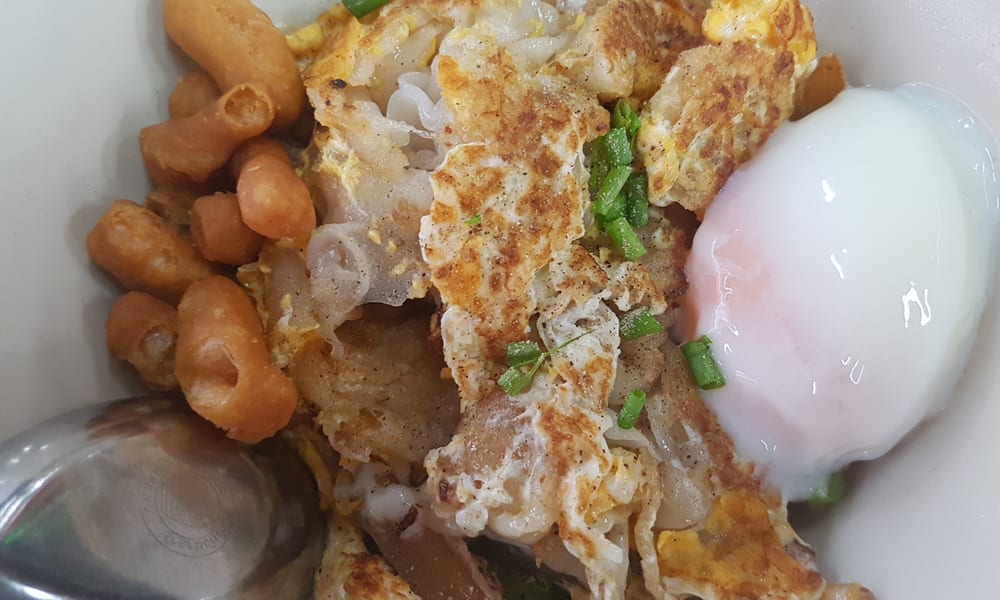
If you're wandering around Khao San and Banglamphu and want a good bowl of fish noodles, Jira Yentafo is the shop locals have recommended for over 30 years. It's a small single shophouse on Chakkraphong Road, opposite the Phra Nakhon Cooperative, just a few minutes' walk from Khao San alley or Wat Chana Songkhram. The shop's selling point is fish balls, prawn balls and fish dumplings made in-house from start to finish, using real fish meat, so the texture is nothing like ordinary factory balls. It's a great fit for anyone who wants old-school Thai noodles, not rushed street food, but a regular's shop passed down through the generations.
The dish to order is the yentafo, with a rich sauce fragrant with fermented bean curd and a lightly salted broth that isn't bland; according to reviews the fish balls are "fluffy, soft to chew, with no fishy smell at all, lightly salted." The fried fish dumplings come out crisp and bouncy, and once dipped in the broth the inside turns nicely moist. If you like it bold, try the sen lek tom yum, sour and spicy enough to cut the richness, lovely with the house-made balls. Many people also buy fish balls and prawn balls by the bag to take home, since this kind of quality is getting hard to find in the Old Town.
Prices are friendly — most bowls are under a hundred baht, nudging up a little if you add extra toppings, fair for ingredients made in-house. The setting is a simple shophouse with not many tables; weekend lunches get fairly packed, but the shop serves fast, so you don't wait long. Its score on food sites is around 3.8 out of 5, with people praising the house-made balls and the yentafo broth above all, while the knock from some is that the shop is small and seating is limited.
Good to know before you go: the shop opens around 08:30–15:00 and is closed on Tuesdays and Wednesdays, so check the day carefully if you're set on coming, since people often miss it on those two days. Come in the late morning to midday for the full range; standouts like the fish dumplings or prawn balls sell out fast on some days. There's a bit of roadside parking out front but not much, so if you're staying around Khao San or Phra Athit, walking over is easier. It's a well-rounded bowl of fish noodles for a day exploring the Old Town around Rattanakosin Island.
Pengpeng Rice Soup (Banglamphu original, branch 1)
Pengpeng Rice Soup, branch 1, is a legendary khao tom kui spot by the Banglamphu canal that has been open since 1944, handing the recipe down to the grandchildren's generation for nearly 80 years. The shop is tucked in a small alley off Phra Sumen Road, just a short walk from Khao San. For anyone exploring the Old Town who wants a dinner or late-night meal the way Phra Nakhon locals actually eat, this place is the answer. The setting is an old shophouse with both an air-conditioned zone and an open-air zone, packed almost every night with Thais and foreign visitors following the reviews.
The dish nearly every table orders is the "minced-pork pickled-plum soup," the shop's signature — a sour, well-rounded broth from the pickled plum, loaded with pork meatballs, perfect over a bowl of hot rice soup. Follow it with the baby clams stir-fried with chili paste, bold and fiery, which many reviews call a standout, the crab fried rice (the menu name is "insane-amount-of-crab fried rice," heavy on crab meat), the punchy pickled crab, and something hard to find in ordinary rice-soup shops — smoked grilled duck that they turn into a salad. If you like stir-fries, there's stir-fried fish maw, jub chai stew, Chinese olives stir-fried with pork, and fried braised intestine to add on.
Reviews line up fairly consistently: the food comes out fast, the seasoning is on point, the plates are big, and the fragrant rice soup goes well with the shop's bold dishes. Prices are middle of the road, about 100–250 baht per person if you order rice soup with a few dishes, but if you come as a group and load up on seafood or crab dishes, the per-head bill can climb. The note from reviews is that at peak times the crowds can mean a long wait, and the shop usually closes for a mid-month break of around 2 days, so if you're coming from far, call to check first (02 281 3531) to be sure.
This place is popular not just for being old, but for keeping its old-style rice-soup flavor, plus a location easy to walk to from Khao San and Banglamphu, open late until 10pm — which makes it the late-night closer for both locals and visitors. It's best for a dinner or late-night meal after wandering the Old Town.
Kanom Bueang Mae Prapha (Tor Ngek Chuan store, Banglamphu)
Closing the list is a shop that has been part of Banglamphu for over 60 years. Kanom Bueang Mae Prapha sells in front of the Tor Ngek Chuan store (the old record-shop building on Phra Sumen Road), just a few steps from the Banglamphu intersection, an easy walk from Khao San Road. It started with Grandma Prapha carrying kanom bueang to sell during World War II, then handing a royal-court recipe down to her children and grandchildren to this day. If you love traditional Thai sweets, which get harder to find every year, or you're looking for a snack to graze on around the Old Town, this is a stop to make — and it's a shop listed in the MICHELIN Guide on the Phra Nakhon side too.
The star of the shop is the two-filling kanom bueang made fresh, one shell at a time right in front of you. The sweet filling uses semi-ripe coconut grated into strands and tossed in sugar, topped with golden threads from duck eggs and sometimes dried persimmon as garnish, while the savory filling stir-fries shrimp with aromatics like shallot and coriander root, tossed with coconut until fragrant, the salty-rich taste a nice contrast to the sweet. The point reviews agree on is that the shell is thin and crisp because it uses rice flour mixed with mung-bean flour in the old recipe, with no coconut cream or dairy like ordinary shops, and the filling comes packed full across the shell. Many say you have to eat it just as it's lifted hot from the griddle for the shell to be properly crisp, since it softens if left too long.
Most reviews lean toward loving it — the age that still keeps the original flavor, the generous filling, and the care the shop takes to wait until each shell is evenly crisp before lifting it off to sell. Its score on Wongnai is around 4.1 from a few hundred reviewers. The note that comes up sometimes is that lines get long at certain times and you'll wait, and it's a takeaway-only shop with no tables to sit at.
Prices are very kind — kanom bueang is about 12-15 baht a piece, with boxes of 5 and 10 to buy as a gift. The shop is open daily around 08:30-18:30. If you drive, parking nearby is hard to find, so it's easier to come on a walking tour of Banglamphu and Khao San and stop to buy. For hot, full-filling pieces, come in the late morning to afternoon while they're still making them fresh, and leave a little time for the queue on weekends.
🍢 Want to taste several places with a guide, or cook Thai food yourself
If you're a foreign visitor or want to understand the Old Town's food beyond just ordering, try booking a guided food tour where a local walks you shop to shop around Khao San Road, Banglamphu and Phra Nakhon, tells you the story behind each dish and leads you down alleys you'd struggle to find on your own. Or take a Thai cooking class and make your own curry, pad thai and som tam, then take the recipes home — fun in a different way. Book ahead through Klook or GetYourGuide, picking the time slot and language that suit you. It works for going solo, as a pair, or in a group.
💡 Know before you eat in Khao San & Old Town, Bangkok
Most shops are within walking distance around Khao San Road, Banglamphu, Dinso and Phra Athit. The Old Town sois are narrow and parking is hard to find, so walking or grabbing a Grab is easiest · if you're coming from far, take the MRT Purple/Blue line to Sanam Chai or Sam Yot and a short Grab onward. Pin the shop name in Google Maps first, since some alleys have unclear signs.
Snacks and old-school shops like Kanom Bueang Mae Prapha, Karim, Mont Nom Sod and roadside pad thai usually take cash or PromptPay, so keep small bills on you · larger sit-down spots like Methavalai Sorndaeng and Krua Apsorn generally take cards and QR payment.
On Lok Yun and breakfast shops often sell out before closing, so go in the morning · Thipsamai (Pratu Phi) and Pengpeng Rice Soup get packed in the evening and at night after people leave Khao San Road · long sit-down spots like Methavalai Sorndaeng have long lines at lunch and on weekends — try to avoid the rush hours.
No need to tip at street and snack shops · for table-service places like Methavalai Sorndaeng or Krua Apsorn, if you're happy with the service, Thais often leave the loose change or around 20–50 THB. Some restaurants already add a service charge to the bill — check the bottom first.
Khao San Road and many famous shops are used to foreign customers, with picture or English menus and staff who can get by · some old-school shops are Thai-only, so use a translation app or point at a photo of the food to order. The vendors are friendly.
Tom yum, curry crab and the bold dishes at Pengpeng Rice Soup or Krua Apsorn are spicier than you'd think. If you're not great with heat, tell the staff 'less spicy (mai phet)' when you order, and get rice or a dessert to cut the heat.
Plan a full day of eating in Khao San & Old Town
The trick is to follow each shop's opening hours, because Old Town places open in clearly different sessions. Start breakfast at On Lok Yun beside the Chalermkrung Theatre, which opens at dawn — order kaya toast and pan eggs with traditional coffee. Follow with a snack like Kanom Bueang Mae Prapha at the Tor Ngek Chuan store in Banglamphu, or kaya toast at Mont Nom Sod near Sao Ching Cha. For a pad thai lunch, you've got both Thipsamai Pad Thai (Pratu Phi) and Pad Thai Fai Ta Lu on Dinso Road to choose from.
For a proper sit-down lunch or dinner, try royal-Thai food at Methavalai Sorndaeng on Ratchadamnoen, or Krua Apsorn on Dinso Road, famous for its curry crab. Karim Roti-Mataba on Phra Athit Road suits an afternoon-to-evening stop paired with a riverside stroll, and if you're out late after walking Khao San Road, Pengpeng Rice Soup, the Banglamphu original, and Jira Yentafo make the perfect closer. Leave a little extra time at lunch and on weekends, since the famous shops have long lines.
To eat several meals in the Old Town without rushing, booking a night in Khao San & Phra Nakhon is far easier — you can walk from Khao San Road and Banglamphu to nearly all the famous spots, and wake up to start your first meal at On Lok Yun. Compare stay prices across a few sites and pick the one you like best.
See Khao San & Phra Nakhon stays, prices compared across 3 sites