🔄 Updated 21 Jun 2026
Ubon isn't like a beach town you can visit almost year-round. Here the headline sights like Sam Phan Bok and Pha Chana Dai are tied to the level of the Mekong and the rainy season, while the Candle Festival happens once a year in July. So the first thing to decide is what you actually want to see, then pick your month around it.
When Is the Best Time to Go
The short answer is late October to February for most travelers. It's the end of the rains into the cool season: not too hot, the waterfalls still have plenty of water, and on early mornings you've got a chance at a sea of fog over Pha Chana Dai. But if your goal is Sam Phan Bok or the Candle Festival, the month shifts.
Late October–December
The most balanced window. End of the rains into the cool season, comfortable temperatures, Saeng Chan Waterfall and Pha Taem lush and green. Early mornings at Pha Chana Dai have a strong chance of a sea of fog, and December is the coldest stretch of the year. Best if you want a bit of every kind of scenery.
January–February
Still cool and clear-skied, great for sunrises and photos. Sam Phan Bok keeps emerging above the water more clearly week by week, there are fewer crowds than over New Year, and room rates ease off a little.
March–May
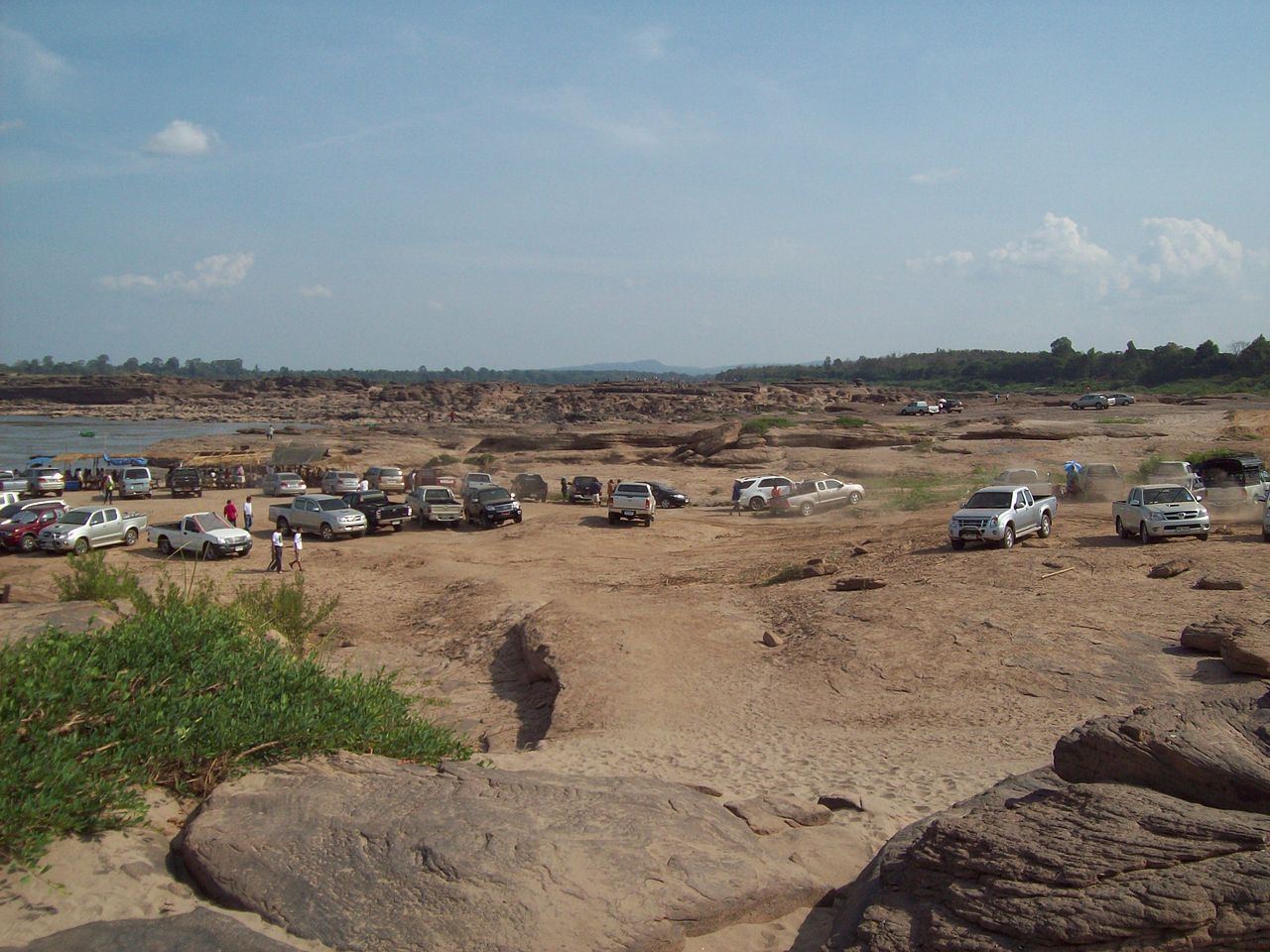
Isan summer in full force, daytime highs of 38–42°C. But this is when Sam Phan Bok looks its best, because the Mekong drops far enough to reveal the full sweep of the rock field. If you can handle the heat, go in the late afternoon (3–6pm) for the best light.
July
The month of the Candle Festival, when Thung Si Muang is at its liveliest of the whole year. It's the rainy season, but worth it if you've come specifically for the carved-wax candle floats. Book your accommodation several weeks ahead because it fills up fast.
June, August–September
Full rainy season. Sam Phan Bok is underwater and you can't take a boat out over the rock field, but the waterfalls run hard and the forest is deep green. Good for nature lovers who don't mind the rain and want cheap rooms.
Straight talk
If you want to see Sam Phan Bok as a vast rock field stretching as far as you can see, come in the dry season (roughly December to May). In the rains the water floods the rock potholes until all that's left is a sheet of water, not the scene in most of the reviews. Check the Mekong level before you set off to be safe.
Understand the Sam Phan Bok Season Before You Go
Sam Phan Bok is a rock field on a sandbar in the middle of the Mekong in Pho Sai district, where the water has eroded the stone into thousands of potholes ("bok") of every shape. The key thing is that it only appears when the Mekong drops. The popular window is roughly December to May, and in some years it starts showing from October, depending on that year's rainfall.
- Distance — about 100–120 km from Ubon city, around 1.5 to 2 hours by car.
- Best time of day — 3–6pm, when the sun softens, the rock shadows look good, and it isn't as hot as midday.
- Getting around on site — you can walk the rock field yourself, or take a local samlor/trailer cart from the parking area right out to the rocks for a per-person fee.
- Rainy season — from June to September the water usually floods the rocks, so you may only be able to take in the river view, not walk on the stone.
What Month Is the Candle Festival
Ubon's Candle Festival is a tradition that's been running for over 100 years, held around the start of Buddhist Lent each year. In 2025 it ran roughly 7–13 July, with a mid-week day to gather the candles and the procession of carved-wax candle floats around Thung Si Muang as the highlight. The exact dates shift with the lunar calendar, so check each year's schedule before you plan.
- The highlight — the procession of large carved-wax candle floats around Thung Si Muang, usually around the start of Buddhist Lent.
- See the candles at your leisure — after the procession, the floats stay on display at Thung Si Muang for several more days, with fewer people and easier photos.
- Worth knowing — it's the rainy season, so bring an umbrella or rain jacket, and rooms in town fill up fast, so book a month or more ahead.
Weather by Season, So You Pack Right
Ubon has a tropical savanna climate, alternating between hot-humid and hot-dry, with three clearly separate seasons. What you wear and pack should match the month you're going.
Cool season (Nov–mid-Feb)
Comfortably cool. Mornings and evenings can drop below 15°C up on Pha Chana Dai, while daytime sun is mild — the best time to travel. Bring a light jacket for the pre-dawn hours.
Hot season (Feb–May)
Very hot, daytime highs of 38–42°C and strong sun. Stay in the shade at midday and avoid walking outdoors between 11am and 3pm. Drink plenty of water.
Rainy season (May–Oct)
Rain in bursts, deep green forest, waterfalls running hard. Some roads into the nature spots get slippery, so bring an umbrella and non-slip shoes, and check the forecast before you head out.
Rough Daily Budget
Ubon is a place you can travel on a modest budget — the food is cheap and good, and there's a range of accommodation. The figures below are an approximate budget per person per day, not including flights or car rental.
Budget
Stay in a guesthouse or small hotel in town, eat at markets and local spots, get around by songthaew and rented motorbike, and stick mostly to in-town sights and temples.
Comfortable
A 3-star hotel in the center, a mix of sit-down restaurants and cafés, and a rental car you drive yourself out to Sam Phan Bok or Pha Taem. This budget gives you the most freedom to move around.
Relaxed
A nice hotel or riverside resort, good restaurants, and a car with a driver to reach the far-flung spots so you don't have to tire yourself out driving. Good for families or small groups.
Money-saving tip
Self-drive car rental in Ubon starts at around 800–1,000 THB a day for a sedan, and you can pick up at the airport, which is only a few kilometers from the city. If there are 3–4 of you, splitting it works out cheaper than hiring a car with a driver, and it's far more flexible than waiting on songthaews.
What to Wear
- Breathable clothing — in the hot season, light long sleeves beat short sleeves for sun protection and cut down on sunburn.
- Sneakers or hiking shoes — Sam Phan Bok, Pha Taem and Pha Chana Dai mean walking on rock and gravel trails, where sandals don't cut it.
- A light layer — pre-dawn on the cliffs is genuinely cold in the cool season, so pack a thin jacket or a scarf.
- Modest clothing for temples — Wat Sirindhorn Wararam and the temples in town require covered shoulders and knees, so bring a sleeved top and long trousers or a long skirt.
- A hat and sunglasses — the Isan sun is strong, especially outdoors at midday.
What to Pack
- High-SPF sunscreen — really matters if you're heading to Sam Phan Bok or out on the Mekong in the daytime.
- A water bottle — some nature spots have few shops, so carry water to avoid getting dehydrated.
- A flashlight or headlamp — if you're climbing Pha Chana Dai for sunrise, you'll be walking while the sky is still dark.
- Personal meds, plus antihistamines and insect repellent — the nature spots have plenty of mosquitoes in the evening.
- A power bank — shooting photos all day drains your battery fast, and charging points are hard to find at the far-out spots.
- Cash — market stalls, samlor carts and the entry fees at many nature spots take cash only.
Getting To and Around Ubon
Ubon has an international airport (UBP) very close to the city, with several direct flights from Bangkok a day, and you can also take an Isan-line train or coach. In town there are songthaews and hired transport, but the headline sights are outside the city and spread far apart, so having your own vehicle is by far the most convenient.
Want a day-by-day Ubon itinerary? See the full city guide.
See the Ubon Ratchathani guide →