📝 Written 2 Jul 2026 · ✅ Fact-checked 3 Jul 2026 · prices and schedules can change — check with the operator before booking
Before picking a spot, think through three things first: what time of year you're visiting, whether you're drawn to nature, history, spirituality, or archaeology, and how much time and transport you have. Udon's attractions are scattered in different directions — some are close to the city, others require nearly an hour and a half of driving. Most importantly, the Red Lotus Sea only blooms in the cool season, so timing it wrong means no flowers at all.
Overall, if you're visiting in the cool season and want beautiful nature shots, the Red Lotus Sea comes first. If you're interested in prehistoric stories and genuine artifacts in a museum setting, choose Ban Chiang. If you're on a spiritual trip seeking blessings from the naga, choose Kham Chanot. And if you enjoy hiking among oddly shaped rocks and ancient rock paintings, choose Phu Phra Bat. The table below gives you the overview, then we go into detail on each site.
| Attraction | Type | Best Season | Best For | Price Range |
|---|---|---|---|---|
| Red Lotus Sea | Nature, lotus-viewing boat rides | Dec–Feb only (peak mid-Jan) | Nature lovers, photographers, cool-season visitors | Boat fee ฿300–500/boat |
| Ban Chiang | World Heritage, prehistoric site | Year-round (museum closed Mon–Tue) | History and museum lovers, families | ฿30 Thai / ฿150 foreigner |
| Kham Chanot | Spiritual, naga folklore | Year-round (very crowded on Buddhist holy days/holidays) | Spiritual visitors, merit-makers, blessing-seekers | No entry fee (donation-based) |
| Phu Phra Bat | Archaeology, rock formations, rock paintings | Year-round (slippery paths in rainy season) | Hikers, geology and archaeology enthusiasts | ฿20 Thai / ฿100 foreigner |
Red Lotus Sea (Nong Han Kumphawapi)

The Red Lotus Sea is Udon Thani's number-one iconic image — a large freshwater marsh whose real name is Nong Han Kumphawapi. Come the cool season, red lotus flowers (actually a species of water lily that blooms pink-purple) cover the water in a carpet stretching as far as the eye can see. The way to experience it is by hopping on a long-tail or small boat out into the middle of the marsh; the boat drivers are local villagers who take you around to see the blooms and stop at photo spots. The most beautiful time is early morning, around 6–8 AM, when the flowers are fully open and the sun isn't too harsh yet. Later than that, the flowers start to close and the bright sun makes photography harder.
The key thing to know clearly is that this spot can only be visited during the cool season. Flowers start blooming around December, peak from mid-January to early February, then gradually fade. If you come to Udon outside this window, you'll only see an empty marsh with no flowers at all. This is the biggest limitation compared to the other three sites, which are open year-round. Checking the bloom status for that particular year before setting out helps avoid disappointment.
Boat fees run around 300–500 baht per boat, which seats several people, so it works out cheap per person if you come as a group. Most real reviews praise the views as more beautiful than expected and the boat drivers as friendly. The complaint most often raised is that long holidays bring big crowds and long waits for a boat, and coming late means both harsh sun and closed flowers. Getting there as early as possible pays off the most.
- Views of red lotus flowers covering the entire water surface — the iconic image and photo spot reviewers praise most
- Cheap per person if you come as a group; boat drivers are friendly locals
- Only about 40 km from the city center — an easy morning-to-noon trip
- Peaceful early-morning atmosphere out on the marsh, ideal for nature lovers
- Only visitable in the cool season, Dec–Feb; outside that window it's just an empty marsh
- Must arrive very early — coming late means closed flowers and harsh sun for photos
- Long holidays bring big crowds and long waits for a boat
Ban Chiang Archaeological Site (World Heritage)

Ban Chiang is the prehistoric site that put Udon Thani on the world map, inscribed as a Cultural World Heritage Site in 1992. What makes it special is the discovery of distinctive red-painted earthenware pottery on a cream background, along with evidence of habitation and metalwork dating back thousands of years. A visit here splits into two parts: the Ban Chiang National Museum, which displays pottery and tools with an easy-to-follow timeline and bilingual signage, and the Wat Pho Si Nai excavation pit, which shows skeletal remains and buried pottery in place at the actual dig site.
Most real traveler reviews praise the museum's good displays, detailed English explanations, and attentive staff. It suits history lovers and families bringing kids to learn. Some reviews note that parts of the exhibit have been installed for a long time and the content may not be thrilling for those not into archaeology. If you're expecting the natural excitement or scenic views of a nature spot, you may need to adjust expectations, since the appeal here is historical value and seeing genuine artifacts firsthand.
Museum admission is 30 baht for Thai visitors and 150 baht for foreigners. It's open Wednesday through Sunday and closed Monday–Tuesday, so check opening days before you go to avoid a wasted trip. The site is about 55 km from the city center, roughly an hour's drive. It's visitable year-round since it's mostly indoors, making it a more season-flexible choice than the Red Lotus Sea.
- A Cultural World Heritage site where you see genuine pottery and excavation pits firsthand
- Well-curated museum with detailed bilingual signage that's easy to follow
- Visitable year-round since it's an indoor site, not weather-dependent
- Cheap admission, great for families bringing kids to learn history
- Some exhibits have been installed for a long time and content may not be thrilling for those not into archaeology
- Museum closed Monday–Tuesday; check the day before visiting
- About 55 km from the city center; a private car or rental is recommended
Kham Chanot (Wang Nakin)

Kham Chanot is Udon Thani's most famous spiritual pilgrimage site — a forested island of chanot trees in the middle of a wetland that locals believe is Wang Nakin, the abode of the naga deities Pu Si Suttho and Ya Si Patumma. Visitors come here to pay respects and ask for blessings related to fortune and luck. You walk across a wooden bridge onto the island, which is thick with chanot trees, and there's a sacred well believed to connect to the underworld city. The atmosphere is shaded and quiet, clearly different from nature-focused spots or museums. The appeal here is belief and devotion, not scenery or activities.
Real reviews reflect that visitors who come with genuine faith are often struck by the sense of sanctity and atmosphere. Some who visit more as general tourists say the walking area isn't very large and doesn't take long to see it all. What you need to prepare for is that Buddhist holy days and long holidays get extremely crowded — expect long queues both crossing the bridge and at the blessing spots. Midday sun is also fairly hot even with the tree cover. Visiting on a weekday or in the morning is much more comfortable.
There's no official entry fee here, but there are donation boxes and shops selling offerings, flowers, incense, and candles along the entrance path — contribute as you see fit. Kham Chanot is in Ban Dung District, about 90 km from central Udon, roughly a 90-minute drive — the farthest of the four sites. If you plan to visit, allow extra travel time and consider pairing it with other attractions in the same zone on the same trip.
- Udon's most famous spiritual pilgrimage site, with a sacred and shaded atmosphere
- No official entry fee; donate as you see fit
- Visitable year-round, not weather-dependent
- Features a wooden bridge and sacred well to walk through and pray at
- Extremely crowded on Buddhist holy days and long holidays, with long queues
- About 90 km from the city center, the farthest of the four sites
- The walking area isn't large; those not visiting for spiritual reasons may find it quick to see
Phu Phra Bat Historical Park (World Heritage)
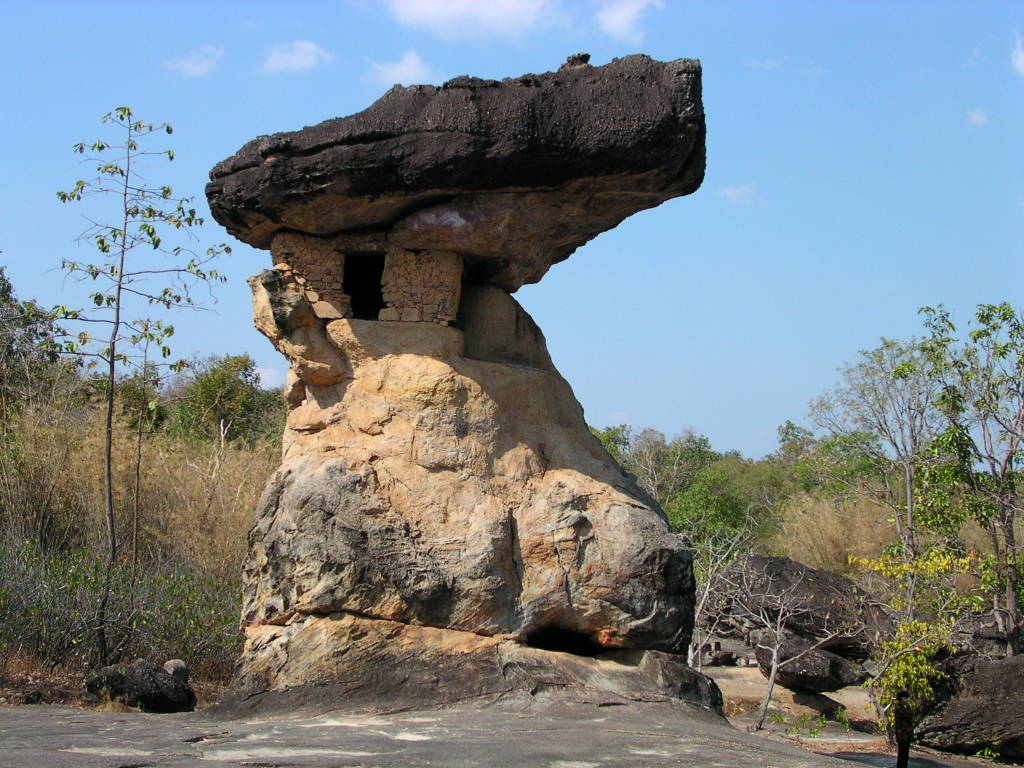
Phu Phra Bat is a historical park on a low hill in Ban Phue District, filled with oddly shaped sandstone rock formations carved by millions of years of natural erosion. Some rocks are stacked to look like mushrooms or towers, and many spots were converted into rock shelters used as dwellings and religious sites since prehistoric times. The highlights are Ho Nang Usa, a natural stone pillar topped with a balanced rock slab, and ancient rock paintings found on several shelter walls, some thousands of years old. It's all explored via walking trails through shady dipterocarp forest. The site was recently inscribed as a World Heritage Site, giving Udon two World Heritage listings.
Most real reviews rate it highly and praise it as excellent value for the entry fee. The odd rock formations and rock paintings create genuine wonder, signage at each point is well done, and there's a spacious parking area with attentive staff. Golf carts are available for internal transport at some times. What sets this apart from Ban Chiang is that here you walk outdoors among rocks and forest rather than through an indoor museum, making it suit those who want both nature and history in one place.
Plan to allow at least 3 hours to see it all. The trail has some ups and downs and stretches of open sun, so wear comfortable walking shoes and bring water and a hat. Paths can get slippery in the rainy season, so be extra careful. Admission is 20 baht for Thai visitors and 100 baht for foreigners. It's about 65 km from the city center and visitable year-round like Ban Chiang and Kham Chanot, but offers a distinctly different outdoor experience.
- Odd sandstone rock formations and ancient rock paintings create a sense of wonder hard to find elsewhere
- A World Heritage site with high review scores; visitors praise it as excellent value
- Outdoor walking among forest and rocks, suiting those who love both nature and history
- Cheap admission, with a spacious parking area and attentive staff
- Requires a lot of walking with ups and downs; allow at least 3 hours — not ideal for those who can't walk much
- Outdoor trail with hot midday sun; paths get slippery in the rainy season
- About 65 km from the city center; a private car is recommended
Quick summary: where should you go
Visiting in the cool season and want beautiful nature shots? Go to the Red Lotus Sea, but only during Dec–Feb and only early in the morning, since the flowers only appear in the cool season and close up once the sun gets strong. Check that year's bloom status before setting out.
Love prehistoric stories and genuine museum artifacts? Choose Ban Chiang. It's visitable year-round since it's an indoor site, great for families and kids learning history. Just avoid Monday–Tuesday when the museum is closed.
Here for spiritual reasons, seeking naga blessings? Go to Kham Chanot. The atmosphere is sacred and there's no entry fee, but avoid Buddhist holy days and long holidays when it's packed, and allow extra time since it's the farthest from the city.
Love hiking and seeing odd rocks and ancient rock paintings? Go to Phu Phra Bat. It's another World Heritage site where you walk outdoors among rocks and forest, with high review scores — just be ready to walk and allow at least 3 hours.
Book Activities & Tours in Advance
Trips to Udon and its top attractions fill up during high season. Booking online ahead of time is more convenient.
Where to stay in Udon Thani?
Choose a hotel in the city center, near Nong Prajak and UD Town, for easy access to your trips out. Compare prices across 3 sites before booking.
Search hotels on AgodaOnce you've picked the right attraction, don't forget to book a well-located hotel as your trip base. See hotels with prices already compared here.
See well-located Udon Thani hotels →