🔄 Updated 21 Jun 2026
Uthai Thani sits about 220 kilometres from Bangkok, a small town on the Sakae Krang River that many people come to for the quiet. The main town is in Mueang Uthai Thani district, with markets, food, places to stay, and the boat piers all clustered along the riverside. The famous sights are spread out, though: Wat Tha Sung is in the Mueang district just a short way out, but Ban Rai and Huai Kha Khaeng are off to the west of the province, tens of kilometres further. That makes transport a bigger deal here than in many towns.
How to get to Uthai Thani from Bangkok
First thing to know: Uthai Thani has no train station in the town itself. The nearest stations are over on the Nakhon Sawan–Chai Nat side, so you'd still need a connecting ride into town. Most people come by bus, van, or by driving themselves. It's close enough for a same-day round trip if you're only seeing the town, but if you also want to reach Ban Rai or Huai Kha Khaeng, an overnight stay makes life much easier.
Bus / van from Mo Chit 2
Leaving from Chatuchak Bus Terminal (Mo Chit 2), there are both air-conditioned buses and vans running straight into Uthai Thani town. They depart often from morning to evening and take around 4 hours depending on traffic, dropping you at Uthai Thani bus terminal not far from the centre. This is the best option if you don't have your own car, since it gets you right into town.
Self-drive
Take Highway 32 (the Asia Highway) then turn onto Highway 333 near the end. It's an easy drive, around 3–3.5 hours if traffic cooperates. The upside is you can reach Ban Rai and Huai Kha Khaeng — both well out of town — without scrambling for a connecting ride. Great for families or groups who want to set their own pace.
Train to Nakhon Sawan/Chai Nat, then connect
If you'd rather take the train, get off at Nakhon Sawan station (Pak Nam Pho) or on the Chai Nat side, then catch a van or songthaew into Uthai Thani — about 40 minutes to an hour more. This route is more of a hassle and means changing vehicles, so it really only suits people who genuinely want the train ride or are coming down from the north.
Which one should you pick?
If you're not driving in, a van or bus from Mo Chit 2 is the most direct and simplest choice since it drops you right in town. But if your plans include Ban Rai or Huai Kha Khaeng — both far out and beyond the reach of public transport — having your own car or a rental pays off far more. Otherwise you'll end up chartering a local vehicle, which adds to the cost.
Getting around Uthai Thani town
Distances within Uthai Thani town are tiny. You can easily walk the municipal market, Trok Rong Ya lane, the Sakae Krang riverside, and the in-town temples. The centre is small and compact, and plenty of people walk or cycle the whole day. To reach spots a bit further out you have several options, but understand first that public transport here is sparse and runs on no fixed schedule.
- Walking / cycling — the town is small and the riverside sights are close together. Some places to stay lend out bicycles, perfect for an easy morning ride along the Sakae Krang River.
- Songthaew — these run around town and link the markets, costing just a few baht, but there's no set schedule and they thin out by late afternoon. Fine if you're not in a hurry.
- Motorbike taxi — easy to find around the market and bus terminal, good for short hops in town. Agree the price before you get on.
- Ride-hailing apps / private cars — available in town but with far fewer cars than in big cities. Late at night or outside the centre you may not find a ride, so plan accordingly.
- Motorbike rental — there are rental shops in town. It's nimble for getting around town and out to Wat Tha Sung, but not suited to the long haul to Ban Rai or Huai Kha Khaeng.
Renting a car in Uthai Thani
Because many of the highlights are spread far from town and out of reach of public transport, renting or chartering a car is the choice many people make when travelling as a group — especially if you're set on Ban Rai or Huai Kha Khaeng. Both self-drive and with-driver options are around.
Self-drive rental
A small sedan starts around ฿800–1,200 per day depending on the model and season. There aren't as many rental shops in Uthai Thani town as in bigger cities, so some people pick up a car in Nakhon Sawan or at a nearby airport and drive in. Bring your driver's licence and a credit card for the deposit. Good for confident drivers who want to control their own schedule.
Chartered car / car with driver
Hired by the day or by the trip, with a driver who knows the way to Wat Tha Sung, Ban Rai, and Huai Kha Khaeng. Good for families or groups who'd rather not drive the long routes themselves. Prices depend on distance and hours — Huai Kha Khaeng, being far out with forest roads, costs more. Settle the route and price clearly before you set off.
Worth knowing
Rental and charter prices climb during festivals and long weekends, especially around the Tak Bat Devo festival in October when the town fills up. If you're coming then, book your car and accommodation ahead, because local vehicles are limited.
Boat rides on the Sakae Krang River
The Sakae Krang River is the heart of Uthai Thani town. A boat ride to see riverside life is something many people come specifically to do — you'll pass floating houses, fish-raising cages, and a simple, unhurried scene that's hard to find in big cities.
- Riverside life cruise — board from a pier in town and loop past the floating houses and fish cages. It takes around 30 minutes and costs roughly ฿50 per person — a short trip that suits anyone short on time.
- Charter a long-tail boat — if you're in a group and want a longer ride, stopping at Koh Thepho or eating fish straight from the cages, you can charter a boat by the trip. The price depends on group size and time, so ask at the pier first.
- Best time of day — early morning or near sunset, when the light is lovely and it's not hot. That's when riverside life feels most alive.
- Photo spots — the bridge across the river and Wat Ubosatharam with its temple hall over the water make a riverside scene people love to shoot.
How to get to Wat Tha Sung
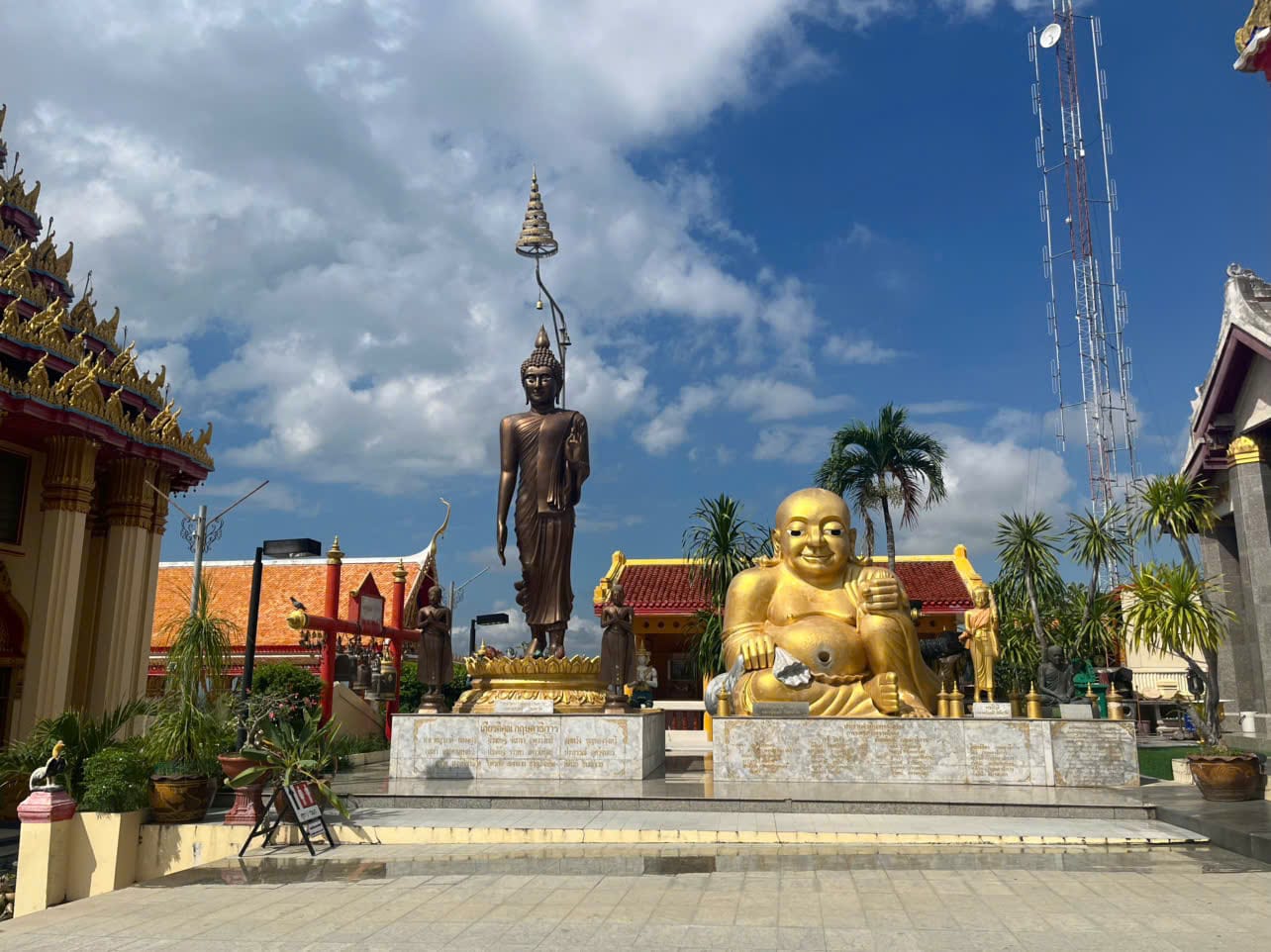
Wat Tha Sung, officially Wat Chantharam, is the temple of Luang Pho Ruesi Ling Dam that draws worshippers from all over the country. The main thing people come to see is the white glass hall covered entirely in mirrored glass. It's in the Mueang district, about 10–12 kilometres out of Uthai Thani town toward Nam Suem subdistrict — the closest to town of all the major highlights.
- How to get there — about 15–20 minutes from town by car or motorbike. Without your own vehicle, take a motorbike taxi or charter a songthaew from town. Agree a round-trip price clearly, because finding a ride back from the temple yourself is fairly hard.
- Glass hall opening times — the glass hall opens in sessions: morning around 9.00–10.30, and afternoon around 14.00–16.00. The rest of the temple grounds can be walked all day. Check the session times before you go so you don't miss it.
- Entry fee — there's no official charge to enter the temple or the glass hall, just donation boxes at various points. Give as you wish.
- Dress code — this is a temple that takes modesty seriously. Dress conservatively, avoid shorts and strappy tops, and remove your shoes where required.
Tip
Wat Tha Sung is very large and hot in the middle of the day. Go for the morning session around 9 to see the glass hall in nice light before it gets too hot, then head back into town for lunch — a half-day trip works out just right.
How to get to Ban Rai
Ban Rai district lies to the southwest of the province, a hilly area with mountain-view cafes, centuries-old giant trees in the Ban Sanam community, the Sao Hai market, and Hup Pa Tat — an ancient prehistoric forest tucked in a valley. It's about 60–80 kilometres from Uthai Thani town depending on the spot, roughly a 1.5-hour drive.
- How to get there — your own car or a rental is easiest. Take Highway 333 then 3011 toward Ban Rai; the last stretch winds through some hills, an easy drive but allow extra time.
- Public transport — there are some vans and songthaews from town to Ban Rai, but services are limited and infrequent. You'd get dropped in the town centre and then struggle to reach the sights from there. Without your own vehicle, chartering a car for the day is worth it and saves you waiting around.
- Hup Pa Tat — walk through a cave into a valley dense with fishtail palms. The path isn't long, it's open in daytime, and morning to early afternoon is best when the light pours nicely into the valley.
- Allow a full day — Ban Rai's sights are spread out — cafes, the giant trees, the market, and Hup Pa Tat — so set aside a whole day and leave town early.
Worth knowing
In Ban Rai, petrol stations and convenience stores are spaced far apart. If you're driving, fill up before leaving town and keep drinking water in the car. The downhill roads can get dark quickly in the evening, so plan to be back in town before nightfall.
How to get to Huai Kha Khaeng
The Huai Kha Khaeng Wildlife Sanctuary is a natural World Heritage Site, a vast forest in the west of the province around Lan Sak district bordering Ban Rai. It's farther and deeper in than anywhere else — 90 kilometres or more from town, over 2 hours' drive, and mostly a protected zone you have to plan ahead for. This is not a spur-of-the-moment stop.
- How to get there — only by your own car or a charter; there's no public transport in. Take the route through Lan Sak; the stretch into the forest zone is a narrow road, dirt in places, so you want a capable vehicle and a driver who knows the way.
- Contact ahead — entering parts of the conservation area, such as nature trails or staying overnight, requires contacting the wildlife sanctuary in advance. There are rules and permitted hours, so always check first.
- Visitor centre and Sap Fa Pha Waterfall — these are spots general visitors can reach more easily than the inner zones of the forest. Good for anyone who wants to feel the forest atmosphere without a long hike.
- When to go — in the rainy season roads are slippery and some are closed; cool season through early hot season is easier for travel. Check the road conditions and whether the area is open with the rangers before you set off.
Plan realistically
Huai Kha Khaeng is a protected forest, not a zoo where you'll easily spot wildlife. What you get is the atmosphere of a great forest and real quiet. If you're set on coming here, set aside a full day or stay overnight in a permitted zone, and prepare like you're heading out for serious nature, not a quick photo stop.
Sample 2-day, 1-night plan without your own car
If you come by van or bus, then use in-town transport and a charter for part of the trip, here's roughly how it works. The focus is the town and Wat Tha Sung, which are easy to reach, while Ban Rai and Huai Kha Khaeng are saved for a return trip when you have a car.
Arrive + Sakae Krang riverside
Wat Tha Sung + heading back
See well-located places to stay in Uthai Thani town, near the river and markets
See Top 10 Uthai Thani Hotels →