🔄 Updated 21 Jun 2026
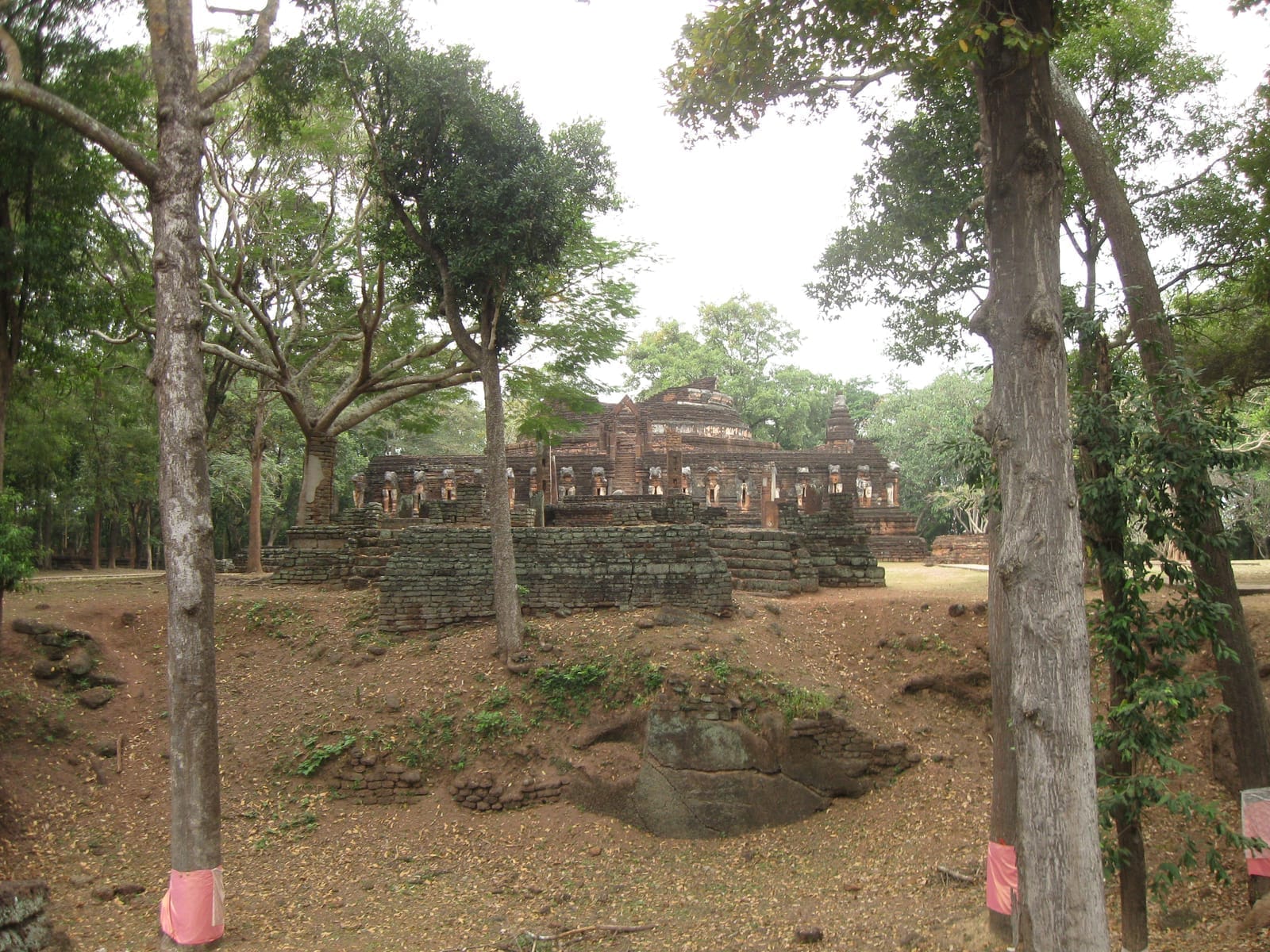
Wat Chang Rop is a large ruined temple inside Kamphaeng Phet Historical Park, set on a laterite mound just north of the old city walls in the area known as the Aranyik zone, or forest-temple district. In ancient times this was where meditation monks who valued quiet would retreat for the rains. Today all that remains are the stupa ruins and the foundations of the assembly halls under thick forest shade, yet it's the spot most visitors come away most impressed by — that row of stucco elephants around the stupa base is the kind of image you recognize instantly.
Why visit Wat Chang Rop
The heart of the site is the elephant-ringed stupa — the main bell-shaped chedi, shaped by Sukhothai-era art, sitting on a square base roughly 31 metres on each side. The base is decorated with 68 half-body stucco elephants, with only the head and the two front legs emerging, as if the elephants were carrying the stupa on their backs. The idea of elephants holding up the universe and supporting the religion appears in elephant-ringed stupas across Sukhothai and Lanna, but Wat Chang Rop stands out because it sits on a high mound — you have to climb steps to reach it, which gives it a different feel from the other temples in the same zone.
- 68 stucco elephants — ringing the square base, head and front legs jutting out; the signature image of Kamphaeng Phet
- Set on a laterite mound — with stairways on all four sides, unlike the flat-ground temples elsewhere in the Aranyik zone
- Stucco scenes of Jataka tales and the Buddha's life were once found here — including the nativity scene; some pieces are now kept in the museum
- Quiet, few crowds — especially on weekdays, when at times it's just you and the birdsong in the forest
Want more out of Kamphaeng Phet? Book tours & activities
Booking online ahead on Klook or GetYourGuide is usually cheaper than the gate and skips the queue. Pick only the experiences you actually want — prices and availability are shown live on each site.
History and what you'll see
Archaeologists date Wat Chang Rop to roughly the 16th century, when Kamphaeng Phet was an important city in the Sukhothai sphere. The main stupa today is down to its base and the lower part of the bell — the spire collapsed long ago — but the elephant base is still clearly visible almost all the way around. At the foot of the stairs there were once lion and guardian sculptures; these are now badly damaged. The stucco reliefs telling Jataka tales and scenes from the Buddha's life that once lined the walls have, in part, been moved to the Kamphaeng Phet National Museum for safekeeping.
Climb up onto the terrace around the stupa base and you'll see the elephants lined up all the way around, each one modelled a little differently. On some you can still make out the cloth patterns and headdress detail. Look outward and it's all dense forest, with the spires of other temples poking above the treetops — it gives you a real sense of the scale of this old forest-temple city.
Get more out of the elephants
Walk slowly around the base and notice how each elephant turns its head and sets its legs a little differently. In a few spots the stucco has flaked away to reveal the laterite core inside, which shows you how the old craftsmen actually built it.
Nearby temples to walk on to
The good thing about the Aranyik zone is that the major temples sit close together, linked by an easy walk or cycle in one loop. Once you've reached Wat Chang Rop, it's worth budgeting time for two or three more temples to make the trip pay off.
Wat Phra Si Iriyabot
Very close to Wat Chang Rop. The mondop at the centre holds Buddha images in four postures — standing, walking, seated, and reclining — modelled against all four walls.
Wat Phra Non
Known for its colossal laterite columns, said to be the largest in Thailand. Walk between the columns and you'll feel the scale of the original hall.
Wat Sing
A small temple in the same zone that once had lion sculptures. Quiet atmosphere, few visitors stop by.
Entry fees and opening hours
Wat Chang Rop is in the Aranyik zone of Kamphaeng Phet Historical Park, which charges admission by zone rather than per temple. The park opens daily from about 08:30 to 16:30. The prices below are the ones you'll most often see, but the park can adjust them, so check again at the ticket booth by the entrance.
- Thai nationals — around ฿20 per zone
- Foreigners — around ฿100 per zone, or a combined two-zone ticket for about ฿150
- Bringing in a bicycle — around ฿10 · car — around ฿50 (you can drive into the Aranyik zone)
- Bicycle rental — available near the entrance and at guesthouses close to the park, around ฿50 per day
Bring cash
The ticket booth and many bicycle-rental spots only take cash, so bring small notes — don't count on being able to scan-and-pay.
Getting to Wat Chang Rop
Wat Chang Rop sits in Nong Pling subdistrict, north of and outside the old city walls, about 5 minutes by car from the in-town zone where Wat Phra Kaeo is. If you're driving, you can go straight into the Aranyik zone and there's parking. If you don't have your own wheels, a songthaew or motorcycle taxi from town is the easy option. Kamphaeng Phet has no airport or train station, so most people arrive by road.
- From Bangkok — bus or minivan from Mo Chit, around 5 hours, getting off at Kamphaeng Phet bus terminal, then on to the park
- From Phitsanulok — fly into Phitsanulok then drive about 1.5 hours; the fastest way in if you're coming from far away
- From town to the park — songthaew, motorcycle taxi, or rent a motorbike and drive yourself
- Within the Aranyik zone — cycle, or park the car at a few points, then walk up the mound to the stupa
Photo spots and the best time
The classic angle is to stand at the foot of the mound and shoot the stupa with the row of elephants along the base, so you catch both the height of the mound and the elephant detail. Another is to climb up onto the terrace and shoot the elephants up close against the forest behind. Morning and late-afternoon light is softer and the elephants' shadows are sharper, which brings out the stucco detail far better than the harsh light at midday.
- Golden hours — morning 08:30–10:00 or late afternoon 15:00–16:30: nice light and not too hot
- From the mound — step back down to the bottom to catch the stairs and the row of elephants together
- Close up — capture the elephant heads and the cloth patterns in the stucco
- Watch your footing — the mound is rough laterite and the steps are old; tread carefully, especially after rain
Before you go
- Comfortable walking shoes — you'll be climbing the mound and laterite steps; not the place for heels
- Sun protection — there's shade in the forest, but the terrace around the stupa is fairly open; bring a hat and water
- Dress respectfully — this is a religious historic site, so dress tidily
- Don't climb on the ruins — the stucco elephants are fragile; don't climb on them or grab them hard, and help keep them intact
- Allow time for the Aranyik zone — about 1.5–2 hours including the nearby temples is a good amount
If you want to understand more about where the stucco elephants came from and what's been excavated, drop by the Kamphaeng Phet National Museum next to the in-town zone before or after, then head back into town for some local food.
Plan a full day in Kamphaeng Phet — ruins, cafes, and local food all in one
See the Kamphaeng Phet travel guide →