🔄 Updated 7 Jun 2026
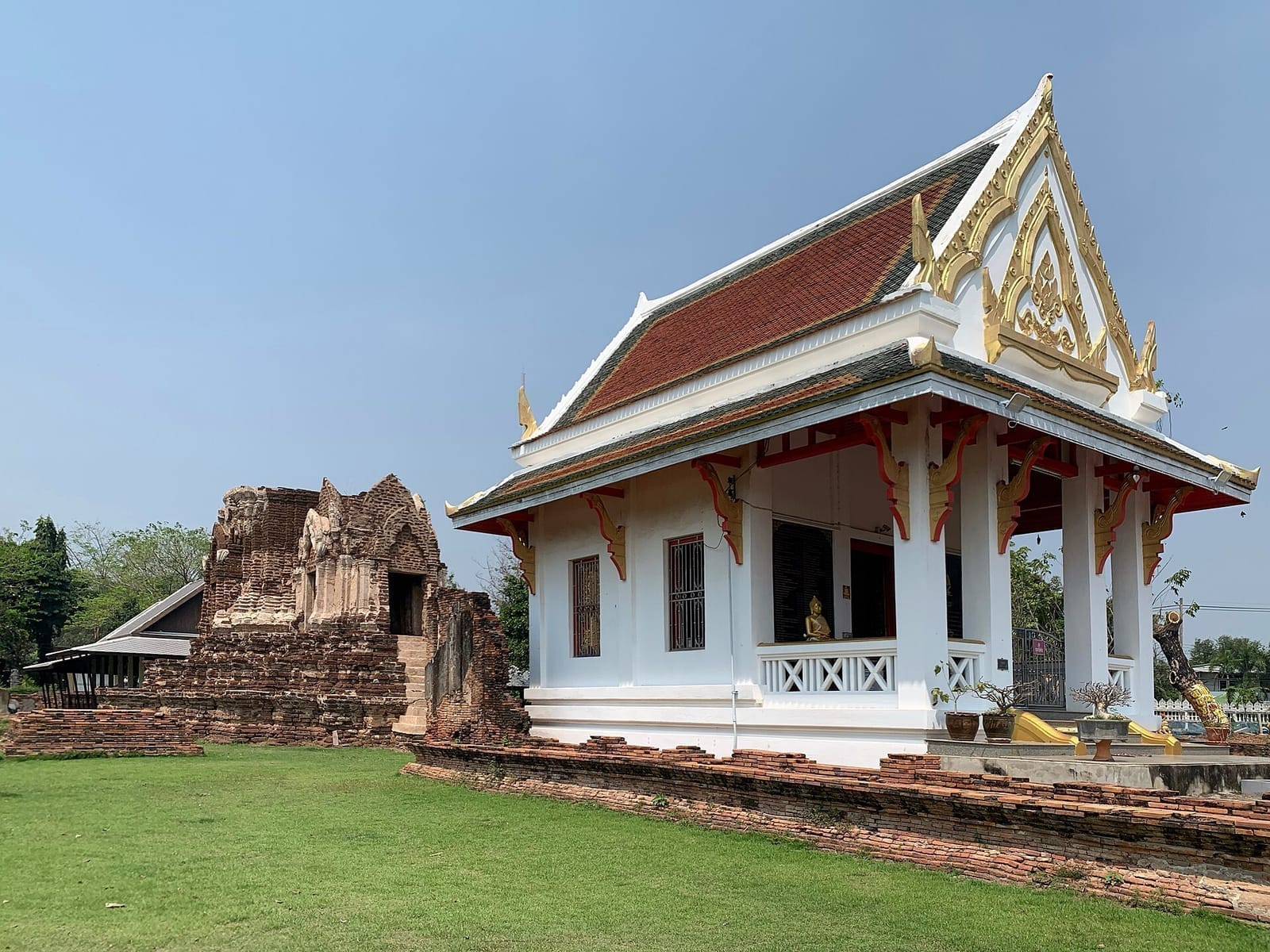
Wat Chula Mani sits on the east bank of the Nan River in Tha Thong subdistrict, Mueang Phitsanulok district. Archaeologists believe this ancient site is older than the Sukhothai period, and it once formed the original Mueang Song Khwae — the earlier town that became Phitsanulok. What makes this temple different from the others in the city is its prang, built of laterite in the Khmer style, whose original structure still stands to this day. The grounds are quiet and shaded with big old trees, far less crowded than Wat Yai in the city center — a good spot for anyone who wants to wander and look at the real thing at an easy pace.
The Khmer Laterite Prang — the Star of the Temple
The prang at Wat Chula Mani is built of laterite, with a base roughly 11 meters wide and 18 meters long. The front is built out as a triple-tiered porch (mukh), set on a tall pedestal of three stacked levels, each with redented corners and stucco ornament running along the tiers. The stucco band on the lower section is shaped into hamsa (swan) figures, which experts say resemble the workmanship on the prang at Wat Phra Si Rattana Mahathat in Lopburi province. When it was still intact, a low surrounding wall (kamphaeng kaeo) once enclosed the whole structure. Today, even after restoration, the Khmer artistic character is still clear. Anyone who enjoys old architecture can happily spend time photographing it, since the morning and afternoon light hit the prang very differently.
- Material — laterite, the favorite building material of early builders, found locally, cut into blocks and stacked
- Form — a Khmer-style prang on a three-tiered redented base with a triple-porch front, showing pre-Sukhothai artistic roots
- Ornament — stucco hamsa figures on the lower frieze, comparable to the prang in Lopburi
- Significance — registered as an ancient monument by the Fine Arts Department, evidence that this area was settled long before Phitsanulok's heyday
Straight talk
Compared with the prang at Ayutthaya or Lopburi, this one isn't huge — don't come expecting grandeur. The charm here is its age and its quiet. You come to Wat Chula Mani to see traces of history without the crowds pressing in, not to photograph some giant monument.
Want more out of Phitsanulok? Book tours & activities
Booking online ahead on Klook or GetYourGuide is usually cheaper than the gate and skips the queue. Pick only the experiences you actually want — prices and availability are shown live on each site.
The Story of King Borommatrailokkanat's Ordination
What put Wat Chula Mani in the history books is that in 1464 (B.E. 2007), King Borommatrailokkanat built a vihara and was ordained as a monk here for a little over 8 months, with as many as 2,348 members of his royal court ordaining to follow him. At that time Phitsanulok served for a period as a capital of the Ayutthaya kingdom, so a king coming here to be ordained shows just how important Wat Chula Mani already was. Later, in the reign of King Narai the Great, a mondop was built to enshrine a replica Buddha footprint carved onto a stone slab for people to venerate, and an inscription recording this event survives as well.
Worth knowing
The name "Mueang Song Khwae" (Town of Two Rivers) comes from its location between two rivers. Wat Chula Mani is what's left of the original town before people moved to found a new one to the north — which became the city of Phitsanulok we see today.
Where to Pray Inside the Temple
Beyond the old relics to look at, Wat Chula Mani is a temple where the people of Phitsanulok genuinely come to pray and make wishes — not just a deserted ancient site. Inside there are several Buddha images and sacred objects to pay respects to.
Luang Pho Phet
A sandstone Buddha image in the meditation posture, the temple's principal image, where people come to make wishes about work and stability. Most visitors don't miss paying respects here first.
Thao Wessuwan
Lately many people come specifically to pay respects to Thao Wessuwan here, asking for wealth and protection from misfortune. It's another spot where people line up to take photos.
Buddha Footprint Mondop
A mondop from the reign of King Narai that enshrines a replica Buddha footprint carved on a stone slab — a historic spot well worth stopping to pay respects.
Old Ordination Hall & Luang Pu Thongkham Ong Dam
The original ordination hall and several Ayutthaya-style Buddha images. You can walk all around it; the hushed, solemn atmosphere makes it a good place to sit and settle your mind.
Getting to Wat Chula Mani
Wat Chula Mani lies south of Phitsanulok's town center along Borommatrailokkanat Road, about 5 kilometers away. That short distance makes it easy to swing by on the same trip as Wat Yai or while sightseeing around town.
- Private car / rental car — the most convenient option. From the town center, drive south along Borommatrailokkanat Road for about 10–15 min; there's parking at the temple
- Rented motorbike — Phitsanulok town has several rental shops, and riding yourself is easy since the route is straight and not far
- Songthaew (shared pickup) — there's a line that runs along this road, but service isn't as frequent as in town, so allow extra time waiting for the ride back
- Taxi / Grab — you can hail one from town, which works well if you're in a group or don't want to drive; the fare isn't expensive given the short distance
Plan it to make it worth your while
Wat Chula Mani sits in a slightly different direction from Wat Yai, but it's still within Mueang district. Pair them up: pay respects to the Phra Buddha Chinnarat at Wat Yai in the morning, then drive south to Wat Chula Mani in the late morning before heading back into town for lunch. It's a route that fits a one-day trip nicely.
Before You Go
- Hours — it's a temple open to the public during the day. Going in the morning to early afternoon is best, while the sun isn't too harsh and the light flatters the prang
- Dress — it's a temple with an ancient-monument zone, so dress modestly; skip spaghetti straps and very short shorts out of respect
- Entry fee — generally there's no entry fee; you can make a donation as you wish at the donation box in the temple
- Time needed — about 45 minutes to 1 hour is enough to walk the prang, pay respects, and see the mondop
What Else Is Nearby
- Wat Phra Si Rattana Mahathat (Wat Yai) — home to the Phra Buddha Chinnarat, a Buddha image known worldwide, right in the city center; easy to pair with Wat Chula Mani in a single day
- Along the Nan River — both Wat Chula Mani and the town sit on the same river, so an evening stroll along the Nan in town has a nice atmosphere
- Markets / local food in town — once you're back in town, you don't have to go far to find kuaytiao hoi kha (dangling-leg noodles) or other local dishes to carry on with
Want to see Phitsanulok's temples, food, and places to stay all in one trip?
See the Phitsanulok Travel Guide →