🔄 Updated 21 Jun 2026
If you're in Prachuap with time for just one spot in town, plenty of people will tell you to climb Khao Chong Krachok, because it rolls a temple visit, a bit of exercise, and a sea view into one. The summit sits around 245 metres above sea level, and 396 steps gets you there — not far, but enough to leave you a little winded. At the top is Wat Khao Chong Krachok, home to Buddha relics that King Rama IX came to enshrine here in 1958, along with a replica Buddha footprint.
What climbing the 396 steps is like
The 396 steps are concrete the whole way, with handrails on both sides and rest pavilions at intervals where you can catch your breath. Most people make the climb comfortably in about 15–25 minutes, depending on how often you stop. The view opens up bit by bit as you go, and as you near the top you start to see the bay below — a spot where people love to pause for photos. If your knees aren't great, just take it slow; nobody's rushing you.
- Footwear — wear sneakers or shoes you can walk in easily; some sections of the stairs are fairly steep.
- Water — bring some up with you, as there aren't many shops at the top.
- Dress — it's a temple, so dress reasonably modestly since you'll be paying respects at the summit.
Want more out of Prachuap Khiri Khan? Book tours & activities
Booking online ahead on Klook or GetYourGuide is usually cheaper than the gate and skips the queue. Pick only the experiences you actually want — prices and availability are shown live on each site.
The monkeys — genuinely worth watching
Khao Chong Krachok has a lot of monkeys, especially around the lower part of the stairs. The ones here are used to people and pretty bold — they like to grab plastic bags, water bottles, or any food you're carrying in your hand. At some points you can rent a monkey-deterrent stick for around 50 THB, so if you're nervous it's worth having one for peace of mind. But most of the time, simply not flashing a bag around is enough to get you through.
Handling the monkeys without the drama
Tuck snacks and water bottles away in a zipped bag, don't swing a plastic bag back and forth, don't hold eye contact with a monkey for too long, and never feed them — the more you give, the more they swarm in. If a monkey walks up close, just calmly step around it and don't run.
The three-bay view at the top
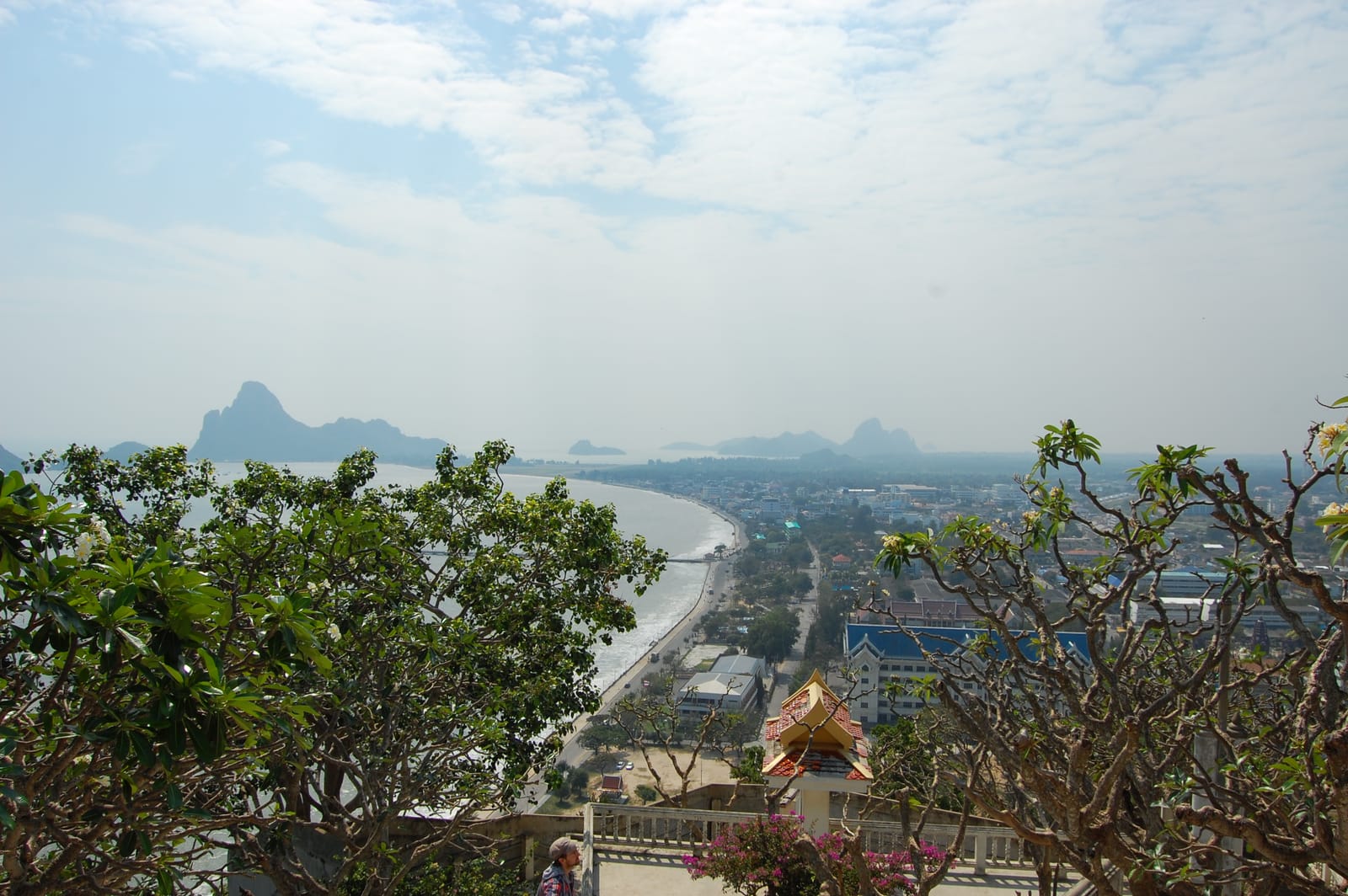
What makes people willing to climb is the 360-degree view at the summit, looking out over three curving bays lined up in a row — which is why locals call it the three-bay viewpoint: Ao Prachuap, Ao Manao, and Ao Noi, with small islands scattered across the sea. On a clear day the curve of the coastline looks gorgeous, and it's the angle you'll come across most often when you search for photos of Prachuap online.
Ao Prachuap
The town-centre bay that stands out most from the summit, with a beachfront road and the town stretching along it.
Ao Manao
The southern bay inside the Wing 5 air base, with clear water and a clean beach — another popular spot in town.
Ao Noi
The quieter northern bay, with a fishing village and Khao Ta Mong Lai nearby.
When to go and how to get there
The times people most like to climb are early morning and the late afternoon before sunset, when the sun isn't harsh and the view is at its best. Going midday means more heat and a tougher climb. The hill sits right in the middle of Prachuap town and is easy to reach — visitors usually park near Wat Thammikaram Worawihan across the way and walk over to the foot of the stairs. There's no entrance fee, but if you'd like to make a donation there's a box at the top.
- Best times — morning 6:30–8:30, or late afternoon 16:00–18:00 to dodge the midday sun.
- Entrance fee — none (donations as you wish).
- Time needed — about 1–1.5 hours up and down, including photos and paying respects.
Pair it with
After coming down the hill, you can wander the market in Prachuap town and find an easy breakfast, or drive on to Ao Manao — the bay you just spotted from the summit. It makes for a tidy half-day trip around town.
Plan a full day in Prachuap
See the Prachuap Khiri Khan travel guide →