🔄 Updated 21 Jun 2026
Wat Phra That Lampang Luang sits in Lampang Luang sub-district, Ko Kha, about 18 km southwest of Lampang town. The temple is built on a low hill, so you'll climb a short naga staircase to reach the main courtyard up top. Art historians often call it one of the most complete Lanna-style wooden temple layouts in Thailand, because the main elements — the gateway arch, the great viharn, and the chedi — line up clearly along a single axis.
Walking in: naga staircase, gateway arch, and the great viharn
The main approach is a long naga staircase climbing up to an intricately decorated stucco gateway arch. Once you pass through, the first building you meet is the great viharn (Viharn Luang) — an early-Lanna open-sided wooden hall with no solid walls around it and a gabled roof that steps down in layers. Inside stands a tiered mondop shrine known as 'Phra Chao Lan Thong'. It's shady and quiet in there, with light slipping in through the gaps in shafts — a spot a lot of people love to photograph.
- Naga staircase — the main climb up to the courtyard, with stucco naga serpents for balustrades; usually the first photo stop where people pause.
- Gateway arch (pratu khong) — an old stucco arch with vine-pattern reliefs, set on the same axis as the viharn and chedi.
- Great viharn (Viharn Luang) — the open-sided wooden hall with a stacked roof and the Phra Chao Lan Thong mondop inside.
- Viharn Nam Taem — an open-sided hall with traces of old mural paintings, considered some of the earliest Lanna wall painting still around.
Want more out of Lampang? Book tours & activities
Booking online ahead on Klook or GetYourGuide is usually cheaper than the gate and skips the queue. Pick only the experiences you actually want — prices and availability are shown live on each site.
The golden chedi and the brass fence with bullet marks
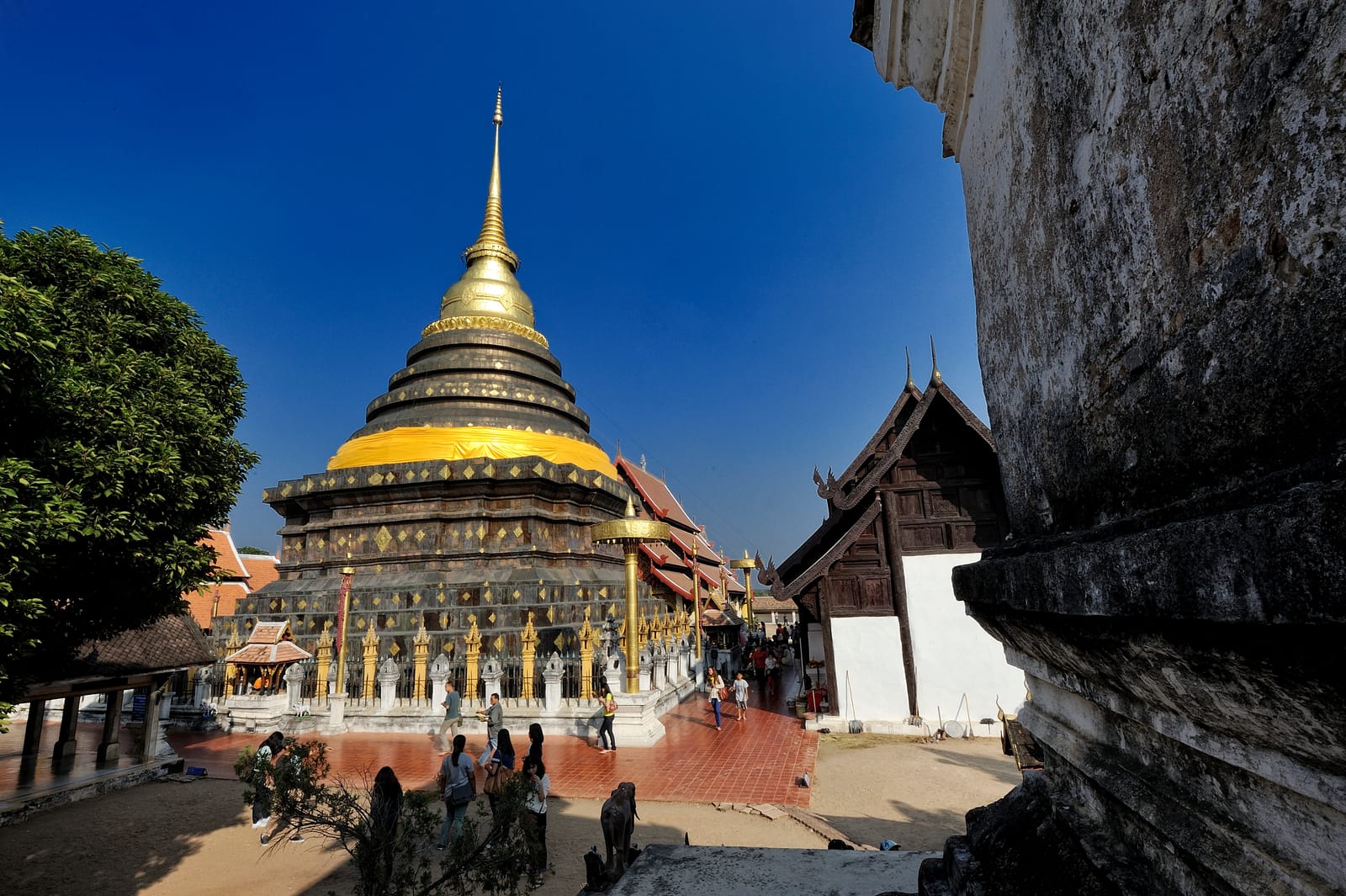
Behind the great viharn is the main chedi — a bell-shaped stupa clad in sheets of pierced brass that northerners call 'thong changko'. In the sun the whole thing glows golden. By tradition it's believed to enshrine relics of the Buddha, which makes it the year-of-birth stupa for people born in the Year of the Ox — many of whom come specifically to pay respects here.
A brass fence rings the chedi, and if you look closely you'll spot old bullet marks on it. They come from the legend of 'Nan Thip Chang' shooting Thao Mahayot, the ruler of Lamphun who had marched in and camped his army inside the temple — the event that, as the story goes, freed Lampang. It's left this fence as a spot locals always point out and tell the tale.
Good to know
The Year of the Ox is this temple's zodiac year, so people born in the Ox year who want to honor their year-of-birth stupa often make a point of coming here. If you weren't born in the Ox year, you can still pay your respects as normal — there's no restriction.
The highlight people come for: the upside-down chedi shadow
This is the reason a lot of people drive all the way out to Ko Kha. In a small hall (Viharn Phra Phuttha) there's a tiny hole in the wall, and light from outside passes through it and projects an image of the chedi and viharn — upside down — onto a cloth or the inner wall. It works on the same principle as a pinhole camera. It's an actual color image, clear enough that it's been called one of Thailand's small wonders.
- The shadow is clearest during the day when the sun is strong; late morning to early afternoon usually shows up better than the soft light of early morning or evening.
- You need to close the doors and windows so the hall goes fully dark before the image floats up clearly. There's usually a staff member or a sign explaining how to view it.
- Note: by Lanna tradition this shadow-viewing hall does not allow women inside — it's a temple rule. Women can visit the rest of the temple as normal.
- The shadow is a natural light phenomenon, so on overcast or gloomy days it may not show up clearly. That's normal.
Straight talk
The upside-down chedi shadow is small and you have to look for it in the dark — it's not the big dramatic image you see in edited review photos. If you go in expecting a small, curious light effect, you'll enjoy it a lot more.
Phra Kaeo Don Tao and the temple museum
The temple also enshrines 'Phra Kaeo Don Tao', a green jade Buddha image in the meditation posture, Lanna in style, regarded as Lampang's revered guardian image. It sits in the Phra Kaeo hall within the temple grounds. There's also a small museum displaying antiques, woodwork, and the temple's old artifacts — an easy extra half hour of wandering.
Phra Kaeo Don Tao hall
Home to Lampang's revered green jade Buddha — worth a stop to pay respects before you leave the temple.
Temple museum
Displays of antiques, woodwork, and old artifacts; about half an hour to round out your visit.
Getting there from Lampang town
The temple is about 18 km from town, and driving yourself is the easiest option — roughly 25–30 minutes. There's a large parking lot and shops out front to stop by. If you don't have a vehicle, there are a few options, but you'll need to plan a little for the ride back.
- Private car / car rental: the most convenient. Take the road toward Ko Kha, about 25–30 minutes; free parking out front.
- Motorbike rental: rental shops in Lampang town run about THB 200–300 per day, ideal for solo travelers or pairs.
- Private hire / Grab: you can book a private car or taxi for the round trip — agree on the price first, since it's hard to flag down a ride back near the temple. Have the driver wait or arrange a pickup time.
- Songthaew / Ko Kha vans: there are vehicles running the Ko Kha route; you may need to transfer or walk a bit into the temple after getting off. Good for travelers flexible on time.
Travel tip
If you don't have your own vehicle, the easiest approach is to hire a car or Grab for the round trip and arrange for the driver to wait — flagging a ride back into town from the temple is very hard in the late afternoon.
Best time to go, opening hours, and etiquette
- Opening hours: open daily, roughly 7:30am–5:00pm; free entry (there may be a donation box to support the temple).
- Best time: come late morning to early afternoon when the sun is good — the golden chedi reflects beautifully, and it's the best window to see the chedi shadow clearly.
- Dress code: this is a sacred temple, so dress modestly — sleeved tops, knee-covering pants or skirts, and remove your shoes before entering the viharn.
- Time needed: about 1–1.5 hours at an unhurried pace, including the shadow spot and the museum.
If you have time to spare around Ko Kha, grab a bite at the shops in front of the temple, or head back into town to carry on at Kad Kong Ta in the evening — which times out nicely as a neat half-day trip.
Want a half-day or full-day Lampang trip that flows together nicely?
See the Lampang travel guide →