🔄 Updated 21 Jun 2026
When people think of temples in Sing Buri, most picture Wat Phra Non Chaksi or Wat Phikun Thong first. But Wat Sawang Arom offers something different — it isn't about scale, it's about craft: sculpting Buddha images, casting them in metal, and preserving nang yai shadow puppets. The temple sits in Ton Pho subdistrict, Mueang Sing Buri district, on the bank of the Chao Phraya River, about 2 kilometers along the river from the town center and the old city shrine. It's easy to reach, parking is no problem, and it rarely gets crowded.
Buddha sculpting and casting — the craft people overlook
What sets Wat Sawang Arom apart from an ordinary temple is that it was once a hub for several kinds of craftsmanship — building ordination halls, viharns, and pavilions, and most notably sculpting and casting Buddha images. That knowledge was passed down from the foundry families of Ban Chang Lo on the Thonburi side, long one of Thailand's foremost sources of master Buddha casters.
Sculpting a likeness of a Buddha image and casting it in metal is painstaking work — from shaping the clay model and refining the face, to making the mold, applying the wax, pouring the metal, and finishing the surface. It's a process that demands skill and patience. Seeing these steps up close gives you a sense of just how many hands a single Buddha image passes through before it's finished.
Want to watch the artisans at work
Sculpting and casting aren't on display every day at all hours — it depends on whether there's a commission in progress at the time. If you're coming as a group or want to see a demonstration, it's best to call the temple ahead at 09 1761 8034 so you don't make the trip for nothing.
Want more out of Sing Buri? Book tours & activities
Booking online ahead on Klook or GetYourGuide is usually cheaper than the gate and skips the queue. Pick only the experiences you actually want — prices and availability are shown live on each site.
Pay respects to the main Buddha in the ordination hall
The heart of a visit is going in to pay respects to the principal Buddha image in the ordination hall. It's quiet inside, a good place to sit and settle your mind for a while before exploring the rest of the temple. For anyone who enjoys making merit and praying at temples, bowing before a Buddha in a temple that casts its own images carries an extra layer of meaning — you see both the origin of the craft and the end result that becomes an image for people to venerate.
- Dress modestly — this is a temple, so wear sleeved tops and trousers or skirts that cover the knees.
- Remove your shoes before entering the ordination hall and keep your voice down when people are chanting or meditating.
- Give what you can — there are donation boxes and merit-making points around the temple, with no pressure to give.
The shadow-puppet museum — a treasure in the same temple
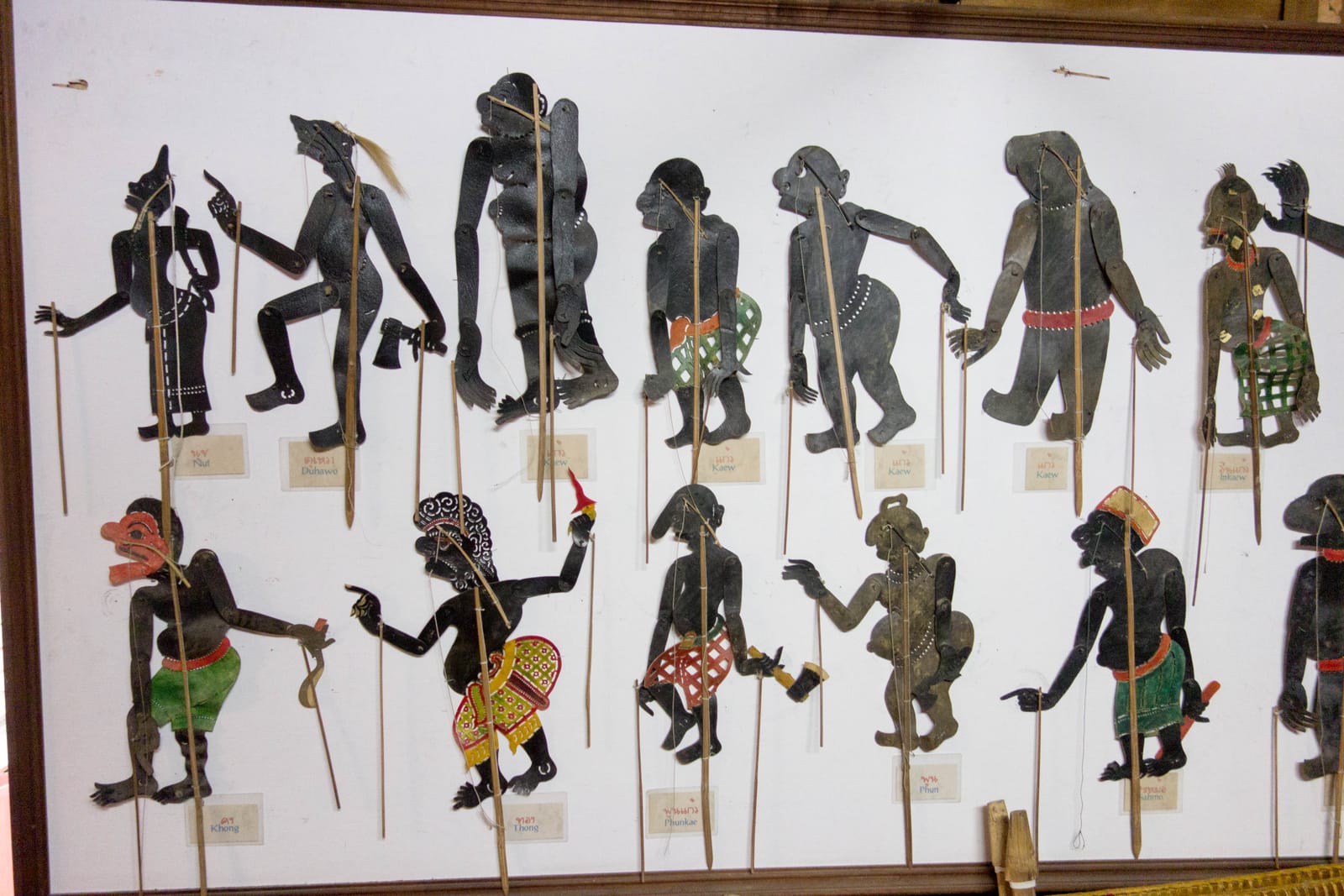
Once you're here, don't miss the nang yai shadow-puppet museum on the upper floor of the sermon hall. Established in 2002, it preserves over 300 nang yai puppets that are still intact and usable in real performances. Many are the work of old craftsmen dating back to the late Ayutthaya period, grouped into major story sets such as scenes from the Ramakien, with deities, giants, monkeys, and battle scenes. The cut patterns on the hide are extremely fine — stand close and the craftsmanship is unmistakable.
What's special is that Wat Sawang Arom is one of the few nang yai troupes in Thailand that is still "alive" — meaning the puppets are still performed and the tradition is being passed on to a new generation. Today young people from the community serve as the puppeteers and narrators, so this isn't a collection kept just for show. If you want to see a real shadow-puppet performance, you'll need to arrange it in advance, since there are no fixed daily shows.
Requesting a shadow-puppet demonstration
A nang yai performance suits larger groups, and the temple needs advance notice to assemble the puppeteers and musicians. Simply walking through the museum to look at the puppets, on the other hand, can be done during opening hours with no admission fee.
Old boats and the temple's collection
Beyond the Buddha images and the shadow puppets, the temple also keeps old longboats that once carried Sing Buri's name. They're part of the heritage of a Chao Phraya riverside community long bound to the water. Touring them alongside the other craft work in the temple paints a picture of how this community has lived with the river and with handcraft over the years.
Opening hours, admission, and how to get there
- Location — Wat Sawang Arom, Village 5, Ton Pho subdistrict, Mueang Sing Buri district, Sing Buri province, on the Chao Phraya River, about 2 km from the town center.
- Shadow-puppet museum hours — Mon–Fri 09:00–16:00 · Sat–Sun 08:30–17:00
- Admission — free, no entry fee (donations welcome).
- Contact / arranging a performance — call 09 1761 8034
- Getting there — under 10 minutes' drive from central Sing Buri · the route 165 bus (Ang Thong–Takhli) passes by.
Wat Sawang Arom is in town, so it's easy to visit and simple to pair with other spots in a single day. Pay respects to the reclining Buddha at Wat Phra Non Chaksi in the morning, swing by Wat Sawang Arom mid-morning for the craft and shadow puppets, then carry on in the afternoon to Bang Rachan Heroes Park or grab a riverside meal in town.
Where to go next in Sing Buri
Wat Phra Non Chaksi
Sing Buri's large, ancient reclining Buddha, a temple closely tied to the town and not far from the center — a good place to pay respects on the same day.
HistoryBang Rachan Heroes Park
A monument and historical grounds honoring the villager heroes of Bang Rachan, where you can walk through and learn the story of their past battles.
FoodSing Buri food guide
Boat noodles, river fish, river prawns, and local sweets — a roundup of the best spots in town and along the river.
Plan a full day in Sing Buri — temples, food, and where to stay
See the Sing Buri travel guide →