🔄 Updated 21 Jun 2026
If it's your first time in Ubon and you've only got half a day in town, Wat Thung Si Mueang is one to keep on the list — it packs several good things into one temple, and it sits right by Thung Si Mueang park and the old government buildings, so it's easy to walk on to other spots. The temple was founded around 1842, in the reign of King Rama III, by Phra Ariyawongsajan Yanwimon (Suai Lakkham), the abbot who oversaw Ubon's monastic affairs at the time. It once served as both a temple and a place where craft skills were taught to the townspeople.
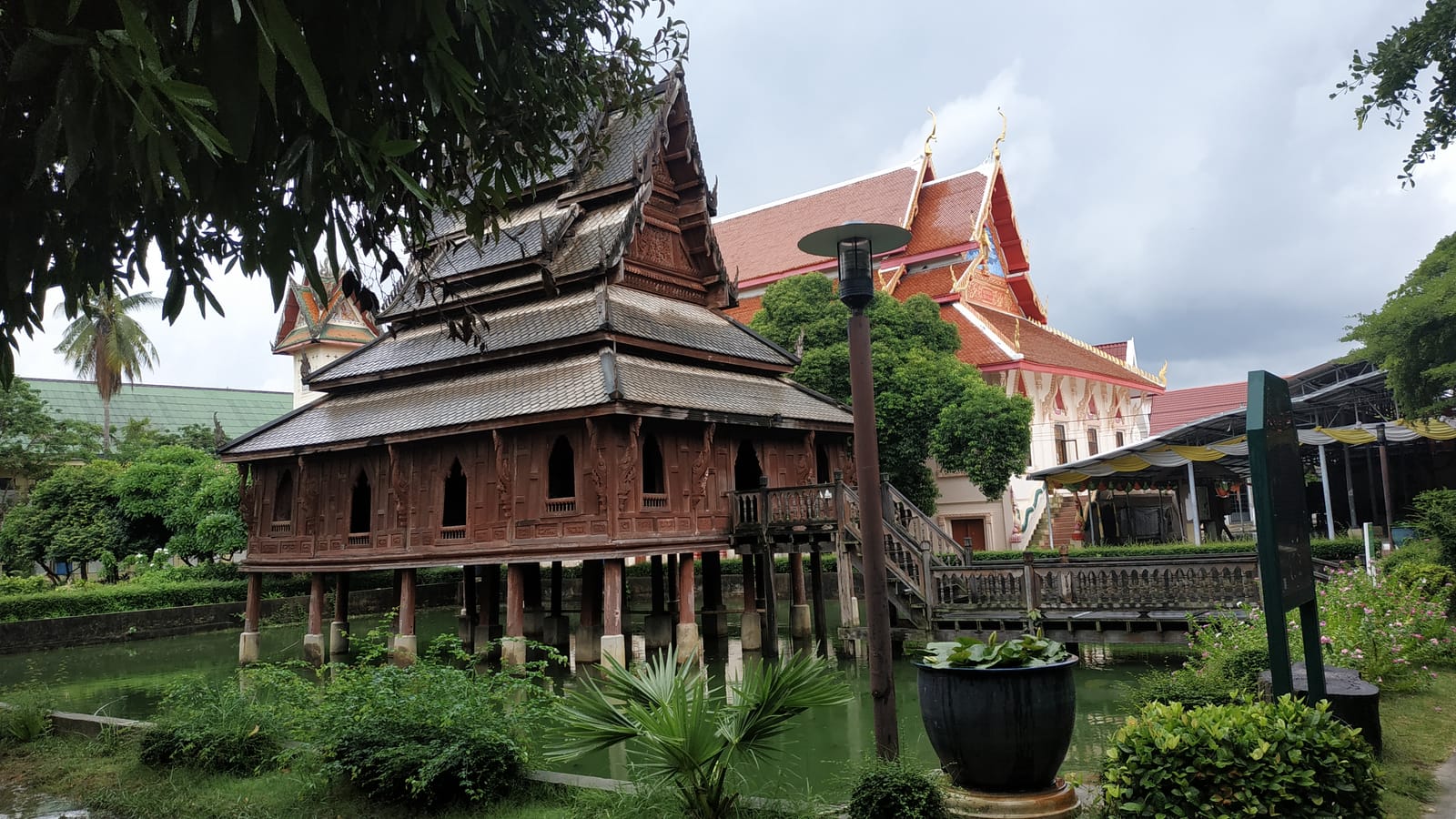
The wooden library over water — what people come to see
The scripture library here is where the Buddhist canon and palm-leaf manuscripts were kept. The whole thing is built of wood and raised up in the middle of a pond. The reasoning is refreshingly simple: keep ants, termites and insects from getting up and chewing on the texts. It's the kind of old-world thinking that's easy to grasp but genuinely works.
What makes this library special is the craftsmanship, which blends three schools of art together — Thai, Lao and Burmese. It's said that a monk from Vientiane helped oversee the construction. The roof is tiered in the Thai style, while the wood carving and structure carry hints of both Lao and Burmese influence. The library has also received a conservation award from the Association of Siamese Architects.
For the best photos
The library reflects most cleanly in the pond early in the morning before the breeze ruffles the surface, and again in the soft light late in the afternoon. Try a low angle to catch both the hall and its reflection — you'll get a much nicer symmetrical shot than standing and shooting straight on.
Want more out of Ubon Ratchathani? Book tours & activities
Booking online ahead on Klook or GetYourGuide is usually cheaper than the gate and skips the queue. Pick only the experiences you actually want — prices and availability are shown live on each site.
The Phra Phuttabat hall and its murals
Another building you shouldn't skip is the Phra Phuttabat hall, the temple's old ordination hall (sim). It was originally built to house a replica of the Buddha's footprint, brought from Wat Saket so people in Ubon could pay their respects. Inside are old murals painted by local Ubon artisans who drew on the influence of the royal court painters in Bangkok.
The paintings tell the story of the Buddha's life and the Ten Jataka tales, especially the Vessantara Jataka. The fun part is that the painters didn't stick strictly to convention — they wove in everyday local life too, from people inside the palace walls to those living along the river. Look closely and it's like opening a window onto the lives of Ubon people almost two hundred years ago. Some sections have faded with age, but you can still follow the stories.
The silver Buddha and Phra Chao Yai Si Mueang
Inside the Phra Phuttabat hall sits Phra Chao Yai Ong Ngoen, a Buddha image in the Subduing Mara posture cast from ngoen hang (a traditional Isan silver), with a lap width of around 89 cm and a height of about 1.45 m. It's a piece of local Isan craftsmanship in the Lan Xang school. Phra Chao Yai Si Mueang, meanwhile, is the principal Buddha in the Si Mueang vihara — an old image dating back to the earliest days of Ubon's founding, deeply revered by locals.
Hours, entry fee and getting there
- Location — Luang Road, Mueang Ubon Ratchathani district, on the east side of Thung Si Mueang park, near the city municipal office and Anuban Ubon school.
- Hours — roughly 8:00–18:00 daily. The library sits in the middle of the pond and can be viewed from the edge any time the temple is open.
- Entry fee — free; you can make a donation as you wish at the donation box.
- Getting there — it's right in the city, walkable from Thung Si Mueang park. There's parking inside the temple for cars and motorbikes, or it's easy to grab a Grab or a local songthaew.
- Dress code — this is an active place of worship, so wear modest clothing that covers shoulders and knees, and take off your shoes before entering the buildings.
Straight talk
The temple isn't large — 30 to 45 minutes is enough to see it all. Its charm is in the age and the craftsmanship, not in scale or grandeur. If you're hoping for a lavish golden temple, you might feel a little underwhelmed, but if you're into old architecture and murals, there's plenty here to linger over, and it's close enough to other spots to fill out a morning.
Where to go next in town
Thung Si Mueang park
A public park in the middle of town right across from the temple, with the city pillar shrine and a replica of the giant Candle Festival sculpture. Nice for a stroll and photos, and it's the venue for the annual Candle Festival parade.
Wat Si Ubon Rattanaram
The temple that enshrines Phra Kaeo Butsarakham, the topaz Buddha that's the spiritual heart of Ubon. It's close by, easy to stop in and pay your respects.
Ubon Ratchathani National Museum
The first museum in Isan, housed in the former provincial hall, covering local history and art.
Wat Maha Wanaram (Wat Pa Yai)
Another old temple, home to Phra Chao Yai Inplaeng, a Buddha image the city holds sacred. A short drive away.
Planning a morning at the old temples in town
Temples and art in the city center
Then history and a bite to eat
Want to do Ubon properly — temples, food and nature? Check out the full Ubon travel guide
See the Ubon travel guide →