🔄 Updated 21 Jun 2026
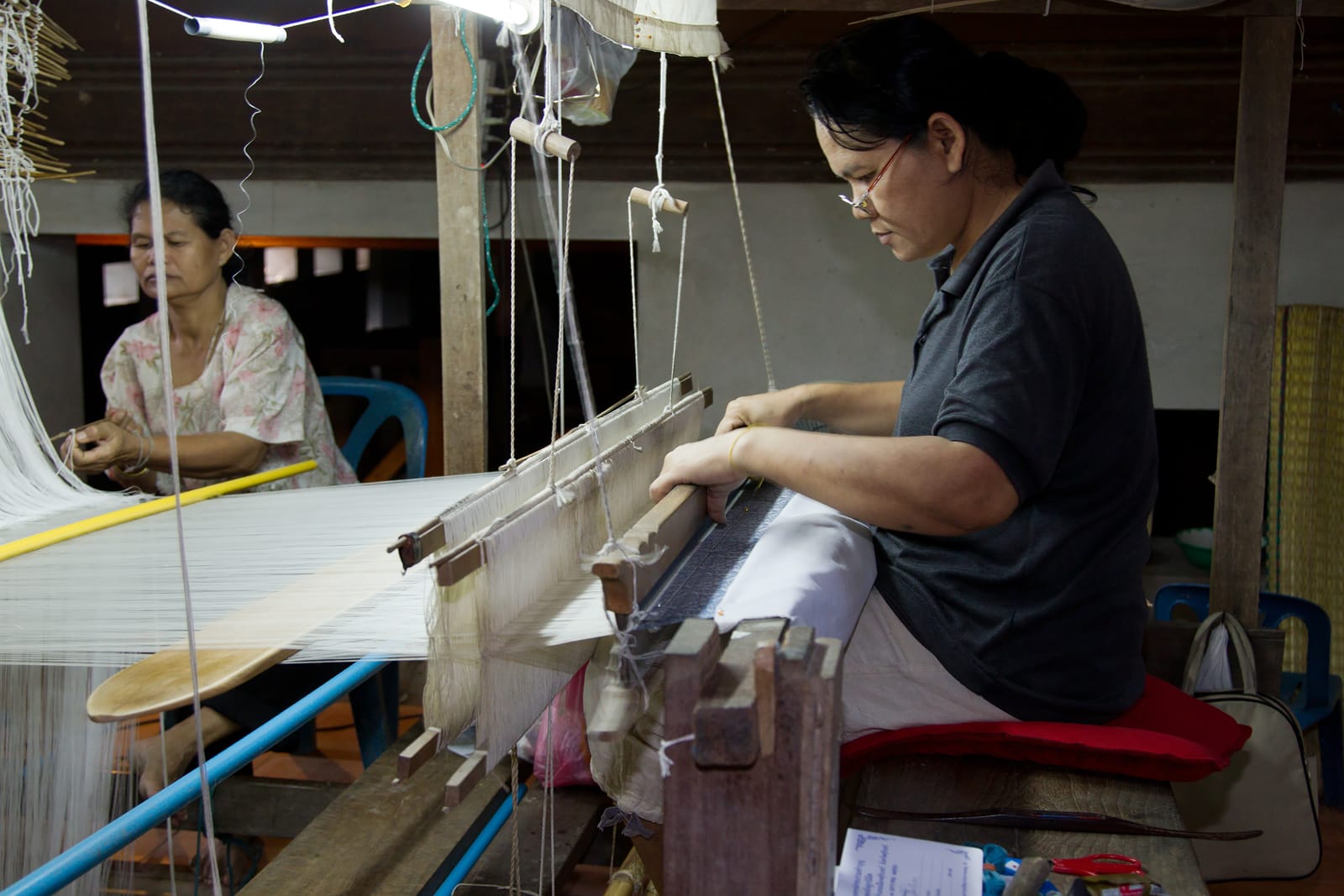
When people think of mud-dyed cloth in Thailand, Sakon Nakhon, Mukdahan or Sukhothai usually come to mind first. We'll be straight with you: Yasothon isn't a mud-dyeing capital in that league. But what Yasothon genuinely does have, and it's well worth a look, is natural-dyed cotton and silk woven all over the province, with many groups going further and fermenting the cloth in mud to deepen the color and soften the fabric. Come here and you can watch the whole process, from spinning the cotton to indigo and bark dyeing, through to the mud ferment and the hand-weaving.
What is mud-dyed cloth, and why ferment it in mud?
Mud-dyed cloth is cloth that has already been naturally dyed, then soaked and fermented in clean mud that's been sieved to remove grit and sand until only the smooth mud is left. It sits for a while, then gets washed out and dried. The minerals in the mud help lock the color in tighter, and the result is cloth that's a shade deeper and more muted than before, soft to the touch, with dye that doesn't run easily. A lot of people say mud-dyed cloth even carries a faint earthy scent.
- It starts with natural dyeing — indigo blue from indigo leaves, red from lac, yellow from jackfruit heartwood or turmeric, black and gray from local fruits and tree bark.
- Then it goes into the mud — the cloth is soaked in clean, sieved mud and left so the minerals grip the fibers, deepening the color and softening the fabric.
- Washing and drying — the mud is rinsed out clean and the cloth is dried in the shade. What you end up with doesn't bleed and washes fine for everyday use.
Mud-fermenting vs. indigo dyeing — what's the difference?
Indigo dyeing is what gives the blue color from indigo leaves. Mud-fermenting is the step that comes after dyeing, to deepen the color and soften the cloth. So a single piece can go through both indigo dyeing and mud-fermenting on the same fabric.
Want more out of Yasothon? Book tours & activities
Booking online ahead on Klook or GetYourGuide is usually cheaper than the gate and skips the queue. Pick only the experiences you actually want — prices and availability are shown live on each site.
Where to find natural-dyed weaving in Yasothon — places you can actually visit
Yasothon has weaving groups scattered across several districts, mostly community enterprises or groups of village women who'll let you stop by to look and buy right at the village. We've picked the ones that stand out and are easy enough to reach. Fair warning: many of these are people's homes, not storefront shops like you'd find in town. If you're going, it's best to call ahead and visit midday on a weekday.
Ban Non Yang Weaving Group (Maha Chana Chai District)
A long-established weaving group founded back in 1977, with around 40-odd members weaving both silk and cotton in all-natural dyes — red from lac, yellow from jackfruit heartwood and turmeric, blue from indigo. They can't keep up with the orders, that's how much demand there is. Come here and you'll see both the silk-raising and the weaving.
Ban Hong Saeng Phu Thai Cloth Group (Loeng Nok Tha District)
A Phu Thai village that still keeps its traditional weaving alive, known for mudmee (ikat) cloth and natural indigo dyeing, with patterns distinctive to the Phu Thai people. They turn it into scarves, sarongs, bags and small souvenir pieces that are easy to pick up. Good for anyone who likes deep indigo tones and tight weaving.
Natural-Dyed Weaving Groups, Kut Chum District
The Kut Chum area is well known for Yasothon's natural-dyed cotton, with several groups in and around Kut Chum sub-district weaving indigo- and bark-dyed cotton. Some patterns are named after the raw material, like the heartwood pattern. The cloth is soft and comfortable, well suited for clothes you'll actually wear.
Ban Na Samai Weaving Group (Mueang District)
Right in Mueang district, the easiest of the bunch to reach. They do both weaving and basketry, an easy stop if you're staying in town and want to see local handicraft without driving far. Check before you go to make sure someone's around.
OTOP Souvenir Shops in Yasothon Town
If you're short on time or it's not convenient to drive out to the villages, the OTOP and souvenir shops in town gather cloth from several groups in one place. Easy browsing, out of the sun, though prices usually run a touch higher than buying at the village. Good for anyone in a hurry or who wants to compare patterns from several groups side by side.
Before you drive out to a village
Many of these weaving groups are people's homes and aren't open as shops all the time. During the rice-farming season, members may be out working the fields. It's best to call ahead through your accommodation or the group's page, and go mid-morning to afternoon on a weekday when you're more likely to catch people at work.
The Yot Sunthon pattern — Yasothon's signature cloth design
If you want a piece that really represents Yasothon, look for the Yot Sunthon pattern, also known as the rattan-fruit pattern. It's the province's signature cloth design, inspired by the local rattan fruit, strung together into a continuous motif. Several groups in the province weave this pattern in natural dyes, so buying one as a souvenir gets you both the look and a piece of the town's story.
How to tell if it's genuinely natural-dyed
At a glance, natural-dyed and chemically dyed cloth can look similar, but there are a few clues that help you tell them apart. We'll be honest: no method is a hundred percent sure unless you've seen the process yourself. But if you buy from a weaving group right at the village, you usually get the real thing and can ask about where it came from.
- The color isn't too loud — natural dyes tend toward soft, deep tones that don't reflect light the way chemical dyes do, and mud-dyed cloth runs even more muted.
- The color may not be perfectly even across the piece — slight variation between batches is normal for hand-dyeing, not a flaw.
- The fabric and the marks of hand-weaving — hand-woven cloth isn't as smooth and uniform as factory cloth; that's part of the handmade charm.
- You can ask where it came from — a real weaving group can tell you what this color was dyed from and how many days it sat in the mud. If they can't answer at all, be careful.
How to buy a souvenir that's worth it
Hand-woven, natural-dyed cloth costs more than ordinary fabric because it takes a lot of time and labor. But if you choose well, you get something that lasts and comes with a story. We'd suggest starting with a small piece if you're new to it, then working up to a full length of cloth.
Scarves & shawls
A good starter souvenir — affordable, light, easy to pack home. Go for indigo tones or deep mud-dyed shades; works for men and women alike.
Sarongs in signature patterns
If you want a piece that truly represents Yasothon, look for the Yot Sunthon pattern or Phu Thai mudmee. Prices run into the thousands, but it's tightly woven and built to last.
Cotton by the meter
Good for anyone who sews their own. Buy it by the meter to make a top or a bag — natural-dyed cotton is comfortable and suits the heat.
Crafted keepsakes
Bags, keychains and cushions that the weaving groups make from offcuts. Cheap and easy to buy a few to give away.
Caring for natural-dyed cloth
Wash by hand or on a gentle cycle, with cold water and a mild detergent. Wash it separately the first time, since a little excess color may come off. Dry it in the shade, out of strong sun, and the color will hold and the cloth will stay soft for a long time.
Fitting a cloth visit into your Yasothon trip
Cloth-spotting pairs nicely with a culture-and-handicraft trip around Yasothon. If you're staying in town and want to see local handwork without driving far, stop by Ban Na Samai or the OTOP shops in town. But if you've got the time and your own car, driving out to Kut Chum, Maha Chana Chai or Loeng Nok Tha lets you see the real process at the village — better value and more atmosphere.
- Pair it with the Ban Si Than triangle-cushion village — in Pa Tio district, another of Yasothon's local handicrafts. You can make a one-day handwork trip out of it.
- Pair it with the Ban Sing Tha old town — wander and photograph the old buildings, then look for cloth and souvenirs in the area.
- Save it for the last day of your trip — buy your souvenirs before heading home so you're not lugging cloth around the whole time.
Plan where to stay and a full Yasothon trip
See the Yasothon travel guide →