🔄 Updated 21 Jun 2026
Between 1942 and 1943, the Japanese army forced Allied prisoners of war and Asian labourers to build a railway from Kanchanaburi through to Burma — more than 400 kilometres of track in little over a year. The brutal pace, hunger, disease, and gruelling labour killed huge numbers of people, which is how it earned the name the Death Railway. The cemetery and museums in the town of Kanchanaburi are where that chapter is kept and remembered.
Don Rak Allied War Cemetery
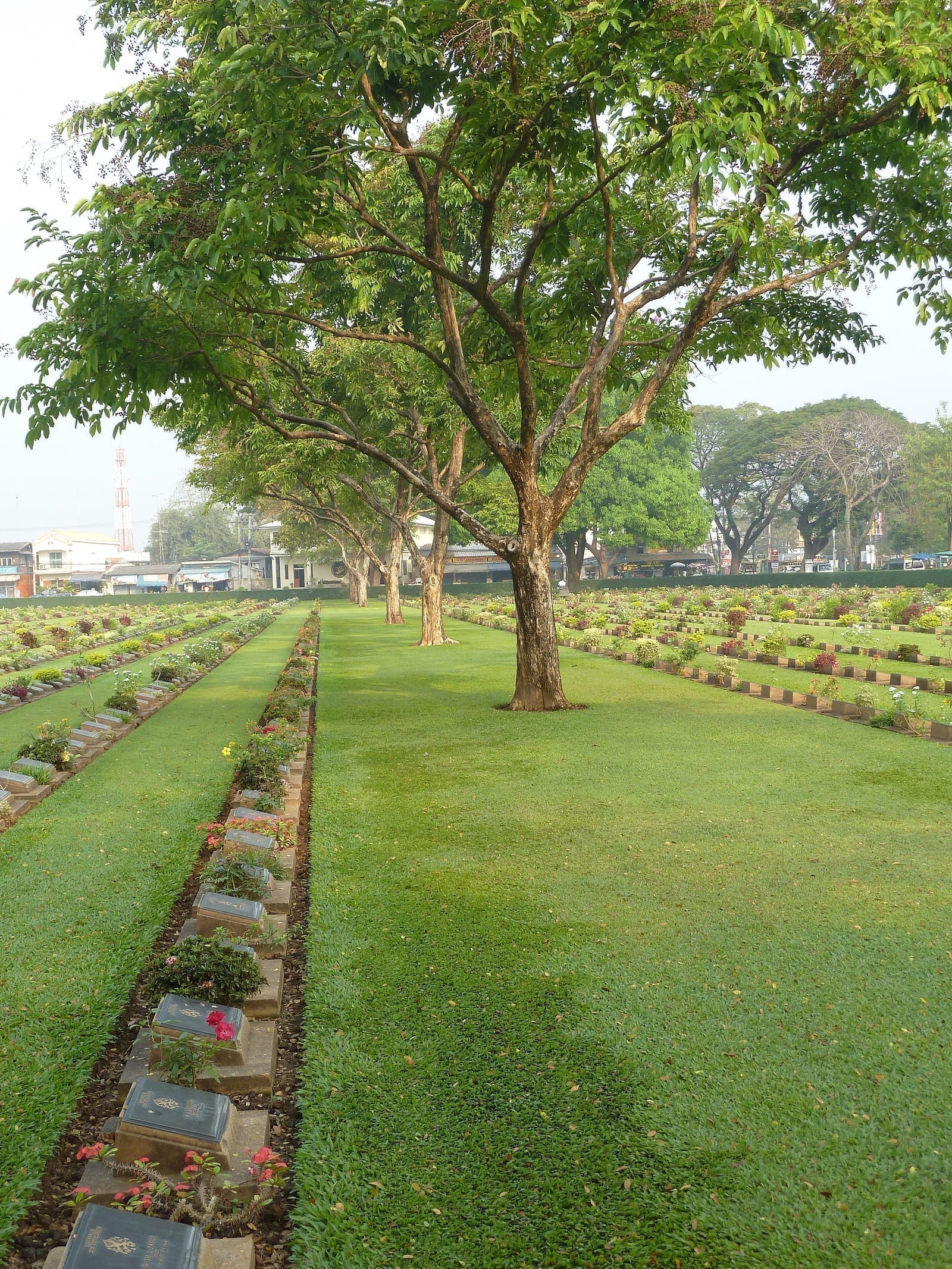
Don Rak Cemetery sits in central Kanchanaburi on Saengchuto Road, almost directly across from Kanchanaburi train station. It was built in 1945 after the war ended, on a plot of roughly 17 rai, as the resting place of POWs who died building the railway — 6,982 graves, mostly British, Dutch, and Australian soldiers. It's maintained by the Commonwealth War Graves Commission (CWGC), with neat green lawns and brass plaques engraved with names, ages, and short messages from families, laid out in quiet rows.
- Opening hours — daily, roughly 08:00–17:00
- Entry — free, no ticket
- Location — Saengchuto Road, Ban Tai subdistrict, Mueang district, opposite Kanchanaburi train station
- Best time — morning or late afternoon, when the sun is gentler and the lawns look their best
Etiquette to know
This is a working cemetery, and relatives of the soldiers still fly in from overseas to visit. Dress modestly, keep your voice down, don't step on the plaques, and if you take photos, do it respectfully. Every year on 25 April there's an Anzac Day remembrance ceremony for Australian and New Zealand soldiers, and it gets especially busy around then.
Want more out of Kanchanaburi? Book tours & activities
Booking online ahead on Klook or GetYourGuide is usually cheaper than the gate and skips the queue. Pick only the experiences you actually want — prices and availability are shown live on each site.
Two war museums — which to choose?
Kanchanaburi has several museums that tell the Death Railway story, but the two people talk about most are the Thailand-Burma Railway Centre, right next to Don Rak Cemetery, and the JEATH War Museum at Wat Tai by the river. Both cover the same history but in very different styles. If you're short on time, go with the first.
Thailand-Burma Railway Centre
A two-storey private museum next door to Don Rak Cemetery, founded by Rod Beattie, an Australian historian who walked and surveyed the entire railway line himself. The displays are well organised, with maps, models, and genuinely researched information, and your ticket includes a drink at the upstairs café. Plan on about 1–1.5 hours.
JEATH War Museum (Wat Tai)
Inside Wat Chaichumphon Chanasongkhram by the Mae Klong River, built in 1977 as a U-shaped row of thatched bamboo huts recreating an actual POW camp. Inside are wartime photos, paintings, and artefacts. The feel is rawer, and it gives you a clearer picture of daily life in the camps.
- Thailand-Burma Railway Centre — open daily, roughly 09:00–16:00 · adults around 160 THB, children 7–12 around 80 THB (includes a drink)
- JEATH War Museum — open daily, roughly 08:00–16:30 · Thais around 10 THB, foreigners around 30–40 THB
- Easy to pair — the Railway Centre is right beside Don Rak Cemetery, so you can walk straight from one to the other. JEATH is in a different part of town, closer to the market and the bridge.
Straight talk
The opening hours of these two private museums shift around with holidays and the season, and ticket prices change in ranges. If you're planning to go on a public holiday or arriving late, close to closing time, it's safer to call your hotel or check the latest page before you set off.
Getting there and planning
- From the town centre — both the cemetery and the Railway Centre are in town; you can walk or grab a motorbike taxi from the riverside accommodation area within a few minutes
- Pair it with — the Bridge over the River Kwai and the Death Railway stations are on the same route, so it's easy to do them all together in a morning
- Total time — cemetery 20–30 min + museum 1–1.5 hours; budget roughly half a day
- What to wear — covered shoulders and knee-length trousers or skirts, especially for JEATH, which is inside a temple
Plan a full Kanchanaburi trip — history, waterfalls, and riverside stays all in one
See the Kanchanaburi travel guide →