🔄 Updated 21 Jun 2026
If you're driving through Uttaradit and hear the phrase Nam Phi iron for the first time, you might think it's just another market souvenir. But it's actually iron with a legend stretching back centuries — a natural iron ore mined only at Ban Nam Phi, believed since ancient times to be tough enough to forge the kingdom's royal swords. So Ban Nam Phi isn't just an ordinary village; it's a blacksmithing community that's still very much alive.
It sits at Ban Nam Phi, Moo 1, Nam Phi subdistrict, Thong Saen Khan district, about 56 km from Uttaradit town. You drive along the Uttaradit–Thong Saen Khan road, then turn onto a local road for the last stretch. It's better suited as a stop along the way than a destination on its own — but once people get here, plenty say it was worth the drive.
Nam Phi Iron-Pit Museum — start here first
The first stop should be the Nam Phi Iron-Pit Folk Museum, open since 1999. The provincial authorities built it to tell the full story of Nam Phi iron from start to finish. Inside, model displays walk you through every step — digging for the ore, smelting the iron, and forging it into knives and swords — alongside real products made from Nam Phi iron that you can look at up close.
- Hours — daily, 8:00 AM–5:00 PM
- Admission — free, no ticket charge
- Who it's for — history buffs, families bringing kids to learn, and anyone who wants the backstory before buying a knife to take home
- Time needed — an easy 30–45 min walk-through
Tip
The building has an audio narration of the history. Walk slowly and listen to it through once — you'll understand why a small lump of iron became an auspicious object people go out of their way to find.
Want more out of Uttaradit? Book tours & activities
Booking online ahead on Klook or GetYourGuide is usually cheaper than the gate and skips the queue. Pick only the experiences you actually want — prices and availability are shown live on each site.
Phra Saeng & Phra Khan pits — once reserved for kings
Among all the iron pits at Ban Nam Phi, two are more special than the rest: the Phra Saeng pit and the Phra Khan pit. In ancient times these two were off-limits, their ore reserved solely for forging weapons for the king. Ordinary villagers had to dig the surrounding pits instead. Walk around and you'll see traces of the old pits still in the actual ground — not replicas.
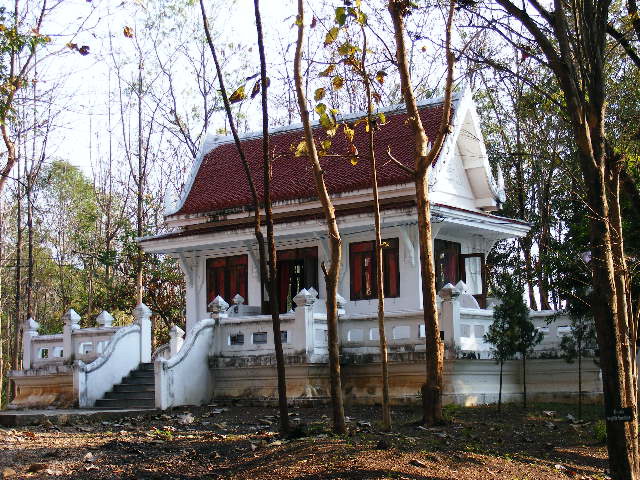
To the north of these two pits stands the Nam Phi Iron-Pit Guardian Shrine. Local Nam Phi legend tells of Pu Thammarat, the guardian spirit of the Phra Saeng pit, who watches over and protects the iron pits. These days many people who follow Thai folk beliefs stop by to ask for blessings of fortune and protection. If you'd like to pay respects, you can bring flowers, incense, and candles — it's not required, but keep it respectful, since this is a sacred place for the locals.
Watch blacksmiths forge knives by hand the old way
The real charm of Ban Nam Phi is that there are still craftsmen's homes forging iron by hand. On some days, the demonstration yard outside the museum has a blacksmith forging for visitors — you'll see the whole process, from heating the iron red-hot to hammering it into shape, quenching it in water, and finishing the edge. It's a sight that's hard to find these days. The sound of the hammer on iron and the sparks flying off are the real deal, and they photograph beautifully on a phone.
- Forging demonstrations usually happen on weekends or when tour groups are around. To be sure, it's worth calling the community or the shop ahead.
- Always ask permission before photographing the smiths. Most are friendly and happy to explain what they're doing.
- Stand at a safe distance — sparks and hot iron really can fly.
Buying real handmade knives & swords — roughly how much
What people come to take home are the handmade knives and swords made from Nam Phi iron. There are several craftsmen's shops in the village. A well-known one is Nirut Nam Phi Iron, which has both a storefront and online sales. Products range from small ritual knives and kitchen knives to swords and krises for those into auspicious objects.
Ritual knife / small blade
Pocket-sized, popular as an auspicious item to carry or keep at home. It's the piece most people buy, since the price is accessible and it's easy to carry.
Kitchen knife
Nam Phi iron forged into a sharp, durable kitchen knife — good for anyone who wants something they'll actually use, not just display. Hold a few at the shop to feel the weight before picking the one that suits your hand.
Kris
More finely detailed work than an ordinary knife. Collectors and folk-belief followers love it, as it's considered a sacred object.
Nam Phi iron sword
A larger piece, with prices climbing by size and craftsmanship. Some have scabbards carved from Burmese rosewood — good for display or serious collecting.
How to spot the real thing
Genuine Nam Phi iron is rare and not cheap. If you find one that's unusually cheap, be suspicious. Buy from a community shop that can clearly explain the origin, ask about a certificate or the maker's background, and remember that the genuine pieces are mostly handmade — no two will be exactly alike.
One thing to know if you're buying a knife or sword to take home: you can't carry it in your hand luggage on a plane. It has to go in checked baggage, wrapped securely. If you're driving back, stow it safely. Most shops will box it up and ship it by post if you'd rather not carry it yourself.
A half-day at Ban Nam Phi — how to plan your time
Ban Nam Phi is a fair way from town, so most people make it a half-day trip and pair it with something else the same day. Here's an easygoing, unhurried sequence.
Learn + shop
Continue the trip back in town
Getting there + tips before you go
- Your own car is easiest — public transport is hard to come by here. If you don't have a car, rent or charter one from town.
- Allow travel time — the round trip plus sightseeing takes about half a day, so don't pack your schedule too tight.
- Carry cash — some community shops accept transfers, others prefer cash. Be ready for both.
- Dress comfortably — the iron-pit yard is outdoors and sunny, so bring a hat and drinking water.
Want a full-day Uttaradit itinerary, including where to stay and what to eat
See the Uttaradit travel guide →