🔄 Updated 21 Jun 2026
People often assume you have to take a boat out to the islands for Trang to be worth it, but the mainland side of Hat Chao Mai is a full day on its own — you can drive to every spot. The string of beaches starts at Pak Meng in the north and runs south through Chang Lang Beach, Hat San, Hat Yao, Yong Ling Beach, and finishes at Chao Mai Beach in the far south. Each beach has its own character: some are good for swimming, others are quiet enough for slow walks and photos, and limestone caves are tucked into the cliffs along the shore, so you can do a few very different things in one area.
Entry Fees, Opening Hours and Getting In
The park headquarters sits on Chang Lang Beach in Mai Fat subdistrict, Sikao district, and is open around 08:30–16:30 daily. Entry is priced like a standard marine park: roughly 40 THB for Thai adults and 20 THB for children, and around 200 THB for foreign adults and 100 THB for children (prices can change by Department of National Parks notice, so confirm at the gate). There are several fee booths along the beaches, and if you keep your ticket after paying, you can use it to enter the other beaches within the park on the same day.
- From Trang town — take Highway 4046 (Trang–Sikao) to around the 30 km mark, turn left onto Highway 4162 and continue straight to Pak Meng Beach, about 35–47 km total and roughly 50 minutes to just over an hour.
- With your own car — the easiest option, since the beaches are several kilometres apart and you connect between them along the coastal road.
- Without a car — rent a motorbike or a car in Trang town, or hire a songthaew / local taxi by the day. Public buses don't reach here conveniently.
Check Before You Go
During the southwest monsoon, roughly May to October, the wind and waves pick up, the water turns murky, and red flags sometimes ban swimming. If you want clear water and open skies, the best stretch is November to April. The Yong Ling sea cave can only be walked through at low tide, so check that day's tide chart before you plan.
Want more out of Trang? Book tours & activities
Booking online ahead on Klook or GetYourGuide is usually cheaper than the gate and skips the queue. Pick only the experiences you actually want — prices and availability are shown live on each site.
Yong Ling Beach and Its Sea Cave, the Highlight Here
Yong Ling Beach (sometimes spelled Hyong Ling) is the one many people rate as the prettiest in the park — a short curve of sand flanked by limestone cliffs on both sides, with a sea cave that tunnels through from one beach and comes out on another. At low tide you can walk through the cave to the far side, where a small, quiet beach feels almost private. Fewer people make it here than to the famous islands, so it stays very calm.
- Walking through the cave — the cave tunnel links the two beaches and is passable at low tide. Wear shoes you can take through water and over rock.
- Photo spots — the light is best from late afternoon into evening, when the pines along the beach turn gold as the sun softens.
- Facilities — there are restrooms and a few small shops, but not as much as at Chang Lang Beach, so bring your own drinking water.
Chao Mai Beach, Shallow and Easy for Swimming
Chao Mai Beach is at the southern end of the park, in Kantang district — a wide, gently sloping shallow beach where you can wade out a long way and the water still isn't deep, ideal for kids and families. Looking out, Koh Libong sits on the horizon, and behind the beach there's a shady pine grove to sit and get out of the sun. There are fewer people here than at Pak Meng, so the mood is quiet.
Nearby is Chao Mai Cave, a stalactite-and-stalagmite cave at Toh Nae cliff. Reaching it means taking a small boat along the Chao Mai canal for about 15 minutes. If you're interested, ask the locals or the park headquarters about a boat on site, since there aren't regular scheduled runs all day. It's a good add-on for anyone who wants a cave to go with the beaches.
Pak Meng Beach, for Sunsets and Seafood
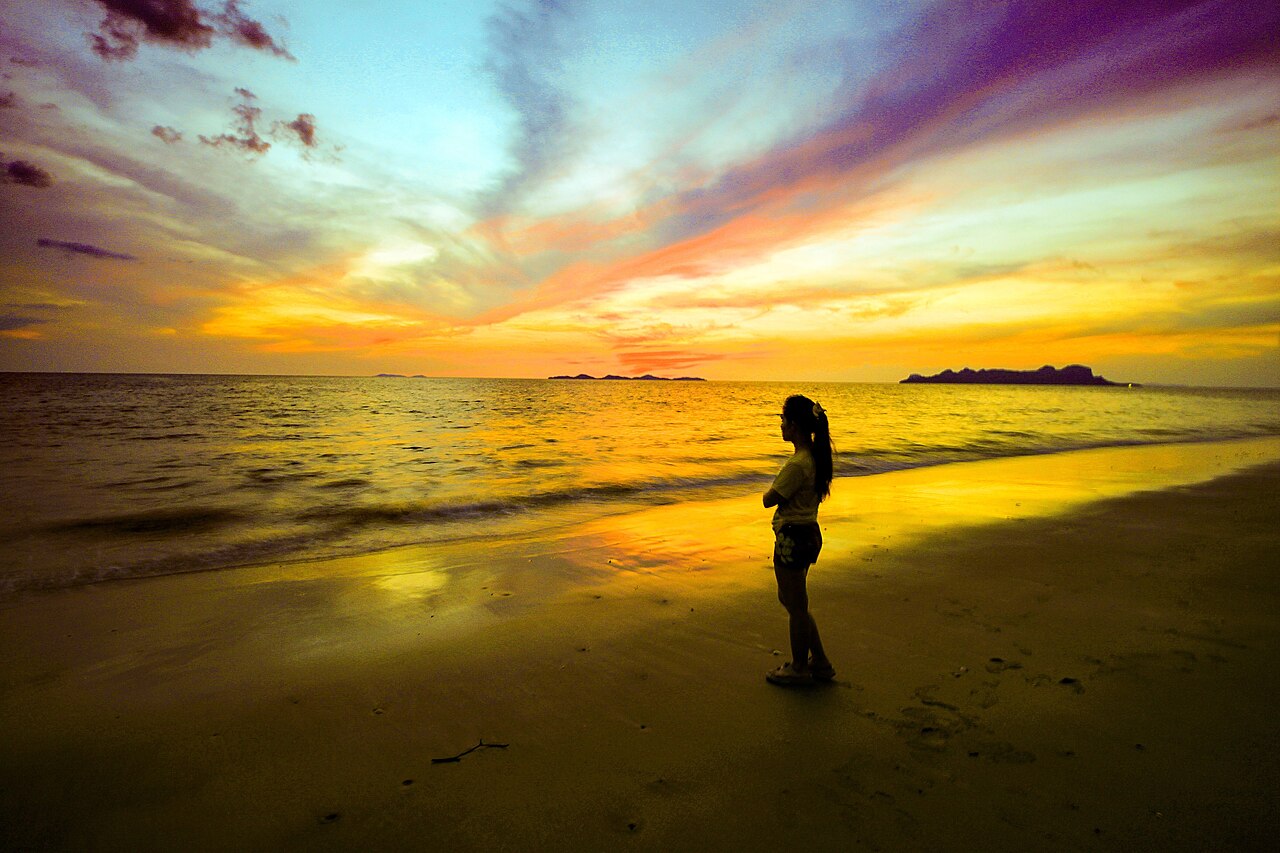
Pak Meng Beach is at the far north — a long crescent-shaped beach lined by pines along the road, and a sunset spot where Trang locals like to come and sit in the evening. Looking out you can see Koh Meng, whose hills are shaped a bit like a person lying on their back, the source of a local folk tale. Along the coastal road there's a long row of seafood restaurants where you can sit and catch the sea breeze.
Suan Son Pak Meng
A long-running beachfront seafood spot where you can sit out in the sea breeze. Fresh prawns, shellfish, crab and fish plus grilled dishes — easy to order and the prices aren't steep.
Pak Meng Seafood
Another popular spot on Pak Meng Beach, focused on fresh seafood right by the water — a good dinner before the sunset.
Pak Meng Pier
The departure point for boats to Koh Mook, Koh Kradan and the Emerald Cave. If you want to add an island trip the next day, it's convenient to start here.
Staying Overnight in the Park: Bungalows and Camping
The park headquarters on Chang Lang Beach has park bungalows and a wide campground under the pines. Pitching your own tent runs about 30 THB per person per night, and you can rent tents and bedding on top of that. Bungalows are booked ahead through the Department of National Parks' online system (nps.dnp.go.th), since long weekends fill up fast. There's a restaurant and a park shop on site, but the options aren't many — if you'd rather have more convenience, you can stay at a hotel in Trang town and drive over in the morning.
Straight Talk
This isn't the crystal-clear water of the outer islands — the coastal water runs greener and murkier. The draw here is the quiet, the long beaches and seeing several of them in one day. If you're after really clear water, taking a boat to Koh Kradan or the Emerald Cave is more on the mark. But if you want a calm mood for walking and photos, this is a great fit.
Making the Most of One Day
Work the beaches south to north, finishing with the Pak Meng sunset
Day one for the mainland beaches, day two by boat to the islands
Plan a full Trang trip — islands, sea and the old town
See the Trang travel guide →