🔄 Updated 21 Jun 2026
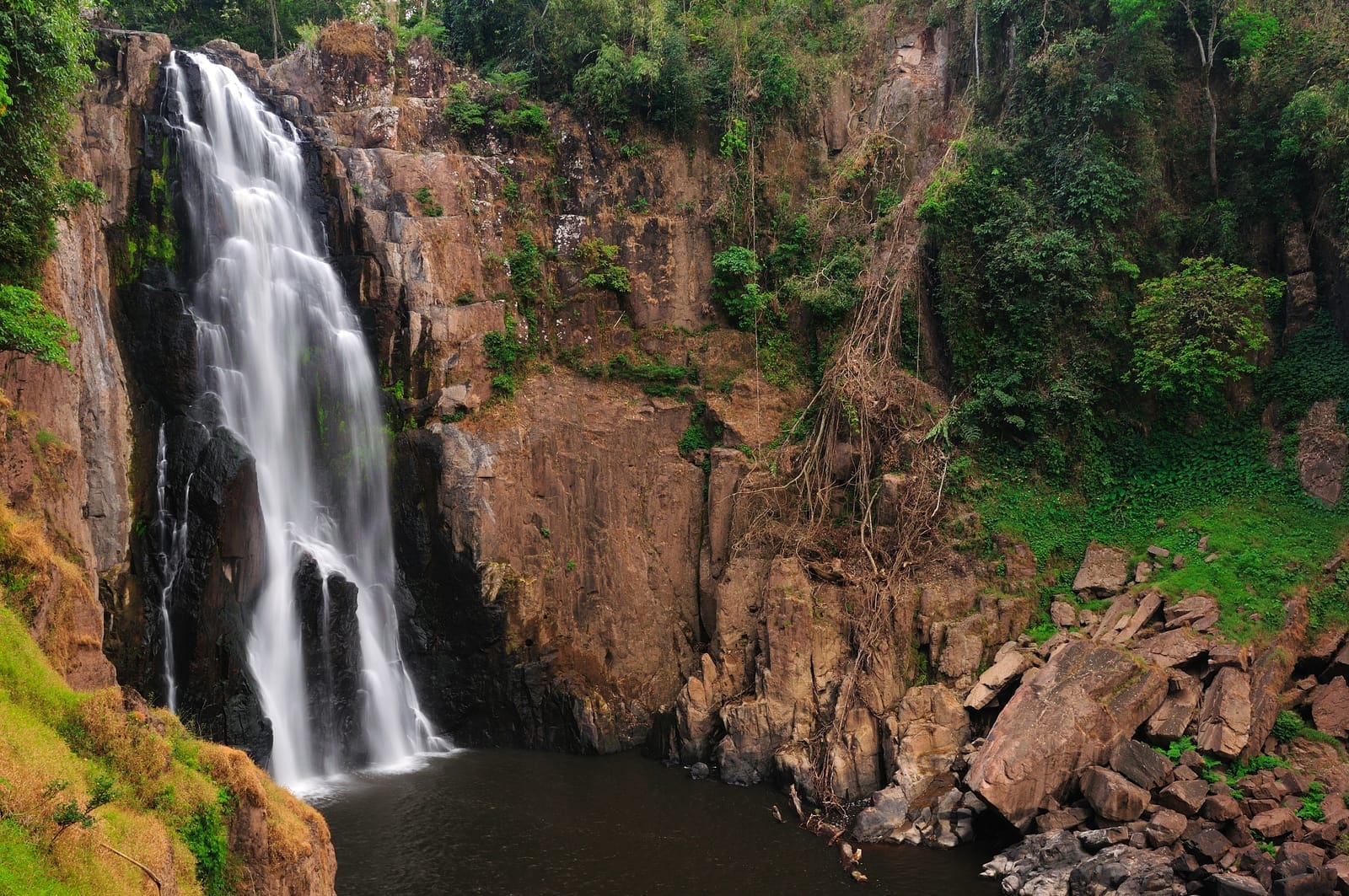
Ask most people about Khao Yai's waterfalls and they'll think of Haew Suwat, the one made famous as a film location. But when it comes to sheer size and height, Haew Narok is the park's number one. The first tier drops around 50 metres down a steep rock face where the water spreads into a wide curtain, then there are two more tiers stepping down below it, for a total of over 150 metres. It's the most dramatic waterfall in Khao Yai and one of the biggest in central Thailand.
One thing to understand before you go: Haew Narok is on the opposite side of the park from Haew Suwat. Haew Suwat sits in the central zone near the headquarters, while Haew Narok is at the far southern end. The entrance is around the km 24 marker on Highway 3077 (the Prachinburi–Khao Yai road on the Nakhon Nayok side). If you drive in through the Noen Hom–Prachinburi checkpoint you'll reach it more easily than coming from the Pak Chong side.
The 3 tiers and the viewpoint
Haew Narok has 3 tiers, but regular visitors can only go down to the viewpoint above the first tier — below that it's a sheer, dangerous drop. From the car park you walk roughly 1 kilometre along a forest trail to the viewpoint, and the final stretch is a set of stairs and a wooden walkway descending another 50 metres or so to the viewing deck. From there you'll see the huge curtain of water plunging into the gorge in front of you, the roar of it filling the air and the cool spray catching your face.
When it photographs best
Mid-morning, around 10am, the sun starts reaching into the gorge and the spray throws a rainbow across the water curtain — the prettiest time to shoot. Come late afternoon and the sun drops behind the ridge, leaving the scene flatter and darker.
Want more out of Khao Yai? Book tours & activities
Booking online ahead on Klook or GetYourGuide is usually cheaper than the gate and skips the queue. Pick only the experiences you actually want — prices and availability are shown live on each site.
The trail — steep and slippery, come prepared
Here's the honest part: the path to Haew Narok is not a flat stroll. The way in is downhill through forest, which means the whole way back is uphill. Plenty of reviews say the same thing — shaky legs and sore calves for the next two days. The final section of stairs and wooden walkway down to the viewpoint is fairly narrow and steep, and if it's just rained the wood and rock get very slippery, so hold the rail and step slowly.
- Distance — about 1 kilometre on foot from the car park each way, with a steep stair descent of another 50 metres or so at the end to reach the viewpoint. Allow roughly 1–1.5 hours round trip including photo stops.
- Footwear — wear trainers or hiking shoes with good grip. Avoid flip-flops or smooth soles entirely, because the stairs and wooden walkway get slick when wet.
- The way back is harder than the way in — it's all uphill. If you have bad knees or you're older, gauge your own fitness first. There are spots to sit and rest along the way, so take your time.
- Don't cross the barriers — the viewpoint has rails and marked boundaries to stand behind. Never climb over to shoot from the cliff edge: the rock is wet and slippery and it's a deep gorge below.
Straight talk on safety
Haew Narok was closed in early 2025 to repair the walkway after a rock-and-soil slide on the cliff face left some people injured, then reopened to visitors in late May 2025. Before you go, check with the park that it's open as normal — especially after heavy rain or when a storm is moving in, as it can close temporarily for safety.
Best season for the water — and when to avoid
Haew Narok is at its best in the late rainy season into early cool season, roughly September to November, when there's plenty of water and the curtain runs wide and strong. But that's also when the trail is at its most slippery. In the dry season (March–May) the flow drops a lot, and some years it's down to a thin trickle — far less impressive.
- September–November — full flow, the widest and prettiest water curtain, but a slippery trail that needs extra care.
- December–February — cool, comfortable weather with enough water still flowing and pleasant walking. This is Khao Yai's high season, so expect crowds.
- March–May — dry season, low water, the falls won't be at full force, but the trail is drier and easier — good for anyone wary of slipping.
- After heavy rain — watch for flash floods. The park has warned about strong flash flooding in the gorge before. If the sky turns dark and rain is on the way, don't go down to the viewpoint.
Entry fees and opening hours
- Park entry (Thai nationals) — adults 40 THB, children 20 THB
- Park entry (foreign visitors) — adults 400 THB, children 200 THB
- Vehicle fee — car 30 THB, motorbike 20 THB
- Waterfall viewing hours — roughly 08:00–17:00 (within the park's opening hours of 06:00–18:00). Aim to reach the falls before late afternoon so you have time for the walk back.
- Pay once — your ticket covers other spots in the park the same day, so there's no need to pay again at Haew Suwat or the viewpoints.
Getting there and nearby spots
Haew Narok is on the southern side of the park, easiest to reach from the Noen Hom checkpoint in Prachinburi/Nakhon Nayok. The waterfall entrance is around the km 24 marker on Highway 3077. If you come from Pak Chong town on the Korat side, you'll have to drive the whole length of the park down to the south, which takes much longer. Inside the park the road winds up and down the hills the entire way, and wildlife like elephants, deer, and monkeys can cross at any time — drive slowly and don't honk to shoo them off.
Haew Suwat Waterfall
A single-tier waterfall about 20 metres high with a wide pool, far easier to reach than Haew Narok. It's the popular falls in the park's central zone — easy to pair with Haew Narok in one day.
ViewpointKm 30 / Pha Kluai Mai Viewpoint
An open viewpoint looking out over green ridgelines as far as you can see — a good stop to take photos and break from the mountain driving. It's right along the park road.
Wildlife watchingNong Phak Chi Watchtower
A wildlife-watching tower beside a grassland. In the late afternoon you've got a chance of spotting deer and other animals coming out to feed — a nature activity plenty of people love.
Planning around long weekends
On long weekends and during the cool-season high season, cars back up at the checkpoint for ages, the waterfall car park fills up fast, and accommodation around Khao Yai books out weeks ahead. If you can, come on a weekday, or enter the park early before 9am — it's far smoother.
Plan a full day of Khao Yai nature and waterfalls
See our Khao Yai travel guide →