Home Destinations Nakhon Ratchasima 🧭 Plan Your Trip 🔎 Search About
HomeThailandNakhon RatchasimaKorat Culture Trip Phimai + Pak Thong Chai Silk
🛕 Korat Trip Plan

Korat Culture Trip
Phimai + Pak Thong Chai Silk

Korat is more than just the gateway you pass through on the way to Khao Yai. If you're into old stories, Khmer sanctuaries, the city's historic temples and handwoven crafts, you can fill a solid three-day culture trip here. This plan starts in town, paying respects at the Thao Suranari shrine and the old temples downtown, then heads out to Phimai for a thousand-year-old stone sanctuary and a giant banyan tree most visitors never reach. It wraps up in Pak Thong Chai, a silk-weaving district famous for decades, where you can watch the weavers at work and pick out a piece to take home. The whole thing is an easy self-drive — no rushing.

🛕 Thousand-year-old Phimai sanctuary🧵 Pak Thong Chai silk🙏 Thao Suranari shrine & old temples
Korat Culture Trip Phimai + Pak Thong Chai Silk

🔄 Updated 21 Jun 2026

The way a Korat culture trip clicks into place is to split it into three clear zones. Day one stays in town — easy walking, plenty of restaurants, and time for the old temples and the Thao Suranari plaza. Day two you drive about 60 km north to Phimai for the stone sanctuary and the museum. Day three you drive roughly 30 km south to Pak Thong Chai to watch silk weaving and shop for souvenirs before heading home. This plan assumes you have your own car or rent one in town, because reaching these two outlying districts by public transport eats up a lot of waiting time.

The most comfortable time to go is November through February — cool weather, so walking around the sun-exposed sanctuary isn't punishing. Come in December and you'll also catch the Pak Thong Chai silk and local-products festival. The hot season from March to May has fierce sun, so plan to walk the sanctuary in the early morning or late afternoon and skip the midday heat.

Day One: Korat Old Town, the Thao Suranari Shrine & Historic Temples

Day one lays down the city's backstory first. Korat has been a frontier town since ancient times, and the moat and Chumphon Gate are still intact. You can stroll the old-town district around the Thao Suranari plaza comfortably all day, and the two or three downtown temples sit close enough to walk between.

Day 1

In town — Thao Suranari, Wat Phra Narai, the old town

09:00
Arrive in Korat, check in or drop your bagsIf you leave Bangkok early in the morning, you'll reach the city around 9–10am. Many downtown hotels let you store luggage before check-in time, so drop your bags and head straight out.
10:00
Pay respects at the Thao Suranari Monument (Ya Mo)The Thao Suranari plaza sits in front of Chumphon Gate in the heart of the city and is deeply revered by Korat locals. Stop to pay respects in the local custom. Around it are stalls selling flower garlands and snacks. It doesn't take long.
10:45
Wat Phra Narai Maharat (Wat Klang Nakhon) + the City Pillar ShrineAn old temple dating to the Ayutthaya era, right next to the City Pillar Shrine — the spot Korat locals consider the city's sacred center. There's a four-armed Vishnu image and an ancient Ganesha to pay respects to, and the ordination hall sits on an island in the middle of a lotus pond, which is an unusual, lovely sight.
12:00
Lunch — original Korat pad meeKorat pad mee (khua mee) is a local dish worth trying — dry-fried rice noodles with a well-rounded flavor. Several famous shops in town serve it, around 60–70 THB a plate. Order it alongside som tam and grilled chicken for a full meal.
13:30
Walk the old town around the moat and Chumphon GateChumphon Gate is one of the old city gates still standing. Stroll around the moat, photograph the old walls — the old-town atmosphere is quiet and calm.
15:00
The Petrified Wood MuseumLocated in Suranari subdistrict, about 20 minutes from town. It keeps petrified wood specimens hundreds of thousands of years old, with sections on prehistoric elephants and dinosaurs. The indoor walk is cool and comfortable, and it's good for kids too.
18:00
Dinner + Terminal 21 or Save One marketTerminal 21 Korat is decorated with an airport theme and has a Sky Deck with 360-degree city views and plenty of restaurants. If you'd rather have a night-market vibe, head to Save One market on Mittraphap Road, packed with food and shopping.

Day one tip

Many of the famous pad mee shops sell out early, and some close in the afternoon. If you have your heart set on a particular one, check its opening hours before you leave the hotel so you're not left disappointed.

🎟️

Book the activities in your Nakhon Ratchasima trip ahead

Booking online ahead on Klook or GetYourGuide is usually cheaper than the gate and skips the queue. Pick only the experiences you actually want — prices and availability are shown live on each site.

🎟️ See all Nakhon Ratchasima tours & activities (Klook)

Day Two: Off to Phimai, the Thousand-Year-Old Stone Sanctuary

Day two is the highlight of the trip. Pack up and leave town in the morning, drive about 60 km along Route 206 — roughly an hour — and arrive before noon so you can walk the sanctuary while the sun is still gentle. All of Phimai district can be done on foot from one spot to the next, since the sanctuary, the museum, and Sai Ngam are all close together.

Day 2

Phimai — the stone sanctuary, museum, Sai Ngam

08:00
Drive out of town to PhimaiDrive about an hour along Route 206 through rice fields, with gas stations along the way for restroom stops. If you've booked a place to stay in Phimai town, you can check in first.
09:00
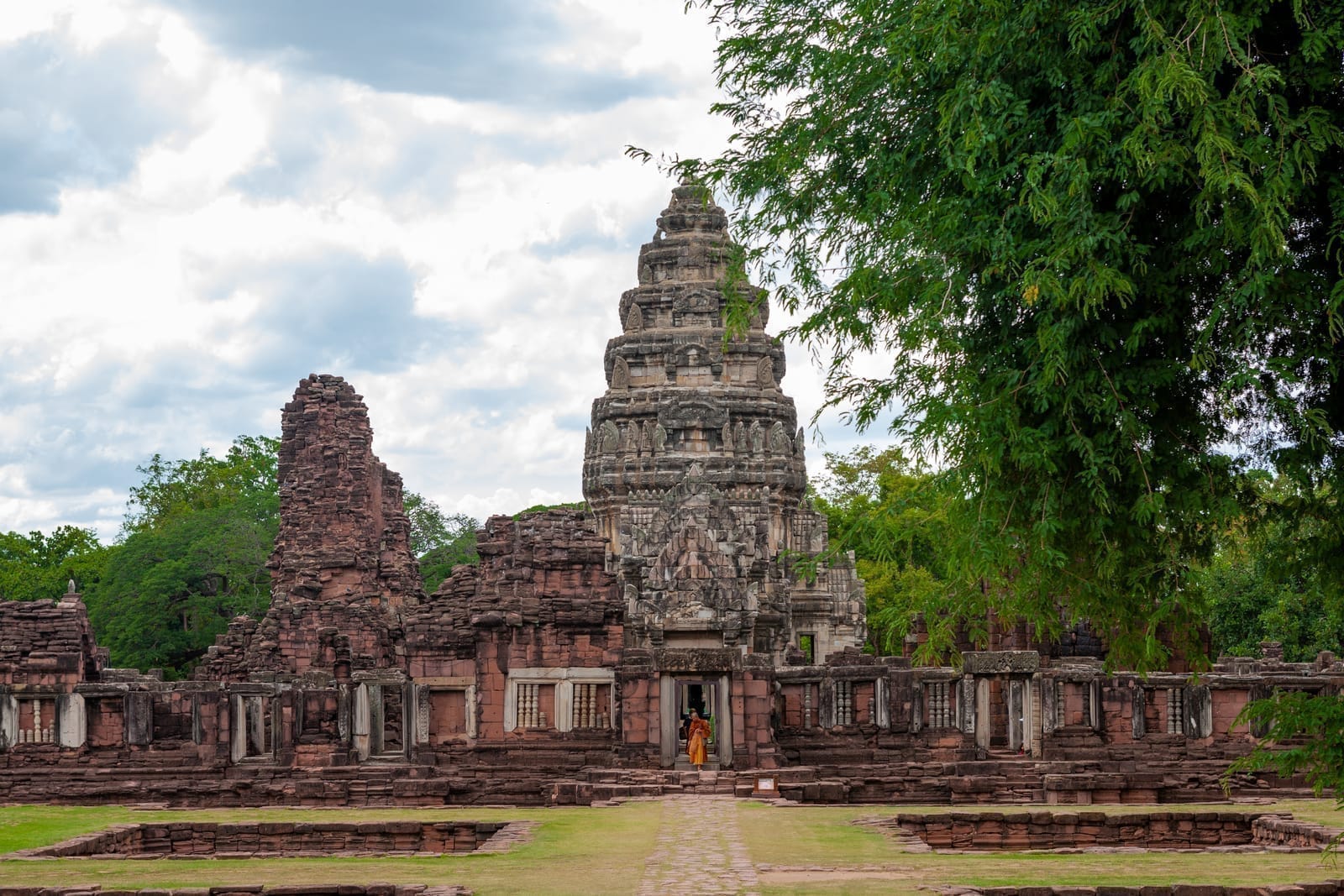
Phimai Historical ParkThe largest Khmer-style stone sanctuary in Thailand, over a thousand years old. What sets it apart from other Khmer sanctuaries is that it faces south. Open daily 07:00–18:00. Thais 20 THB, foreigners 100 THB; students in uniform and monks enter free. Allow about an hour and a half to walk around, and don't miss Meru Phrommathat to the southeast of the sanctuary.
11:00
Phimai National MuseumOn the bank of the Mun River, less than 500 meters from the sanctuary. It holds lintels, door guardians, and Khmer sculptures unearthed in the area — after seeing it, the sanctuary's story makes a lot more sense. Entry for Thais is around 20 THB.
12:30
Lunch — Phimai noodles / a shop near the sanctuaryPhimai mee, with its chewy, springy noodles, is a local specialty. There are standout shops around the Sai Ngam area like Khun Samruam Pad Mee Sai Ngam, the kind of place people will drive a long way for. Or try Phimai stewed pork knuckle, a local favorite. Around the sanctuary there are also made-to-order restaurants nearby to choose from.
14:00
Sai Ngam ParkA giant banyan tree over 350 years old, its roots and branches twining together into a natural canopy. You can walk under the banyan shade for several hundred meters — cool, shaded and pleasant. No entry fee, lots of photo spots, and restaurants along the reservoir where you can sit and catch the breeze.
16:30
Rest / evening stroll through Phimai marketIf you're staying a night in Phimai, an evening stroll through the small market in Phimai town gives you the feel of an old town that's still alive. If you're heading back to sleep in Korat city, it's an hour's drive back.

Straight talk

Half a day to most of a day at Phimai is plenty for most people. If you're not especially into history, don't force yourself to stay all day until you're bored — time it well and save your energy for the silk-shopping day, which is more fun. If you're really into Khmer history, though, give it the full time — the sanctuary and museum have plenty of detail to take in.

Day Three: Pak Thong Chai, Home of Handwoven Silk

On the last day, head south toward Pak Thong Chai, a district famous for handwoven silk for decades. It's about 30 km from Korat city along Route 304, and once you enter the district you'll start to see silk shops lined up on both sides of the road, open almost every day. Pak Thong Chai silk has been registered as a GI product unique to the area — dense, lustrous, and colorfast, making it a souvenir you'll actually use.

Day 3

Pak Thong Chai — watch the weaving, shop for silk, head home

09:00
Check out, drive to Pak Thong ChaiFrom Korat city, drive about 30 km along Route 304, around 40 minutes. You'll start seeing silk shops as soon as you enter the district.
09:45
Pak Thong Chai Silk Cultural CenterLocated in the Pak Thong Chai municipality along Route 304 around the km 107–108 mark. There's an exhibition walking you through the whole process from raising silkworms to weaving the cloth, with a shop out front selling silk and ready-made clothing. Get the basics here first, then go pick out your purchases — you'll understand the fabric much better.
11:00
Stop by a shop / weaving group to watch real weaversMany shops in Pak Thong Chai have looms set up behind the storefront where you can watch the weavers at work — see the warp and weft threads and the mudmee patterns made by hand, thread by thread. Well-known names in the area include Korat Thai Silk and community weaving handicraft groups.
12:30
Lunch in Pak Thong Chai townThe town has made-to-order restaurants and local noodle shops to choose from. Fill up before you start the silk-shopping mission.
13:30
Pick out silk to take homePlain silk starts at around 800 THB per yard and up. Large pieces of finely patterned mudmee silk move up into the low thousands to several thousand THB, depending on the number of heddles and the difficulty of the pattern. Silk scarves are small, affordable souvenirs, and you can have cloth cut by the meter to whatever length you want.
15:00
Set off for homeFrom Pak Thong Chai, get onto Mittraphap Road back to Bangkok — about 3 and a half hours — arriving home around dusk. Or, if you have time, stop at Khao Yai on the way, since it's on the same route.

How to tell real silk

When you burn a strand of real silk it shrinks into a crumbly ash that smells like burnt hair — it doesn't melt into a hard bead the way synthetic fiber does. Most shops in Pak Thong Chai will let you feel the cloth and watch the weaving. If you're unsure, just ask the seller straight out what percentage real silk it is — the weavers here can answer clearly because they make it themselves.

Extra Culture Stops, If You Have Time to Spare

Temples

Wat Ban Rai

The famous temple of Luang Pho Khun, with the Thep Witthayakhom Vihara — an unusual, beautiful boat-shaped hall set over water. It's in Dan Khun Thot district, fairly far from town, so it suits stretching the trip to four days.

History

Thung Samrit Heroes Memorial

The historical site where Ya Mo rallied her forces to resist the enemy, in Phimai district. You can stop here right after the sanctuary if you're interested in the story of Thao Suranari.

Crafts

Dan Kwian Pottery Village

The famous Dan Kwian clay pottery village along Route 224 toward Chok Chai. Walk around the earthenware crafts and pick up home-decor pieces.

Rough Budget Per Person

  • 2 nights' accommodation — hotels in Korat city start around 600–1,200 THB/night, even better split between two people.
  • Phimai sanctuary + museum entry — around 40 THB total for Thais, about 200 THB for foreigners. Sai Ngam and the silk cultural center are free.
  • Food — local dishes run 50–80 THB a plate; 300–500 THB a day eats well.
  • Silk souvenirs — set aside a budget. Scarves start in the low hundreds, good-quality pieces run into the thousands — depends on how hard you shop.
  • Fuel + tolls — round trip Bangkok–Korat plus local driving, around 1,800–2,500 THB per car.
  • Total per person — roughly 3,000–4,500 THB, depending on accommodation, how many people split the car cost, and your silk budget.

How to Get There

Self-driving is by far the easiest for this plan, since Phimai and Pak Thong Chai sit on opposite sides of the city. From Bangkok, take Mittraphap Road, about 3 hours to Korat city. If you don't have a car, buses and vans run all day from Mo Chit to the Korat bus terminal, then rent a car in town for flexibility. Phimai has vans and buses from the terminal, and Pak Thong Chai has songthaews and short-route vans running frequently — but if you travel purely by public transport, budget a fair amount of time for waiting on rides.

Plan the route smartly

If you're driving from Bangkok, you can stop at Pak Thong Chai before entering the city on the first day, since it's right on the way in, then work through the in-town and Phimai stops on the following days. That cuts down on doubling back. Check the map and swap the order of the days to match the direction you're coming in from.

Want a well-located hotel in Korat city as a base for three days of sightseeing

See 10 Korat hotels →

FAQ

How many days do you need for a Korat culture trip?

Three days is just right. Day one explores the city, paying respects at the Thao Suranari shrine and the old temples; day two goes to Phimai for the stone sanctuary and Sai Ngam; day three goes to Pak Thong Chai to watch silk weaving and shop for souvenirs. If you only have two days, trim the in-town part and focus on Phimai and Pak Thong Chai.

How much is entry to the Phimai sanctuary, and what are the hours?

Phimai Historical Park is open daily 07:00–18:00. Entry is 20 THB for Thais and 100 THB for foreigners; students in uniform and monks and novices enter free. Go in the early morning or late afternoon to avoid the fierce midday sun.

How far is Pak Thong Chai from Korat city?

Pak Thong Chai district is about 30 km south of the city along Route 304, around 40 minutes by car. As soon as you enter the district you'll start seeing silk shops lined up on both sides of the road.

About how much does Pak Thong Chai silk cost?

Plain silk starts at around 800 THB per yard and up. Large pieces of finely patterned mudmee silk move up into the thousands to several thousand THB depending on the number of heddles and the difficulty of the pattern. Silk scarves are small souvenirs in the low hundreds, so there's a choice for every budget.

When is the best time to visit Korat for a culture trip?

November to February is cool and pleasant, so walking the open-air sanctuary isn't punishing. Come in December and you'll also catch the Pak Thong Chai silk and local-products festival. In the hot season the sun is harsh, so visit the sanctuary in the morning or late afternoon.

Copyright & Image Takedown Policy

Thailandaddict is created to review and share travel experiences. Where an image is sourced from elsewhere, we credit the source. If you are the copyright owner and prefer that your image not appear on this site, please contact us and we will gladly remove the image or correct the information.