🔄 Updated 12 Jun 2026
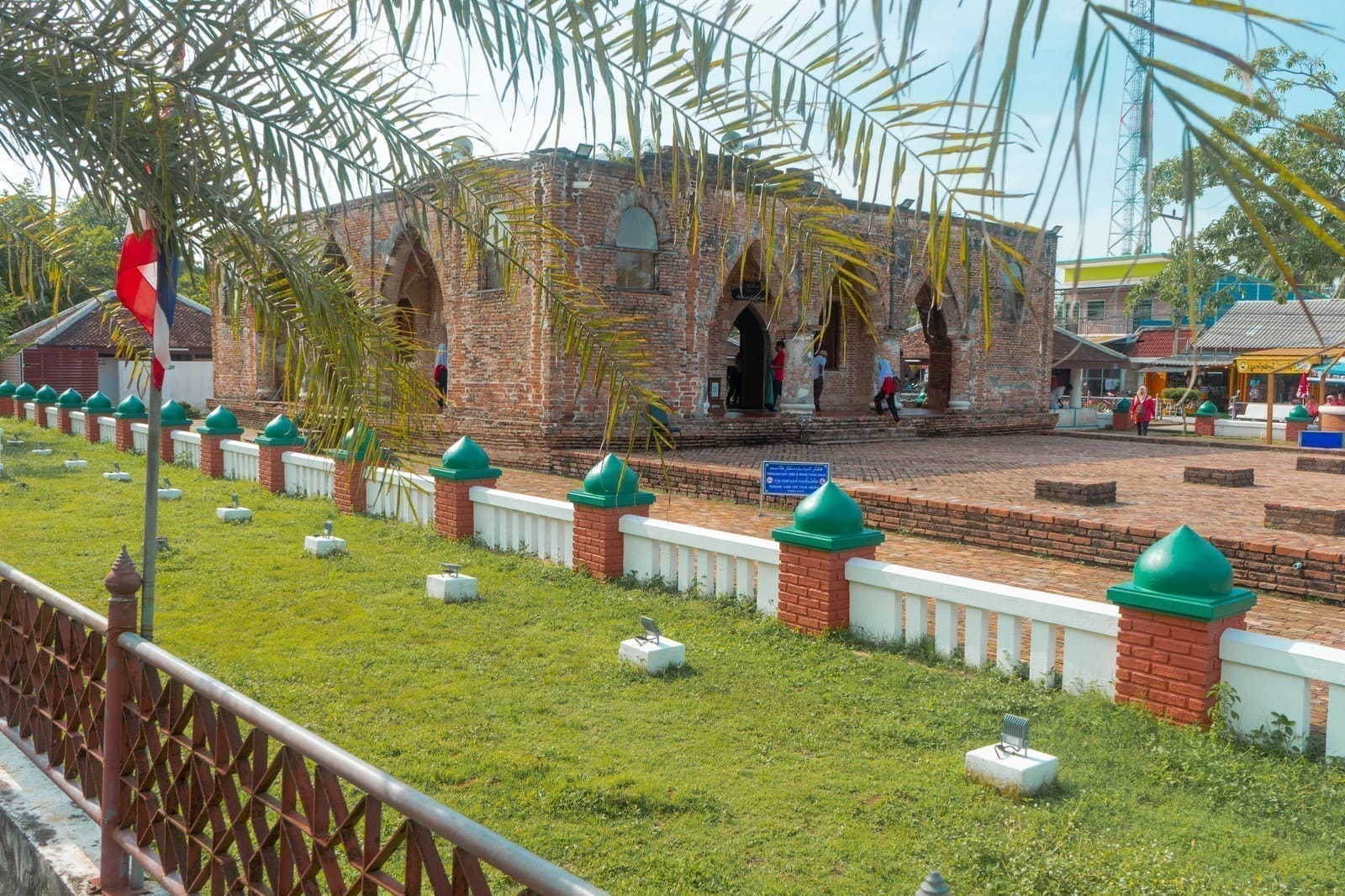
When people picture a landmark in Pattani, the first image that usually comes to mind is Krue Se Mosque — partly because it's both an old historical site and the spot where stories from two cultures meet, the Muslim-Malay side and the Chinese side. The mosque itself is a red-brick structure with only the walls and columns left standing; there's no complete roof or dome. Walking around it doesn't take long, but if you know the story behind it before you stand and look, you really feel the weight of the history left hanging there.
The history of Krue Se Mosque
Krue Se Mosque (sometimes spelled Krue Seh) is an old mosque that historians estimate to be roughly 400 years old or more. It was built when Pattani was still a thriving trading port of the Patani Sultanate. The exact period of construction is still debated — some evidence points to the reign of Sultan Muzaffar Shah, while others place it in the time of Raja Biru. What everyone agrees on is that the mosque was never finished and was abandoned after the center of power moved away, leaving only the ruined walls and columns we see today.
Today Krue Se Mosque is registered as a historical site and looked after by the Fine Arts Department, which has reinforced the structure to keep it stable while preserving its "unfinished" form exactly as it was. That makes it both a historical place and a sacred one that locals hold in deep respect.
Want more out of Pattani? Book tours & activities
Booking online ahead on Klook or GetYourGuide is usually cheaper than the gate and skips the queue. Pick only the experiences you actually want — prices and availability are shown live on each site.
The legend of Lim Ko Niao — why the mosque was never finished
The story that made Krue Se Mosque famous far and wide is the legend of Lim Ko Niao. As it's told, a Chinese merchant named Lim To Khiam sailed here to trade and settled in Krue Se, married the daughter of the local ruler, converted to Islam, and ended up overseeing the construction of this very mosque. His younger sister, Lim Ko Niao, crossed the sea from China to bring her brother home, but Lim To Khiam refused to go — he was bound to the unfinished mosque he was still building.
Heartbroken, Lim Ko Niao hanged herself from a cashew tree near the mosque, cursing it so that it would never be completed. The story goes that afterward, every time construction came close to finishing, lightning would strike the roof and dome — and this happened so many times that the work was finally given up for good. Later, villagers carved a figure for worship from the wood of the tree where Lim Ko Niao died, and built a shrine — the origin of the reverence for "Lim Ko Niao" that continues to this day.
An honest word on legend vs. fact
The lightning-curse legend is local folklore that adds color to the place. Archaeological surveys by the Fine Arts Department explain that the collapsed dome was more likely down to a structure that was never finished and a weight that wasn't balanced, rather than anything supernatural. Both can coexist — come and enjoy the legend while understanding the historical side at the same time.
Architecture worth noticing
What sets Krue Se Mosque apart from a typical mosque is that the whole thing is built from bare red brick, with no plaster over the surface — so you can clearly see the brickwork and the marks of time. Keep an eye out for these details as you walk around.
- Columns and pointed arches — round brick columns support pointed arches, drawing on Middle Eastern and Persian architectural influence. They look a bit like European Gothic arches, but this is Malay craftsmanship.
- The unfinished dome — the main dome collapsed and was never rebuilt, leaving only the base and framing to show that it was originally meant to be a curved dome.
- Thick brick walls — the walls are thick brick in the manner of old buildings; in places you can still see arched window openings and traces of structural reinforcement from restoration work.
- Brick and light — in the morning and late afternoon, the low angled light deepens the red of the brick, making it a favorite spot for photos.
Respect the site
Krue Se Mosque is still a place of worship and a sacred site for the local Muslim-Malay community. Dress modestly with shoulders and knees covered; women should bring a headscarf. Take off your shoes where required, keep your voice down, and ask before photographing local people.
Leng Chu Kiang Shrine (Lim Ko Niao Shrine) nearby
If you've made it to Krue Se, the other place people usually pair it with is the Lim Ko Niao Shrine, also known as Leng Chu Kiang Shrine, in the center of Pattani town. It's an old Chinese shrine where people come to pay respects and ask for blessings all year round, especially during the Lim Ko Niao procession festival after Chinese New Year, which features a fire-walking ceremony and a procession around town — a major traditional event that draws people from across the South and from Malaysia. Seeing both the mosque ruins and the shrine in one day lets you understand both sides of the legend in full.
Getting to Krue Se Mosque
Krue Se Mosque is in Ban Krue Se, Tanyong Lulo Subdistrict, Mueang Pattani District, right beside National Highway 42 (the Pattani–Narathiwat route), about 7 km from Pattani town. It's easy to reach since it sits right on the main road.
- Private car / rental car — the easiest option. From Pattani town, take Highway 42 toward Narathiwat; it's about a 10–15 min drive, and there's a parking lot in front of the mosque.
- Rented motorbike — good if you're traveling solo or as a pair, and nice and nimble — but ride carefully, since this is a main road where traffic moves fast.
- Local songthaew / minibus — vehicles run the Pattani–Narathiwat route and pass right by the mosque; ask the driver to drop you at the Krue Se stop.
- Taxi / chartered ride — if you'd rather not drive, charter a car from town for a round trip, or hire one to take you around several spots in a single day. Agree on the price first.
Check the situation before you travel
Pattani is in Thailand's Deep South border region. Before you commit to a trip, it's worth following the news and the latest safety advisories from government agencies and local media. Travel during the day, plan your route ahead, and ask locals or your accommodation about any spots to avoid. In general, major attractions like Krue Se Mosque see visitors as normal — but a little preparation and checking ahead makes the trip more relaxed.
What to know and the best time to go
- Opening hours — it's an open-air historical site, open for visits during daylight hours; mornings to late afternoon are best. There's no entry fee.
- Time needed — about 30–45 min to walk around the mosque itself; allow half a day if you add the Leng Chu Kiang Shrine in town.
- Morning and evening — the low angled light makes the brick walls look great and the air isn't as hot; midday brings strong, hot southern sun.
- What to bring — drinking water, a hat or umbrella for the sun, comfortable walking shoes, and modest clothing that covers shoulders and knees.
Leng Chu Kiang Shrine
The Lim Ko Niao shrine in town, the other half of the Krue Se Mosque legend. Come to pay respects, ask for blessings, and see the old Chinese architecture.
Old townAnoru Old Town
An old quarter along the Pattani River with old shophouses and Chinese-Malay architecture. Wander, take photos, and soak up the feel of an old trading port.
Place of worshipPattani Central Mosque
The province's main mosque — large and striking, with contemporary architecture. Another landmark you can add on after Krue Se.
FoodPattani Southern-Malay food
Pattani is a town of bold flavors — khao yam, nasi dagae, ayam kolae. Track some down nearby once you're done sightseeing.
Want to do Pattani properly — the food, the old town, and the coast
See the Pattani travel guide →