🔄 Updated 21 Jun 2026
If you're in Lampang with only a half day to a full day for culture, these three temples cover almost every angle. Wat Pong Sanuk is Buddhist craftsmanship that earned an international conservation award. Wat Sri Chum is the largest Burmese temple in Thailand, with a teak-trade story to tell. And Wat Lai Hin Luang is a quiet Lanna hall out in Ko Kha that most visitors haven't found yet — perfect if you want to dodge the crowds.
Three standout temples worth visiting
Wat Pong Sanuk (Wihan Phra Chao Phan Ong)
An old temple in the city center, believed to have been founded around 680 CE in the time of Prince Anantayot, son of Queen Chamthewi. The highlight is the Wihan Phra Chao Phan Ong, an open-sided cruciform wooden hall on a low mound, ringed by roughly 1,080 small votive Buddha images — which is how it got its name ("Hall of a Thousand Buddhas"). Inside, Buddha images sit facing the four directions, with decoration blending Lanna, Burmese, and Chinese art. It received a UNESCO conservation award in 2008.
Wat Sri Chum
The largest Burmese temple in Thailand, built in 1893 by a Burmese merchant during the era when British firms ran the teak-logging concessions in Lampang. The original hall was an intricately carved woodwork masterpiece, but it burned down in 1992, leaving only the fretwork wooden gateway with its floral motifs to show the old craftsmanship. A new hall has since been built, housing a Burmese-style Buddha image, and there's a golden Burmese–Mon style chedi to pay respects at.
Wat Lai Hin Luang (Selaratana Pappataram)
An old Lanna temple on a low mound in Ko Kha, about 6 km from the district office. It's thought to predate 1471, with a major restoration by craftsmen from Kengtung around 1683. The highlights are the Lanna-style open hall built by Kengtung artisans and the finely detailed stucco arched gateway. The temple also has a small museum holding palm-leaf manuscripts and antiques. It was registered as a national historic site in 1980. The atmosphere is quiet and still off most people's radar.
Want more out of Lampang? Book tours & activities
Booking online ahead on Klook or GetYourGuide is usually cheaper than the gate and skips the queue. Pick only the experiences you actually want — prices and availability are shown live on each site.
Wat Pong Sanuk — what to look for
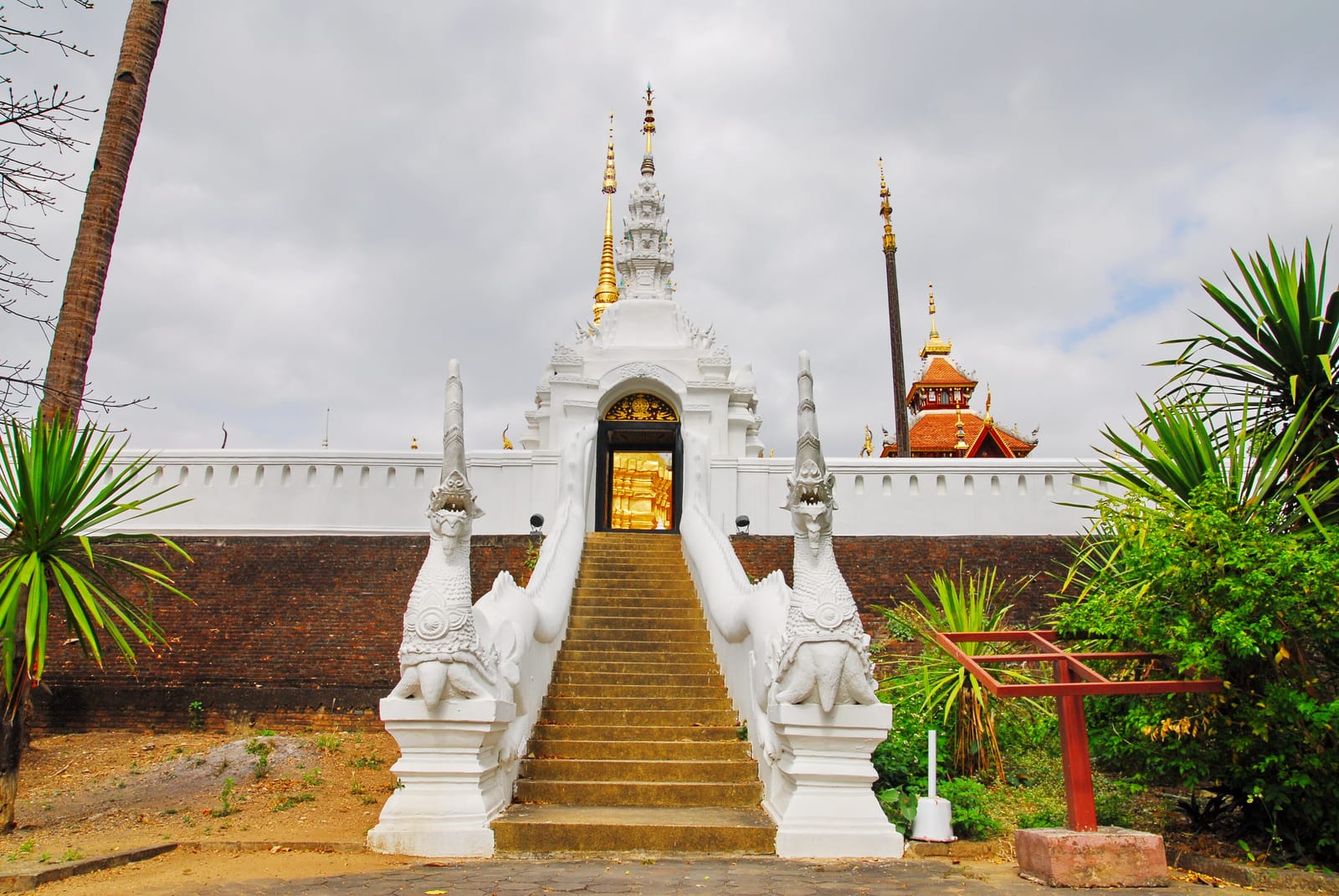
Wat Pong Sanuk is split into Pong Sanuk Nuea (north) and Pong Sanuk Tai (south), which sit right next to each other. The heart of it is the Wihan Phra Chao Phan Ong on a low mound — a few steps up a naga staircase and you're there. This is an open, cruciform wooden hall with Buddha images facing all four directions, which is rare to see in Thailand. The hall is ringed by so many small terracotta votive Buddhas — over a thousand — that they gave it its name.
- Wihan Phra Chao Phan Ong — a cruciform open wooden hall with Buddha images facing four directions, ringed by around 1,080 votive images. The heart of the temple.
- Stucco gateway and hamsa columns — old Lanna-style stucco work and decorative columns that photograph well.
- Temple museum — holds wooden Buddha images, cloth and saa-paper scroll paintings of the Vessantara Jataka, antique scripture chests, and a white-elephant flag from the reign of King Rama VI.
Tip
The Wihan Phra Chao Phan Ong is an open-sided hall, so the morning light and the late-afternoon light pour into it most beautifully. Come to avoid the midday sun, and dress modestly — this is a working temple still used for religious ceremonies.
Wat Sri Chum — a Burmese temple in the city center
Wat Sri Chum is a trace of the era when Lampang was a teak-trading town. The Burmese merchant who came in with the British concession firms built this temple in the late 19th century, which is why you get genuine Burmese architecture in the middle of a northern Thai city. The original wooden hall was stunning but burned down in 1992. Still, the surviving carved wooden gateway with its floral motifs gives you a sense of how ornate the original must have been, and the golden Burmese-style chedi is fully intact for paying respects.
Burmese–Mon style chedi
A golden chedi blending Burmese and Mon art, enshrining Buddha relics brought over from Burma. It's the main spot where people come to pay respects.
Carved wooden gateway
Openwork wood carved with floral motifs that survived the 1992 fire — you can still see the original Burmese craftsmanship.
If you're into Burmese temples, Lampang has several more scattered around the city to track down — like Wat Mon Pu Yak, Wat Mon Cham Sin, and Wat Chong Kha. If you have the time, you can follow a trail of four Burmese temples in a single day, since most of them are close together.
Wat Lai Hin Luang — a Lanna hall in Ko Kha
If you want to head out of the city for somewhere quieter, Wat Lai Hin Luang in Ko Kha district is the answer. The temple sits on a low mound in the middle of an old community, with a Lanna open hall built by Kengtung craftsmen that still holds its graceful proportions. The stucco arched gateway out front is the standout piece that everyone photographs. The temple also has a museum holding palm-leaf manuscripts and old temple objects — ideal if you want to take in Lanna art without competing for angles with anyone.
- Lanna open hall — built by Kengtung craftsmen, with the low proportions typical of genuine Lanna style; major restoration around 1683.
- Stucco arched gateway — finely detailed stucco work in front of the hall, the main photo spot.
- Lanna antiquities museum — holds palm-leaf manuscripts, temple implements, and valuables; registered as a national historic site in 1980.
Before you head to Ko Kha
Wat Lai Hin Luang is about 18 km out of the city, and driving is by far the easiest way. If you're coming this way, it's worth stopping at Wat Phra That Lampang Luang, which is also in Ko Kha district — it's the region's revered temple and genuinely beautiful, so you can fit both into one trip.
Half-day temple route (in the city)
Temples in Lampang city
Full-day temple route (city + Ko Kha)
Temples in the city
Ko Kha district
Temple etiquette
Every temple we recommend is still in active use. Dress modestly, cover your shoulders and knees, take off your shoes before entering a hall, and keep your voice down inside the hall areas. There's no entry fee, but you can drop a donation in the merit boxes to help maintain the temple as you see fit.
Want a place to stay near the old town so temple-hopping is easy?
See the Top 10 hotels in Lampang →