🔄 Updated 21 Jun 2026
When people think of temple trips in the north, Chiang Mai and Chiang Rai usually come to mind first, but Lampang has plenty that visitors haven't fully caught on to. Many of the temples here are still genuine wooden halls, not restored until they're spotless, and what makes the place special is that Lampang was once a timber-trading town in the era when Burmese merchants ran the concessions. They left behind several Burmese-style teak temples scattered across the city. This 3-day plan splits the trip into a first day out of town to the temple that defines the city, a second day walking the old-town temples, and a third day up into the hills for one temple with a view before you head home.
Before you set off: what to know about Lampang's temples
Most temples in Lampang are still active places where locals come to make merit, not museums, so dressing respectfully matters. Skip shorts and skirts above the knee, and skip tank tops or spaghetti straps. Some temples lend out a wrap-around sarong if you turn up underdressed, but not all of them, so packing your own shawl is the safer bet.
- Opening hours for most temples — roughly 07:30–17:00. Some hilltop temples close earlier (around 16:00–16:30), so schedule the ones on the mountain for late morning to early afternoon.
- Getting around — out-of-town temples like Lampang Luang sit about 18 km from the centre, so you'll want your own car or a rental car/motorbike. In-town temples can be linked up on foot or by horse-drawn carriage and tuk-tuk.
- Making merit — bring small notes and coins for the donation boxes, flowers and incense, and the entry fee for the museums at a few temples.
- Taking off your shoes — every assembly hall requires you to remove your shoes, and the old wooden floors get hot in places by midday, so packing socks helps.
Plan the route smartly
Wat Phra That Lampang Luang is in the opposite direction from the old town (it's in Ko Kha district, to the southwest), so combining it with the in-town temples on the same day means a lot of backtracking. That's why this plan keeps Lampang Luang as its own first-day highlight, then sweeps up the city temples the next day.
Book the activities in your Lampang trip ahead
Booking online ahead on Klook or GetYourGuide is usually cheaper than the gate and skips the queue. Pick only the experiences you actually want — prices and availability are shown live on each site.
Day 1 — Wat Phra That Lampang Luang, the heart of the trip
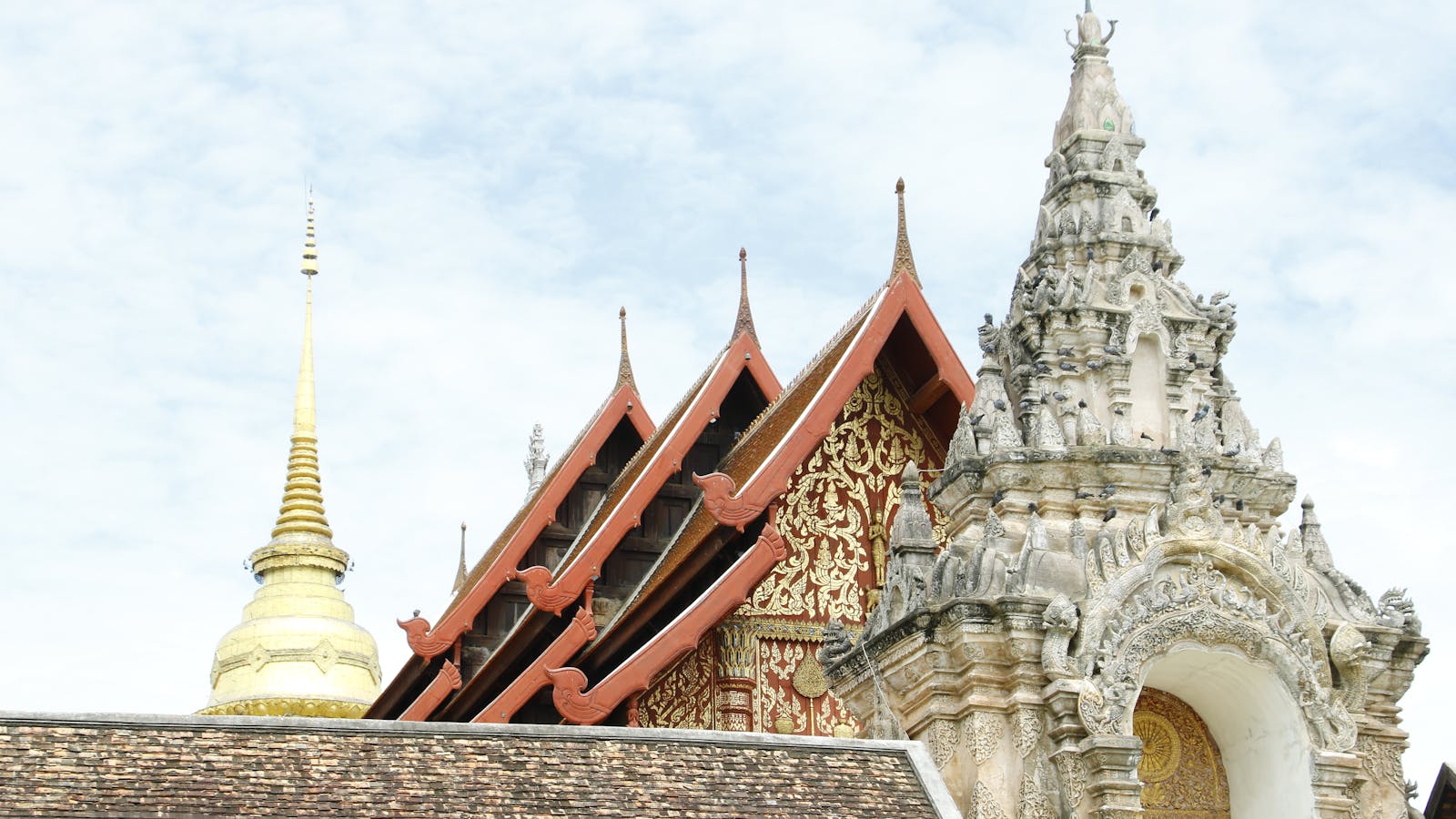
Give the whole first day to the temple that defines the city. Wat Phra That Lampang Luang sits in Ko Kha district, about 18 km from the centre, a 25–30 minute drive. It's known as one of the most complete wooden temples in Thailand. What people come specifically to see is the inverted shadow of the chedi inside the Phra Phuttha hall: light slips through a tiny hole in the wall and projects an upside-down image of the chedi onto a cloth, a natural pinhole camera that shows up clearly on a bright morning.
Lampang Luang–Ko Kha (the city's temple)
A story that makes it more fun to look at
On the brass railing in front of the Phra Phuttha hall there's still a mark believed to be a bullet hole from when Nan Thip Chang shot Thao Maha Yot. Try to spot it as you pass, and the history starts to feel closer to hand than you'd expect.
Day 2 — Old-town temples where Lanna meets Burma
Today you walk the temples in Lampang town, starting at Wat Phra Kaeo Don Tao Suchadaram by the Wang River, a temple a thousand years old. The legend says a woman named Suchada found an emerald inside a watermelon (don tao means melon mound) before it was carved into a Buddha image. This is where the famous Emerald Buddha was once enshrined. From there you go and catch the Burmese-style teak temples that are a signature of Lampang in particular.
Wat Phra Kaeo Don Tao Suchadaram
A royal temple on the Wang River, a thousand years old, with the legend of Suchada finding an emerald in a watermelon. The starting point of the culture trip.
Wat Sri Chum
The largest Burmese-style teak temple in Thailand, with carved 'jong' woodwork by Burmese craftsmen from the timber-trading days.
Wat Sri Rong Mueang
A hall built entirely of teak in Burmese style, with a tiered spired roof and coloured-glass inlay; inside is a Phra Bua Khem in the subduing-Mara pose.
Wat Chedi Sao Lang
A temple of 20 chedis blending Lanna and Burmese art, with a solid gold Buddha and the tale of a wooden urn dug up here.
Old-town temples (Lanna–Burmese)
Why Lampang has so many Burmese temples
In Lampang's timber-trading days, the Burmese and Shan merchants and well-to-do families who came in for the forestry concessions built and restored a number of temples, roughly 15 across the city. That's why they have stacked spired roofs, carved woodwork and coloured glass unlike the typical Lanna temple.
Day 3 — A hilltop temple and a view before you leave
On the last day, head a little higher. Wat Chaloem Phra Kiat Phra Chom Klao Rachanusorn (formerly Wat Phra Phutthabat Pu Pha Daeng) sits on a hill in Chae Hom district. Its standout feature is the small chedis perched on the rocky peaks, which look almost as if they're floating in the sky. You can't drive your own car up here; you have to buy a ticket for the temple's four-wheel-drive truck, around 100 THB round trip, then walk a stretch on foot. If you'd rather not go that far, swap it for the in-town temples you haven't covered yet.
Doi Phra Bat–Chae Hom (a temple with a view), then home
Adjust the plan to your energy
If you'd rather skip the hill on the last day, swap in the in-town temples you missed, like Wat Phra Chao Than Jai or Wat Pa Fang, then follow up with the morning market and souvenirs for a lighter trip, which suits anyone bringing older relatives along.
Who this trip suits
- Merit-makers and history lovers — you want to pay respects and see real craftsmanship at an unhurried pace.
- Architecture fans — Lampang puts Lanna and Burmese styles in one city, hard to find elsewhere.
- Families — the pace is relaxed, there are horse carriages and souvenirs, and kids and grandparents can go together.
- Anyone wanting to dodge the crowds — quieter than Chiang Mai, and visitors still haven't filled it up.
Want a well-placed hotel to use as a base for the temple walks
See the Top 10 Lampang hotels →