🔄 Updated 21 Jun 2026
Most people know Lopburi for its monkeys, but the real draw is how tightly its history is stacked in the old quarter around the train station. This was once 'Lavo', an important Khmer-influenced city some 800–900 years ago, and later the second capital of King Narai the Great in the Ayutthaya period. All of it still sits within walking distance, which makes Lopburi one of the most enjoyable places in central Thailand to explore ancient sites on foot.
The best part is how close everything is. Step off the train at Lopburi station and walk out, and Wat Phra Si Rattana Mahathat is right across the road. A little further on you reach Phra Prang Sam Yot, San Phra Kan, King Narai's Palace and Ban Vichayen — all inside an old-town district you can comfortably cover in half a day to a full day.
Khmer ruins — traces of Lavo
Before it became King Narai's city, Lopburi was 'Lavo', a Khmer-culture town that fully absorbed Bayon-style art. The three laterite prangs and old shrines around town are key evidence of that era, and they're the kind of thing history-minded travellers shouldn't skip.
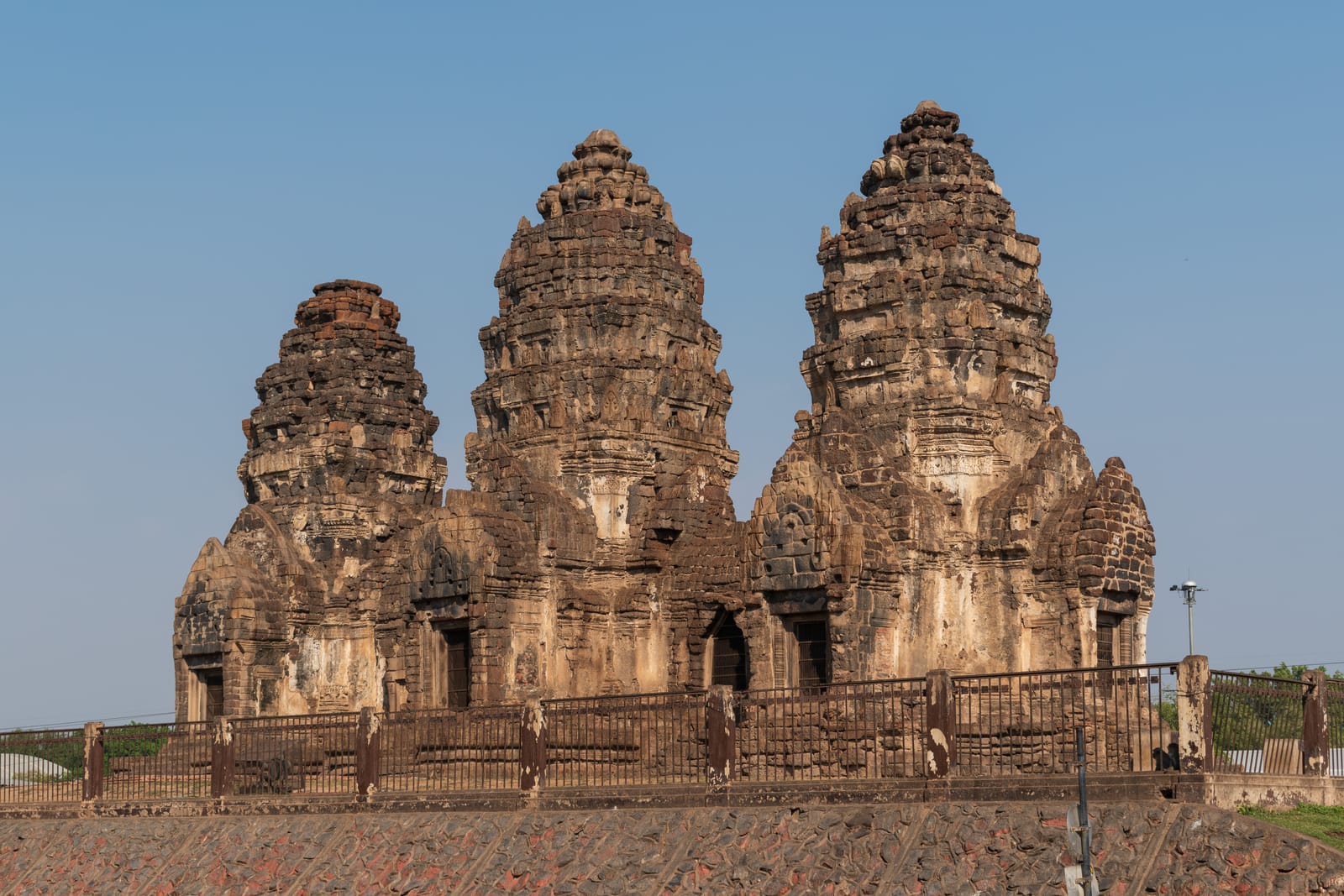
Phra Prang Sam Yot
The symbol of Lopburi and the image most people picture when they think of the city. Three stucco-coated laterite prangs joined by linking porches, set on a north–south axis, built in the Bayon style under King Jayavarman VII around 800 years ago. Originally a Mahayana Buddhist shrine, it was later adapted into a temple. The monkey troop hangs around here too, so keep your belongings secure.
Prang Khaek
Three small brick prangs in the middle of the old town, among the oldest historic structures in Lopburi. It was heavily restored with brick-and-mortar work during King Narai's reign. You can walk around the outside any time and there's no entry fee — a handy stop on the way from King Narai's Palace.
San Phra Kan
An old Khmer shrine built of stacked laterite on a tall base, beside the railway on the east side of Phra Prang Sam Yot. Today it's a revered shrine where Lopburi locals come to pay respect, and it's the spot where the city's monkeys gather most densely.
Watch the monkeys
Phra Prang Sam Yot and San Phra Kan are prime monkey territory. Don't carry plastic bags, snacks or water bottles in plain sight, take off your sunglasses, and hold your phone tight. The monkeys here are bolder and faster than you'd expect.
Want more out of Lopburi? Book tours & activities
Booking online ahead on Klook or GetYourGuide is usually cheaper than the gate and skips the queue. Pick only the experiences you actually want — prices and availability are shown live on each site.
Wat Phra Si Rattana Mahathat — the ruined temple by the station
If you arrive in Lopburi by train, this is the first place to stop — it sits directly across from the station, just a road's width away. It's a ruined temple of around 20 rai, and the highlight is the old central prang decorated with stucco that blends Khmer art with the Lavo and Ayothaya styles. The makara-and-naga motif on the arch pediment is still clearly visible. You can wander the remains of the main hall and the surrounding chedis at an easy pace, in a quieter atmosphere than the other sites.
- Hours — 07:00–17:00, closed Monday–Tuesday
- Entry — Thais 10 THB · foreigners 50 THB · children free
- Location — opposite Lopburi train station, an easy walk on to Phra Prang Sam Yot
King Narai's Palace — the residence of King Narai the Great
This is the heart of the old town's Ayutthaya-era side. King Narai's Palace (Phra Narai Ratchaniwet) was built by King Narai the Great as his second capital, used to receive foreign envoys and as a periodic royal residence. Inside the broad palace walls you'll find the remains of throne halls, water reservoirs and buildings that mix Thai and European craftsmanship of the time. Walking around, you get a sense of just how open this city was to the outside world more than 300 years ago.
The palace grounds also hold the King Narai National Museum, displaying Lopburi-style antiquities, everyday objects and Khmer sculpture. If you like seeing the real artefacts alongside the history, it helps a lot in understanding the bigger picture of Lavo and Lopburi.
- Historic grounds (palace walls) — open daily, roughly 08:00–17:00, walkable outdoors
- King Narai National Museum — open Wed–Sun 09:00–16:00, closed Monday–Tuesday
- Museum entry — Thais 30 THB · foreigners 150 THB · students in uniform, seniors and clergy free
Plan your day around the closures
The palace museum and Wat Phra Si Rattana Mahathat are both closed Monday–Tuesday. If you want to see everything in one trip, avoid those two days — or build in time to walk just the historic grounds, which stay open daily.
Ban Vichayen — a European-style house from the Ayutthaya era
A few hundred metres from King Narai's Palace is the Royal Reception House for foreign envoys, better known as Ban Vichayen. It's a cluster of brick buildings once used to host the diplomatic missions that came to see King Narai, and the residence of Constantine Phaulkon (Chao Phraya Vichayen), the prominent foreign official of that era. The architecture mixes European elements — arched openings, a Christian chapel and a layout unlike a typical Thai temple — making it one of the best places to understand how Ayutthaya opened up to the world.
- Hours — 07:00–17:00, closed Monday–Tuesday
- Entry — Thais 10 THB · foreigners 30 THB
- Location — Vichayen Road, an easy walk from King Narai's Palace
Working temples — paying respects in the old town
Beyond the ruins and historic sites, Lopburi still has temples that are very much in use, where you can make merit as normal. They're easy to drop into while you walk the old town, and there's no entry fee.
Wat Sao Thong Thong
An old temple in the old-town area near Ban Vichayen, with a hall and old chedi that blend traces of several artistic periods. It's an easy stop along the way — a quiet spot to pay respects before moving on.
Wat Manee Chonlakhan
A riverside temple with a tall, distinctively shaped chedi — another photo and merit-making spot that Lopburi locals know well. It sits a bit further out from the historic district, so it's best if you have a car.
A half-day walking route through the old town
If you're coming up from Bangkok by train as a day trip, half a day is enough to hit almost all the main sights, since everything clusters around the station. Here's an order that flows from one stop to the next without backtracking.
Walking Lopburi's old town
Dress for it
Cover your shoulders and knees for the palace and temple grounds. Lopburi's sun is strong for most of the year, so pack a hat, water and sunscreen — walking at midday gets fairly hot.
Plan a full day in Lopburi — temples, monkeys and good eats
See the Lopburi guide →