🔄 Updated 21 Jun 2026
Narathiwat's food scene is clustered in the town district (Mueang), all within a short walk or drive of each other. This eating plan focuses on the three things at the heart of town: the Malay-style morning tea houses, khao yam and nasi dagang eaten with budu, and the old-school sweets at Yakang market. We split it into 2 days so you can eat comfortably instead of cramming everything in. Day one loops around town from morning to evening; day two catches the morning market and Yakang floating market, which only opens certain days. Once you've read it, just reorder things around wherever you're staying.
Before you go — check the situation first
Narathiwat sits in Thailand's southern border region. Before you actually travel, follow the latest news and official safety advisories, pick a sensible time to visit, and keep a backup plan. Most of the town is a Malay-Muslim community: dress modestly and covered up, ask permission before photographing people or inside shops, and respect prayer times. Do that and you'll get a warm, friendly welcome.
The 2-day plan at a glance
The plan breaks down simply. Day one is a tasting day in town: start with morning kopi tea, move on to khao yam and nasi dagang for a late-morning meal, swing by a roti and teh tarik shop in the afternoon, then walk Narathat Beach for the evening breeze to close out the day. Day two catches the morning market before the sky brightens, then heads to Yakang floating market in the 100-year-old sweets quarter (open Friday and Saturday only), before wrapping the trip with edible souvenirs to take home. Everything is in and around the town district, just a few minutes' drive apart.
- Day 1 — morning kopi tea + khao yam and nasi dagang for late morning + roti and teh tarik in the afternoon + Narathat Beach in the evening
- Day 2 — morning market for a wrapped khao yam + Yakang floating market 100-year-old sweets + edible souvenirs
- Things you have to try — khao yam with budu, nasi dagang, nasi lemak, teh tarik, roti with curry, tepung putu, and the old Yakang sweets
Book the activities in your Narathiwat trip ahead
Booking online ahead on Klook or GetYourGuide is usually cheaper than the gate and skips the queue. Pick only the experiences you actually want — prices and availability are shown live on each site.
Day 1 morning — kopi tea, the local way to open the day
The local way to start the day in Narathiwat is to sit at a tea house. Here people call the local coffee shops tea houses, or kopi shops. The coffee is brewed strong with condensed milk and eaten with patongko (fried dough sticks) or dim sum, and some shops serve a morning dim sum spread too. The vibe is neighbors settling in for long chats. The old-timer everyone mentions is Ton Mayom tea house in town, open for more than 25 years, focused on morning dim sum — steamed buns, har gow, siu mai. It runs from 06:00 to around 14:00. Start your day here, then move on to a heavier meal.
Morning tea to open the day
Tea-house menu lingo
If you see "kopi" on the menu, that's coffee with milk; "kopi o" is black coffee; "teh" or "teh tarik" is tea with milk. If you're not sure what to order, just tell the staff straight up — people here are kind and happy to explain.
Day 1 late morning — khao yam with budu, and nasi dagang
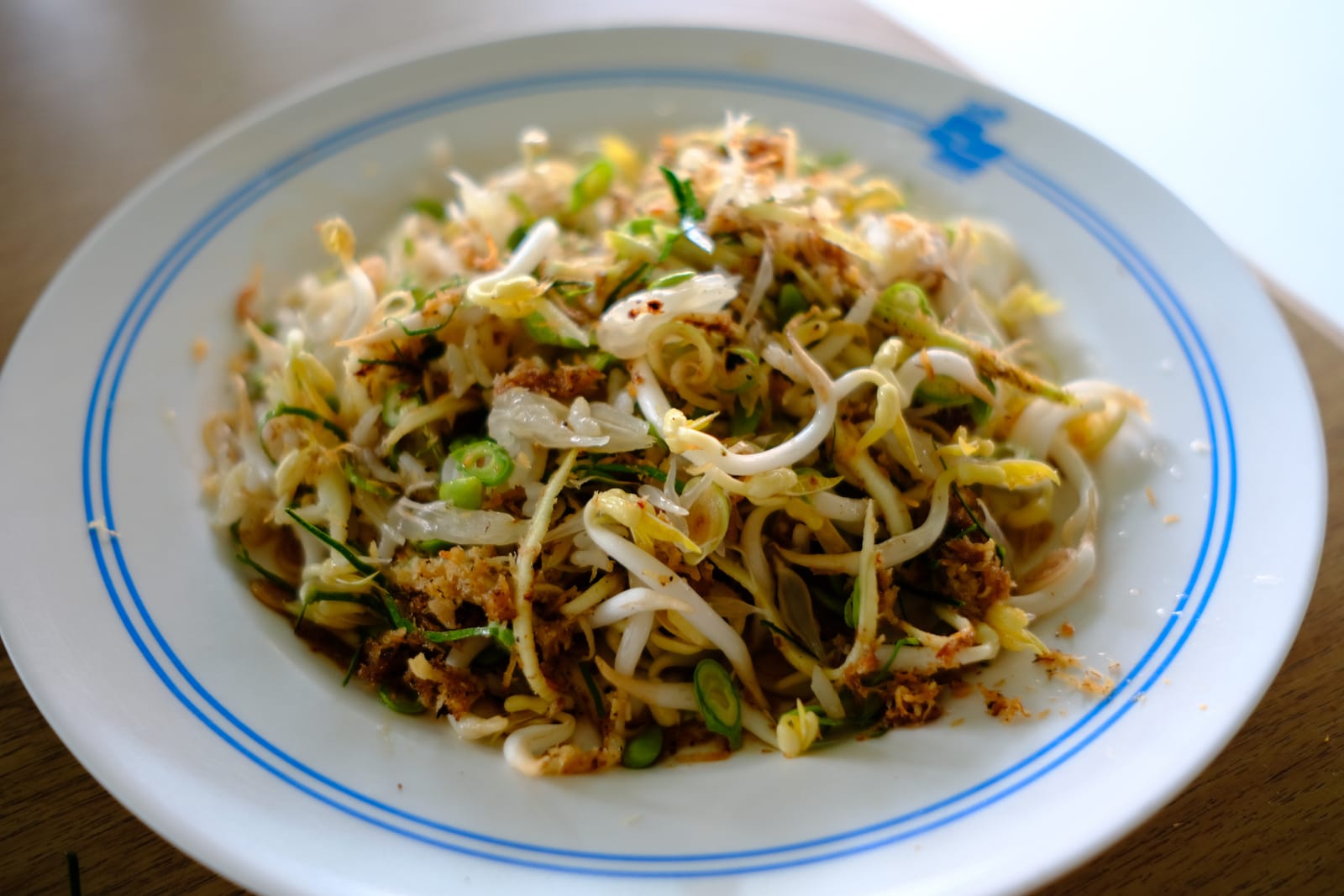
Once your stomach starts to feel empty around late morning, it's time for the two star plates. Khao yam is steamed rice tossed with finely shredded vegetables, toasted coconut, and powdered dried shrimp, dressed in budu — a sauce simmered from fermented fish with its own salty, fragrant character. Squeeze in a little lime, mix it all together, and you've got a dish that's light but full of every flavor. The other plate is nasi dagang, rice cooked with coconut milk and aromatics, eaten with a rich fish curry — a genuine Malay breakfast-to-late-morning dish. The shop people talk about most is AKHOO by Nasir, which serves nasi dagang, nasi lemak (Malaysian-style coconut rice), and khao yam all under one roof.
Khao yam and nasi dagang, the town's main plates
What is budu?
Budu is the fermented fish sauce of the south, made from fish fermented with salt until it becomes a dark-brown liquid that's salty and fragrant — the heart of southern khao yam. If you've never had it, drizzle on a little at a time and add more from there to hit the right balance for your palate. If you fall for it, a bottle of budu is one of the province's most popular edible souvenirs.
Day 1 afternoon–evening — roti, teh tarik, then beach breeze
The afternoon is for snacks and drinks. Roti eaten with curry or dusted with milk and sugar, paired with teh tarik poured back and forth between high cups until it foams — a familiar sight around town. A popular stop is Roti de forest, Yakang branch, sitting across from Yakang Mosque, with a relaxed vibe and a full spread of savory dishes, sweets, and drinks. Another spot famous for tea is Hua Mum Cha Chak Bang Nara, near the bypass intersection, which does khao yam, roti, patongko, and teh tarik. When the sun softens, drive out to Narathat Beach for the sea breeze to close the day. The long beach runs right up against town — take a stroll and look at the kolae boats that are a signature of Narathiwat's fishermen.
Roti de forest (Yakang branch)
A relaxed roti-and-drinks spot across from Yakang Mosque, with a full lineup of savory dishes and sweets — good for an afternoon break
Hua Mum Cha Chak Bang Nara
A spot famous for teh tarik near the bypass intersection, with khao yam, roti, patongko, and a range of drinks
Narathat Beach
A long beach right by town — watch the kolae boats and catch the sea breeze in the evening to close out an easy first day
Roti, teh tarik, then down to the beach
Day 2 morning — morning market for a wrapped khao yam
Day two starts earlier. The town's morning market in the south buzzes before the sky even brightens, with khao yam wrapped in banana leaf, red sticky rice, local sweets, and fresh produce to choose from. Buy a wrapped khao yam and some morning sweets and eat them by the Bang Nara River, the way locals really do — and it's cheap, just a few tens of baht a parcel. As you walk the market you'll see southern ingredients: budu, luk niang (bitter beans), sator, and curry pastes. If you've got edible souvenirs in mind, the morning market is a good source.
Narathiwat's morning market
Yakang market opens only certain days
Yakang community floating market (the 100-year-old sweets) opens only Friday–Saturday, roughly 14:00–21:00. If you're planning to eat the old Yakang sweets, line up day 2 of your trip to fall on a Friday or Saturday first, because if you come on a weekday there's no market. Check the market's latest page again before you go, in case the hours change.
Day 2 afternoon–night — Yakang floating market, 100-year-old sweets
The highlight that closes the trip is Yakang community floating market, an old riverside community that was once an important trading quarter of the town, known for heritage sweets passed down for over a hundred years. The sweets people come specifically to try include akok (egg cakes baked in a pan), tepung putu (steamed cakes topped with coconut), putu piring, bata buroh, and several rare ones you can't find elsewhere. The market opens afternoon to night — walk and taste sweets one piece at a time, breaking it up with tea and herbal drinks. It's an eating run that gives you both good food and the story of the community.
Ton Mayom tea house
An old tea house in town, over 25 years running, focused on morning dim sum like steamed buns, har gow, and siu mai, eaten with hot kopi — where locals open their day
AKHOO by Nasir
The local Malay eatery people think of for nasi dagang and khao yam, with Malaysian-style nasi lemak, satay, roti with curry, and teh tarik. Mornings are the local menu; lunch is khanom jeen with curry
Hua Mum Cha Chak Bang Nara
A spot famous for teh tarik pulled high and foamy, near the bypass intersection, with khao yam, roti, patongko, and made-to-order breakfast. Kolae boats decorate the shop
Roti de forest (Yakang branch)
A relaxed roti shop across from Yakang Mosque, with several styles of roti, savory dishes, sweets, and drinks — good for an afternoon break while walking the Yakang quarter
Yakang community floating market (100-year-old sweets)
A riverside market in an old community, the town's source of heritage sweets — akok, tepung putu, putu piring, bata buroh, and rare Malay desserts. Open Friday–Saturday only
Narathiwat morning market
A fresh morning market in town with banana-leaf khao yam parcels, red sticky rice, local sweets, and southern ingredients like budu, sator, and luk niang. Easy to buy and easy on the wallet
Roadside roti–teh tarik stalls
Across town there are roadside roti and teh tarik stalls to drop by for a snack. Roti crisp outside and soft inside, dusted with milk and sugar or eaten with curry — a town-wide snack staple
Edible-souvenir shops in town
Souvenir shops carry bottled budu, keropok (fish crackers), dried Malay sweets, and southern curry pastes — good to grab before the trip ends, easy to carry and keeps well
Yakang market closes the trip
Eat with respect for the locals
Most shops in Narathiwat are halal and Muslim-owned, with no alcohol and no pork on the menu. Order and dress to fit the context. Photographing food is fine, but if you want to shoot people or inside the kitchen, ask first. Do that and both you and the shop owner can enjoy the food trip with peace of mind.
Getting there and planning the days right
Narathiwat has its own airport with flights from Bangkok, plus trains and buses into town. Most of the food spots are in the town district and some are walkable, but if you want to move freely it's worth renting a car or motorbike for getting around town, since some shops are in different areas. The key to this plan is to set day 2 on a Friday or Saturday so you catch Yakang floating market, which only opens those two days. The morning tea houses and khao yam are open every day, so reorder things around where you're staying.
- Getting to town — fly into Narathiwat airport, or take the train/bus into town, then eat your way mainly through the town district
- Around town — renting a car or motorbike is handier, since the shops are spread across a few different areas
- Planning the days — set day 2 on a Friday or Saturday so you catch Yakang floating market's 100-year-old sweets
Want a full provincial itinerary, not just the food trail? See the Narathiwat travel guide covering every category
See the Narathiwat travel guide →