🔄 Updated 21 Jun 2026
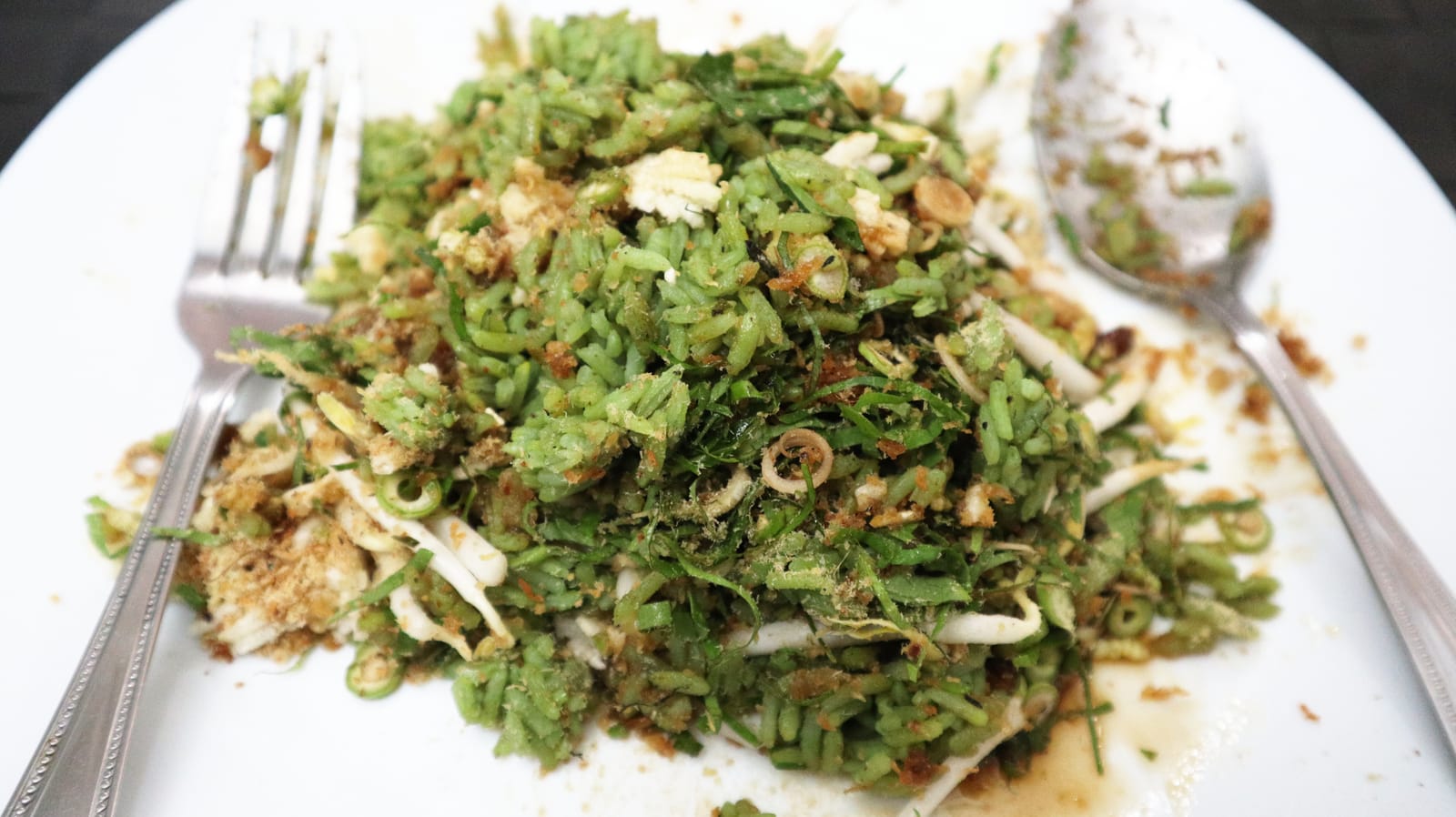
Khao yam is eaten all across southern Thailand, but the Narathiwat version carries a clearer Malay character than most. The budu sauce tends to be simmered richer, the dish uses backyard-garden herbs you'll only find locally, and many stalls still tint the rice with natural colors like butterfly-pea flower or turmeric. A single plate ends up with the colors and aromas that tell you straight away it's from Narathiwat.
What is khao yam, and how do you eat it?
The heart of khao yam is the budu sauce, the fermented fish sauce of the Deep South. It's simmered with palm sugar, lemongrass, kaffir lime leaf and shallots until it turns a deep brown — salty first, sweet after. It's spooned over rice that's been tossed with shredded greens, then topped with garnishes for a full range of flavors. You eat it by mixing everything together before taking a bite.
- Herbs and greens — long beans, lemongrass, shredded kaffir lime leaf, torch ginger flower, wild betel leaf, sour mango or sour star gooseberry. Every stall mixes it differently.
- Toasted coconut — toasted to a fragrant brown, adding richness and aroma.
- Fish powder or toasted fish — for saltiness and crunch. Some stalls also use ground dried shrimp.
- Budu sauce — add as much or as little as you like. For your first time, ask for it on the side so you can add it yourself.
- Chili powder and lime — added to cut the richness and bring sour and heat.
How to do it your first time
Tell the cook "budu on the side" and pour it on a little at a time, because real budu is intense and more pungent than many people are used to. Once it's mixed in with the greens and toasted coconut, the flavor rounds out a lot.
Want to taste deeper? Try a Narathiwat food tour or cooking class
Half a day with a local who knows the lanes — or cooking a dish yourself — teaches you more than just eating. Book ahead on Klook or GetYourGuide.
Khao yam stalls and spots locals actually go to
Below are the khao yam stalls and spots in Narathiwat that have real reviews and a real presence. We've ordered them by how well they suit travelers — both sit-down shops and traditional morning-market stalls. Prices are rough ranges and may change, and some small stalls sell out fast or close on Fridays (prayer day). It's worth calling ahead if you've set your heart on a particular one.
Narathiwat Municipal Morning Market (Kuda Pakhi)
A downtown morning market on Phichit Bamrung Road where locals come to buy khao yam for breakfast. There are several stalls to choose from, dressed in the Narathiwat budu style, and around them you'll find red sticky rice, local sweets and seasonal greens. The best starting point if it's your first visit.
Bale Hile Market (old market on the Bang Nara River)
A century-old market on the Bang Nara River along Phupha Phakdi Road, a hub of savory and sweet food for the original Malay community. You'll find khao yam, curries, ayam goleng (grilled chicken) and local sweets, and it's especially lively during Ramadan. A genuinely community atmosphere.
Khao Yam Pak Tai Khun Ji (Narathiwat recipe)
A shop that makes a point of simmering its own budu fresh every day, with fragrant toasted coconut and rich toasted fish — a traditional Narathiwat-style khao yam. Good for anyone who wants to sit down comfortably and get that deep, made-fresh flavor. Reviewers note it as a healthy meal.
Baan 2 Rudu (Yi-ngo) — old-recipe khao yam
A homey garden restaurant in Yi-ngo district known for its old family khao yam recipe, served in the morning and by advance order. Good for anyone driving out of town who wants the traditional version. Call ahead, since they only serve khao yam in the morning.
Khao Yam Yango (Yi-ngo)
A roadside shop in Yi-ngo district, easy to spot by the orange sign on a white wooden-slat fence. The khao yam comes loaded with garnishes — butterfly-pea rice, toasted fish, the full coconut works — at a friendly price. A handy stop for people passing through Yi-ngo.
Rueso Morning Market (in front of the train station)
The morning market of Rueso district, with rich budu khao yam eaten alongside red sticky rice tossed with coconut, hitting a nice sweet-salty balance. It's breakfast for locals before the market winds down by mid-morning. Handy if your trip runs through the Rueso route.
Riverside Dam Market (on the Bang Nara River)
A local food spot by the dam in the middle of town. You can stroll and sample plenty, including khao yam and Malay sweets, with an easy view of the river. Good if you want to eat as you wander along the water.
Khao Yam Tak Bai (traditional Tak Bai recipe)
The Tak Bai district side is known for its old-recipe khao yam, with rice cooked in turmeric and many kinds of herbs, and some vendors serving it in beautiful woven baskets. It's a district specialty you can find at markets and shops around Tak Bai town — ask locals which vendor is open that day.
Chaba Roti & Food Park (kampong-style food park)
A kampong-vibe spot with a varied menu — khao yam, rice porridge, roti and tea. Good for families or groups who want to eat several things in one place. There's comfortable seating and a photogenic setting, so if your group can't agree on one dish, there's plenty to choose from.
20-Baht Yam Stall, Riverside Market (before the riverside fort)
A budget yam stall in the riverside market, near the housing estate before the riverside fort. It opens from midday onward, so it's handy if you sleep in but still want cheap khao yam in a local-market setting.
It sells out fast — go early
Khao yam is a breakfast food, and many market stalls wind down by around 9–10 a.m., with some selling out before that. If you're set on one particular stall, go before 9 or call ahead — and keep in mind that on Fridays, some Muslim shops close during prayer time.
What to eat with khao yam for a full meal
Locals rarely eat khao yam on its own — they order other Malay dishes alongside it for the same breakfast. Try adding these to fill up and get a wider range of flavors.
Nasi dagae
Sticky rice wrapped in banana leaf, eaten with fish or chicken curry — another popular Deep South breakfast, served with a rich curry sauce.
Red sticky rice with coconut
Soft sticky rice tossed with coconut, sweet and salty in just the right balance. You'll find it at the same morning markets as khao yam — eat it as a dessert to finish.
Roti and tea
End your breakfast with hot tea and soft Malay-style roti — part of the tea-shop culture that's long been a fixture of life in Narathiwat.
A few things to read before you go to Narathiwat
Narathiwat is a place where Malay-Muslim food and culture are woven into everyday life. Visiting to eat here gets much more fun if you understand the local context and prepare a little.
- Check the situation before you travel — Narathiwat is in the Deep South border region. Before going, follow the news and the latest official safety advisories, and plan your route according to the guidance at the time.
- Respect Muslim-Malay culture — dress modestly, especially when entering community markets or near a mosque, and ask before photographing people. Most shops are halal, with no pork or alcohol.
- Friday is prayer day — some shops close or stop selling around midday on Fridays, so allow extra time and ask locals.
- Carry cash — most market stalls and small shops take cash, and a plate of khao yam usually runs about ฿20–50.
Asking locals is your best bet
Many of Narathiwat's best stalls aren't pinned on any map. Asking a market vendor or a driver which stall is open today and hasn't sold out will often lead you to the best plate of the day more reliably than online reviews.
Plan a full day of eating in Narathiwat
See the Narathiwat travel guide →